
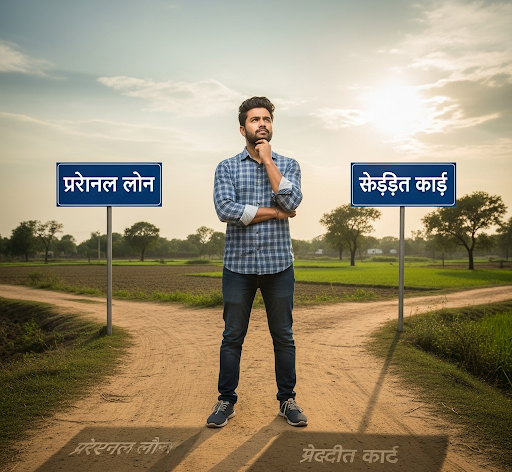
Personal Loan vs Credit Card —
Which Should You Choose?
Interest rates compared, ideal use cases, credit score impact, and when switching from credit card debt to personal loan saves thousands in interest.
The Fundamental Difference
A credit card and a personal loan are both forms of unsecured credit, but they work very differently. A credit card is a revolving credit line — you borrow, repay, borrow again, with interest only on outstanding balances not cleared by the due date. A personal loan is a fixed lump sum disbursed to your bank account, repaid in equal monthly instalments (EMIs) over a defined tenure at a fixed rate. The choice between them depends on the amount, repayment timeline, and whether you can discipline your repayment.
Interest Rate Comparison
| Credit Type | Interest Rate | Effective Monthly Rate |
|---|---|---|
| Credit card — paid in full by due date | 0% | 0% |
| Credit card — converted to EMI (0% scheme) | Processing fee only (1-3%) | Negligible |
| Credit card — standard EMI conversion | 12-18% p.a. | 1-1.5% |
| Personal loan (750+ CIBIL) | 10-14% p.a. | 0.83-1.17% |
| Personal loan (650-750 CIBIL) | 15-24% p.a. | 1.25-2% |
| Credit card — revolving (minimum payment only) | 36-42% p.a. | 3-3.5% |
When to Use Credit Card vs Personal Loan
| Scenario | Better Option | Reason |
|---|---|---|
| Purchase repayable within due date | Credit card | 0% interest; earn rewards |
| Large purchase on 0% EMI scheme | Credit card EMI | Zero interest + convenience |
| Medical emergency — large amount, 3-12 month repayment | Personal loan | 12-18% vs 36-42% — saves heavily |
| Wedding or travel — Rs 2-5 lakh, planned repayment | Personal loan | Fixed rate, disciplined repayment |
| Pay off existing credit card debt | Personal loan | Dramatically lower rate |
| Small amount (Rs 5,000-30,000) — 30 days repayment | Credit card | Fast; interest-free within period |
The Credit Card Debt Trap — And How to Escape It
Paying only the credit card minimum payment is the most expensive financial habit in India. On a Rs 1 lakh outstanding at 42% revolving interest, making only minimum payments (typically 5% of outstanding): it takes over 11 years to clear the debt and you pay Rs 3.2 lakh in interest — more than triple the original amount. The escape route: take a personal loan at 12-15%, pay off the credit card completely, and repay the structured personal loan EMI over 12-24 months.
Personal Loan vs Credit Card Checklist
- Always pay credit card full outstanding by due date — 0% interest is the card’s best feature
- If you cannot clear credit card balance, convert to EMI via app immediately (12-18% vs 42%)
- For amounts above Rs 50,000 with repayment timeline over 3 months — always take a personal loan
- Use the Personal Loan EMI Calculator to compare total interest cost vs credit card EMI
- If you have revolving credit card debt — apply for a personal loan to consolidate immediately
- After consolidating, cut the problematic credit card spending to prevent re-accumulation
🧮 Free Calculators — Use Them Now
No login required. Updated for FY 2025-26.
Frequently Asked Questions
The interest rate gap is significant. Personal loans from banks charge 10-24% per annum (best rates for 750+ CIBIL scores). Credit card revolving interest (when you pay only the minimum) charges 36-42% per annum — effectively 3-3.5% per month. Credit card EMI conversion (converting outstanding to EMI at the point of sale or post-purchase) typically charges 12-18% per annum, which is lower than revolving rate but still higher than a direct personal loan. If you need more than 30 days to repay, a personal loan at 12-18% is almost always cheaper than credit card revolving interest at 36-42%.
Credit cards are better for: purchases you can repay within the 20-50 day interest-free period (no interest at all if paid in full by due date); small amounts where loan processing time is inconvenient; purchases offering specific card rewards, cashback, or EMI conversion offers at 0% interest rate (common during festive seasons); and emergency short-term needs when personal loan processing takes 1-3 days. The golden rule: use a credit card only if you are certain you can pay the full outstanding amount on or before the due date.
For a medical emergency, credit card is often faster for immediate payment (instant at hospital) while a personal loan takes 1-3 business days for disbursement. If your credit card limit covers the expense and you can repay within the due date (or convert to 0% hospital EMI scheme), use the credit card. If the amount is large and repayment will take 3-18 months, apply for a personal loan simultaneously and use the credit card as a bridge — then transfer the balance to the personal loan to reduce interest cost from 36-42% to 12-18%.
Taking a personal loan has two effects on your CIBIL score. Initially, a hard inquiry (when the bank pulls your report) reduces your score by 5-10 points. Adding a new loan also temporarily reduces your average account age. However, a personal loan adds to your credit mix (positive factor) and, if paid on time, builds a strong repayment track record that improves your score over 12-18 months. Net effect: a small temporary dip (10-20 points) followed by score improvement over the loan tenure if paid without defaults.
Yes, and this is one of the smartest debt management moves available. Credit card revolving debt at 36-42% can be refinanced into a personal loan at 12-18% — an immediate 18-24% reduction in interest rate. For a Rs 2 lakh credit card outstanding at 42% for 12 months: interest cost = Rs 84,000. Personal loan at 15% for 12 months: interest = Rs 16,620. Saving = Rs 67,380. Use the Debt Consolidation Calculator to model this for your exact situation. Apply for a personal loan, receive the disbursement, and immediately pay off the credit card balance in full.
Credit card EMI is when you convert a large credit card purchase into monthly instalments, either at point of sale (0% EMI schemes offered by retailers) or post-purchase through the credit card app. The key differences from personal loans: credit card EMI is faster to activate (immediate, no new application); 0% credit card EMI schemes charge no interest (only processing fee of 1-3%); standard credit card EMI charges 12-18% per annum; a credit card EMI does not require a separate credit inquiry; and credit card EMI reduces your available credit limit until cleared. Personal loans provide a lump sum to your bank account with more flexibility in use.