
Credit Card Balance Transfer: Complete Guide to Reduce Interest Burden

Credit Card Balance Transfer
Credit Card Balance Transfer: Complete Guide to Reduce Interest Burden 2025 | CalcWise

When Kavitha realized she was paying 45,000 rupees annually in credit card interest on her 2.5 lakh outstanding balance, she felt trapped in an endless cycle of minimum payments and mounting debt. Her friend suggested a balance transfer, but she was skeptical – how could moving debt from one card to another solve her problem?

Six months later, after transferring her balance to a card offering 0% interest for 12 months, Kavitha had saved over 22,000 rupees in interest and paid down 1.2 lakh of her principal debt. Her story isn’t unique – millions of Indian cardholders are paying unnecessarily high interest rates because they don’t understand how balance transfer can be a powerful debt management tool.

The High Cost of Credit Card Debt

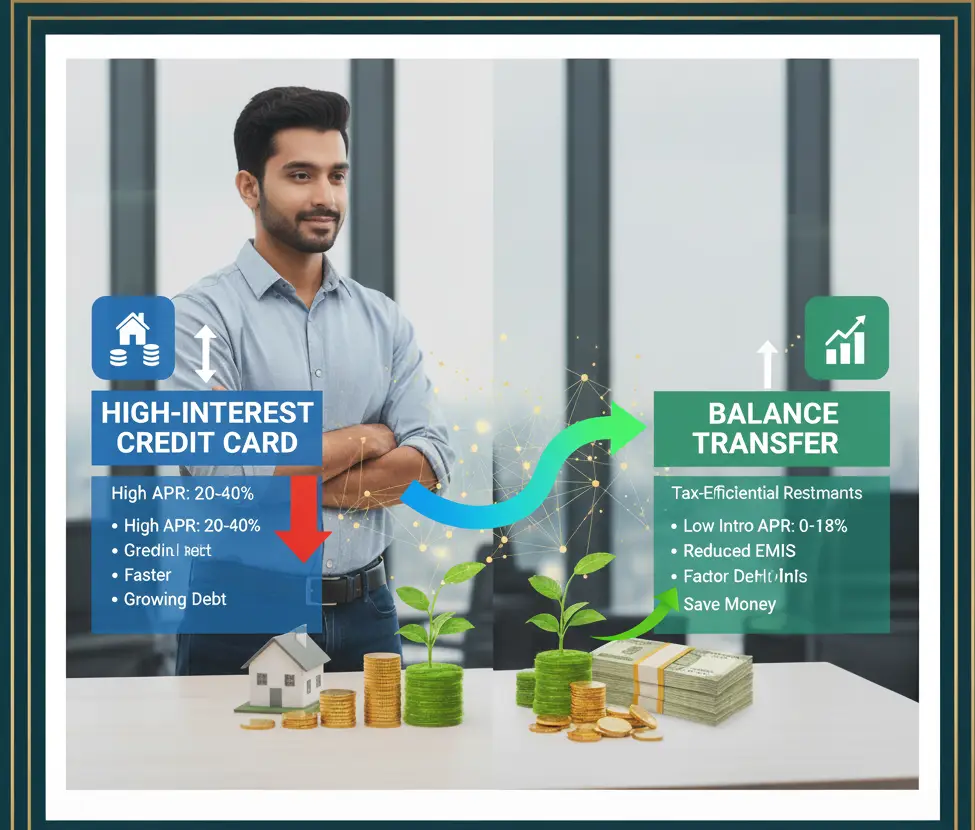
Credit cards in India typically charge 36-48% annual interest on outstanding balances. For someone with 2 lakh rupees debt, this means paying 72,000-96,000 rupees annually just in interest! Balance transfer offers can reduce this to as low as 0-15% for promotional periods, potentially saving thousands of rupees.

What is Credit Card Balance Transfer?

Credit Card Balance Transfer is a financial tool that allows you to move your outstanding debt from one credit card (or multiple cards) to another credit card, typically one that offers better interest rates or promotional terms. The new card issuer pays off your existing debt, and you now owe the money to the new card company under (hopefully) more favorable conditions.

Simple analogy: Think of it like moving your debt from an expensive hotel to a budget hotel. You’re still a guest (still have debt), but your daily rate (interest rate) is much lower, allowing you to save money and potentially check out (pay off debt) sooner.

How Balance Transfer Works

Step-by-step process:

  1. Application: You apply for a balance transfer offer with a new card issuer
  2. Approval: The new bank evaluates your creditworthiness and approves the transfer
  3. Debt payoff: The new bank directly pays your existing card company
  4. New terms: Your debt is now with the new bank at the promotional interest rate
  5. Repayment: You make payments to the new bank under the new terms

Real example: Rajesh has 3 lakh rupees outstanding on his HDFC card at 42% annual interest. He transfers this to an SBI balance transfer offer at 12% annual interest for 24 months. His annual interest cost drops from 1.26 lakh rupees to 36,000 rupees – a saving of 90,000 rupees per year!

Types of Balance Transfer Offers

1. 0% Interest Promotional Offers

Features:

  • No interest charged for promotional period (6-18 months typically)
  • Usually requires excellent credit score (750+)
  • May have balance transfer fees (2-5% of transferred amount)
  • Reverts to regular rates after promotional period

Best for: Disciplined borrowers who can pay off debt during the promotional period

2. Low Fixed Rate Offers

Features:

  • Fixed interest rate (typically 12-24% annually) for extended period
  • Rate guaranteed for 24-36 months
  • More accessible than 0% offers
  • Lower balance transfer fees

Best for: Those who need more time to pay off debt and want predictable payments

3. EMI-Based Balance Transfer

Features:

  • Convert balance to fixed EMI structure
  • Predetermined tenure (12-60 months)
  • Fixed monthly payment amount
  • Interest rates typically 15-25% annually

Best for: Those who prefer structured repayment with fixed monthly obligations

Current Balance Transfer Offers in India (2025)

Bank/Card Promotional Rate Duration Processing Fee Key Features
SBI Card 0% for 12 months 12 months 2.99% of transfer amount No annual fee for first year
HDFC Bank 0.99% per month 18 months 1.99% of transfer amount Instant approval for existing customers
ICICI Bank 1.25% per month 24 months 2.5% of transfer amount EMI conversion available
Axis Bank 0% for 6 months 6 months 3% of transfer amount Lifetime free card option
Kotak Mahindra 1.5% per month 12 months 2% of transfer amount Instant digital processing
American Express 0% for 15 months 15 months No processing fee Premium card benefits included

Important Disclaimer

Rates and offers change frequently: The rates shown are indicative and based on recent market offerings. Always check with banks directly for current rates, as promotional offers vary by customer profile, credit score, and market conditions. Terms and conditions apply to all offers.

Eligibility Criteria for Balance Transfer

Basic Eligibility Requirements

  • Age: 21-65 years (varies by bank)
  • Credit Score: Minimum 650, preferably 750+ for best offers
  • Income: Minimum monthly income of 25,000-50,000 rupees
  • Employment: Salaried or self-employed for minimum 2 years
  • Existing debt: Outstanding balance should be manageable relative to income

Factors That Improve Approval Chances

1. Strong Credit Profile

  • High credit score: 750+ score gets best rates and higher limits
  • Good payment history: No recent missed payments or defaults
  • Low credit utilization: Using less than 30% of available credit limits
  • Credit mix: Good mix of credit cards, loans, and EMIs

2. Stable Financial Profile

  • Consistent income: Stable employment and income for 2+ years
  • Bank relationship: Existing relationship with the new bank
  • Debt-to-income ratio: Total EMIs below 50% of monthly income
  • Account conduct: Good track record with existing cards

Documents Required

  • Latest credit card statements showing outstanding balance
  • Last 3 months salary slips or income proof
  • Last 6 months bank statements
  • Identity and address proof
  • PAN card and Form 16 (if applicable)

Benefits of Credit Card Balance Transfer

1. Significant Interest Savings

The primary benefit is reducing your interest burden. Moving from a 42% annual rate to a 12% promotional rate can save thousands of rupees.

Savings calculation example:

  • Outstanding balance: 2 lakh rupees
  • Current rate: 42% annually (3.5% monthly)
  • New rate: 12% annually (1% monthly)
  • Monthly interest saving: 5,000 rupees
  • Annual interest saving: 60,000 rupees

2. Debt Consolidation

If you have multiple credit cards with outstanding balances, balance transfer allows you to consolidate all debt into one card with:

  • Single monthly payment instead of multiple payments
  • Simplified debt management and tracking
  • Potentially lower overall interest rate
  • Reduced risk of missing payments

3. Improved Cash Flow

Lower interest rates mean more of your payment goes toward principal reduction:

  • Faster debt reduction
  • Lower minimum payment requirements
  • More money available for other expenses or savings
  • Reduced financial stress

4. Credit Score Improvement

Balance transfer can help improve your credit score by:

  • Reducing overall credit utilization ratio
  • Enabling faster debt payoff
  • Avoiding late payments due to lower payment burden
  • Demonstrating responsible debt management

Real-World Success Stories

Case Study 1: The Multiple Card Debt Consolidation

Profile: Sunita, 32, marketing manager, Mumbai

Initial Debt Situation:

  • HDFC Card: 1.2 lakh at 44% annual interest
  • SBI Card: 80,000 rupees at 40% annual interest
  • Axis Card: 60,000 rupees at 42% annual interest
  • Total debt: 2.6 lakh rupees
  • Total monthly interest: 9,200 rupees

Balance Transfer Solution:

  • Transferred all balances to ICICI balance transfer offer
  • New rate: 15% annually for 24 months
  • Processing fee: 6,500 rupees (2.5% of transfer amount)
  • New monthly interest: 3,250 rupees
  • Monthly savings: 5,950 rupees

Results after 18 months:

  • Total interest saved: 89,550 rupees
  • Principal paid down: 1.8 lakh rupees
  • Remaining balance: 86,500 rupees
  • Credit score improved from 680 to 740

Case Study 2: The Emergency-to-Recovery Journey

Profile: Rajesh, 38, software engineer, Bangalore

Background: Used credit cards extensively during father’s medical emergency

Initial Situation:

  • Total credit card debt: 4.5 lakh rupees across 3 cards
  • Average interest rate: 43% annually
  • Monthly interest burden: 16,125 rupees
  • Minimum payment obligation: 22,500 rupees monthly

Balance Transfer Strategy:

  • Transferred to SBI 0% offer for 12 months
  • Processing fee: 13,455 rupees (2.99% of amount)
  • Committed to paying 40,000 rupees monthly during 0% period
  • Used saved interest amount for faster repayment

Outcome:

  • Paid off entire debt in 11 months
  • Total interest saved: 1.8 lakh rupees
  • Avoided debt trap and financial stress
  • Rebuilt emergency fund simultaneously

Case Study 3: The Business Owner’s Smart Move

Profile: Priya, 45, restaurant owner, Delhi

Challenge: Business credit cards with high balances from pandemic-related expenses

Initial Debt:

  • Business credit card debt: 6.8 lakh rupees
  • Interest rate: 46% annually
  • Monthly interest: 26,133 rupees
  • Affecting business cash flow significantly

Solution:

  • Balance transfer to business card with 18% fixed rate for 36 months
  • Processing fee: 20,400 rupees (3% of amount)
  • New monthly interest: 10,200 rupees
  • Monthly cash flow improvement: 15,933 rupees

Impact:

  • Improved business cash flow
  • Reduced financial stress on operations
  • Structured repayment plan
  • Annual interest savings: 1.9 lakh rupees

Calculate Your Potential Savings

Use our calculators to understand how balance transfer can help you:

Step-by-Step Balance Transfer Process

Phase 1: Research and Comparison (Week 1)

Step 1: Assess Current Debt

  • List all credit cards with outstanding balances
  • Note current interest rates and minimum payments
  • Calculate total monthly interest burden
  • Check your current credit score

Step 2: Research Available Offers

  • Compare balance transfer offers from different banks
  • Check eligibility criteria for each offer
  • Calculate total cost including processing fees
  • Read terms and conditions carefully

Step 3: Calculate Potential Savings

  • Compare current vs. new interest rates
  • Factor in processing fees and other charges
  • Calculate break-even timeline
  • Project total savings over the promotional period

Phase 2: Application and Approval (Week 2-3)

Step 4: Prepare Documentation

  • Gather all required documents
  • Ensure credit score is optimized
  • Clear any pending payments on existing cards
  • Update income and employment information

Step 5: Submit Application

  • Apply online or visit branch
  • Provide accurate information about existing debt
  • Submit all required documents
  • Follow up on application status

Step 6: Approval and Documentation

  • Review approval terms carefully
  • Understand interest rate structure
  • Note the promotional period end date
  • Sign necessary agreements

Phase 3: Transfer and Management (Week 3-4)

Step 7: Execute the Transfer

  • Provide details of cards to be paid off
  • Ensure sufficient credit limit for transfer
  • Monitor the transfer process
  • Confirm old balances are cleared

Step 8: Post-Transfer Management

  • Verify transfer completion
  • Set up new payment schedules
  • Close old cards if not needed (carefully consider credit score impact)
  • Create repayment strategy for promotional period

Common Mistakes to Avoid

1. Not Reading Terms and Conditions

Mistake: Focusing only on promotional rates without understanding post-promotional rates

Reality check: Many 0% offers revert to 35-45% after the promotional period

Solution: Always understand what happens after the promotional period ends

2. Continuing to Use Old Cards

Mistake: Using cleared credit cards for new purchases

Consequence: Accumulating new debt while still paying off transferred balance

Solution: Either close old cards or keep them for emergencies only

3. Only Making Minimum Payments

Mistake: Not taking advantage of low promotional rates to pay down principal

Missed opportunity: During 0% periods, every rupee paid goes toward principal

Solution: Pay as much as possible during promotional periods

4. Ignoring Processing Fees

Mistake: Not factoring processing fees into savings calculations

Reality: 2-5% processing fees can significantly impact short-term savings

Solution: Calculate break-even period including all fees

5. Not Having a Repayment Plan

Mistake: Transferring balance without a clear strategy to pay it off

Consequence: Still carrying debt when promotional rates expire

Solution: Create a detailed month-by-month repayment plan before transferring

Balance Transfer Red Flags

Warning signs that balance transfer might not be right for you:

  • 🚩 Poor spending discipline – You continue accumulating new debt
  • 🚩 Unstable income – Your income is irregular or uncertain
  • 🚩 Multiple transfers – You’ve done several balance transfers without paying off debt
  • 🚩 High debt-to-income ratio – Your total debt exceeds 40-50% of income
  • 🚩 Credit score below 650 – You may not qualify for good offers

Alternatives to Balance Transfer

1. Personal Loan for Debt Consolidation

When to consider:

  • You don’t qualify for good balance transfer offers
  • You want fixed EMI structure
  • You need a longer repayment tenure
  • You want to close all credit cards

Comparison example:

  • Balance transfer: 2 lakh at 15% for 24 months = 24,944 rupees EMI
  • Personal loan: 2 lakh at 16% for 36 months = 7,029 rupees EMI
  • Trade-off: Lower EMI vs. higher total interest cost

2. EMI Conversion on Existing Cards

Features:

  • Convert outstanding balance to fixed EMI
  • Interest rates typically 15-24% annually
  • No processing fees usually
  • Tenure options from 6-60 months

Best for: Small balances or when balance transfer isn’t available

3. Loan Against Property or Gold

For large debts (above 5 lakh):

  • Much lower interest rates (10-15%)
  • Longer repayment tenure
  • Risk of losing collateral
  • More complex documentation

Advanced Balance Transfer Strategies

The Chain Transfer Strategy

For sophisticated debt managers with excellent credit scores:

  • Step 1: Transfer to 0% offer for 12 months
  • Step 2: Pay down as much as possible during 0% period
  • Step 3: Transfer remaining balance to another 0% offer
  • Step 4: Repeat until debt is eliminated

Requirements: Excellent credit score, multiple card relationships, disciplined payments

The Arbitrage Strategy

Using balance transfer for investment arbitrage:

  • Transfer balance to 0% promotional rate
  • Invest the money you would have paid in interest
  • Earn returns higher than the promotional rate
  • Pay off balance before promotional period ends

Risk warning: Only for experienced investors who understand market risks

The Partial Transfer Strategy

For those who don’t qualify for full balance transfer:

  • Transfer the maximum approved amount
  • Focus on paying off the transferred amount during promotional period
  • Continue minimum payments on remaining balances
  • Apply for additional transfers as credit improves

Impact on Credit Score

Positive Impacts

  • Lower credit utilization: New credit limit reduces overall utilization ratio
  • Payment history improvement: Lower interest burden makes payments easier
  • Debt reduction: Faster principal paydown improves debt-to-income ratio
  • Account diversity: New account adds to credit mix

Potential Negative Impacts

  • Hard inquiry: New application creates temporary score dip (5-10 points)
  • New account impact: Reduces average account age initially
  • Temptation to overspend: Available credit on old cards may lead to new debt

Best Practices for Credit Score Protection

  • Keep old credit cards open (unless they have annual fees)
  • Maintain low utilization on all cards
  • Make all payments on time
  • Avoid applying for multiple new cards simultaneously
  • Monitor credit score regularly

Tax Implications of Balance Transfer

No Direct Tax Benefits

Unlike home loans or business loans, credit card interest (including balance transfer interest) is not tax-deductible for personal use. However:

  • Business use: If transferred balance was for business expenses, interest may be deductible
  • Investment purpose: Interest on funds used for investment may qualify for deduction
  • Documentation required: Maintain proper records linking expenses to business/investment

Processing Fee Treatment

  • Personal use: No tax deduction available
  • Business use: Can be claimed as business expense
  • Investment purpose: May be added to cost of investment

Future Trends in Balance Transfer

Digital Innovation

  • AI-powered offers: Personalized rates based on spending patterns
  • Instant transfers: Real-time balance transfer processing
  • App-based management: Complete transfer process via mobile apps
  • Automated optimization: Alerts for better transfer opportunities

Product Evolution

  • Flexible promotional periods: Customizable promotional durations
  • Performance-based rates: Rates adjusted based on payment behavior
  • Integrated financial planning: Balance transfer as part of holistic debt management
  • Cross-bank transfers: Simplified inter-bank transfer processes

Regulatory Changes

  • Enhanced disclosure: Clearer terms and condition explanations
  • Cooling-off periods: Time to reconsider transfer decisions
  • Fair lending practices: Protection against predatory balance transfer offers
  • Standardized comparisons: Uniform comparison formats across banks

Creating Your Balance Transfer Action Plan

Month 1: Assessment and Planning

  • Week 1: Complete debt audit and credit score check
  • Week 2: Research and compare available offers
  • Week 3: Calculate potential savings and create repayment plan
  • Week 4: Prepare documentation and optimize credit profile

Month 2: Application and Transfer

  • Week 1: Submit balance transfer application
  • Week 2: Follow up on approval status
  • Week 3: Complete transfer documentation
  • Week 4: Execute transfer and verify completion

Month 3-15: Execution and Monitoring

  • Monthly: Make payments according to plan
  • Quarterly: Review progress and adjust if needed
  • 6 months before promotional end: Plan for rate change or new transfer
  • At promotional end: Execute next phase of debt management strategy

Your Balance Transfer Checklist

Before proceeding with balance transfer, ensure you have:

  • Clear understanding of current debt situation
  • Researched and compared multiple offers
  • Calculated total cost including fees
  • Created detailed repayment plan
  • Checked credit score and eligibility
  • Prepared all required documentation
  • Committed to spending discipline
  • Planned for post-promotional period

When Balance Transfer Isn’t the Answer

Signs You Need Professional Help

  • Debt exceeds 50% of annual income: May need debt counseling
  • Multiple missed payments: Credit repair should come first
  • Bankruptcy consideration: Legal consultation required
  • Gambling or addiction issues: Underlying issues need addressing

Alternative Solutions

  • Debt counseling: Professional guidance for severe debt situations
  • Debt management plans: Structured plans with credit counselors
  • Debt settlement: Negotiating with creditors for reduced payments
  • Asset liquidation: Selling assets to pay off debt

Conclusion: Your Path to Financial Freedom

Credit card balance transfer isn’t just about moving debt from one card to another – it’s about taking control of your financial destiny. When used strategically, it can save thousands of rupees in interest, accelerate debt payoff, and provide the breathing room needed to rebuild your financial health.

The key to successful balance transfer lies not in finding the lowest promotional rate, but in creating and executing a comprehensive debt elimination strategy. The promotional period is your opportunity – use it wisely to pay down principal aggressively while interest costs are minimized.

Remember that balance transfer is a tool, not a solution. The real solution lies in addressing the underlying spending patterns and financial habits that led to debt accumulation in the first place. Use the savings from balance transfer to build an emergency fund, improve your financial literacy, and create systems that prevent future debt cycles.

For many Indians trapped in high-interest credit card debt, balance transfer represents hope – hope for lower payments, faster debt elimination, and eventual financial freedom. But hope alone isn’t enough. It requires discipline, planning, and the commitment to change financial behaviors permanently.

Start your balance transfer journey with realistic expectations, thorough planning, and unwavering discipline. Your future financially-free self will thank you for taking this important step toward debt elimination and financial stability.

Don’t let high credit card interest rates steal your financial future. Take action today, but take it wisely. Every month you delay is another month of unnecessarily high interest payments that could have been invested in your family’s future instead.

Additional Resources and Support

Continue your financial education and get support for your debt management journey:

For official information about credit regulations and consumer rights, visit the Reserve Bank of India (RBI) website.

Transferring balance without a clear strategy to pay it off

Consequence: Still carrying debt when promotional rates expire

Solution: Create a detailed month-by-month repayment plan before transferring

Balance Transfer Red Flags

Warning signs that balance transfer might not be right for you:

  • 🚩 Poor spending discipline – You continue accumulating new debt
  • 🚩 Unstable income – Your income is irregular or uncertain
  • 🚩 Multiple transfers – You’ve done several balance transfers without paying off debt
  • 🚩 High debt-to-income ratio – Your total debt exceeds 40-50% of income
  • 🚩 Credit score below 650 – You may not qualify for good offers

Alternatives to Balance Transfer

1. Personal Loan for Debt Consolidation

When to consider:

  • You don’t qualify for good balance transfer offers
  • You want fixed EMI structure
  • You need a longer repayment tenure
  • You want to close all credit cards

Comparison example:

  • Balance transfer: 2 lakh at 15% for 24 months = 24,944 rupees EMI
  • Personal loan: 2 lakh at 16% for 36 months = 7,029 rupees EMI
  • Trade-off: Lower EMI vs. higher total interest cost

2. EMI Conversion on Existing Cards

Features:

  • Convert outstanding balance to fixed EMI
  • Interest rates typically 15-24% annually
  • No processing fees usually
  • Tenure options from 6-60 months

Best for: Small balances or when balance transfer isn’t available

3. Loan Against Property or Gold

For large debts (above 5 lakh):

  • Much lower interest rates (10-15%)
  • Longer repayment tenure
  • Risk of losing collateral
  • More complex documentation

Advanced Balance Transfer Strategies

The Chain Transfer Strategy

For sophisticated debt managers with excellent credit scores:

  • Step 1: Transfer to 0% offer for 12 months
  • Step 2: Pay down as much as possible during 0% period
  • Step 3: Transfer remaining balance to another 0% offer
  • Step 4: Repeat until debt is eliminated

Requirements: Excellent credit score, multiple card relationships, disciplined payments

The Arbitrage Strategy

Using balance transfer for investment arbitrage:

  • Transfer balance to 0% promotional rate
  • Invest the money you would have paid in interest
  • Earn returns higher than the promotional rate
  • Pay off balance before promotional period ends

Risk warning: Only for experienced investors who understand market risks

The Partial Transfer Strategy

For those who don’t qualify for full balance transfer:

  • Transfer the maximum approved amount
  • Focus on paying off the transferred amount during promotional period
  • Continue minimum payments on remaining balances
  • Apply for additional transfers as credit improves

Impact on Credit Score

Positive Impacts

  • Lower credit utilization: New credit limit reduces overall utilization ratio
  • Payment history improvement: Lower interest burden makes payments easier
  • Debt reduction: Faster principal paydown improves debt-to-income ratio
  • Account diversity: New account adds to credit mix

Potential Negative Impacts

  • Hard inquiry: New application creates temporary score dip (5-10 points)
  • New account impact: Reduces average account age initially
  • Temptation to overspend: Available credit on old cards may lead to new debt

Best Practices for Credit Score Protection

  • Keep old credit cards open (unless they have annual fees)
  • Maintain low utilization on all cards
  • Make all payments on time
  • Avoid applying for multiple new cards simultaneously
  • Monitor credit score regularly

Tax Implications of Balance Transfer

No Direct Tax Benefits

Unlike home loans or business loans, credit card interest (including balance transfer interest) is not tax-deductible for personal use. However:

  • Business use: If transferred balance was for business expenses, interest may be deductible
  • Investment purpose: Interest on funds used for investment may qualify for deduction
  • Documentation required: Maintain proper records linking expenses to business/investment

Processing Fee Treatment

  • Personal use: No tax deduction available
  • Business use: Can be claimed as business expense
  • Investment purpose: May be added to cost of investment

Future Trends in Balance Transfer

Digital Innovation

  • AI-powered offers: Personalized rates based on spending patterns
  • Instant transfers: Real-time balance transfer processing
  • App-based management: Complete transfer process via mobile apps
  • Automated optimization: Alerts for better transfer opportunities

Product Evolution

  • Flexible promotional periods: Customizable promotional durations
  • Performance-based rates: Rates adjusted based on payment behavior
  • Integrated financial planning: Balance transfer as part of holistic debt management
  • Cross-bank transfers: Simplified inter-bank transfer processes

Regulatory Changes

  • Enhanced disclosure: Clearer terms and condition explanations
  • Cooling-off periods: Time to reconsider transfer decisions
  • Fair lending practices: Protection against predatory balance transfer offers
  • Standardized comparisons: Uniform comparison formats across banks

Creating Your Balance Transfer Action Plan

Month 1: Assessment and Planning

  • Week 1: Complete debt audit and credit score check
  • Week 2: Research and compare available offers
  • Week 3: Calculate potential savings and create repayment plan
  • Week 4: Prepare documentation and optimize credit profile

Month 2: Application and Transfer

  • Week 1: Submit balance transfer application
  • Week 2: Follow up on approval status
  • Week 3: Complete transfer documentation
  • Week 4: Execute transfer and verify completion

Month 3-15: Execution and Monitoring

  • Monthly: Make payments according to plan
  • Quarterly: Review progress and adjust if needed
  • 6 months before promotional end: Plan for rate change or new transfer
  • At promotional end: Execute next phase of debt management strategy

Your Balance Transfer Checklist

Before proceeding with balance transfer, ensure you have:

  • Clear understanding of current debt situation
  • Researched and compared multiple offers
  • Calculated total cost including fees
  • Created detailed repayment plan
  • Checked credit score and eligibility
  • Prepared all required documentation
  • Committed to spending discipline
  • Planned for post-promotional period

When Balance Transfer Isn’t the Answer

Signs You Need Professional Help

  • Debt exceeds 50% of annual income: May need debt counseling
  • Multiple missed payments: Credit repair should come first
  • Bankruptcy consideration: Legal consultation required
  • Gambling or addiction issues: Underlying issues need addressing

Alternative Solutions

  • Debt counseling: Professional guidance for severe debt situations
  • Debt management plans: Structured plans with credit counselors
  • Debt settlement: Negotiating with creditors for reduced payments
  • Asset liquidation: Selling assets to pay off debt

Conclusion: Your Path to Financial Freedom

Credit card balance transfer isn’t just about moving debt from one card to another – it’s about taking control of your financial destiny. When used strategically, it can save thousands of rupees in interest, accelerate debt payoff, and provide the breathing room needed to rebuild your financial health.

The key to successful balance transfer lies not in finding the lowest promotional rate, but in creating and executing a comprehensive debt elimination strategy. The promotional period is your opportunity – use it wisely to pay down principal aggressively while interest costs are minimized.

Remember that balance transfer is a tool, not a solution. The real solution lies in addressing the underlying spending patterns and financial habits that led to debt accumulation in the first place. Use the savings from balance transfer to build an emergency fund, improve your financial literacy, and create systems that prevent future debt cycles.

For many Indians trapped in high-interest credit card debt, balance transfer represents hope – hope for lower payments, faster debt elimination, and eventual financial freedom. But hope alone isn’t enough. It requires discipline, planning, and the commitment to change financial behaviors permanently.

Start your balance transfer journey with realistic expectations, thorough planning, and unwavering discipline. Your future financially-free self will thank you for taking this important step toward debt elimination and financial stability.

Don’t let high credit card interest rates steal your financial future. Take action today, but take it wisely. Every month you delay is another month of unnecessarily high interest payments that could have been invested in your family’s future instead.

Additional Resources and Support

Continue your financial education and get support for your debt management journey:

For official information about credit regulations and consumer rights, visit the Reserve Bank of India (RBI) website.