
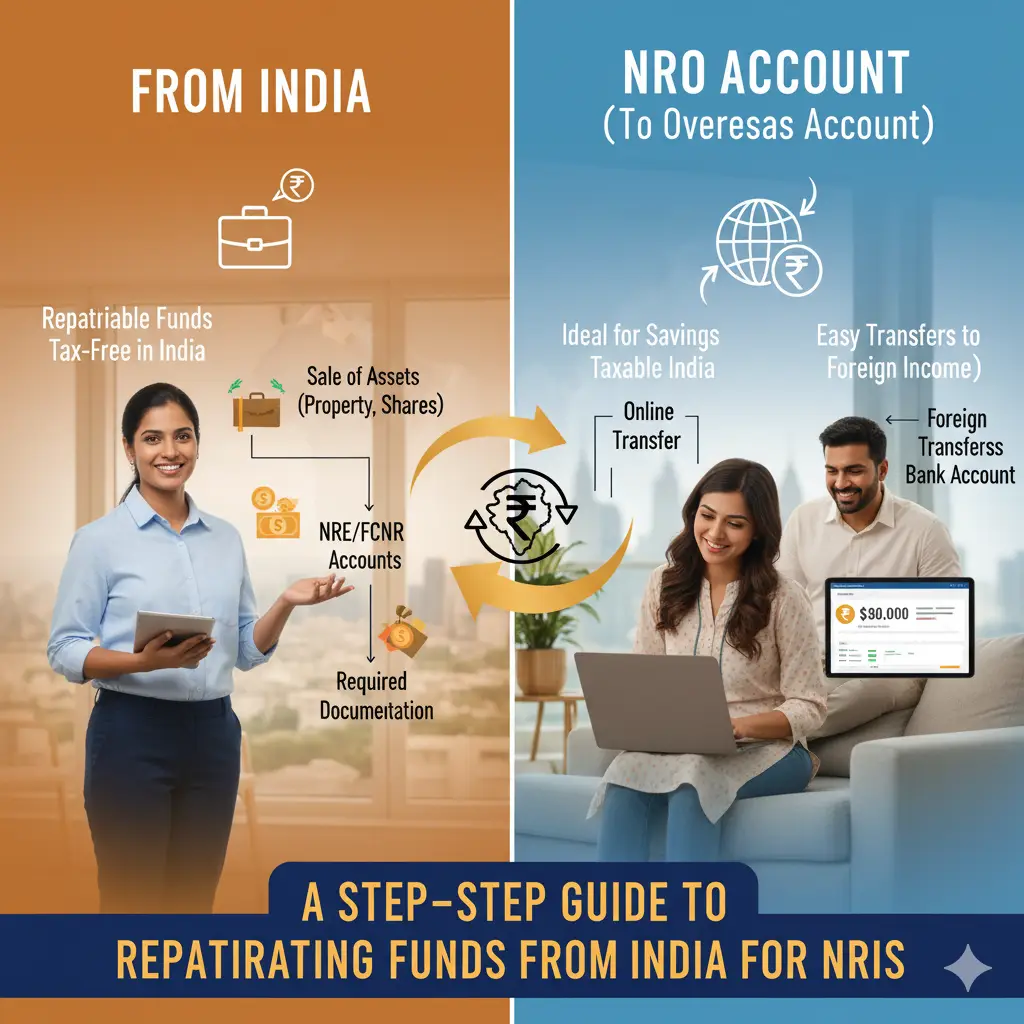
Repatriating Funds from India as NRI — Complete Step-by-Step Guide 2026
📘 NRI Repatriation — The Rules That Determine How Quickly You Get Your Money Abroad
Moving money from India to your country of residence as an NRI involves specific FEMA rules that trip up even experienced expats: NRO accounts are capped at USD 1 million per year while NRE accounts have no cap; Form 15CA and 15CB are mandatory for most significant remittances; and property sale proceeds require TDS compliance before a single rupee leaves India. Getting this wrong means repatriation delays, bank rejections, or worse — FEMA penalties. This guide covers every repatriation scenario for NRIs in 2026 with specific steps and timelines.
📊 NRI Repatriation Data — India 2025-26
- RBI, FY 2024-25: NRI outward remittances from India (NRO account repatriation): USD 4.8 billion. Average per transaction: USD 105,000. Form 15CA/15CB filed for NRI remittances: 2.8 lakh certificates. Growing as more NRIs comply with documentation requirements.
- RBI, 2025: NRE account balances: Rs16.4 lakh crore — freely repatriable at all times without any cap. Many NRIs unnecessarily route India income through NRO (capped) when NRE would give unlimited repatriation. Account structuring advice from an FEMA specialist saves years of repatriation constraints.
- FEMA penalties, FY 2024-25: FEMA violation show-cause notices related to unauthorized repatriation: 1,840 notices. Penalties assessed: Rs280 crore. Common violation: remitting from resident savings account (not NRO) without RBI approval.
- Income Tax Portal, AY 2025-26: Form 15CA filings: 38.4 lakh (all types). NRI-related 15CA (Part C — where CA certificate 15CB is required): 2.8 lakh. Average remittance per 15CA filing: Rs45L. Total certified for remittance: Rs1.26 lakh crore.
1. Annual Repatriation Limits
| Account / Source | Annual Cap | Documentation |
|---|---|---|
| NRE savings or FD | No cap — unlimited | No 15CA/15CB needed |
| FCNR deposit (at maturity) | No cap — unlimited | No 15CA/15CB needed |
| NRO savings or FD | USD 1 million per FY | 15CA + 15CB mandatory |
| NRE-funded property sale | No cap — unlimited | 15CA + 15CB + sale documents |
| NRO-funded property sale | USD 1 million per FY | 15CA + 15CB + full documentation |
| Pension or inheritance | No cap (specific FEMA provisions) | Documentation of source required |
💡 Structure Income Through NRE — Avoid the USD 1M Cap Forever
The USD 1M annual NRO cap becomes binding only when NRIs have substantial India-sourced income or large property sale proceeds. Prevention: invest via NRE account from the start. Foreign remittances into NRE = uncapped repatriation later. If you receive India rental income in NRO and want to repatriate more than USD 1M: either wait multiple years or get RBI special approval (takes 3-6 months and is not guaranteed).
2. Form 15CA and 15CB — The Core Process
- Engage CA: CA with NRI and FEMA experience reviews your India income, TDS deducted, taxes paid, DTAA applicability
- CA uploads Form 15CB: digitally on incometax.gov.in. Certificate number generated. CA fee: Rs3,000-15,000 depending on complexity
- Upload Form 15CA: you (or CA on your behalf) upload Form 15CA on income tax portal, referencing 15CB certificate number. Select correct Part (A, B, C, or D)
- Print Form 15CA: download acknowledgement with ITD reference number
- Submit to bank: Form 15CA acknowledgement + Form 15CB certificate + supporting documents (TDS certificate, property sale deed, ITR copy if asked)
- Bank processes: FEMA compliance check by bank’s authorised dealer team (1-3 days). Funds remitted to your foreign bank account
| Form 15CA Part | When to Use | 15CB Required? |
|---|---|---|
| Part A | Remittance below Rs5L total in year | No |
| Part B | Remittance covered by specific CBDT orders | No |
| Part C | Remittance above Rs5L — most NRI repatriations | Yes — 15CB mandatory |
| Part D | Remittance not chargeable to tax in India | No (but CA should confirm) |
3. Which Accounts Allow Repatriation
| Account | Repatriable? | Cap | Note |
|---|---|---|---|
| NRE savings / FD | Yes | None | No documentation beyond standard bank form |
| FCNR | Yes | None | Principal + interest at maturity |
| NRO savings / FD | Yes | USD 1M/year | 15CA + 15CB + tax compliance |
| RFC (Resident Foreign Currency) | Yes during RNOR | None during RNOR | After ROR: RBI approval needed |
| Resident savings | Generally no | Not freely repatriable | RBI case-by-case approval required |
4. Property Sale Proceeds Repatriation
Property funded via NRE account: full proceeds (after tax) repatriable without annual cap. Bank will verify the NRE origin of purchase funds — maintain records. Property funded via NRO or India income: subject to USD 1M/year cap. For large properties (Rs2Cr+): may require 2+ years of annual repatriation tranches unless RBI special approval obtained. Maximum properties whose proceeds can be repatriated without cap: up to 2 residential properties funded via NRE can be repatriated without the USD 1M cap (FEMA provision). This is the key planning insight: if planning future repatriation on sale, fund property purchases from NRE from the start.
5. Tax Compliance Before Repatriation
The 15CB certification process requires the CA to verify: (1) TDS was deducted at correct rate on all India income being repatriated. (2) ITR filed for the relevant AY (if income above Rs2.5L). (3) Any advance tax liability settled. (4) No outstanding income tax demand. The bank will ask for: Form 16A (TDS certificate from payer), AIS or 26AS extract, ITR acknowledgement for recent years (some banks). What if taxes are not paid: bank will decline to process repatriation. FEMA requires all India taxes to be compliant before allowing foreign remittance of income-related funds. Clean up any outstanding ITD demands before attempting repatriation of large amounts.
6. Timeline — How Long Repatriation Takes
| Activity | Days |
|---|---|
| Engage CA and provide documents | Day 1-2 |
| CA prepares and uploads 15CB | Day 2-5 |
| Upload Form 15CA | Day 5-6 |
| Submit to bank with all documents | Day 6-7 |
| Bank FEMA compliance review | Day 7-10 |
| Funds remitted abroad | Day 10-14 |
| Funds received in foreign account | Day 12-17 (SWIFT processing) |
7. Common NRI Repatriation Mistakes
- Converting NRE to resident savings instead of RFC: On return to India, NRE should be converted to RFC (Resident Foreign Currency) not regular savings. RFC remains repatriable during RNOR; regular savings do not.
- Exceeding USD 1M cap in single year: NRO-funded repatriations above USD 1M in one financial year require RBI approval. Plan across multiple years or structure NRE investments from the beginning.
- Not maintaining NRE origin documentation: When selling NRE-funded property, you must prove to bank that original purchase was NRE-funded. Keep: NRE account statements showing the property payment transfer, sale deed reference to NRE funding. Without this, bank may treat it as NRO and apply the USD 1M cap.
- Skipping 15CA/15CB for smaller amounts: Some banks process small NRO remittances without 15CA/15CB. But compliance obligation exists. An ITD query later asking about unreported foreign remittances creates problems. Always use 15CA/15CB for NRO remittances above Rs5L.
- Not filing Indian ITR before large repatriations: Banks increasingly ask for recent ITR acknowledgement as part of repatriation documentation. Non-filing creates roadblocks at exactly the moment you need to move money.
🧮 Free Calculators — Use Them Now
No login required. Updated for FY 2025-26.
Frequently Asked Questions
NRI repatriation limits under FEMA (2026): NRO account repatriation: maximum USD 1 million per financial year (April-March) per NRI. This covers all NRO remittances combined — rental income, FD maturity, property sale proceeds, dividends, inheritance, any other India-sourced income. NRE account repatriation: fully and freely repatriable — NO annual cap. NRE account funds (deposited from foreign income) can be sent abroad in any amount at any time with no limit. This is the fundamental FEMA distinction: NRO has a USD 1M cap; NRE has no cap. FCNR (Foreign Currency Non-Resident) deposits: fully repatriable upon maturity — no cap, same as NRE. Property sale proceeds: if property was purchased with NRE funds — repatriation is uncapped (treated as NRE-origin funds). If purchased with NRO funds — subject to USD 1M cap. NRI pension income from India: can be repatriated without limit (separate provision for pension, social security). Joint account: USD 1M cap applies per NRI individually — a joint NRO account held by husband and wife NRIs can each repatriate USD 1M.
Form 15CA and 15CB are mandatory documents for NRI fund repatriation from India: Form 15CB: a Chartered Accountant certificate confirming that applicable Indian taxes have been deducted or paid on the funds being repatriated. The CA computes: total India income in the remittance, applicable tax rate (ITR assessment or TDS), taxes deducted at source, any balance tax payable, and certifies DTAA provisions applied if relevant. Chartered Accountant digitally signs Form 15CB on the income tax portal. Form 15CA: your (the NRI remitter) declaration to the income tax department about the nature of the remittance. Uploaded by you (or your CA) on incometax.gov.in after Form 15CB is certified. Part A, B, C, or D depending on remittance amount and whether 15CB is required. Process: (1) CA prepares and uploads Form 15CB on income tax portal. (2) Obtain 15CB certificate number. (3) Upload Form 15CA with reference to 15CB. (4) Take Form 15CA/15CB to your bank along with repatriation request. (5) Bank verifies, processes foreign remittance. Total processing time: 3-7 days from CA engagement to bank completing remittance.
Bank account repatriation rules for NRIs: NRE (Non-Resident External) account: fully repatriable anytime. Source of funds: foreign remittances brought to India. No Indian-sourced income allowed in NRE (would violate FEMA). Repatriation: any amount, any time, no cap, no 15CA/15CB required. NRO (Non-Resident Ordinary) account: repatriable up to USD 1 million per year. Requires: 15CA + 15CB (CA certificate), proof of tax deduction (TDS certificate or advance tax payment), ITR of relevant years in some cases. Source: India-sourced income (rent, dividends, salary, pension, FD interest). FCNR (Foreign Currency Non-Resident) deposit: fully repatriable at maturity. Held in foreign currency (USD, GBP, EUR etc.) within Indian bank. At maturity: full principal plus interest remitted to NRI abroad without any cap. RFC (Resident Foreign Currency) account: applicable on return to India (converting NRE). During RNOR period: fully repatriable. After ROR: repatriation requires RBI approval. Resident savings/FD account: generally NOT repatriable freely. Resident accounts are for India-use money. If an NRI accidentally converts NRE to resident savings (instead of RFC): repatriation becomes complex and requires case-by-case RBI approval.
Property sale repatriation — step by step: Step 1 — Sale completion: property sold, proceeds credited to NRI NRO account. Buyer should have deducted TDS (20% on LTCG property, 30% on STCG) before paying. Step 2 — Tax compliance: verify TDS was deposited by buyer (Form 26AS). If NRI is entitled to lower tax (actual LTCG tax on gain vs 20% TDS on full value): file ITR, claim refund. OR apply for lower TDS certificate before sale (Section 197). Step 3 — CA engagement: engage a CA to prepare Form 15CB. CA verifies: TDS deposited, ITR compliance, DTAA applicable, net amount eligible for repatriation. CA issues 15CB certificate digitally. Step 4 — Form 15CA: upload on incometax.gov.in with 15CB reference number. Step 5 — Bank repatriation request: submit to NRO account bank: Form 15CA acknowledgement, 15CB certificate, TDS certificate (Form 16A from buyer), sale deed copy, CA letter. Step 6 — Bank processes: 3-7 working days for bank FEMA compliance check and foreign remittance. Annual cap: if property sale proceeds exceed USD 1 million equivalent, requires multiple financial years or RBI special approval. For NRE-funded property: no annual cap — full proceeds repatriable in one transaction.
Tax compliance required before NRI repatriation: All India income must be tax-compliant before repatriation. Required: TDS deducted and deposited on all India income (bank ensures this on NRO FD; buyer must ensure on property sale), ITR filed for relevant assessment year if income above filing threshold, advance tax paid if applicable (self-assessed tax for income where TDS was insufficient). The 15CB process ensures: CA examines all India income, verifies all taxes paid, certifies the net amount is eligible for remittance. What happens if taxes are not paid: bank will refuse to process repatriation without 15CA/15CB. If 15CB is submitted with incorrect tax computation: both NRI and CA are liable. If ITD later finds under-taxation: demand notice with interest (Section 234B, 234C). DTAA benefit in 15CB: if NRI is resident in a treaty country, CA can include applicable DTAA provisions in 15CB — reducing effective India tax on certain income types before computing net remittable amount. No TDS for small NRO amounts below threshold: some banks allow small NRO remittances without 15CA/15CB if total remittance to NRI is below Rs5L in a year — check with your specific bank for current threshold.