
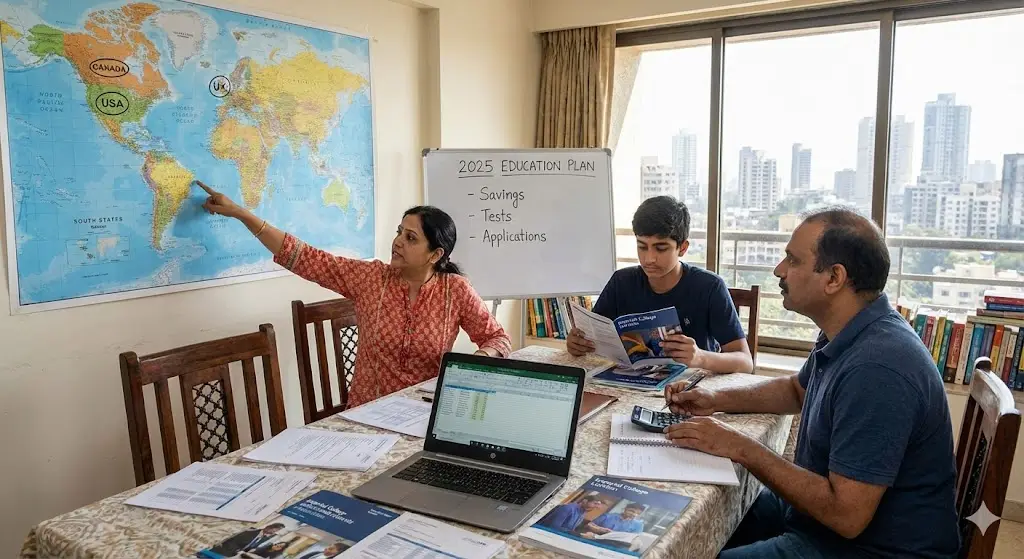
How to Plan for Your Child’s Overseas Education — India 2026 Complete Guide
📘 Overseas Education Planning — The Financial Reality
Sending a child to study in the USA, UK, Canada, or Australia is one of the largest discretionary financial commitments an Indian family can make — totalling ₹1-4 crore for a 4-year undergraduate degree at 2026 exchange rates. With the Indian rupee depreciating approximately 3-4% against the US dollar annually and university costs rising 5-7% per year in dollar terms, the actual corpus required in 12-15 years from now is substantially larger than today’s fees suggest. Planning early with a structured SIP is the only way to make this goal achievable without destroying family finances.
📊 Overseas Education Finance — Key Data
- Ministry of External Affairs, 2025: Indian students studying abroad: 13.4 lakh (a new record). USA hosts 3.3L, Canada 4.3L, UK 1.9L, Australia 1.6L. Growth: 22% YoY increase in Indian students going abroad.
- RBI LRS Data FY 2024-25: Total LRS remittances for education: $8.4 billion. TCS at 5% collected on education remittances: ₹3,150 crore. Average education remittance per family: ₹47 lakh/year.
- HDFC Credila, 2025: Average overseas education loan disbursed: ₹38 lakh. Repayment default rate: 2.1% (low — education loans have strong repayment culture in India).
- INR/USD trend (RBI): INR has depreciated from ₹45 (2005) to ₹84 (2026) — an average 3.2% annual depreciation. Planning at current rates underestimates costs by 50-80% over 15 years.
1. Real Costs — Country-Wise Breakdown 2026
| Country | Annual Tuition | Annual Living | Total/Year (₹) | 4-Year Total (₹) |
|---|---|---|---|---|
| USA (top 50 universities) | $45,000–60,000 | $20,000–25,000 | ₹54–70L | ₹2.16–2.8 Cr |
| USA (state universities) | $25,000–40,000 | $18,000–22,000 | ₹36–52L | ₹1.44–2.08 Cr |
| UK (top universities) | £28,000–45,000 | £12,000–18,000 | ₹42–67L | ₹1.68–2.68 Cr |
| Canada (universities) | CAD$20,000–35,000 | CAD$14,000–20,000 | ₹20–33L | ₹80L–1.32 Cr |
| Australia | AUD$28,000–45,000 | AUD$18,000–25,000 | ₹24–37L | ₹96L–1.48 Cr |
| Germany (public) | €1,500–3,000 | €10,000–14,000 | ₹10–15L | ₹40–60L |
| Singapore | SGD$25,000–45,000 | SGD$14,000–20,000 | ₹29–49L | ₹1.16–1.96 Cr |
⚠️ These Are 2026 Costs — Add INR Depreciation for Future Planning
If your child is 5 years old and will study in 13 years, the ₹50L/year USA cost today will be approximately ₹74L/year in 2039 — accounting for 3% annual USD inflation AND 3% annual INR depreciation (compounded = ~6% annual increase in INR terms). A 4-year US degree costing ₹2 crore today will cost approximately ₹3.2 crore in 2039. Always plan for future-inflated costs, not today’s fees.
2. How Much Corpus Do You Need?
To calculate the required corpus at the time your child starts university:
Corpus = Annual Cost × (1 + Inflation)^Years × 4-year factor
| Child Age Now | Years to Study | USA Corpus Needed | Canada Corpus | Germany Corpus |
|---|---|---|---|---|
| Newborn (0) | 18 years | ₹3.8 Cr | ₹1.9 Cr | ₹72L |
| 3 years | 15 years | ₹3.2 Cr | ₹1.6 Cr | ₹60L |
| 5 years | 13 years | ₹2.8 Cr | ₹1.4 Cr | ₹52L |
| 8 years | 10 years | ₹2.3 Cr | ₹1.15 Cr | ₹43L |
| 10 years | 8 years | ₹2.0 Cr | ₹1.0 Cr | ₹37L |
3. SIP Strategy — Start When the Child Is Born
Time is the most powerful force in education corpus building. ₹15,000/month SIP started at birth (18-year horizon at 13% CAGR) grows to ₹1.72 crore — started at age 5, the same SIP reaches only ₹73L. The 5-year delay costs ₹99L in corpus.
| Child Age | Years | SIP Needed for ₹2 Cr (Canada) | SIP Needed for ₹3 Cr (USA) |
|---|---|---|---|
| 0 (birth) | 18 | ₹22,000/mo | ₹33,000/mo |
| 3 years | 15 | ₹34,000/mo | ₹51,000/mo |
| 5 years | 13 | ₹48,000/mo | ₹73,000/mo |
| 8 years | 10 | ₹82,000/mo | ₹1,23,000/mo |
| 10 years | 8 | ₹1,22,000/mo | ₹1,83,000/mo |
If the monthly SIP feels unaffordable, use a 10% annual step-up SIP — starting lower and increasing by 10% every year. A step-up SIP starting at ₹12,000/month at birth achieves the same ₹2 crore corpus as a flat ₹22,000/month SIP — making it accessible even on a growing income.
Fund Selection for Education Corpus
- Years 0-12: 80% equity (Nifty 50 index + mid-cap), 20% debt. Maximum growth phase.
- Years 12-15: Shift 30% from equity to debt/arbitrage annually. Reduce volatility as target date approaches.
- Year 15-18: 50% debt, 50% equity. Protect corpus from market crash just before withdrawal.
4. Managing Currency (Forex) Risk
The INR-USD/GBP/CAD exchange rate at the time of withdrawal significantly affects your actual purchasing power. Key strategies:
Invest Partly in USD-Denominated Assets
As the corpus grows (typically from Year 10 onwards), shift 20-30% into USD-denominated assets to naturally hedge currency risk: US equity index funds (Motilal Oswal S&P 500 ETF), International Fund of Funds (PPFAS Flexi-Cap’s international allocation), or Sovereign Gold Bonds (gold appreciates when INR depreciates).
Remittance Timing
Don’t convert all INR to foreign currency on a single day — use the LRS to remit 3-6 months of fees in advance when the INR is relatively strong (INR strengthens typically in Q1-Q2 — April to September — when export earnings are high). Avoid converting during Q3-Q4 when INR typically weakens against USD.
5. Education Loans for Overseas Study
| Lender | Max Loan | Rate | Collateral Required | Moratorium |
|---|---|---|---|---|
| SBI Global Ed-Vantage | USD $1.5M | 10.75-11.5% | Required above ₹50L | Study period + 1yr |
| HDFC Credila | ₹1 crore | 11-13.5% | Required above ₹40L | Study period + 6mo |
| Avanse Financial | ₹75L | 11.5-14% | Sometimes waived (top colleges) | Study period + 1yr |
| Prodigy Finance | $220,000 | 8-12% (variable) | None (income-based) | 6 months after graduation |
| MPOWER Financing | $100,000 | 10-14% | None | Study period |
Section 80E benefit: 100% of interest paid on education loan is deductible (old regime only, for 8 years from repayment start). On ₹30L loan at 12%: annual interest ≈ ₹3.6L, tax saving at 30% bracket = ₹1.08L/year. Over 8 years: ₹8.64L in tax saved — significantly reducing effective loan cost.
6. LRS Remittance — Rules and TCS
The Liberalised Remittance Scheme allows each Indian resident to remit up to USD $250,000 per year for permissible purposes. For education:
- TCS at 5%: On amounts above ₹7 lakh in a financial year remitted for education purposes. This TCS is refundable — claim it as income tax credit in your ITR.
- Bank requirements: Student visa copy, admission letter from university, fee receipt or invoice. Banks must verify genuineness of education purpose.
- Forex cards: Niyo Global, HDFC Multicurrency Card, IndusInd Indus Forex Card — load foreign currency at RBI reference rate; no forex conversion charges for international transactions. Save 2-3% vs using a standard credit card abroad.
7. Scholarships and Financial Aid — Reducing the Burden
Many Indian families overlook scholarship opportunities, assuming they are rare or inaccessible. In 2026, several well-funded scholarship programs specifically target Indian students:
- Inlaks Foundation: Fully funded scholarships to top global universities — covering tuition and living for postgraduate study. 20-25 awards per year. Highly competitive but well-funded.
- Narotam Sekhsaria Foundation: Interest-free loans (₹20-30L) for master’s programmes at top global universities.
- Tata Trusts Scholarships: For postgraduate study, primarily in science and technology domains.
- DAAD (Germany): German government scholarships for Indian students — covers living expenses, travel, and health insurance for German universities (minimal tuition anyway).
- Chevening (UK): Fully funded UK government scholarships for Indian master’s students — tuition + maintenance + flights.
- University Financial Aid (USA): Many US universities offer merit-based financial aid to international students. Liberal arts colleges (like Williams, Amherst, Vassar) are particularly known for need-blind international admissions.
🧮 Free Calculators — Use Them Now
No login required. Updated for FY 2025-26.
Frequently Asked Questions
Total annual costs (tuition + living) for 2026-27: USA (top universities): $60,000-90,000 (~₹50-75L/year). USA (state universities): $35,000-55,000 (~₹29-46L/year). UK (top universities): £35,000-55,000 (~₹37-58L/year). Canada: CAD$35,000-55,000 (~₹21-33L/year, more affordable). Australia: AUD$40,000-65,000 (~₹21-35L/year). Germany: €12,000-20,000 (~₹11-18L/year — minimal tuition, living costs only). A 4-year US degree at a mid-range state university totals approximately ₹1.5-2 crore inclusive of all costs at 2026 exchange rates.
For a 5-year-old child targeting a US degree in 13 years (2039): assume total cost ₹2.5 crore (₹1.8 crore today’s cost × 3% annual USD inflation × 1.5 INR depreciation factor). SIP needed at 12% CAGR for 13 years: ₹78,000/month. With 10% annual step-up starting at ₹32,000/month: achieves the same corpus. Start with what you can afford — even ₹15,000/month SIP started at birth grows to ₹1.12 crore by the child’s 18th birthday at 12% CAGR.
Under the Liberalised Remittance Scheme (LRS), Indian residents can remit up to USD $250,000 (approximately ₹2.1 crore) per financial year per person for permissible purposes including education. Tax Collected at Source (TCS): 5% TCS applies on remittances above ₹7 lakh in a financial year for education purposes (claimable as income tax credit in ITR). TCS was raised to 20% from October 2023 for non-education remittances — education remains at 5%. Education institution direct payments have TCS at 5%; personal account remittances for education also 5% if loan-funded.
Education loans have advantages beyond just funding: (1) Interest paid on education loan qualifies for Section 80E deduction — 100% of interest paid, no limit, for 8 years after repayment starts (old regime only). (2) Loan creates financial accountability for the student. (3) Preserves your investment corpus to continue compounding. Recommended hybrid: fund 40-50% through accumulated savings/SIP, take education loan for 50-60%. Leading lenders for overseas education loans: SBI Global Ed-Vantage (up to $1.5M), HDFC Credila, Avanse, Prodigy Finance (for top-ranked universities). Rates: 10.5-13.5% p.a. Collateral: required above ₹40-75L depending on lender.
Canada and Germany offer the best cost-to-quality ratio: Canada — reasonable tuition ($15,000-20,000/year), post-graduation work permit (3 years), pathway to PR. Germany — minimal tuition at public universities (€1,500-3,000/year, mostly administrative fees), strong engineering programmes, 18-month post-study work visa. Australia — quality universities, solid PR pathway via skilled migration after graduation. UK — high cost but 2-year post-study work visa (Graduate Route) makes it viable for students from top institutions. USA — highest cost but best global brand value; worth it for top 50 universities, marginal for others.