
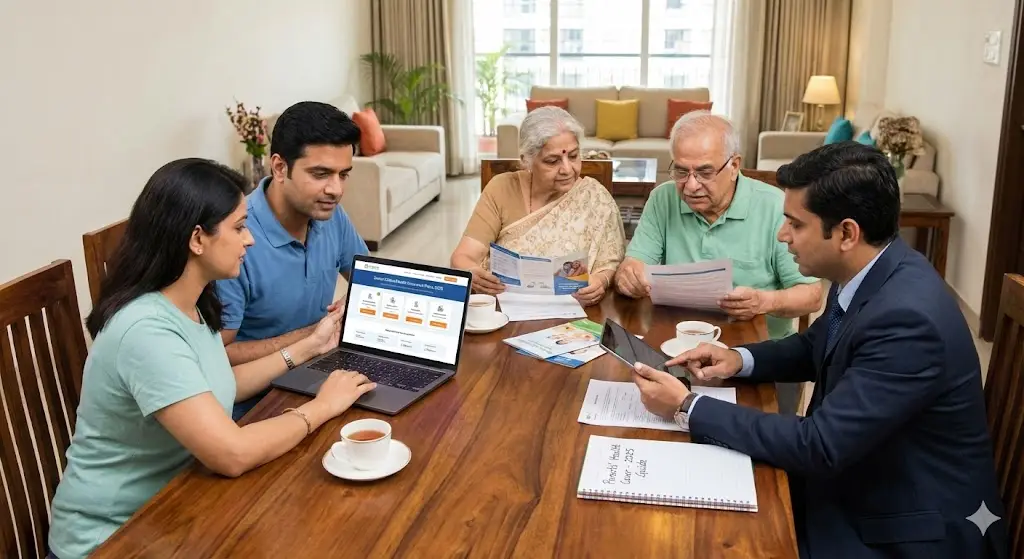
How to Buy Health Insurance for Parents in India — 2026 Complete Guide
📘 Why Parent Health Insurance Is Different
Buying health insurance for senior citizen parents in India requires different decision criteria than buying for yourself — older age means higher premiums, mandatory medical tests, pre-existing disease complications, and a much higher probability of making a large claim within 3-5 years. India’s medical inflation runs at 14% annually (FICCI 2025); a bypass surgery that cost ₹3 lakh in 2015 costs ₹7-10 lakh in 2026. Getting this decision right can protect your family from financial catastrophe.
📊 Health Insurance Market Data — IRDAI & Ministry of Health
- IRDAI Annual Report 2023-24: India’s health insurance premium: ₹1.05 lakh crore. Health insurance claims ratio: 85%+, driven largely by senior citizen claims.
- FICCI Healthcare Report 2025: Medical inflation in India: 14% p.a. Average family hospitalisation cost in metro cities: ₹1.8-4.5 lakh per episode.
- Finance Ministry, Budget 2025: Section 80D deduction for senior citizen parents: ₹50,000/year under old tax regime. Only 18% of senior citizens in India have health insurance (IRDAI, 2024).
- National Sample Survey 2024: 42% of hospitalised Indians have no health coverage. Out-of-pocket spending on healthcare: 47% of total health expenditure — among the highest in Asia.
1. Why Parents Need a Separate Health Insurance Policy
Many families assume their employer’s group health cover or a combined family floater extends adequate protection to parents. In most cases, this is insufficient for three reasons:
Problem 1: Employer Cover Ends When You Change Jobs
In India’s job market, the average tenure at one company is 2-3 years. If your parents are covered under your employer’s group plan and you resign, they lose coverage immediately — often just when they have developed health conditions that would make them uninsurable or very expensive to insure independently. A standalone policy for your parents is permanent and portable regardless of your employment.
Problem 2: Family Floaters Don’t Work Well for Seniors
A family floater divides a single sum assured among all family members. When you add parents (60+) to your family floater, you add two high-risk members who are statistically likely to claim. One large claim by a parent exhausts the floater, leaving the rest of the family unprotected for the rest of the year. Separate policies for parents and for your own family is the correct structure.
Problem 3: Age-Related Exclusions and Higher Co-Payments
Family floaters usually have age entry limits (55-65 years maximum) and apply co-payment clauses (10-20%) to senior members even if younger members have no co-payment. Dedicated senior citizen plans are designed specifically for older policyholders and may offer better terms for senior-specific conditions.
2. Seven Features to Check Before Buying Parents’ Health Insurance
| Feature | What to Look For | Red Flag |
|---|---|---|
| Co-payment | Zero or maximum 15% | More than 20% co-pay on all claims |
| Room Rent Sub-Limit | 1% of SI per day, or no sub-limit | Fixed room rent limit (₹3,000/day caps total claim proportionally) |
| Pre-existing Disease Wait | 1-2 years | 4-year waiting period for PEDs |
| Cashless Hospitals | 5+ hospitals within 10km of parents’ home | Network limited to private hospitals only |
| Restoration Benefit | 100% SI restored after claim | No restoration — one claim = no coverage rest of year |
| Domiciliary Coverage | Included — covers home treatment | Only inpatient hospitalisation covered |
| AYUSH Coverage | Ayurveda, yoga, homeopathy covered | Not relevant if parents prefer allopathy only |
💡 Room Rent Sub-Limit: The Hidden Policy Killer
Room rent sub-limits are the most commonly misunderstood feature in health insurance. If your policy has a room rent limit of ₹4,000/day and your parent occupies a ₹8,000/day room, the insurer proportionally reduces ALL related charges (doctor’s fees, nursing, diagnostics) — not just the room rent. A ₹5L bill can become a ₹2.5L claim if the room rent limit is triggered. Always choose a plan with no room rent limit or at least 1% of sum insured per day.
3. How Much Health Insurance Coverage Is Enough for Parents?
The most common mistake: buying ₹2-3 lakh coverage and thinking it’s adequate. Medical costs in 2026 for major procedures:
| Procedure | Metro City Cost (2026) | Tier 2 City Cost | Min Coverage Needed |
|---|---|---|---|
| Cardiac Bypass Surgery | ₹5–10L | ₹3–6L | ₹10L |
| Knee Replacement (both knees) | ₹4–7L | ₹2.5–4L | ₹7L |
| Cancer Treatment (6 months) | ₹8–25L | ₹5–15L | ₹15L+ |
| Stroke (ICU + rehab) | ₹3–8L | ₹2–5L | ₹10L |
| Kidney Failure (dialysis) | ₹3–5L/year | ₹2–3.5L/year | ₹10L |
For parents below 65 in a metro: minimum ₹10 lakh coverage. For parents 65-75+: ₹15-20 lakh, factoring in potentially multiple major claims. Top-up plans can supplement a base plan affordably — a ₹15L top-up triggered above ₹5L costs ₹6,000-12,000/year for a 65-year-old.
4. Managing Pre-Existing Disease Coverage
Most parents above 60 have at least one PED — diabetes, hypertension, thyroid disorders, and back/knee issues are extremely common. The waiting period for PEDs is the biggest barrier in parent health insurance.
PED Strategy 1: Choose 1-2 Year Waiting Period Plans
Some insurers offer 1-year PED waiting period plans at 15-25% higher premium. For parents with diabetes and hypertension (likely to need related treatment in 1-2 years), the higher premium is usually worth it versus waiting 3-4 years for coverage to kick in.
PED Strategy 2: Start Early Before PEDs Develop
If your parents are currently healthy at 55-58, buy their health insurance now. Once PEDs are declared (at medical test or by health form), future insurers will apply waiting periods. Buying when healthy gives immediate full coverage and locks in lower age-based premiums for life.
PED Strategy 3: Port Existing Coverage
IRDAI portability rules: if your parents already have a health policy, they can port to a better policy while retaining their PED waiting period credit. A parent who has held a policy for 2 years can port and the new insurer must credit those 2 years against their standard 4-year PED wait.
5. Section 80D Tax Benefit on Parents’ Health Insurance
Premiums paid for your parents’ health insurance qualify for Section 80D deduction under the old tax regime. The limits for FY 2025-26:
| Category | Maximum Deduction | Notes |
|---|---|---|
| Self + Spouse + Children | ₹25,000/year | ₹5,000 can be for preventive health check-up |
| Senior Citizen Parents (60+) | ₹50,000/year | Includes premium paid for either or both parents |
| Self (if senior citizen 60+) | ₹50,000/year | If you are also 60+ |
| Maximum combined (you + senior parents) | ₹75,000/year | ₹25K (self) + ₹50K (senior parents) |
At the 30% tax bracket: ₹50,000 deduction for parent health insurance = ₹15,000 saved in tax annually. Over 20 years, the government effectively co-pays ₹3 lakh of your parents’ insurance cost through this deduction (old regime). This benefit is not available under the new tax regime.
6. Step-by-Step Process to Buy Parents’ Health Insurance
- Decide sum insured: Start with ₹10 lakh minimum. Add top-up if budget allows. Consider the city your parents live in — metro needs higher coverage than Tier 2.
- List your parents’ PEDs accurately: Incomplete disclosure can lead to claim rejection. Declare all diagnosed conditions, surgeries, and current medications.
- Get comparison quotes: Use insurance aggregators (Policybazaar, Coverfox, IRDAI’s Bima Sugam portal) for the same sum insured across 5-6 insurers. Premium variation for the same cover can be 40-60% across insurers.
- Verify the network hospital list: Download the insurer’s hospital network for your parents’ PIN code specifically. Google “insurer name + cashless hospital [city]” for the latest list. Government/PSU hospitals should be included.
- Check claim settlement ratio: IRDAI publishes annual claim settlement ratios. Prefer insurers with 95%+ claim settlement ratio and under 1% complaints ratio. Star Health (2025: 96.2%), HDFC ERGO (94.5%), and Care Health (93.8%) are consistently above average.
- Complete pre-medical tests honestly: Most insurers require medical tests above 45-55 years or above ₹5L sum insured. Attend these seriously — false/incomplete declarations void your policy.
- Set up auto-renewal: Health insurance must be renewed before expiry to maintain continuity benefits (PED credit, no-claim bonus). Set a calendar reminder 2 months before renewal to compare rates.
7. Tips for Smooth Claims
💡 Pre-Authorisation for Cashless Claims
For planned procedures (knee replacement, cataract, etc.): inform the insurer 3-5 days in advance to get pre-authorisation. Emergency admissions: notify the insurer within 24 hours. The hospital’s insurance desk handles most of this — ask for the “insurance helpdesk” on arrival and give them your policy number, not just the card.
- Keep all original bills and discharge summaries — even for reimbursement claims months later
- Photo-document all prescriptions and reports using your phone during hospitalisation
- Check pre and post-hospitalisation cover period — most plans cover 30 days pre and 60 days post
- Know your day-care procedures list — 400+ procedures including dialysis, chemotherapy, cataract surgery don’t require 24-hour admission
- Use the insurer’s 24/7 helpline before admission for any planned procedure to confirm coverage and get the claim started
🧮 Free Calculators — Use Them Now
No login required. Updated for FY 2025-26.
Frequently Asked Questions
For parents aged 60-70, consider plans with: (1) no co-payment clause or low co-pay (10-15% max), (2) no room rent sub-limit or high sub-limit (single standard room at minimum), (3) direct cashless network hospitals near your parents’ city, (4) coverage for pre-existing diseases after 1-2 year waiting period (not 4 years), and (5) minimum ₹5-10 lakh sum insured. Star Health Senior Citizens Red Carpet, Care Senior, and HDFC ERGO Optima Senior are frequently cited in 2026 reviews, but compare fresh quotes — premiums and features change annually.
Yes. Under Section 80D of the Income Tax Act, you can claim up to ₹25,000/year deduction on health insurance premium paid for yourself + spouse + children. Additionally, ₹25,000 for non-senior citizen parents (₹50,000 if parents are senior citizens aged 60+). Maximum combined deduction: ₹75,000/year if you and your parents are both senior citizens. This deduction is available only under the old tax regime — not the new regime.
Usually not the primary strategy. Employer group plans may allow parent add-on, but: (1) cover ends if you resign/are laid off; (2) claims under employer plan may affect your personal no-claim bonus; (3) group plans often have higher co-payment for senior members; (4) the cover isn’t portable. Ideally, buy an independent personal plan for your parents, and use employer cover only as secondary/overflow coverage for very high-cost procedures.
Co-payment means you pay a fixed percentage of the claim amount — the insurer covers the rest. For example, with 20% co-pay on a ₹3 lakh claim, you pay ₹60,000 and insurer pays ₹2.4 lakh. Most senior citizen plans have 10-30% co-payment clauses. Avoid plans with >20% co-pay for parents — it defeats the purpose of insurance for large claims. Some plans allow you to pay a higher premium to waive co-payment entirely — worth considering for parents 70+.
Most health plans have a 2-4 year waiting period for pre-existing diseases (PEDs) like diabetes, hypertension, thyroid, arthritis. Shorter waiting periods (1-2 years) are available at higher premiums. For parents already unwell, consider plans with 1-year PED waiting period even if they cost 20-30% more — the cost difference is worth it versus a 4-year wait during which a major related claim would be rejected.