
Margin Trading — Risks, Rewards & SEBI Rules in India 2026
📘 Margin Trading in India — The High-Stakes Reality
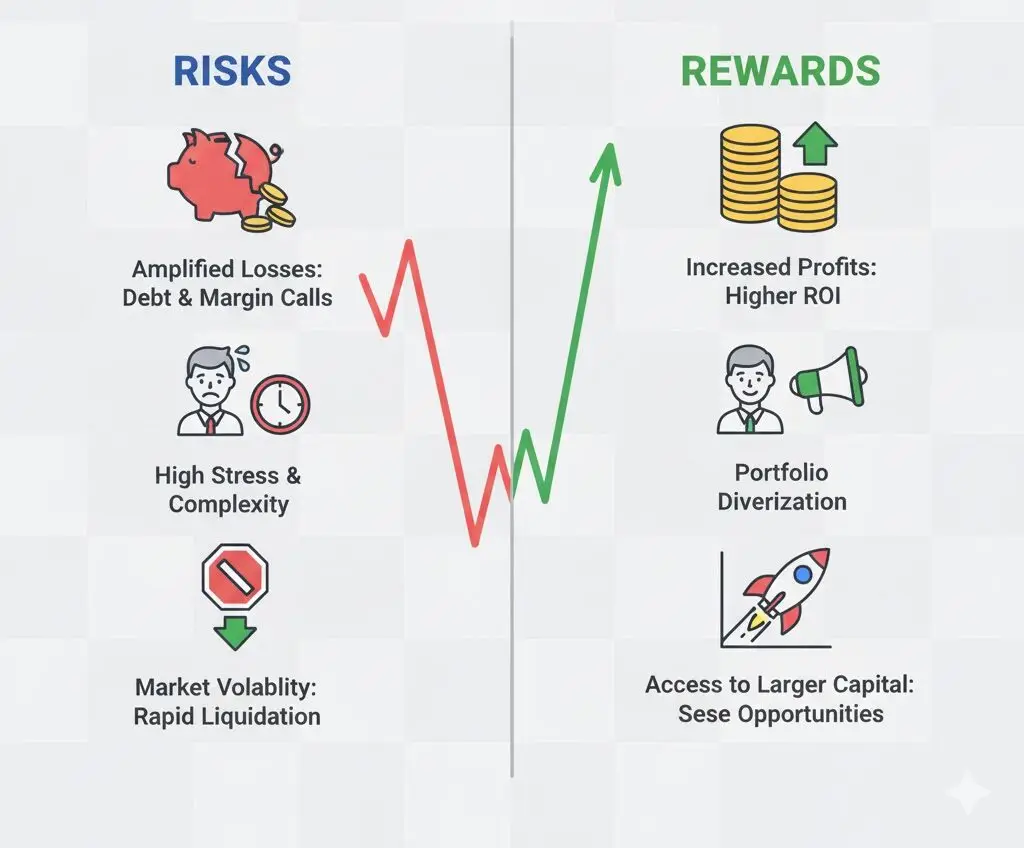
Margin trading is the use of borrowed funds from your broker to buy more securities than your own capital allows — amplifying both potential gains and potential losses. In India, margin trading is regulated by SEBI through the Margin Trading Facility (MTF) framework and intraday leverage rules. While leverage can accelerate returns in bull markets, SEBI’s own data (93% of F&O traders lose money, FY 2024-25) underscores that most retail investors are net losers from leveraged trading. This guide explains how margin trading works, its true costs, SEBI’s current rules, and how to determine if it fits your profile.
📊 Margin Trading & Leverage Data — SEBI India 2025-26
- SEBI Study FY 2024-25: 93% of individual equity derivatives traders lost money. Average loss per losing trader: ₹54,000. Top 1% of profitable traders account for 95% of total profits made by all retail traders.
- NSE, 2025: Average daily margin trading exposure in Indian equities: ₹85,000 crore. MTF (overnight leveraged positions) outstanding: ₹35,000-40,000 crore at any time.
- SEBI Circular, 2024: Margin Trading Facility interest rate cap: brokers cannot charge more than 18% p.a. + spread. In practice: most brokers charge 18-24% p.a. on MTF balances.
- AMFI, 2026: Comparison: Nifty 50 index fund 20-year CAGR: 14.8% with zero leverage, zero margin cost, minimal volatility amplification. Margin trading on same Nifty 50 stocks requires 18-24% return just to break even on funding cost.
1. Types of Margin Facilities in India
| Type | Duration | Leverage | Cost | Settlement |
|---|---|---|---|---|
| Intraday MIS (Margin Intraday Square-off) | Same day only | 3–10× | No interest (auto-square-off by 3:20pm) | Automatic by broker |
| SEBI MTF (Margin Trading Facility) | Overnight / multi-day | 2–4× | 18–24% p.a. interest | Hold until you exit |
| Pledging shares as margin | Ongoing collateral | Up to 50% of pledged value | 0.01-0.05%/day haircut | Release by unpledging |
| F&O margin (futures) | Till expiry | Varies by contract | Opportunity cost + brokerage | Mark-to-market daily |
⚠️ Intraday Leverage ≠ Free — Hidden Costs Add Up
Intraday MIS leverage has no explicit interest, but carries: (1) Auto-square-off risk — if you don’t close by 3:20pm, broker closes at market price (often worse than you’d choose). (2) Higher brokerage on leveraged position size. (3) Psychological pressure of monitoring all-day amplified positions. (4) STT on delivery if you miss square-off. The “free” leverage has real hidden costs.
2. The True Cost of Margin Funding
For SEBI MTF (overnight leveraged positions), the carrying cost destroys potential returns faster than most investors realise:
| Margin Position | Daily Interest at 21% p.a. | Monthly Interest | Annual Break-Even Stock Return |
|---|---|---|---|
| ₹1 lakh borrowed, ₹1L own | ₹57/day | ₹1,726 | Stock must return 21%+ just to break even |
| ₹2 lakh borrowed, ₹1L own | ₹115/day | ₹3,452 | Stock must return 28%+ to break even on your ₹1L |
| ₹4 lakh borrowed, ₹1L own | ₹229/day | ₹6,904 | Stock must return 42%+ to break even on your ₹1L |
The mathematics are clear: with borrowing at 21% p.a., you need stock returns significantly above 21% just to preserve capital. India’s best large-cap stocks deliver 12-18% CAGR on average — well below the margin funding cost. Margin trading is most profitable when stock returns dramatically exceed 21% — which happens in bull markets but isn’t the long-term average.
3. SEBI Margin Rules — Current Framework 2026
- MTF eligible stocks: Only SEBI-approved Group 1 securities (liquid, large-cap) can be bought on MTF. Brokers maintain updated lists.
- Funding limit: No explicit cap on MTF amount; individual broker policies apply. SEBI requires brokers to maintain adequate capital against MTF books.
- Interest rate: SEBI caps MTF at reference rate + spread (effectively max ~24%). Most brokers charge 18-21% p.a.
- Margin maintenance: Investor must maintain 25%+ of total position value as equity in the account at all times. Below this → margin call.
- Peak margin rule: Since August 2021: 100% of required upfront margin must be available before trade — brokers cannot fabricate margin from intraday unrealised profits.
- Pledging: Shares held in demat can be pledged as margin — CDSL/NSDL facilitated. But pledged shares can be forcibly sold during margin shortfalls.
4. Margin Calls — The Forced Exit Risk
Margin calls are not theoretical — they happen in every significant market correction, often to investors who thought they were “safe.” The sequence:
- Market falls 8-10% on bad news (FII selling, global risk-off, surprise negative earnings)
- Your leveraged position loses 16-30% in value
- Account equity falls below maintenance margin (25% of position)
- Broker sends margin call: deposit more funds within 24 hours or positions are sold
- Under distress, you cannot deposit — broker sells at current low prices, locking in the loss
- Markets recover days later — but you’ve been forced out at the bottom
💡 The Only Safe Margin Usage Rule
If you use margin at all: never exceed 50% of your maximum eligible margin. Keep 50%+ cash buffer in your account. This means a 20% market crash won’t trigger a margin call — you have enough equity cushion to withstand the drawdown without forced selling. Using maximum available margin is how investors get destroyed during corrections.
5. When Margin Trading Makes Sense
Despite the risks, there are narrow scenarios where leverage can be rational:
- Experienced traders with demonstrated edge: If you have 2+ years of profitable trading history with clear methodology and risk management, limited leverage (2× max) on highest-conviction positions during clear market opportunities.
- Short-duration specific opportunity: Rights issue funding (borrow for 15 days to participate in rights offering at discount), where the gain certainty is high and the borrowing period is short and definable.
- Pledging existing portfolio for short-term capital need: Pledging your existing long-term equity portfolio to raise funds for a specific short-term need (business requirement, property purchase gap) — at 18% p.a. vs 15-18% personal loan rate, this can make sense for 30-90 day periods.
6. When Margin Trading Destroys Wealth
- Beginner investors: No experience, no methodology, using leverage because “the market is going up” — this is how accounts go to zero in first corrections.
- Buying falling stocks on margin: “It’ll recover” thesis with leveraged position in a declining stock = forced margin call when it keeps falling.
- Near-retirement capital on margin: Using retirement savings as margin collateral — catastrophic if markets correct at the wrong time.
- Maximum leverage usage: Using 80-90% of available margin leaves zero buffer for volatility. A 5% adverse move triggers margin call.
- Intraday leverage without auto-square-off: Forgetting to close intraday positions means broker forcibly converts them to delivery at potentially terrible prices.
7. Better Alternatives to Leverage
For investors attracted to margin trading’s return-amplification, these alternatives provide better risk-adjusted returns:
| Alternative | Return Potential | Risk vs Margin | Best For |
|---|---|---|---|
| Step-up equity SIP | 13-15% CAGR (index) | Far lower | Long-term wealth building |
| Mid-cap equity funds | 14-18% CAGR (5yr+) | Moderate | Higher returns, no leverage risk |
| Direct equity (quality stocks) | 15-25% CAGR (select) | Moderate | Experienced stock pickers, long horizon |
| Small-cap index fund | 18%+ CAGR (20yr) | High but no leverage risk | 15+ year investors with high risk tolerance |
The returns available from unleveraged equity investing — 13-18% CAGR in diversified equity over long periods — are exceptional by any global standard. Leverage is not necessary to build significant wealth; time and discipline are.
🧮 Free Calculators — Use Them Now
No login required. Updated for FY 2025-26.
Frequently Asked Questions
Margin trading allows investors to buy more securities than they can afford by borrowing from their broker. Two types in India: (1) Intraday margin — broker provides 5-20× leverage for same-day trades; position must be squared off by end of day. (2) SEBI Margin Trading Facility (MTF) — buy shares with borrowed funds and hold beyond same day; SEBI-approved stocks only; margin funding cost typically 18-24% p.a. charged by broker. Example: ₹1 lakh capital with 5× leverage buys ₹5 lakh of shares. A 10% gain = ₹50,000 profit (50% return on your ₹1 lakh). A 10% loss = ₹50,000 loss (50% return) — plus margin call if the loss erodes the collateral below minimum.
A margin call occurs when your portfolio’s equity falls below the broker’s minimum maintenance margin (typically 20-25% of total position value). Example: you buy ₹5 lakh of shares with ₹1 lakh own capital and ₹4 lakh borrowed. Maintenance margin = 25% of ₹5L = ₹1.25L. If shares fall 5% (to ₹4.75L), your equity = ₹0.75L — below the ₹1.19L maintenance margin. Broker issues margin call: deposit more funds immediately or broker forcibly sells shares at current (low) price to recover the loan. Margin calls hit at the worst time — during market crashes when you’re already losing. Avoid: keep margin utilisation below 50% of maximum; keep 30-40% cash buffer in margin account.
SEBI’s FY 2024-25 study on equity derivatives: 93% of individual F&O traders lost money. While this specifically covers derivatives, margin equity trading has similar issues: (1) Interest cost of 18-24% p.a. means the stock must gain at least 18-24% per year just to break even on funding cost. (2) Market downturns force margin calls at the worst time — forced selling at lows. (3) Leverage amplifies losses as readily as gains. (4) Emotional decision-making worsens under leveraged pressure. For most retail investors, zero-leverage equity investing in index funds or quality stocks is superior on a risk-adjusted basis.
SEBI’s MTF is available only on a SEBI-approved list of stocks (Group 1 securities — liquid, high-cap stocks meeting SEBI’s criteria for collateral quality). In practice: most large-cap Nifty 50 and Nifty 100 stocks are MTF-eligible. Small-cap and mid-cap stocks with low liquidity are typically excluded. The eligibility list is maintained by exchanges and updated periodically. Check your broker’s MTF eligible stock list — Zerodha, Angel One, ICICI Direct, HDFC Securities all publish their MTF stock lists. Pledged shares (used as margin) must also be on the approved list.
SEBI’s peak margin rule (implemented August 2021 — fully effective 2022) requires traders to have 100% of the required upfront margin in their account before placing a trade — no more using intraday profits as margin for the same-day next position. For intraday traders: broker can provide up to 80% margin benefit (MIS/CO orders) on eligible stocks, but this leverage must come from approved broker sources, not fabricated intraday P&L. Effectively: leverage for intraday trading in the cash segment has been capped and standardised. Some brokers still offer significant leverage through MIS (Margin Intraday Square-off) orders — verify your broker’s specific leverage multiples, as they vary.