
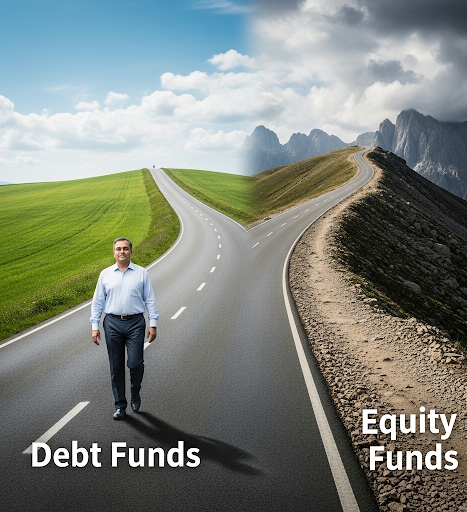
Debt Mutual Funds
in India — Complete Guide
Liquid funds, corporate bonds, gilt, short-duration — how debt funds work, types compared, credit risk explained, the FD vs debt fund decision, and which fund for which goal.
What Are Debt Mutual Funds?
Debt mutual funds invest in fixed-income instruments — government bonds, treasury bills, corporate bonds, commercial papers, and certificates of deposit. The fund earns interest from these securities (carry return) and also gains or loses value as bond prices move (mark-to-market return). Unlike bank FDs where returns are fixed and guaranteed, debt fund NAVs fluctuate daily as bond prices change with interest rate movements and credit events.
Debt funds serve two key purposes in a portfolio: parking short-term money safely with better returns than savings accounts, and providing stability in a diversified portfolio alongside equity.
Types of Debt Funds — Explained
| Category | Maturity Profile | Risk | Typical Return | Best Use Case |
|---|---|---|---|---|
| Overnight Fund | 1-day maturity instruments | Negligible | 6-6.5% | Parking cash overnight |
| Liquid Fund | Up to 91-day maturity | Very Low | 6.5-7.5% | Emergency fund, idle cash |
| Ultra Short Duration | 3-6 months Macaulay duration | Low | 6.5-7.5% | 3-6 month savings goals |
| Low Duration | 6-12 months duration | Low | 7-8% | 6-12 month goals |
| Short Duration | 1-3 years duration | Low-Moderate | 7-8.5% | 1-3 year goals |
| Medium Duration | 3-4 years duration | Moderate | 7.5-9% | 3-5 year goals |
| Corporate Bond | AA+ rated bonds, 1-4 years | Moderate | 7.5-8.5% | Quality corporate paper for 2-4 years |
| Gilt Fund | Government bonds (long duration) | High interest rate risk, zero credit risk | 7-10% | Rate cut cycles |
| Credit Risk Fund | AA and below rated bonds | High (credit default risk) | 9-11% | Sophisticated investors only |
| Dynamic Bond | Flexible duration | Moderate-High | 7-9% | Active rate cycle positioning |
How Interest Rate Changes Affect Debt Funds
Bond prices and interest rates move in opposite directions — this is a fundamental law of fixed income. When RBI raises rates, new bonds offer higher yields, making existing lower-yielding bonds less attractive, pushing their prices down. This reduces NAV of long-duration debt funds. When RBI cuts rates, existing higher-yielding bonds become more valuable, pushing prices up — NAV rises.
Duration (measured in years) tells you the sensitivity: a fund with 5-year duration will see NAV change by approximately 5% for each 1% change in interest rates. A liquid fund (0.1-year duration) barely moves; a gilt fund (7-10 year duration) can swing 7-10% for a 1% rate change. Match your fund duration to your goal timeline and rate cycle view.
Credit Risk — The Hidden Danger in Debt Funds
Credit risk occurs when a bond issuer fails to pay interest or principal on time. The 2019-2020 period saw several high-profile credit events in India (DHFL, Vodafone bonds, IL&FS) that caused dramatic NAV drops in credit risk funds and some other debt funds holding lower-rated bonds.
Safer credit quality hierarchy: Government Securities (zero credit risk) > AAA-rated bonds > AA+ > AA > A1+ money market. For most retail investors, funds investing primarily in government bonds or AAA/AA+ rated corporate bonds are appropriate. Credit risk funds (which hold AA and below for higher yield) are only suitable for sophisticated investors who understand and can absorb potential default losses.
Debt Fund Tax Treatment — The 2023 Change
Important change from Finance Act 2023: debt mutual fund gains are now taxed at the investor’s income tax slab rate regardless of holding period. This applies to all debt funds purchased on or after April 1, 2023. Previously, debt funds held for 3+ years benefited from indexation — adjusting the purchase price for inflation before computing gains, which dramatically reduced taxable gains for long-holding investors. This tax advantage is now eliminated.
Implication: for investors in the 30% tax bracket, the after-tax return from debt funds and bank FDs are now approximately equivalent for tax purposes. Debt funds retain advantages in liquidity (anytime redemption with no penalty), flexibility (partial redemption), and SIP convenience.
Debt Fund vs Bank FD — Complete Comparison
| Parameter | Debt Mutual Fund | Bank FD |
|---|---|---|
| Returns | Market-linked (6.5-9%) | Fixed (6.5-8% currently) |
| Return guarantee | No — NAV fluctuates | Yes — guaranteed rate |
| Tax (post-April 2023) | Slab rate (same as FD) | Slab rate |
| Liquidity | Anytime, no penalty | Penalty for premature exit (0.5-1%) |
| Partial withdrawal | Yes — any amount | No — must break entire FD |
| Safety | Market risk, credit risk | DICGC insured up to Rs 5 lakh |
| Minimum investment | Rs 100-500 | Rs 1,000-10,000 |
| TDS | Not deducted | 10% if interest above Rs 40,000/year |
Building the Debt Allocation in Your Portfolio
Debt funds serve specific roles in a well-structured portfolio. A framework by life stage:
- Emergency fund (all ages): 3-6 months expenses in liquid fund — non-negotiable
- Short-term goals (under 3 years): Short-duration debt fund or corporate bond fund
- Medium-term stability (3-7 years): Dynamic bond or medium duration fund
- Portfolio stabiliser: 20-30% of total portfolio in debt reduces overall volatility
- Retirement income: Short-duration and ultra-short funds for monthly withdrawal
Debt Fund Selection Checklist
- Match fund duration to your investment horizon — never hold long-duration gilt in short-term money
- Check credit quality: prefer funds with 80%+ in AAA and sovereign instruments
- Compare expense ratios — direct plans typically 0.1-0.5% vs regular plans at 0.5-1.2%
- Review AUM size: very small debt funds (under Rs 500 crore) may have liquidity issues during stress
- For emergency fund: choose liquid fund with instant redemption facility on your investment platform
- Use the FD Calculator to compare guaranteed FD returns with expected debt fund returns before deciding
🧮 Free Calculators — Use Them Now
No login required. Updated for FY 2025-26.
Frequently Asked Questions
Debt mutual funds invest in fixed-income instruments: government bonds (gilt), treasury bills, corporate bonds, commercial papers, and certificates of deposit. The fund earns interest from these instruments and also makes capital gains or losses when bond prices move. Bond prices move inversely to interest rates: when interest rates rise, bond prices fall (NAV drops); when rates fall, bond prices rise (NAV increases). The fund’s returns come from the combination of accrued interest income (carry return) and price movements (mark-to-market gain or loss). Unlike FDs, debt fund NAVs fluctuate daily.
Liquid funds invest in instruments with maturity up to 91 days — making them the safest and most stable debt category with minimal NAV fluctuation. Returns are typically 6.5-7.5% and redemption is processed within 1 business day (instant redemption up to Rs 50,000 or 90% of folio value on most platforms). Short-duration funds invest in instruments with Macaulay duration of 1-3 years — offering slightly higher returns (7-8.5%) but with moderate sensitivity to interest rate changes. Use liquid funds for emergency corpus and parking 3-6 month savings; short-duration funds for 2-3 year financial goals.
Credit risk is the risk that a bond issuer fails to pay interest or principal on time — a default. Lower-rated bonds (AA, A, BBB) offer higher yields to compensate for higher credit risk. When a debt fund holds lower-rated bonds and an issuer defaults, the fund’s NAV can drop sharply. Credit risk funds (which invest in AA and below rated instruments for higher yield) are suitable only for sophisticated investors who understand this risk. For most retail investors, funds that invest primarily in AAA and AA+ rated instruments or government securities are safer. Always check the credit quality of a debt fund’s portfolio before investing.
Debt funds have several advantages over bank FDs depending on the situation. Tax efficiency: debt fund gains held for 3+ years used to have indexation benefit (this changed from FY 2023-24 — now debt fund STCG and LTCG are both taxed at slab rate, same as FD). Liquidity: debt funds can be redeemed anytime (no premature withdrawal penalty unlike FDs). Flexibility: you can invest any amount and redeem partially. However, FDs offer guaranteed returns and DICGC insurance up to Rs 5 lakh. For investors in the 30% slab, short-term debt funds and liquid funds are generally equivalent to FDs in tax treatment — FDs may be preferable for simplicity and certainty.
A significant change happened in Finance Act 2023: all debt mutual funds purchased after April 1, 2023, regardless of holding period, have their gains taxed at the investor’s applicable income tax slab rate — the same as FD interest. Previously, debt funds held for 3+ years benefited from indexation (adjusting purchase cost for inflation) which significantly reduced the taxable gain, making them tax-efficient for investors in the 30% bracket. This change eliminated the key tax advantage of debt funds over FDs for new investments. Debt funds still offer liquidity and SIP flexibility advantages, but the tax arbitrage advantage is gone.
For emergency fund, liquid fund is the best choice: safest debt category (max 91-day maturity instruments); instant redemption available up to Rs 50,000 on most platforms (24×7); full redemption processed within 1 business day; returns of 6.5-7.5% — better than savings account (3-4%) and equivalent to most bank FDs without lock-in; no exit load after 7 days; and no TDS deducted on redemption (unlike FD interest). Keep your entire emergency corpus (3-6 months of expenses) in a single liquid fund for maximum convenience. Treat it like a high-yield savings account — it is safer than bank FD up to the DICGC limit concern.