
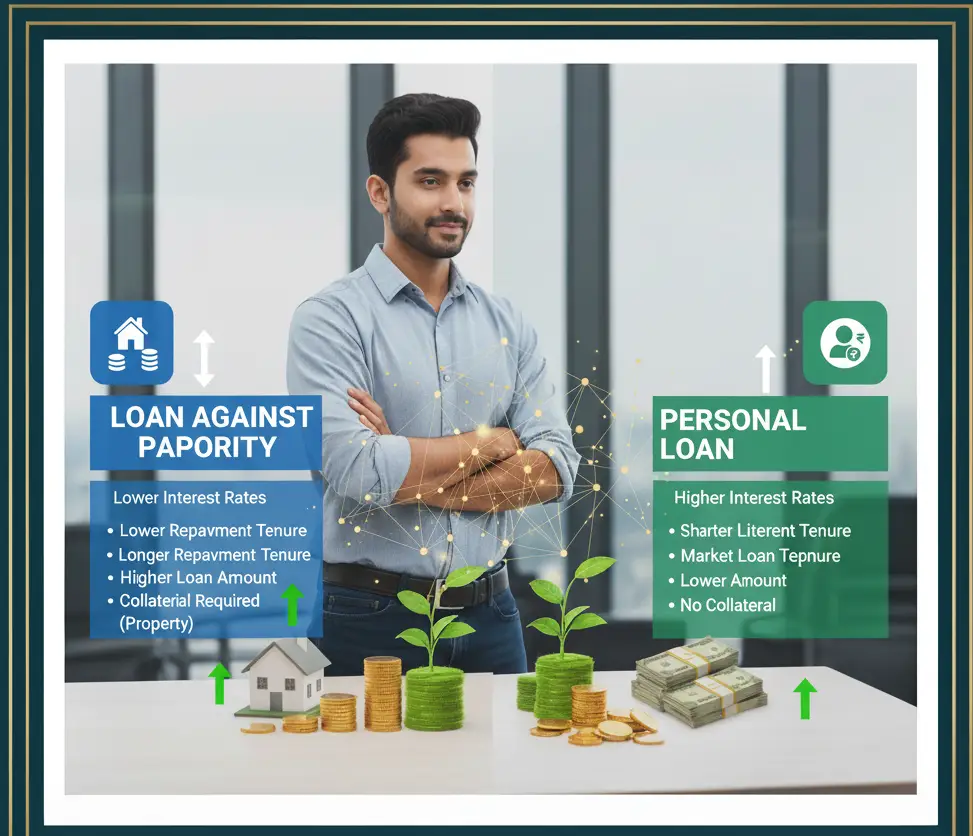
When Suresh needed 25 lakh rupees urgently to expand his textile business, he faced a classic dilemma. His bank offered him a personal loan at 16% interest with minimal paperwork, while another lender proposed a Loan Against Property (LAP) at 11% interest using his Mumbai flat as collateral. The 5% difference seemed attractive, but was it worth risking his home?
This scenario plays out across India every day. Borrowers need substantial funds and must choose between the convenience of unsecured personal loans and the cost-effectiveness of secured loans against property. The decision involves much more than just interest rates – it impacts your family’s financial security, borrowing capacity, and long-term wealth strategy.
The Stakes of This Decision
Choosing the wrong loan type can cost you lakhs in additional interest or, worse, put your family home at risk. For a 20 lakh loan over 10 years, the difference between LAP (11%) and Personal Loan (16%) is approximately 11 lakh rupees in total interest payments. However, the cheapest option isn’t always the smartest choice.
Understanding the Fundamentals
What is a Loan Against Property (LAP)?
A Loan Against Property is a secured loan where you pledge your residential, commercial, or industrial property as collateral to the lender. The property remains with you, but the lender holds legal charge over it until the loan is fully repaid.
Key characteristics:
- Secured loan backed by property collateral
- Lower interest rates due to reduced lender risk
- Higher loan amounts (up to 70-80% of property value)
- Longer repayment tenures (up to 20 years)
- Risk of property loss if unable to repay
Real example: Rajesh owns a flat worth 80 lakh rupees in Pune. He can get a LAP of up to 56-64 lakh rupees (70-80% of property value) at 10.5-12% interest for business expansion or any other purpose.
What is a Personal Loan?
A Personal Loan is an unsecured loan based purely on your creditworthiness, income, and repayment capacity. No collateral is required, making it a purely trust-based lending arrangement.
Key characteristics:
- Unsecured loan with no collateral requirement
- Higher interest rates to compensate for increased risk
- Lower loan amounts (typically 10-40x monthly income)
- Shorter repayment tenures (1-7 years)
- No risk to any specific asset
Real example: Priya earns 1.5 lakh rupees monthly as an IT manager. She can get a personal loan of up to 20-25 lakh rupees at 14-18% interest for any purpose, with repayment over 3-5 years.
Head-to-Head Comparison: LAP vs Personal Loan
| Feature | Loan Against Property (LAP) | Personal Loan | Winner |
|---|---|---|---|
| Interest Rate | 9.5% – 14% per annum | 11% – 24% per annum | LAP |
| Loan Amount | Up to ₹5 crore (70-80% of property value) | Up to ₹50 lakh (income-based) | LAP |
| Tenure | Up to 20 years | 1-7 years | LAP |
| Processing Time | 15-30 days | 1-7 days | Personal Loan |
| Documentation | Extensive (property + income) | Minimal (income + identity) | Personal Loan |
| Collateral Risk | Property at risk | No collateral risk | Personal Loan |
| Tax Benefits | Available for business/investment purposes | Limited tax benefits | LAP |
| Prepayment Charges | Usually 1-3% (varies by lender) | 0-4% (many banks offer zero charges) | Personal Loan |
| Eligibility Criteria | Property ownership + income proof | Income + credit score based | Personal Loan |
Interest Rate Deep Dive: The Real Cost of Borrowing
LAP Interest Rate Factors
LAP rates vary based on several factors:
- Property type and location: Residential in metro cities get better rates
- Property value and condition: Higher value, newer properties get preferential rates
- Loan-to-Value ratio: Lower LTV (60% vs 80%) often means better rates
- Borrower profile: Salaried employees typically get 0.5-1% better rates than self-employed
- Loan amount: Higher amounts (above 50 lakh) may get preferential pricing
Personal Loan Interest Rate Factors
Personal loan rates depend on:
- Credit score: 750+ gets best rates, below 650 faces higher rates or rejection
- Income level: Higher income (above 1 lakh monthly) gets better rates
- Employment type: Government/PSU employees get 1-2% better rates
- Existing relationship: Salary account holders get 0.5-1% discount
- Loan amount and tenure: Smaller amounts for shorter tenure get competitive rates
Real Cost Comparison Example
Scenario: 20 lakh rupee requirement for business expansion
LAP Option:
- Loan amount: 20 lakh rupees
- Interest rate: 11% per annum
- Tenure: 15 years
- Monthly EMI: 22,785 rupees
- Total interest: 21.01 lakh rupees
- Total repayment: 41.01 lakh rupees
Personal Loan Option:
- Loan amount: 20 lakh rupees
- Interest rate: 16% per annum
- Tenure: 5 years (maximum available)
- Monthly EMI: 48,723 rupees
- Total interest: 9.23 lakh rupees
- Total repayment: 29.23 lakh rupees
Analysis: While LAP has higher total interest due to longer tenure, the EMI is 53% lower, providing better cash flow management. The choice depends on your cash flow capacity and investment returns potential.
Hidden Cost Alert
Processing Fees Reality: LAP processing fees (0.5-2% of loan amount) can be substantial for large loans. A 50 lakh LAP might have processing fees of 50,000-1,00,000 rupees, while personal loans often have lower absolute processing costs despite higher percentage fees.
Eligibility Criteria: Who Can Get What?
LAP Eligibility Requirements
Basic eligibility:
- Age: 21-65 years (varies by lender)
- Income: Minimum 25,000-50,000 rupees monthly
- Property ownership: Clear, marketable title
- Credit score: 650+ (preferably 700+)
- Work experience: 2-3 years minimum
Property criteria:
- Property age: Usually less than 20-30 years
- Location: Should be in lender-approved areas
- Approvals: All legal approvals and clearances required
- Construction: Must be completed (no under-construction properties)
Personal Loan Eligibility Requirements
Basic eligibility:
- Age: 21-60 years
- Income: Minimum 15,000-25,000 rupees monthly
- Credit score: 700+ for best rates, 650+ minimum
- Work experience: 1-2 years minimum
- Debt-to-income ratio: Below 50% of monthly income
Preferred customer criteria:
- Employment type: Government, PSU, MNC employees preferred
- Company category: Listed companies, established businesses
- Banking relationship: Salary account, credit card history
- Income stability: Consistent income over 2+ years
Use Case Analysis: When to Choose What
Choose LAP When:
1. Large Fund Requirements (Above 15-20 Lakhs)
Scenario: Business expansion, real estate investment, major infrastructure projects
- Personal loans have amount limitations
- LAP can provide substantial funding (up to property value)
- Lower EMI burden makes large amounts manageable
2. Long-term Financial Planning
Scenario: Children’s higher education abroad, business setup, real estate development
- Longer tenure spreads cost over extended period
- Lower EMI preserves cash flow for other investments
- Tax benefits available for business or investment purposes
3. Investment Opportunities with Returns > LAP Rate
Scenario: Stock market investment, business opportunities, real estate purchase
- If expected returns exceed LAP rate (11-12%), arbitrage opportunity exists
- Lower cost of funds enhances investment returns
- Longer tenure provides time for investments to mature
Choose Personal Loan When:
1. Urgent Fund Requirements
Scenario: Medical emergencies, immediate business needs, time-sensitive opportunities
- Quick processing (1-7 days vs 15-30 days for LAP)
- Minimal documentation requirements
- No property valuation or legal verification delays
2. No Property Available or Unwilling to Risk Property
Scenario: Rented accommodation, jointly owned property, risk-averse borrowers
- No collateral required
- Family home remains safe from any loan default risk
- Suitable for those without clear property titles
3. Short-term Requirements (1-3 Years)
Scenario: Working capital, equipment purchase, short-term business needs
- No prepayment charges in many banks
- Can close loan quickly when funds become available
- Avoid long-term commitment for short-term needs
Real-World Case Studies
Case Study 1: The Business Expansion Dilemma
Profile: Amit, 40, owns a manufacturing unit in Noida, needs 30 lakh for expansion
Property Details: Residential flat worth 60 lakh in Delhi
LAP Option Analysis:
- Available amount: 42-48 lakh (70-80% of property value)
- Interest rate: 11.5% (business purpose)
- Tenure: 15 years
- EMI for 30 lakh: 34,500 rupees
- Tax benefit: Interest deductible as business expense
Personal Loan Option Analysis:
- Maximum available: 25 lakh (income limitation)
- Interest rate: 15.5%
- Tenure: 5 years maximum
- EMI for 25 lakh: 60,500 rupees
- Additional 5 lakh needed from other sources
Decision: Amit chose LAP because personal loan couldn’t meet his full requirement, and the lower EMI preserved cash flow for business operations.
Case Study 2: The Medical Emergency
Profile: Priya, 35, IT professional, needs 8 lakh for parent’s heart surgery
Property Details: Flat worth 45 lakh in Bangalore (bought recently, still under loan)
LAP Challenges:
- Property already mortgaged for home loan
- Additional mortgage complications
- Processing time: 20-25 days (too long for emergency)
- Valuation and legal verification delays
Personal Loan Benefits:
- Pre-approved limit available due to salary account
- Instant disbursement within 24 hours
- No collateral complications
- Amount sufficient for medical requirement
Decision: Priya chose personal loan due to urgency and property complications.
Case Study 3: The Investment Opportunity
Profile: Rajesh, 45, consultant, found a pre-launch property deal needing 40 lakh
Property Details: Commercial property worth 80 lakh in Pune
Investment Analysis:
- Pre-launch property expected to appreciate 25% in 2 years
- Rental yield expected: 8% annually
- Total expected return: 16-17% annually
LAP vs Personal Loan Decision:
- LAP at 12%: Net gain of 4-5% annually
- Personal loan at 16%: Net gain of 0-1% annually
- LAP allows full 40 lakh funding
- Personal loan limited to 20-25 lakh
Decision: Rajesh chose LAP for full funding and better arbitrage opportunity.
Calculate Your Best Option
Use our calculators to compare LAP vs Personal Loan for your specific situation:
- Personal Loan EMI Calculator – Calculate personal loan EMI and total cost
- Loan Comparison Calculator – Compare different loan options
- Personal Loan Eligibility Calculator – Check your eligibility
- Home Loan EMI Calculator – For property-related calculations
Tax Implications: Optimizing Your Tax Benefits
LAP Tax Benefits
LAP offers several tax advantages depending on usage:
For Business Purposes
- Interest deduction: Full interest amount deductible as business expense
- No upper limit: Unlike Section 24(b), no 2 lakh cap for business interest
- Processing fee: Deductible as business expense
- Depreciation: If used for business assets, additional depreciation benefits
For Investment in Real Estate
- Interest deduction: Up to 2 lakh annually under Section 24(b)
- Capital gains: Interest paid can be added to cost of acquisition
- Rental income: Interest deductible against rental income
Personal Loan Tax Benefits
Personal loan tax benefits are limited:
- Business use: Interest deductible if used for business purposes
- Investment purposes: Limited deduction opportunities
- Personal use: No tax benefits for personal consumption
- Medical expenses: No direct tax benefit on loan interest
Tax Planning Example
Scenario: Business owner taking 25 lakh loan at 30% tax bracket
LAP (11% interest) Tax Impact:
- Annual interest: 2.75 lakh rupees
- Tax saving (30% bracket): 82,500 rupees
- Net cost of borrowing: 1.92 lakh rupees (7.7% effective rate)
Personal Loan (16% interest) Tax Impact:
- Annual interest: 4 lakh rupees
- Tax saving: 1.2 lakh rupees
- Net cost of borrowing: 2.8 lakh rupees (11.2% effective rate)
Annual savings with LAP: 88,000 rupees (3.5% effective rate difference)
Risk Analysis: Understanding What You’re Signing Up For
LAP Risk Factors
1. Property Risk
- Foreclosure risk: Property can be seized and sold if unable to repay
- Market value fluctuation: Property value decline doesn’t reduce loan liability
- Legal complications: Family disputes, unclear titles can create problems
- Maintenance responsibility: You must maintain property condition throughout loan tenure
2. Financial Risk
- Long-term commitment: 15-20 year financial obligation
- Interest rate risk: Floating rates can increase EMI burden
- Prepayment charges: Early closure can be expensive
- Processing delays: Property issues can delay funding
Personal Loan Risk Factors
1. Financial Risk
- Higher cost: Significantly higher interest burden
- Shorter tenure: Higher EMI pressure on monthly cash flow
- Credit score impact: Default severely impacts credit rating
- Limited amount: May not meet large funding requirements
2. Opportunity Risk
- Reduced borrowing capacity: High EMI affects future loan eligibility
- Cash flow strain: High EMI may limit other investment opportunities
- Debt trap potential: Easy availability can lead to over-borrowing
Documentation and Process Comparison
LAP Documentation Requirements
Income Documents
- Last 3 years ITR with computation
- Last 6 months bank statements
- Salary certificates / business financials
- Form 16 / P&L and Balance Sheet
Property Documents
- Original property papers (title deed, sale deed)
- Property tax receipts
- Building plan approval
- Occupancy certificate
- Property valuation report
- Legal verification report
- Insurance documents
Processing Steps
- Application submission (Day 1-2)
- Initial document verification (Day 3-5)
- Property inspection and valuation (Day 7-12)
- Legal verification (Day 10-15)
- Technical evaluation (Day 12-18)
- Credit approval (Day 15-20)
- Documentation and disbursement (Day 20-25)
Personal Loan Documentation Requirements
Basic Documents
- Last 3 months salary slips
- Last 6 months bank statements
- Form 16 or ITR (for higher amounts)
- Identity and address proof
- Employment proof
Processing Steps
- Online application (Day 1)
- Document upload and verification (Day 1-2)
- Credit evaluation (Day 2-3)
- Approval and agreement (Day 3-5)
- Disbursement (Day 3-7)
Documentation Red Flags
LAP Documentation Pitfalls:
- 🚩 Unclear property titles or pending litigation
- 🚩 Missing building approvals or occupancy certificates
- 🚩 Property in non-approved layouts or disputed areas
- 🚩 Insufficient property insurance coverage
Personal Loan Red Flags:
- 🚩 Inconsistent income proof or bank statements
- 🚩 High existing EMI obligations (>50% of income)
- 🚩 Recent job changes or employment gaps
- 🚩 Poor credit history or multiple loan inquiries
Interest Rate Negotiation Strategies
LAP Rate Negotiation Tips
1. Property Value Maximization
- Professional valuation: Get independent valuation to support higher property value
- Recent transactions: Show comparable property sales in your area
- Property improvements: Document renovations and improvements made
- Location advantages: Highlight metro connectivity, upcoming infrastructure
2. Financial Profile Strengthening
- Income documentation: Show consistent income growth over years
- Business stability: For business owners, emphasize business longevity and growth
- Existing relationship: Leverage existing banking relationships
- Lower LTV: Offer lower loan-to-value ratio for better rates
Personal Loan Rate Negotiation Tips
1. Credit Profile Optimization
- Credit score improvement: Ensure score is above 750 before applying
- Existing relationship leverage: Use salary account, credit card history
- Income proof enhancement: Include all income sources, bonuses
- Employment stability: Emphasize tenure with current employer
2. Market Competition
- Multiple quotes: Get offers from 3-4 different lenders
- Fintech comparisons: Include digital lenders in comparison
- Seasonal offers: Time application during festive season offers
- Professional category: Highlight if in preferred employment category
Prepayment and Closure Strategies
LAP Prepayment Considerations
When to Prepay LAP
- Interest rate environment: When rates are expected to rise further
- Investment alternatives: When you can’t find investments yielding >LAP rate
- Risk reduction: To remove property risk and free up collateral
- Financial stability: When you have stable alternative income sources
LAP Prepayment Strategy
- Partial prepayments: Make regular partial prepayments to reduce tenure
- Windfall utilization: Use bonuses, maturity proceeds for prepayment
- EMI vs tenure reduction: Choose based on cash flow requirements
- Tax planning: Time prepayments for optimal tax benefits
Personal Loan Prepayment Considerations
When to Prepay Personal Loan
- High interest burden: Personal loans should be first priority for prepayment
- Cash flow improvement: Immediate relief in monthly budget
- No penalties: Most banks don’t charge prepayment penalties
- Credit score improvement: Early closure improves credit profile
Personal Loan Prepayment Strategy
- Emergency fund first: Ensure adequate emergency fund before prepayment
- Lump sum vs EMI increase: Both strategies work for personal loans
- Multiple loans: Prioritize highest interest rate loans first
- Investment opportunity cost: Prepay if you can’t generate >loan rate returns
Special Situations and Considerations
Joint Property Scenarios
Co-owned Property LAP
- All owners consent: All property owners must agree to mortgage
- Joint liability: All owners become liable for loan repayment
- Income clubbing: Combined income considered for eligibility
- Legal complications: Future property sale/transfer becomes complex
Business Purpose Loans
LAP for Business
- Business documentation: Requires detailed business financials
- Cash flow assessment: Business cash flow evaluation important
- Industry risk: Some industries may face restrictions
- Business vs personal guarantee: Both personal and business liability
Personal Loan for Business
- Easier documentation: Based on personal income, not business
- Quick funding: Faster for urgent business needs
- Amount limitations: May not meet larger business requirements
- Higher cost: Expensive for long-term business funding
Alternative and Hybrid Strategies
The Split Strategy
For large funding requirements, consider splitting between LAP and personal loan:
Example: 35 lakh requirement
- 25 lakh via LAP: Lower cost, longer tenure, property risk
- 10 lakh via personal loan: Quick funding, no collateral, higher cost
- Benefits: Balanced risk, partial quick funding, optimized cost
The Stepping Stone Strategy
Use personal loan as bridge financing while arranging LAP:
- Step 1: Take personal loan for immediate requirement
- Step 2: Apply for LAP simultaneously
- Step 3: Use LAP proceeds to close personal loan
- Benefits: Immediate funding + eventual cost optimization
The Investment Arbitrage Strategy
Use LAP for investment arbitrage opportunities:
- LAP at 11%: Borrow at relatively low cost
- Invest in opportunities yielding 15%+: Business, stocks, real estate
- Net arbitrage: 4%+ annual gain
- Risk management: Ensure investment liquidity for EMI payment
Decision Making Framework
Use this framework to make the right choice for your situation:
- Urgency Assessment: How quickly do you need the funds?
- Amount Requirement: What is the total funding needed?
- Risk Tolerance: Are you comfortable risking your property?
- Cash Flow Capacity: Can you handle higher EMI or prefer lower EMI?
- Investment Plans: Do you have investment opportunities yielding >loan rate?
- Tax Benefits: Can you utilize tax deductions effectively?
- Property Status: Do you have clear, unencumbered property?
Future Trends and Considerations
Digital Transformation Impact
LAP Digital Evolution
- AI-based property valuation: Faster, more accurate property assessment
- Digital documentation: Reduced paperwork through blockchain verification
- Online legal verification: Automated title searches and clearances
- Instant approvals: Real-time processing for simple cases
Personal Loan Innovation
- Algorithm-based lending: Instant approvals based on digital footprint
- Flexible repayment: EMI adjustments based on income fluctuations
- Embedded finance: Loans integrated with purchase platforms
- Alternative credit scoring: Beyond traditional credit scores
Regulatory Changes
- Interest rate transparency: Better disclosure of all-in costs
- Cooling-off periods: Extended time to reconsider loan decisions
- Digital lending guidelines: Standardized practices for fintech lenders
- Consumer protection: Enhanced grievance redressal mechanisms
Conclusion: Making the Smart Choice
The choice between Loan Against Property and Personal Loan isn’t just about interest rates – it’s about aligning your borrowing strategy with your financial goals, risk tolerance, and life circumstances. Both products serve different purposes and have their place in comprehensive financial planning.
LAP emerges as the winner when you need substantial funding, have time for processing, can afford to pledge property as collateral, and want to optimize borrowing costs. It’s particularly powerful for business expansion, investment opportunities, or long-term financial goals where the lower cost of funds can create significant value over time.
Personal loans shine when speed matters, when you don’t have property to pledge, when funding requirements are moderate, or when you prioritize keeping your assets unencumbered. They’re the go-to choice for emergencies, short-term needs, or when you want to maintain maximum financial flexibility.
The sophisticated borrower often uses both products strategically – personal loans for immediate needs and LAP for planned, long-term requirements. The key is understanding that borrowing is a tool, and like any tool, its effectiveness depends on how well it matches the job at hand.
Remember, the cheapest loan isn’t always the best loan. Consider the total cost of borrowing, including opportunity costs, risks, and the impact on your overall financial plan. Your borrowing decision today will influence your financial flexibility for years to come, so choose wisely.
Whether you choose LAP for its cost efficiency or personal loan for its convenience, ensure that the borrowing aligns with your ability to repay comfortably without compromising your family’s financial security. Smart borrowing is about building wealth, not creating financial stress.
Expert Guidance and Tools
Make informed borrowing decisions with our comprehensive resources:
- Loan Management Guide – Complete borrowing strategies
- Loan Calculators – Compare all loan options
- Debt Consolidation Calculator – Optimize existing loans
- Loan Education Center – Comprehensive loan guides
For official information about lending regulations and consumer rights, visit the Reserve Bank of India (RBI) website.