
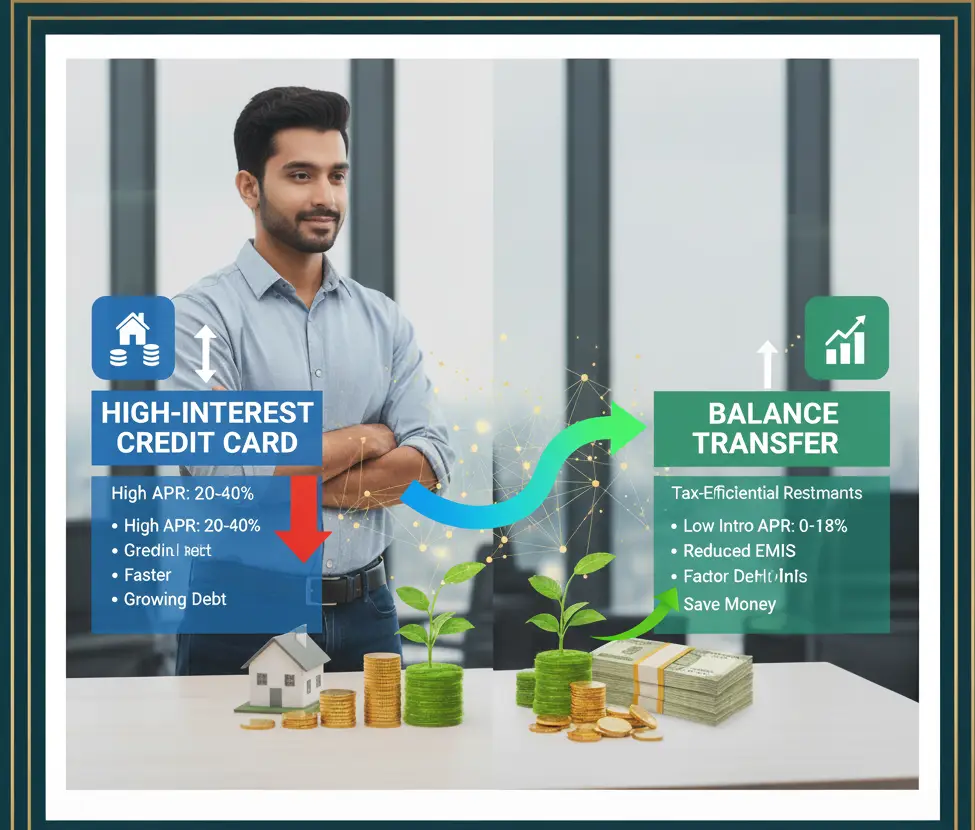
Credit Card Balance Transfer
Complete Guide 2026
How balance transfer works in India, all hidden charges (1-3% transfer fee + GST), which banks offer best 0% promotional periods, CIBIL impact, the 5-step debt elimination strategy, and balance transfer vs personal loan comparison for different debt sizes.
Balance Transfer — The Debt Elimination Accelerator
Credit card interest in India at 36-45% per annum is one of the most expensive forms of debt available. A Rs 1 lakh outstanding balance not repaid for 12 months accumulates Rs 36,000-45,000 in interest alone. Balance transfer to a 0% promotional card buys you 3-12 months to aggressively repay principal without interest eating into every payment. Used with discipline — paying aggressively and not accumulating new purchases — balance transfer is the fastest legal way to eliminate credit card debt. Used without discipline — making minimum payments and continuing to spend on the card — it merely defers the problem at 1-3% transfer fee cost.
Balance Transfer — Step by Step
| Step | Action | Watch Out For |
|---|---|---|
| 1 | Identify your total credit card outstanding across all cards | Include all cards; don’t undercount |
| 2 | Check eligibility: apply for balance transfer card at HDFC, ICICI, SBI, or Axis | Hard inquiry affects CIBIL temporarily |
| 3 | Compare balance transfer offers: 0% for how many months? Transfer fee? | Some “0% offers” have high transfer fees |
| 4 | Initiate transfer: bank pays off old card balance | Confirm old card is fully paid off |
| 5 | Freeze the new balance transfer card — DO NOT use for new purchases | New purchases often accrue interest immediately |
| 6 | Pay aggressively every month: total balance / promotional months | Minimum payment only = disaster when promo ends |
| 7 | Clear all balance before promotional period ends | Remaining balance jumps to 30-40% immediately |
True Cost Comparison
| Scenario | Rs 1L Outstanding | Cost | End State |
|---|---|---|---|
| Stay on 40% card, minimum payment (3% of balance/month) | Rs 1,00,000 | Rs 40,000+ interest/year; never repaid in minimum | Debt increases; CIBIL worsens |
| Balance transfer 0% (6 months, 2% fee); Rs 17,000/month | Rs 1,02,000 (after fee) | Rs 2,000 transfer fee total; Rs 0 interest if cleared | Debt-free in 6 months at Rs 2,000 total cost |
| Personal loan at 14% (3 years) | Rs 1,00,000 | Rs 23,000 total interest over 3 years | Debt-free in 36 months; clear schedule |
Balance transfer (Rs 2,000 cost) beats personal loan (Rs 23,000 cost) massively — IF you have Rs 17,000/month available to pay aggressively. If you can only pay Rs 3,400/month (personal loan equivalent on 3 years), personal loan is the correct choice.
Balance Transfer Decision Matrix
| Can pay total balance within promotional period? | Best Option |
|---|---|
| Yes — can pay full balance within 3-12 months | Balance transfer; maximum Rs 2,000-3,000 cost; debt-free quickly |
| No — need 12-36 months to repay | Personal loan at 12-15%; fixed EMI; clear timeline |
| Cannot qualify for either | Partial balance transfer + aggressive minimum payment reduction plan |
Post Debt-Free Financial Rebuilding
- Keep old credit card open (account age helps CIBIL) but with zero balance
- Use the former monthly EMI amount as equity SIP — the habit of the same amount is already established
- Build emergency fund immediately — credit card debt was likely caused by lack of buffer
- Set up credit card auto-pay for full outstanding every month — never pay interest again
Balance Transfer Checklist
- Calculate exactly how many months needed to clear balance — choose transfer period accordingly
- Compare total cost (transfer fee + any annual fee) vs interest saved
- DO NOT use the balance transfer card for new purchases during promotional period
- Set up auto-pay for at least the calculated monthly repayment amount
- If balance remains at promotional period end: apply for another transfer or take personal loan immediately
- After debt clearance: redirect former debt payment to equity SIP
🧮 Free Calculators — Use Them Now
No login required. Updated for FY 2025-26.
Frequently Asked Questions
A credit card balance transfer moves your existing credit card outstanding balance from a high-interest card (36-45% annual interest) to a new card from a different bank that offers a promotional 0% or low-interest rate for a specified period (typically 3-12 months). How it works: you apply to Bank B for a new credit card with balance transfer facility; Bank B pays off your outstanding balance with Bank A directly; your debt now sits with Bank B at 0% or promotional rate for the agreed period; you must repay the transferred balance to Bank B before the promotional period ends, or a high interest rate (typically 30-40%) kicks in on the remaining balance. The key discipline: use the promotional 0% period aggressively to pay off as much principal as possible; balance transfer does not eliminate debt — it buys you a time window of cheaper credit to make faster progress on repayment.
Balance transfer is not truly free even when advertised as 0%. Charges to watch: (1) Balance Transfer Fee: 1-3% of the transferred amount charged upfront; on Rs 1 lakh transfer, Rs 1,000-3,000 is added immediately to the new balance; (2) Processing Fee: some banks charge a flat processing fee (Rs 500-2,500) in addition to or instead of percentage fee; (3) GST on fees: 18% GST on the processing/transfer fee; (4) New card annual fee: if the balance transfer card has an annual fee, this is an additional cost; (5) End of promotional period rate: if any balance remains when the 0% period ends, it reverts to the standard rate (30-40% per annum) — the most dangerous trap; (6) Minimum payment trap: most balance transfer cards require minimum monthly payment even during 0% period; missing minimum payment can void the promotional rate and trigger full interest immediately. Total effective cost of balance transfer: 1-3% transfer fee + GST = 1.18-3.54% effective cost for the promotional period; if you can clear the balance in the promotional period, this is dramatically cheaper than 36-45% per year on the old card.
Balance transfer availability varies by bank and changes periodically. As of 2026, banks that commonly offer credit card balance transfer: HDFC Bank: offers balance transfer at 0% for 3 months or low EMI rates (12-18% annualised) for 6-12 months; applicable to existing HDFC cardholders and new card applicants; ICICI Bank: balance transfer to ICICI cards from other bank cards; promotional 0% for 3-6 months on eligible cards; SBI Card: balance transfer to SBI credit cards; 0% for 3 months available; Axis Bank: MyZone, Magnus, and other premium Axis cards offer balance transfer from competing banks; Kotak Mahindra Bank: balance transfer to Kotak cards with 0% for 3 months option. Key conditions: typically available only to customers with 6+ months of good repayment history; new card approval required; transferred balance cannot exceed credit limit of new card; apply directly at bank’s website or call credit card customer care. Best practice: call your existing card’s bank first — they sometimes offer promotional rate on existing card to retain you rather than lose the balance.
Balance transfer affects your CIBIL score in several ways: Short-term negative: new credit card application triggers a hard inquiry — reduces score by 3-10 points temporarily; new account creation also temporarily lowers average account age; Medium-term positive: if balance transfer allows you to reduce utilisation on your original card (even partially), this improves score; credit utilisation (proportion of credit limit used) is 30% of CIBIL score; paying off the old card significantly improves this; Long-term positive: if balance transfer enables faster debt elimination with consistent payments, CIBIL score rises significantly in 12-18 months; paying down credit card debt from 80-100% utilisation to 10-20% can add 50-80 CIBIL points over 12 months. Caution: never apply for balance transfer if you’re planning to apply for a home loan or other major credit in the next 3-6 months — the hard inquiry and new account creation affect CIBIL during this period.
Balance transfer alone doesn’t eliminate debt — it reduces the cost of existing debt and provides a window. The 5-step strategy to actually become debt-free: (1) Transfer balance to 0% promotional card; (2) Freeze the transferred card — do NOT use it for new purchases (new purchases accrue interest immediately on most balance transfer cards even during 0% period); (3) Calculate required monthly payment: divide total transferred balance by number of months in promotional period; this is your minimum monthly payment to clear before 0% ends; (4) Pay the calculated amount every single month without exception — set up auto-pay if possible; (5) If any balance remains at end of promotional period: immediately request another balance transfer to a new 0% card (if eligible), take a personal loan at 12-15% to clear the balance, or escalate payments aggressively in the last 1-2 months of promotional period. The trap to avoid: making only minimum payments during the 0% period — you will have a large balance when the promotional rate expires and face full 30-40% interest immediately.
Balance transfer vs personal loan for credit card debt: Balance transfer is better when: you can realistically clear the balance within the promotional 0% period (3-12 months); your transferred amount is manageable with aggressive monthly payments; you can qualify for the new card; no other major credit applications planned in next 6 months. Personal loan is better when: outstanding is large (Rs 3-10 lakh) that cannot be cleared in 3-12 months of promotional period; you want a fixed clear repayment schedule (personal loan has fixed tenure and EMI); balance transfer card eligibility is uncertain due to CIBIL; you want to consolidate multiple cards into one fixed EMI. Numbers: Rs 3 lakh credit card debt at 40%. Balance transfer: 0% for 6 months, Rs 50,000/month required to clear = Rs 3,000 processing fee. Personal loan: 14% for 3 years, Rs 10,249/month EMI, Rs 68,964 total interest. If you can pay Rs 50K/month: balance transfer saves Rs 65,964 vs personal loan. If you can only pay Rs 10,249/month: personal loan is better than revolving at 40% after promotional period ends.