
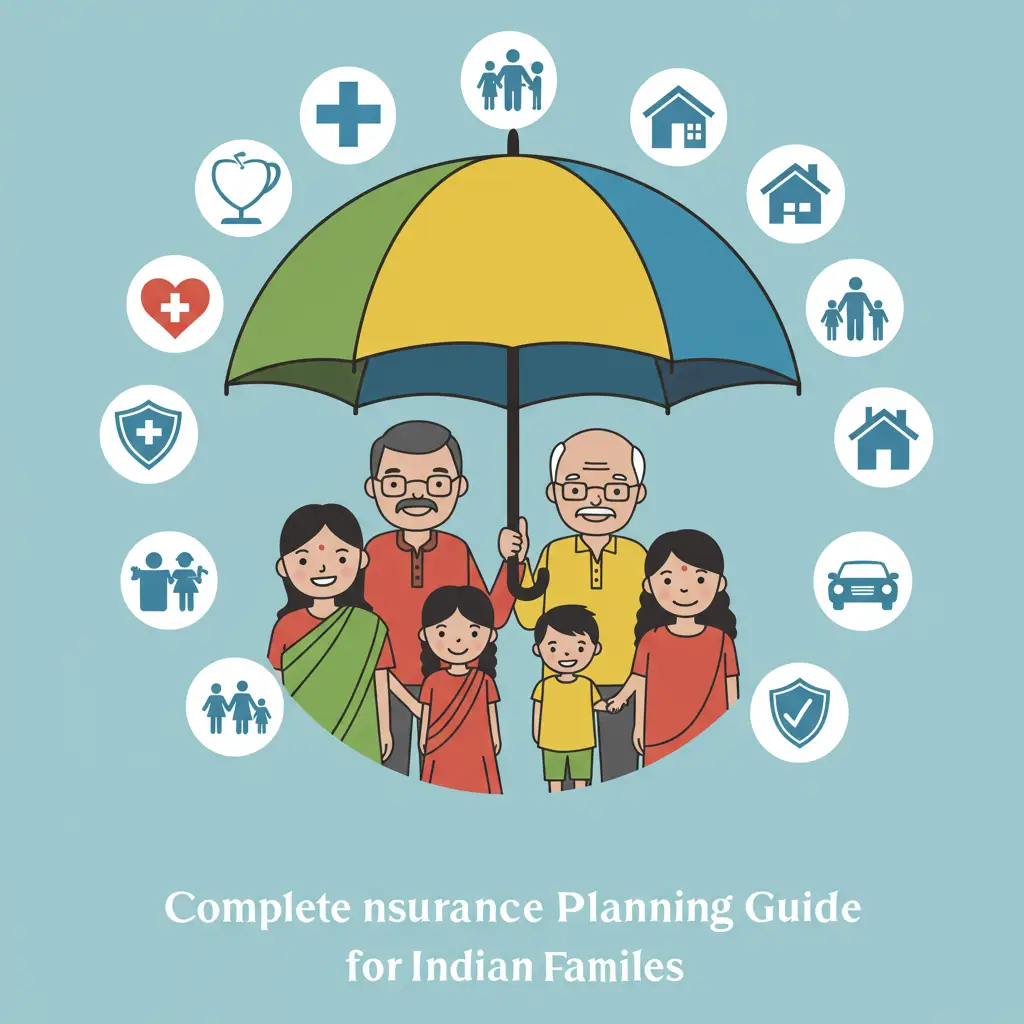
Complete Insurance Planning
for Indian Families 2026
How much term insurance your family actually needs, family health insurance structure (base + super top-up), critical illness, personal accident, home insurance, and what to completely avoid — the definitive family protection guide.
Why Insurance Is the Foundation of Every Financial Plan
Before any investment, before any SIP, before any goal planning — insurance. The financial principle is simple: a well-designed investment plan can be destroyed in one hospitalisation, one unexpected death, one critical illness, or one major accident. Insurance converts catastrophic financial events into manageable financial events. Without it, every other element of financial planning rests on a fragile foundation.
Indian families are chronically underinsured. The average Indian household carries health cover of Rs 3-5 lakh (inadequate for a week’s hospital stay in a private hospital) and term insurance of Rs 25-50 lakh (covering 2-3 years of expenses at best). This guide provides the correct sizing for every insurance need.
The Complete Family Insurance Stack
| Insurance Type | Who Needs It | Recommended Cover | Approximate Annual Premium |
|---|---|---|---|
| Term Life Insurance | All earning members with dependents | 10-20x annual income; min Rs 1-2.5Cr | Rs 8,000-25,000 (age 25-35) |
| Family Health (Base) | All family members | Rs 15-20L family floater | Rs 18,000-40,000/year |
| Super Top-Up Health | All family members | Rs 50L above Rs 5L deductible | Rs 5,000-15,000/year |
| Critical Illness | Primary earner(s) | Rs 25-50L lump sum | Rs 5,000-20,000/year (age 30-45) |
| Personal Accident | Primary earner(s) | Rs 50L-1Cr | Rs 2,000-5,000/year |
| Home Insurance | All homeowners | Full replacement value of structure + contents | Rs 500-2,000/year |
| Vehicle Insurance | All vehicle owners | Comprehensive (own damage + third party) | Rs 5,000-20,000/year |
Term Insurance — Precise Sizing for Your Family
Use this formula for each earning member who has dependents:
Cover = (Annual household expenses × Years to financial independence) + Outstanding loans + Children’s education corpus + Other planned obligations
| Family Scenario | Annual Expenses | Loan Outstanding | Education | Recommended Cover |
|---|---|---|---|---|
| Young couple, no children, home loan | Rs 7L | Rs 40L | Nil | Rs 1.5-2Cr |
| Family with 2 children (school age) | Rs 10L | Rs 40L | Rs 40L | Rs 2.5-3Cr |
| Single parent, 1 child | Rs 7L | Rs 20L | Rs 25L | Rs 2-2.5Cr |
| High-income family, multiple goals | Rs 20L | Rs 80L | Rs 60L | Rs 5-6Cr |
Health Insurance — The Base + Top-Up Structure
The most cost-efficient health coverage structure for families:
- Base policy Rs 20L family floater: Covers first Rs 20L of hospitalisation; wide hospital network; good claim settlement ratio; select from established insurers (Star Health, Niva Bupa, Care Health, HDFC Ergo)
- Super top-up Rs 50L (deductible Rs 5L): Activates when single hospitalisation claim exceeds Rs 5L; covers up to Rs 50L above the deductible; annual premium just Rs 5,000-15,000 for this massive additional protection
- Total effective coverage: Rs 70L at annual premium of approximately Rs 30,000-55,000 combined — far cheaper than a Rs 70L base policy which would cost Rs 80,000-1,50,000/year
- Why this structure works: most hospitalisations are under Rs 5L (base covers); catastrophic hospitalisations (cancer, cardiac surgery, major accidents) exceed Rs 5L and the top-up kicks in; you pay for the high-value protection efficiently
What to Absolutely Avoid
| Product to Avoid | Why | Better Alternative |
|---|---|---|
| Endowment/Money Back Policy | 4-6% returns + inadequate insurance; worst of both worlds | Term insurance + ELSS SIP separately |
| ULIP (bundled) | 2-5% annual charges; low effective insurance; poor investment | Term insurance + direct mutual fund SIP |
| Child ULIP/Child Plan | Same as ULIP — insures the child (wrong person to insure) | Term insurance on parent + education SIP for child |
| Single premium life insurance | Low sum assured; poor liquidity; poor tax treatment above Rs 5L premium | Term insurance for risk; PPF/ELSS for savings |
| Hospital cash/daily benefit plan | Expensive for limited coverage; unnecessary with good health insurance | Increase base health cover instead |
Family Insurance Annual Review Checklist
- Verify term insurance cover is still 10-20x current annual income — increase if income has grown
- Check if health insurance sum insured needs increase — medical inflation at 10-15%/year
- Update nominees on all insurance policies after any life event (marriage, children, divorce)
- Pay all insurance premiums in April for the new financial year — claim tax deductions properly
- Review pre-existing condition declarations — never conceal; full disclosure is legally essential
- Check claim settlement ratio (CSR) of your insurer annually — switch if CSR has deteriorated below 90%
- Ensure home insurance covers current replacement value, not original purchase price
- Avoid using insurance as investment — term + SIP always outperforms endowment or ULIP
🧮 Free Calculators — Use Them Now
No login required. Updated for FY 2025-26.
Frequently Asked Questions
Term insurance cover should be calculated to replace the income of the insured for the financial dependents’ needs. The standard rule: 10-15x annual income — but this is often insufficient. A more precise calculation: (Annual household expenses × Years until dependents are financially independent) + (Outstanding loans — home loan, car loan, personal loan) + (Children’s education corpus required) + (Any other planned major expenses). Example: Rs 10L annual expenses, 20 years until children are independent, Rs 40L home loan outstanding, Rs 25L children’s education target = (Rs 10L × 20) + Rs 40L + Rs 25L = Rs 2.65 crore minimum cover. At age 30, a Rs 2.5 crore 30-year term policy costs approximately Rs 18,000-25,000/year — less than Rs 2,000/month for complete family financial protection. Buy term insurance as early as possible; premiums double approximately every 5 years of age delay.
Family health insurance has evolved dramatically — the right structure for 2026: (1) Base policy: Rs 15-20L family floater (all members covered under one sum insured) from a reputable insurer with good claim settlement ratio and hospital network; annual premium Rs 18,000-45,000 depending on ages and city; (2) Super top-up: Rs 50L super top-up above Rs 5L deductible (base policy covers the deductible); annual premium just Rs 5,000-15,000 for this extra Rs 50L protection; combined cover = Rs 65L at much lower cost than buying Rs 65L base policy; (3) Personal health insurance: each working adult should have a personal policy in their own name independent of employer group cover — employer cover lapses at resignation; (4) Parents’ coverage: buy a senior citizen health policy for parents separately — do NOT add them to your family floater (their presence raises premium significantly); (5) Critical illness cover: Rs 25-50L lump sum payout for cancer, heart attack, stroke — use for lost income during treatment not covered by regular health insurance.
Complete family insurance stack: (1) Term life insurance: primary earner(s) must have term insurance of 10-20x annual income; pure protection — no savings component; Rs 1 crore cover at age 30 costs Rs 8,000-12,000/year; (2) Health insurance: family floater Rs 15-20L base + Rs 50L super top-up; total protection Rs 65L at Rs 25,000-55,000/year combined; (3) Critical illness: Rs 25-50L lump sum for 36 critical illnesses — supplements health insurance for income replacement during extended treatment; (4) Personal accident: Rs 50L-1Cr cover for accidental death and disability — complements term insurance for accidents specifically; costs Rs 2,000-5,000/year; (5) Home insurance: covers structure and contents against fire, flood, earthquake, theft; often overlooked; Rs 500-2,000/year for Rs 50L+ cover; (6) Vehicle insurance: mandatory third-party cover; add comprehensive own-damage cover; (7) What to avoid: endowment/ULIP mixed products; child plans that bundle insurance with investment; these deliver poor returns and inferior protection.
Insurance premiums offer significant tax deductions: Section 80C: life insurance premium is deductible within the Rs 1.5 lakh 80C limit; condition — sum assured must be at least 10x annual premium for policies issued after April 2012; term insurance satisfies this easily; note — 80C already likely filled by EPF + ELSS, so LIC premiums may not provide additional deduction; Section 80D: health insurance premium for self, spouse, and children up to Rs 25,000/year (Rs 50,000 if you are a senior citizen); parents’ health insurance additional Rs 25,000 (Rs 50,000 if senior citizens); total maximum 80D = Rs 1 lakh (both you and parents senior citizen); Section 10(10D): maturity proceeds of life insurance are tax-free if sum assured is at least 10x annual premium and premium is below Rs 5 lakh annually; for term insurance — death claim is always fully tax-free for nominees; Insurance premium payment advice: always pay via digital mode (cheque, NEFT, UPI) — cash payment premium does not qualify for 80C or 80D deduction.
Critical illness insurance pays a lump sum on diagnosis of a specified serious illness — not reimbursement of medical bills but a fixed benefit. The lump sum covers: lost income during treatment (6-18 months away from work); expensive treatments not covered under regular health insurance (immunotherapy, targeted therapy, bone marrow transplant); rehabilitation and home care costs; emotional comfort of financial security during illness. Who needs it: anyone with dependents who rely on their income; the primary earner in a single-income household must have critical illness cover; professionals (doctors, IT professionals, executives) whose income would stop completely during extended illness. Coverage amount: Rs 25-50L is appropriate for most urban Indian families. Annual premium: Rs 5,000-20,000/year depending on age, gender, and sum assured. Purchase strategy: buy early (age 25-35) for lowest premium; premium is fixed at purchase age for the entire policy term.
Pre-existing conditions (diabetes, hypertension, heart conditions, thyroid disorders) significantly affect health insurance options: (1) Waiting period: most health policies have 2-4 year waiting period for pre-existing conditions; claims related to pre-existing conditions are rejected during this period; (2) Loading: insurers may charge 10-50% higher premium for declared pre-existing conditions; (3) Strategy for early buyers: buy health insurance at young age before any conditions develop — pre-disease policy has no loading or waiting period for future conditions; (4) If already diagnosed: (a) check if existing employer group insurance covers the condition — group policies typically have no pre-existing waiting period; (b) compare individual policies across insurers — some offer shorter waiting periods; (c) consider Arogya Sanjeevani Policy (IRDAI standard product with defined terms); (5) Never conceal pre-existing conditions — non-disclosure leads to claim rejection at the most critical moment; full disclosure is legally and practically essential. Critical illness policies have particularly strict pre-existing condition exclusions — read carefully before purchase.