
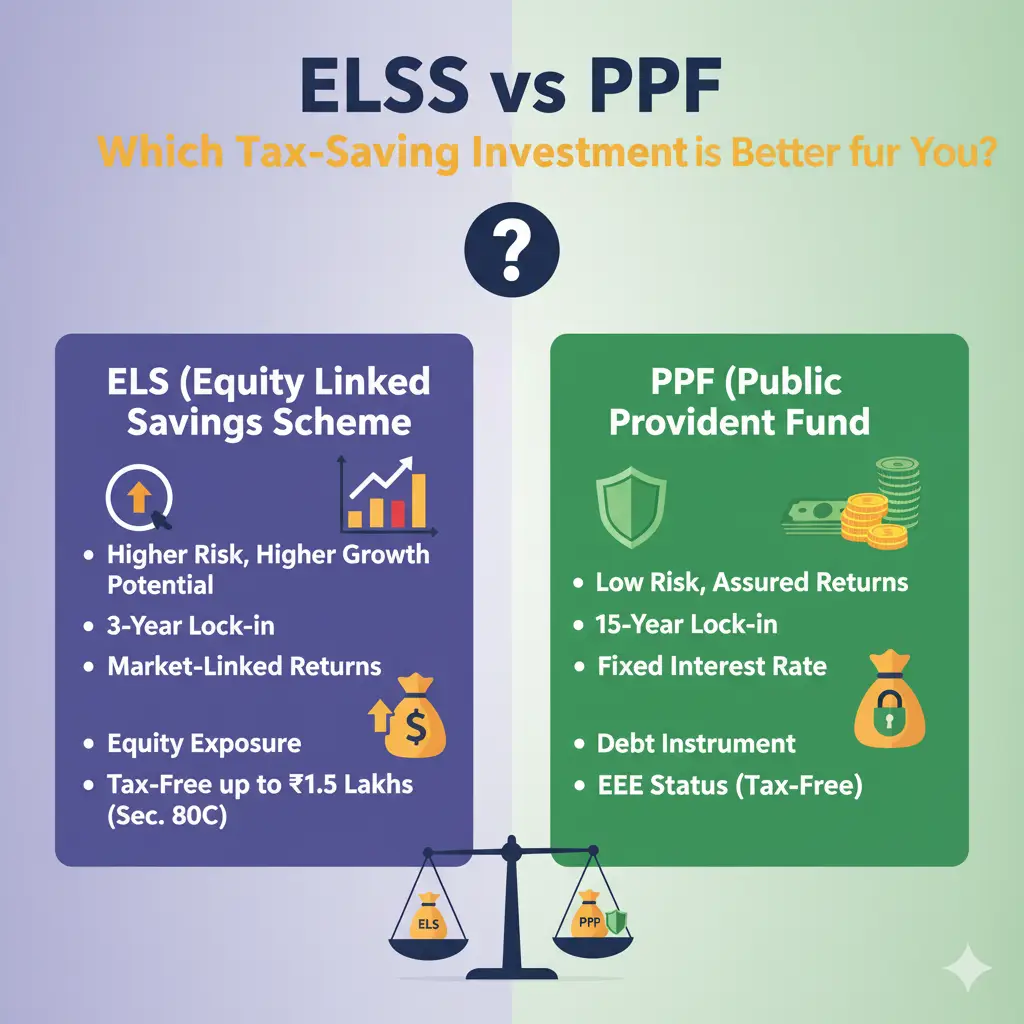
ELSS vs PPF
— Which is Better For You?
Returns compared over 15 years, lock-in period difference (3 years vs 15 years), tax treatment analysis (LTCG on ELSS vs EEE on PPF), who should choose which, and the optimal strategy of using both together for maximum 80C benefit.
The 80C Decision — ELSS or PPF or Both?
Every taxpayer in India choosing between ELSS and PPF for their Section 80C investment faces a genuine trade-off between certainty and growth potential. PPF offers absolute safety (sovereign guarantee) with modest guaranteed returns and triple tax-free status. ELSS offers potential for significantly higher returns with equity market risk and LTCG tax on gains. Both qualify for the same Rs 1.5 lakh Section 80C deduction. The right answer depends on your age, risk tolerance, and existing guaranteed savings — not on a universal rule.
Side-by-Side Comparison
| Parameter | ELSS | PPF |
|---|---|---|
| Type | Equity Mutual Fund | Government Savings Scheme |
| Expected Returns | 12-15% CAGR (market-linked) | 7.1% guaranteed (rate reviewed quarterly) |
| Risk | High — can lose 30-40% in market crashes | Zero — sovereign guarantee |
| Lock-in | 3 years per instalment | 15 years (partial from year 7) |
| Tax on investment | 80C deduction (same as PPF) | 80C deduction |
| Tax on returns | LTCG 12.5% above Rs 1.25L/year | Fully tax-free (EEE) |
| Tax on maturity | LTCG applies | Fully tax-free |
| Liquidity post lock-in | Fully liquid — redeem anytime | Partial (year 7+); full at 15 years |
| Court attachment | Can be attached by courts | Cannot be attached — court-proof |
| Minimum investment | Rs 500/month SIP or Rs 500 lump sum | Rs 500/year minimum |
| Maximum investment | Rs 1,50,000/year for 80C; no limit for investing | Rs 1,50,000/year (no excess accepted) |
The 15-Year Corpus Comparison
Rs 1.5 lakh per year invested in both instruments from age 30 to age 45:
| Scenario | Investment Duration | ELSS Corpus (13% CAGR) | PPF Corpus (7.1%) | Winner |
|---|---|---|---|---|
| 15 years (optimistic market) | Rs 22.5L total invested | Rs 74 lakh | Rs 40.68L | ELSS by Rs 33L |
| 15 years (average market) | Rs 22.5L total invested | Rs 67 lakh | Rs 40.68L | ELSS by Rs 26L |
| 15 years (bear market phase) | Rs 22.5L total invested | Rs 44-50 lakh | Rs 40.68L | Marginal ELSS or PPF |
Even in below-average market conditions, ELSS tends to outperform PPF over 15 years — but the gap shrinks significantly in poor market periods. The certainty premium of PPF (knowing exactly what you will get) has real psychological and planning value, especially for conservative investors and those near retirement.
After-Tax Returns Comparison
For a 30% bracket investor, the tax-equivalent return comparison matters:
| Instrument | Pre-Tax Return | After-Tax Return | Pre-Tax Equivalent (30% bracket) |
|---|---|---|---|
| PPF | 7.1% tax-free | 7.1% | 10.1% (7.1% ÷ 0.70) |
| ELSS (with tax harvesting) | 13% CAGR | ~11-12% | 13% (lower bracket due to LTCG rate) |
| Bank FD | 7.5% | 5.25% (30% tax) | 7.5% pre-tax but 5.25% after |
ELSS still delivers higher after-tax returns even considering LTCG — but the gap between ELSS and PPF narrows significantly after factoring in tax. PPF’s 10.1% pre-tax equivalent at 30% bracket is remarkably competitive with low-risk alternatives.
The Optimal Strategy — Use Both
For most investors, the best approach is combining ELSS and PPF to fill the Rs 1.5 lakh 80C limit:
| Investor Profile | ELSS Allocation | PPF Allocation | Rationale |
|---|---|---|---|
| Young (20-35), moderate risk, long horizon | Rs 1,00,000 | Rs 50,000 | Equity-heavy for max growth; PPF as guaranteed base |
| Mid-career (35-45), moderate risk | Rs 75,000 | Rs 75,000 | Balanced — growth + guaranteed safety |
| Conservative at any age | Rs 50,000 | Rs 1,00,000 | Guaranteed dominates; modest equity exposure |
| Approaching retirement (50+) | Rs 25,000-50,000 | Rs 1,00,000-1,25,000 | Capital preservation priority; PPF dominant |
| Business owner (court risk) | Rs 50,000 | Rs 1,00,000 | PPF heavy — court-proof protection for PPF balance |
ELSS vs PPF Decision Checklist
- Below 40 with EPF already providing guaranteed savings → ELSS provides better additional returns
- Business owner with credit risk → allocate more to PPF (court-proof); less to ELSS (attachable)
- Conservative investor who cannot handle 30% portfolio drop → PPF provides certainty
- Above 50 with less than 10 years to retirement → increase PPF allocation significantly
- Want shortest lock-in (3 years) for flexibility → ELSS is far superior to PPF’s 15 years
- For maximum wealth building over 15+ years → ELSS with tax harvesting delivers more corpus
- Use both: ELSS for growth potential + PPF for guaranteed foundation = optimal 80C strategy
- Both qualify for the same 80C deduction — the choice is about post-80C wealth building characteristics
🧮 Free Calculators — Use Them Now
No login required. Updated for FY 2025-26.
Frequently Asked Questions
ELSS (Equity Linked Savings Scheme) is a diversified equity mutual fund where investments up to Rs 1.5 lakh/year qualify for Section 80C deduction. It has a mandatory 3-year lock-in per investment instalment and is completely market-linked — returns depend on stock market performance (historical CAGR: 12-15% over 10+ years). Gains above Rs 1.25 lakh per year are taxed at 12.5% LTCG. PPF (Public Provident Fund) is a government savings scheme offering 7.1% guaranteed interest, compounded annually. Investment up to Rs 1.5L/year qualifies for 80C with a 15-year lock-in period. It has EEE tax status — investment deductible, interest tax-free, and maturity completely tax-free. PPF carries zero credit or market risk (sovereign guarantee). The fundamental choice: ELSS for higher expected returns with market risk; PPF for guaranteed, risk-free, fully tax-free returns.
Historical comparison over 10-15 year periods: ELSS funds (diversified equity): 12-15% CAGR on average; top performers have delivered 14-18% CAGR; worst performers: 8-10% CAGR. PPF: 7.1% guaranteed (rate has ranged from 7.1-8.7% over the last decade). At 15 years, Rs 1.5L/year: ELSS at 13% CAGR → approximately Rs 67 lakh (before LTCG tax on gains above Rs 1.25L annually). PPF at 7.1% → Rs 40.68 lakh (completely tax-free, no deductions). After-tax comparison at 30% bracket: ELSS effective return ~11-12% (after LTCG on accumulated gains); PPF effective return ~10.1% pre-tax equivalent (7.1% tax-free = ~10.1% pre-tax for 30% bracket). Over 15+ years, ELSS still delivers significantly more wealth even after tax — but with market risk. Over 10 years, the gap narrows considerably during bear markets.
ELSS: 3-year lock-in per investment instalment. Each SIP instalment locks for 3 years from its investment date — so a monthly ELSS SIP started in April 2024 begins unlocking in April 2027 (one month’s units per month). After 3 years, fully liquid — redeem any amount anytime. PPF: 15-year lock-in from account opening date. Partial withdrawal is permitted from the 7th year (50% of balance at end of 4th year or 50% of preceding year balance, whichever is lower). Loan against PPF is available in years 3-6. PPF can be extended in 5-year blocks after 15 years (with or without continued contributions). Verdict: ELSS has dramatically shorter lock-in (3 years vs 15 years) and much higher flexibility post-lock-in. If liquidity before 15 years matters, ELSS is significantly better. For those who can commit to a 15-year horizon, PPF’s guaranteed compounding in the final years (when the corpus is large) is powerful.
Yes — and this is the recommended approach for most investors. ELSS and PPF are not mutually exclusive; together they fill the Rs 1.5 lakh 80C limit optimally: (1) Investors with 5+ year horizon and moderate risk: Rs 75,000-1,00,000/year in ELSS (equity growth) + Rs 50,000-75,000/year in PPF (guaranteed foundation) — combined Rs 1.5L exactly fills the 80C limit; (2) Conservative investors: Rs 50,000 ELSS + Rs 1,00,000 PPF — more safety but less growth potential; (3) Aggressive investors: Rs 1,50,000 ELSS alone — maximum equity exposure with full 80C; (4) Optimal for most: a 50-50 or 60-40 split between ELSS and PPF provides the best of both — guaranteed base (PPF) + equity upside (ELSS). Additional investment beyond 80C limit: only ELSS qualifies for continued 80C benefit; PPF deposits above Rs 1.5L earn no interest and no 80C benefit — use equity SIP for amounts above the 80C limit.
Choose ELSS over PPF as primary 80C investment when: you are below age 45 with 10+ year investment horizon (more time to average out market volatility); you already have guaranteed savings (EPF, PPF) as a foundation and need equity growth; you want the shortest lock-in (3 years vs 15 years) for flexibility; you can psychologically handle seeing your investment value drop 20-30% during market corrections without selling; you are in the 30% tax bracket and want the highest after-tax long-term returns. Choose PPF over ELSS when: you are above age 50 with shorter investment horizon (less time to recover from market downturns); you are a conservative investor who prioritises certainty over maximum returns; you want protection from court attachment (PPF cannot be seized by creditors); you are a business owner who values the sovereign guarantee and PPF’s court-proof status; you have no EPF or other guaranteed retirement savings and PPF provides the only secure retirement foundation.
ELSS tax treatment: investment qualifies for 80C deduction (same as PPF); gains after 3-year lock-in are LTCG — taxed at 12.5% on gains above Rs 1.25 lakh per financial year; the first Rs 1.25L of LTCG per year is completely tax-free; tax is paid only when you redeem. PPF tax treatment: EEE (Exempt-Exempt-Exempt) — investment deductible under 80C (E1); annual interest is completely tax-free (E2); maturity proceeds are completely tax-free (E3). For a 30% bracket investor with Rs 1.5L annual investment over 15 years: PPF maturity = Rs 40.68L completely tax-free. ELSS corpus (at 13% CAGR): approximately Rs 67L before tax; LTCG tax on the gain portion (Rs 67L – Rs 22.5L invested = Rs 44.5L gain): if booking Rs 1.25L LTCG/year systematically, tax can be minimised to Rs 3-5L total. After tax: ELSS delivers approximately Rs 62-64L vs PPF’s Rs 40.68L — ELSS remains ahead but the gap narrows after tax.