
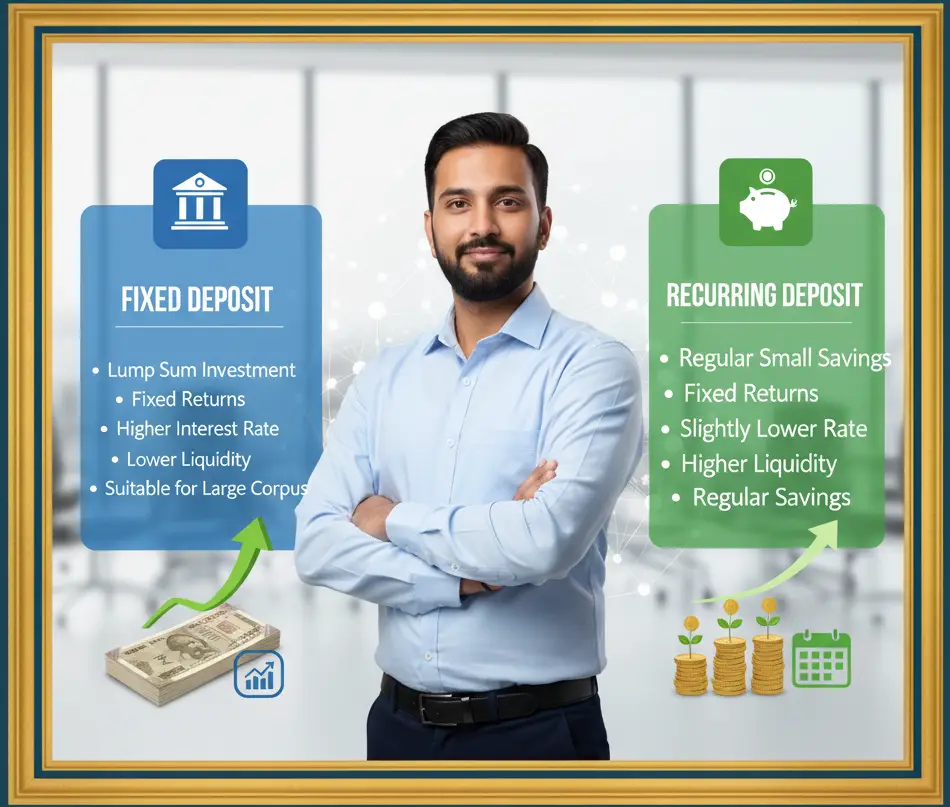
Fixed Deposit vs Recurring Deposit
Complete Guide India 2026
Why FD always earns more than equivalent RD, identical tax treatment at slab rate, senior citizen FD advantages (0.5% extra + 80TTB Rs 50K deduction), premature withdrawal rules, and when to choose FD vs equity SIP for long-term goals.
FD vs RD — When Each Makes Sense
Fixed Deposits and Recurring Deposits are both simple, guaranteed-return products. The choice between them is straightforward once you understand the core distinction: FD is for a lump sum you have now; RD is for a monthly amount you want to save systematically. Beyond this, both are taxed identically, carry the same DICGC insurance protection, and serve similar conservative financial goals.
FD vs RD — Side by Side
| Feature | Fixed Deposit | Recurring Deposit |
|---|---|---|
| Investment type | One-time lump sum | Fixed monthly instalments |
| Interest from day 1 | Full amount | Only first instalment; others from deposit date |
| Total interest earned | Higher (lump sum earns fully) | Lower (gradual deployment) |
| Minimum investment | Rs 1,000 (typically) | Rs 100-500/month |
| Tenure flexibility | 7 days to 10 years | 6 months to 10 years |
| Interest rate | 6.5-8.0% (bank and tenure specific) | Same as equivalent FD tenure rate |
| Tax on interest | Slab rate; TDS at 10% if >Rs 40K/year | Identical to FD |
| DICGC protection | Rs 5 lakh per bank per depositor | Rs 5 lakh per bank per depositor |
| Premature closure | Allowed; 0.5-1% interest penalty | Allowed; 1-2% interest penalty |
The FD Return Advantage — Illustrated
Same Rs 12,000 and 7% rate, FD vs RD over 12 months:
| Instrument | Amount Invested | How Invested | 12-Month Maturity | Interest Earned |
|---|---|---|---|---|
| Fixed Deposit | Rs 12,000 | Lump sum on Day 1 | Rs 12,840 | Rs 840 |
| Recurring Deposit | Rs 12,000 | Rs 1,000/month for 12 months | Rs 12,454 | Rs 454 |
FD earns Rs 386 more — because the entire Rs 12,000 is deployed and earning from Month 1, while in RD only Rs 1,000 earns for 12 months; the rest earns for progressively shorter periods.
After-Tax Return Comparison
| Instrument | Gross Return | After Tax (30% bracket) | After Tax (10% bracket) |
|---|---|---|---|
| FD at 7.5% | 7.5% | 5.25% | 6.75% |
| Liquid Fund at 7.25% | 7.25% | 5.075% (slab rate) | 6.525% |
| PPF at 7.1% | 7.1% | 7.1% (tax-free EEE) | 7.1% (tax-free) |
| ELSS SIP at 12% (LTCG) | 12% | ~10.5% (12.5% LTCG above Rs 1.25L) | ~11.5% |
For investors in the 30% bracket: PPF (tax-free 7.1%) beats FD (5.25% after tax) by 185 basis points annually. ELSS (10.5% after LTCG) beats FD by 525 basis points for 5+ year goals. These differences compound dramatically over 10-20 year periods.
When FD Is the Right Choice
- Capital safety required (goal under 3 years or emergency fund) → FD or liquid fund
- Senior citizen needing regular income → SCSS (8.2%) or FD with monthly payout
- Investor who cannot handle equity volatility → FD as comfort instrument (accept lower returns)
- Short-term parking (1-12 months) where liquid fund is unavailable or inconvenient → FD
- Never for 5+ year wealth building goals → equity SIP delivers 2-3x more than FD after tax
FD vs RD Checklist
- Have lump sum → FD; saving monthly → RD (equity SIP preferred for 5+ year goal)
- Senior citizens: check SCSS (8.2%) before bank FD — generally better rate
- Senior citizens: submit Form 15H to avoid TDS if income below Rs 3 lakh
- Claim Section 80TTB: Rs 50,000 annual deduction on bank/post office interest
- Spread deposits: keep under Rs 5 lakh per bank (DICGC insurance limit)
- For 5+ year goals: compare FD after-tax return vs equity SIP — SIP almost always wins
- Don’t break FD prematurely unless truly urgent — penalty erodes return
🧮 Free Calculators — Use Them Now
No login required. Updated for FY 2025-26.
Frequently Asked Questions
Fixed Deposit (FD): invest a lump sum once for a chosen tenure (7 days to 10 years); interest accrues on the entire amount from day 1; rates typically 6.5-8.0% depending on bank, tenure, and age; suitable when you have a lump sum to deploy. Recurring Deposit (RD): invest a fixed amount monthly for a chosen tenure (6 months to 10 years); each monthly instalment earns interest from its date of deposit; overall interest is lower than equivalent FD because capital is deployed gradually; suitable when you don’t have a lump sum but can save monthly. The decision rule: have Rs 50,000+ available now? → FD. Can only save Rs 5,000/month? → RD (though equity SIP often better for goals above 5 years).
FD always generates more interest than an equivalent RD for the same total amount, because in FD the entire principal earns from day 1. In RD, only the first instalment earns for the full tenure; later instalments earn for shorter periods. Example: Rs 12,000 in FD for 12 months at 7% = Rs 12,840 maturity. Rs 1,000/month RD for 12 months at 7% = Rs 12,454 maturity. The FD earns Rs 386 more. However, this comparison only applies when you have the lump sum available. For monthly savings, RD is the equivalent product — though equity SIP outperforms RD significantly over 5+ years.
Both FD and RD interest are taxed identically as ‘income from other sources’ at your income slab rate. TDS rules: bank deducts TDS at 10% if total interest from that bank exceeds Rs 40,000/year (Rs 50,000 for senior citizens above 60). Submit Form 15G (below 60) or Form 15H (senior citizens) to your bank if total income is below the taxable limit — this prevents TDS deduction. Key point: interest is taxable annually as it accrues, not only at maturity. Even for a 5-year FD, you must declare and pay tax on each year’s accrued interest in your annual ITR. Senior citizens also get Section 80TTB: Rs 50,000 annual deduction on bank/post office interest — effectively makes first Rs 50,000 of FD/SCSS interest tax-free each year.
FD is better than equity SIP for: (1) Goals under 3 years — equity is too volatile; (2) Emergency fund parking — capital safety essential; use liquid MF (6.5-7.5%) or FD; (3) Regular monthly income — FD with monthly interest payout provides predictable income; (4) Conservative senior citizens — SCSS (8.2%) and FDs provide stable guaranteed income; (5) When capital preservation is more important than growth. Equity SIP beats FD for: (1) Goals 5+ years away — 12% CAGR equity vs 5.25% after-tax FD return at 30% bracket; (2) Long-term wealth building — LTCG 12.5% is much better than slab-rate FD interest; (3) Retirement corpus building — 30-year equity SIP creates 3-5x more corpus than FD equivalent.
FD premature withdrawal: allowed at most banks anytime; penalty of 0.5-1% reduction from the applicable interest rate for the actual holding period. Example: 5-year FD at 7%; withdrawn after 1 year; 1-year rate was 6.5%; effective rate paid = 6.5% – 1% penalty = 5.5%. Some small finance banks have lock-in FDs with no premature withdrawal — check terms before booking. RD premature closure: allowed; penalty of 1-2% on interest; alternatively, you can take a loan against RD (80-95% of RD balance at 1-2% above RD rate) if you need funds temporarily without closing the RD. Note: premature closure due to account holder’s death typically has no penalty at most banks.
Senior citizen FD advantages: 0.25-0.75% higher interest rate at most banks vs general public; some banks offer additional 0.25% for super senior citizens (above 80). On Rs 10 lakh at 7.75% (0.5% extra): extra annual income = Rs 5,000 vs general customer. Compare with SCSS: SCSS offers 8.2% — higher than most bank FDs for up to Rs 30 lakh for those above 60; post office backed; quarterly interest payment. Tax benefit Section 80TTB: senior citizens can deduct up to Rs 50,000 of bank and post office interest annually — effectively tax-free to this extent. TDS threshold: no TDS if annual interest below Rs 50,000 (vs Rs 40,000 for non-seniors); submit Form 15H to bank if income below Rs 3 lakh.