
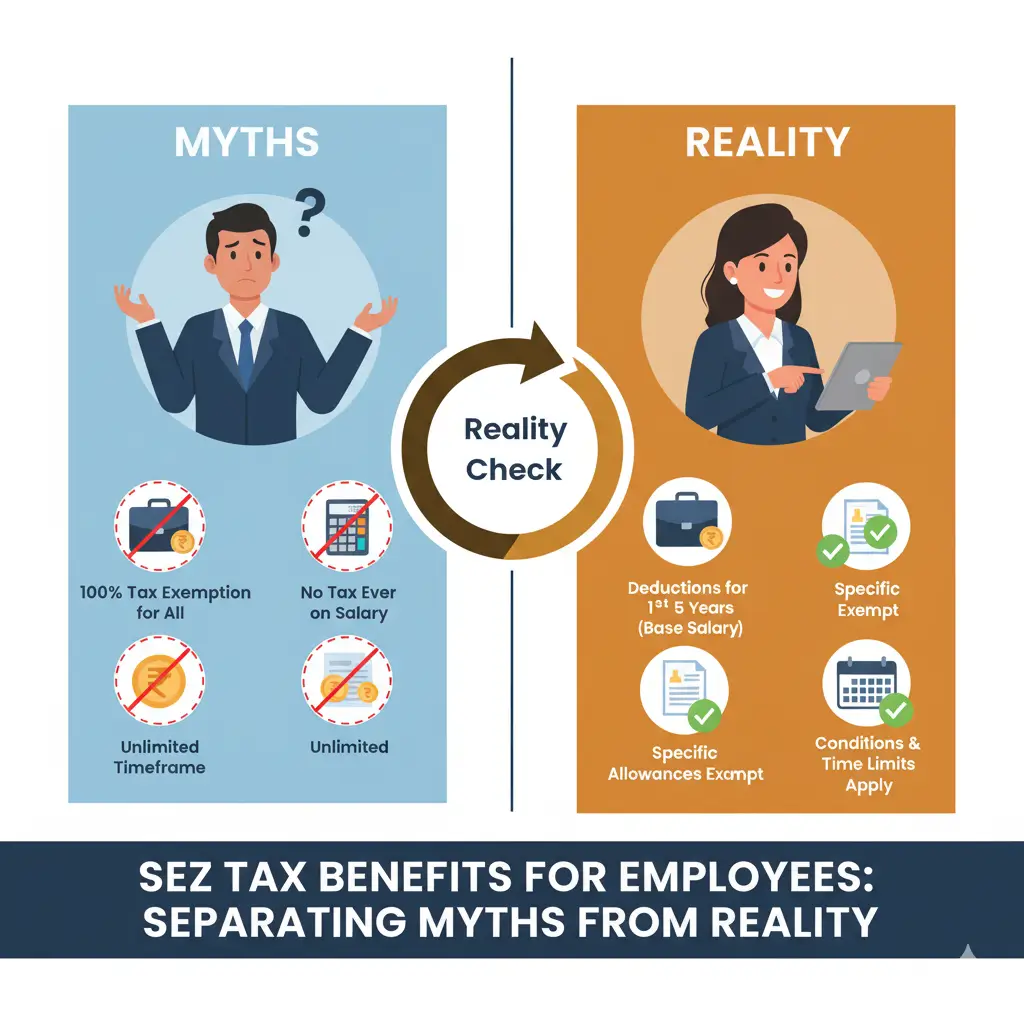
SEZ Tax Benefits for Employees — Myths vs Reality India 2026
📘 SEZ Employee Tax — The Most Persistent Myth in Indian Tax
Millions of IT employees at Infosys, TCS, Wipro, and other companies operating from Special Economic Zones believe they receive income tax exemption as SEZ employees. They do not. The Section 10AA tax benefit under India’s SEZ Act applies exclusively to the company (the SEZ unit) — not to its employees. Your salary from an SEZ employer is taxed identically to salary from any other company. This guide clarifies exactly what SEZ tax benefits exist, who actually receives them, and what tax planning SEZ employees should actually be doing.
📊 India SEZ Data — 2025-26
- Ministry of Commerce, March 2026: Operational SEZs in India: 428. SEZ employment: 29 lakh+ employees. Exports from SEZs: Rs10.8 lakh crore in FY 2024-25. IT and ITES constitute 62% of SEZ exports — the dominant sector.
- CBDT, AY 2025-26: Zero evidence of any Section 10AA benefit passing to employees as personal income tax exemption. All SEZ unit employees file ITR as standard salaried employees. Common misconception rate among SEZ employees (SEBI survey): 34% incorrectly believe they have some personal income tax benefit from working in an SEZ.
- Section 10AA benefit: The company-level benefit reduces corporate tax significantly for the 15-year window. Estimated total Section 10AA benefit claimed: Rs48,000 crore in AY 2024-25. Beneficiary: the company’s profit after tax — passed to shareholders or reinvested, not to employees directly.
- DESH Bill status, June 2026: Development of Enterprise and Service Hubs (DESH) Bill introduced in Parliament to replace SEZ Act. Wider product coverage, sunset clause removal, and flexible zone sizes proposed. Final enactment pending as of June 2026.
1. The Core Myth — Employees Don’t Get Section 10AA
Section 10AA of the Income Tax Act provides a profit-linked deduction to the SEZ unit (the business entity). Here is the benefit structure:
| Period | Deduction for SEZ Unit (Company) | Benefit to Employee |
|---|---|---|
| Years 1-5 of commercial production | 100% of export profits | Zero — no personal income tax benefit |
| Years 6-10 | 50% of export profits | Zero |
| Years 11-15 | 50% of reinvested profits | Zero |
| After 15 years | No benefit | Zero |
The benefit reduces corporate income tax on the company’s profits. The employee’s salary is taxable income at standard slab rates regardless of whether the employer is an SEZ unit or a company in the domestic tariff area.
⚠️ Filing Wrong ITR Based on This Myth Creates Problems
Some SEZ employees have been misled by colleagues or even employers into believing they don’t need to pay full income tax. Filing ITR with incorrect exemptions claimed on the basis of SEZ employment = demand notice + penalty. Your Form 16 from an SEZ employer shows full salary income with TDS deducted at standard rates — exactly as it should. File ITR correctly without any SEZ-specific exemption claim.
2. What the SEZ Company Actually Gets
| Benefit | For SEZ Unit (Company) | Not Available To |
|---|---|---|
| Section 10AA profit deduction | 15-year export profit deduction | Employees |
| Duty-free import of capital goods | Zero import duty on equipment | Personal imports |
| Zero-rated GST supply to SEZ | Domestic suppliers can supply GST-free | Employee personal purchases |
| Single window clearance | Simplified regulatory approvals | Employees |
| Exemption from routine inspections | Self-certification instead of govt inspection | Employees |
3. Real (Indirect) Benefits SEZ Employees May Receive
- Higher compensation packages: Profitable (tax-benefited) SEZ companies historically offered higher salaries to attract talent. As Section 10AA benefits sunset for older SEZs, this advantage is reducing for many established IT companies.
- Better campus amenities: Large IT SEZ campuses (Infosys Mysuru, TCS Siruseri, Wipro Electronic City) provide subsidised cafeteria, gyms, creches, transport — reducing personal costs by Rs3,000-8,000/month.
- Employer NPS/VPF matching: Some profitable SEZ companies offer employer NPS at 14% of basic — a tax-efficient benefit not related to SEZ status but enabled by profitability.
- Stock options (ESOP): Profitable IT SEZ companies have strong ESOP programmes. The ESOP benefit is company-specific and taxed normally (as perquisite at exercise) — no SEZ exemption applies.
4. GST in SEZ Areas — The Employee Reality
| Transaction | GST Treatment |
|---|---|
| Company buying goods/services for business from domestic suppliers | Zero-rated (company benefit) |
| Employee buying lunch at SEZ campus cafeteria | Normal GST applies (5% on food) |
| Employee buying at SEZ retail shop | Normal GST applies |
| Employee taking goods manufactured in SEZ outside | Subject to import duty (SEZ = foreign territory for customs) |
5. Income Tax Planning for SEZ Employees — Standard Approach
SEZ employees should use the same tax planning framework as all salaried employees. Priority deductions for the 30% bracket (common for IT/SEZ employees):
| Deduction | Section | Annual Limit | Tax Saving (30%) |
|---|---|---|---|
| EPF + PPF + ELSS + insurance | 80C | Rs1,50,000 | Rs45,000 |
| NPS additional | 80CCD(1B) | Rs50,000 | Rs15,000 |
| Health insurance (self + senior parents) | 80D | Rs75,000 | Rs22,500 |
| Home loan interest | 24(b) | Rs2,00,000 | Rs60,000 |
| Total maximum deductions | Rs4,75,000 | Rs1,42,500 |
6. SEZ Policy Evolution and Employee Impact
The SEZ landscape is changing: (1) Sunset clause impact: SEZs established in 2006-2010 are now at or beyond their 15-year benefit window. Section 10AA benefits for these units have largely expired. Companies may be relocating operations or modifying strategies. (2) DESH Bill: if enacted, will modernise the zone framework with wider product coverage and sunset clause removal. Could revive SEZ attractiveness and potentially sustain higher employer profitability. (3) Employee impact: as SEZ tax benefits expire for older companies, the indirect salary/amenity advantages may reduce. The Indian IT sector’s high salaries are driven by global demand, not SEZ policy — this dynamic is likely to continue regardless of SEZ policy changes.
7. Direct Answers to Common SEZ Employee Questions
| Question | Answer |
|---|---|
| Do I pay less income tax working in an SEZ? | No — standard slab rates apply |
| Should I declare SEZ employment separately in ITR? | No — standard salaried employee ITR |
| Can I claim Section 10AA in my personal ITR? | No — Section 10AA is for companies only |
| Is my Form 16 from an SEZ company different? | No — same as any other company’s Form 16 |
| Do I get GST exemption shopping inside SEZ? | No — personal purchases attract normal GST |
| Does my employer’s SEZ tax benefit affect my ESOP? | Indirectly (company profitability) but no direct impact on ESOP valuation |
🧮 Free Calculators — Use Them Now
No login required. Updated for FY 2025-26.
Frequently Asked Questions
This is the most common SEZ tax myth: employees working in a Special Economic Zone (SEZ) do NOT get personal income tax exemption. The tax benefit under Section 10AA applies only to the SEZ unit (the company operating in the SEZ) — not to its employees. Your salary from an SEZ company is taxed exactly the same as salary from any other employer: normal income tax slabs apply, TDS is deducted, and you file ITR as a normal salaried employee. What the company gets (Section 10AA): 100% profit deduction for the first 5 years, 50% for years 6-10, 50% of reinvested profits for years 11-15. This reduces the company’s corporate tax — potentially allowing them to offer higher salaries or benefits, but there is no direct tax pass-through to employees. Employees of SEZ companies: pay full income tax at standard slab rates. No exemption, no deduction, no special treatment.
While SEZ employees don’t get income tax exemption, they may benefit in other ways from working in an SEZ: (1) Duty-free imports: companies in SEZs can import equipment, raw materials, and goods duty-free. This sometimes translates to better-equipped workplaces. (2) Cafeteria and amenities: many large SEZ campuses (Infosys, TCS, Wipro campus SEZs) provide subsidised meals, transport, and amenities that reduce employee out-of-pocket costs. (3) Higher salaries: companies that benefit from Section 10AA tax savings sometimes pass a portion to employees as higher compensation to attract talent in competitive markets. (4) Better employer EPF/NPS contributions: profitable (tax-benefited) SEZ companies may offer higher employer NPS or VPF contributions. None of these are statutory rights of SEZ employees — they are company-specific benefits.
SEZ GST rules: (1) Supply of goods and services INTO an SEZ from outside (domestic tariff area): treated as zero-rated supply. Domestic suppliers can export to SEZ without GST or claim GST refund. This benefits the SEZ company buying from domestic suppliers. (2) Personal purchases by employees inside SEZ: employees buying from shops inside SEZ premises — the shops charge GST normally. There is no personal GST exemption for SEZ employees for their personal consumption. (3) Bringing goods into SEZ for personal use: non-dutiable goods (personal effects) are allowed without duty. Dutiable goods: customs duty applies. (4) Taking goods out of SEZ for personal use: goods manufactured or procured in SEZ that employees try to bring into the domestic tariff area are subject to import duty (as SEZs are considered foreign territory for customs purposes). The GST exemptions are for the SEZ as a business entity — not for personal employee transactions.
SEZ employee income tax planning is identical to any other salaried employee’s — because there is no special SEZ employee benefit. Standard tax planning for SEZ employees: (1) Choose old vs new regime: if you have home loan, 80C investments (EPF, PPF, ELSS), 80D (health insurance), and HRA — calculate both regimes. The SEZ-company employer usually provides good salary packages, pushing many to 30% bracket where old regime benefits are maximum. (2) Maximise 80C: PPF, ELSS, EPF employee + VPF. Rs1.5L limit. (3) 80D: health insurance premiums for self and parents. (4) NPS 80CCD(1B): additional Rs50,000 deduction in old regime if employer offers NPS or you invest yourself. (5) HRA if renting: claim HRA exemption based on actual rent, salary, and city. (6) Home loan: if taken, Section 24(b) Rs2L deduction on interest in old regime. These are the same deductions available to all salaried Indians — SEZ employment provides no additional tax advantage on personal income.
SEZ policy has evolved significantly since the original 2005 SEZ Act: (1) DESH Bill (Development of Enterprise and Service Hubs): proposed replacement for the SEZ Act to make zones more competitive globally. As of June 2026: DESH Bill has been introduced in Parliament but not yet enacted. Pending finalisation. (2) Sunset clause concerns: the Section 10AA 15-year tax benefit window means that SEZs established in early-to-mid 2000s are now exhausting their tax benefits. Many IT SEZ units are beyond the 15-year window and no longer benefit from Section 10AA. (3) MAT (Minimum Alternate Tax): SEZ units are still subject to MAT (15% on book profit), reducing the effective tax benefit. (4) Employee impact: as company tax benefits phase out, the indirect benefits to employees (higher salaries from profitable tax-benefited companies) also reduce. From a pure employee perspective, SEZ employment is increasingly similar to non-SEZ employment in terms of tax and compensation.