
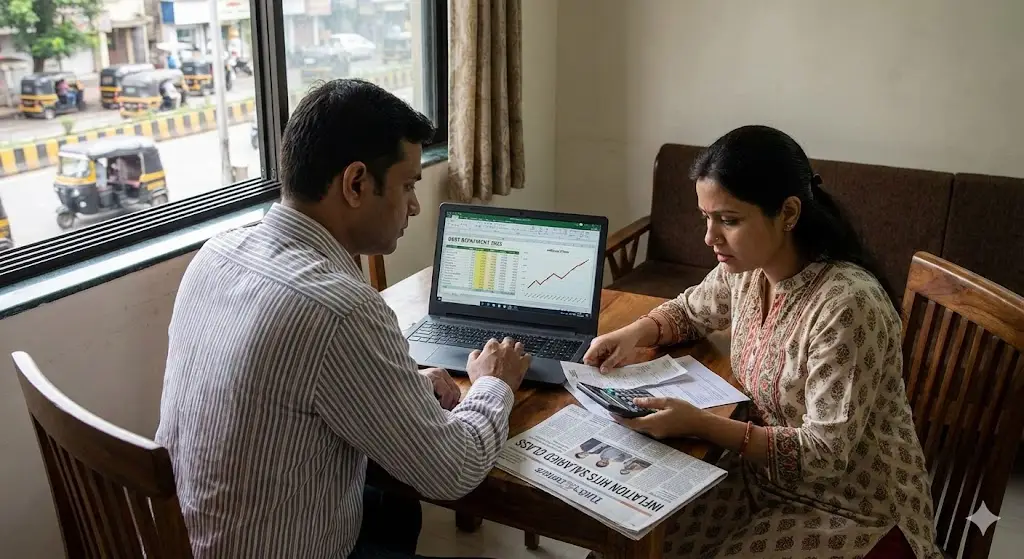
Managing Debt During High Inflation in India — Complete 2026 Strategy Guide
📘 Debt in High-Inflation Environment — The Challenge
Managing debt during inflation is a double-edged challenge: while moderate inflation erodes the real value of fixed-rate debt (your ₹30,000 EMI has lower real purchasing power impact each year), high inflation also forces central banks to raise interest rates — increasing the cost of floating-rate loans and new credit. India’s retail inflation averaged 5.5% in FY 2025-26, and RBI’s repo rate remained at 5.25% post-June 2025 cuts. For Indian households holding ₹65 lakh crore in total retail credit (RBI, March 2025), debt management strategy directly determines wealth accumulation outcomes.
📊 India Debt & Credit Data — RBI 2025-26
- RBI, March 2025: Total retail credit in India: ₹65+ lakh crore. Home loans: ₹32.2L cr (14% YoY growth). Personal loans: ₹15.8L cr (16% YoY). Credit card outstanding: ₹2.7L cr.
- CIBIL TransUnion, FY 2024-25: 34% of Indian credit card holders regularly revolve balance (pay only minimum). Average credit card interest rate: 36-48% p.a. — 4× the home loan rate.
- RBI Financial Stability Report, 2025: Household debt-to-GDP ratio: 38% — manageable but rising. Urban household EMI burden: average 42% of monthly income in metro cities (above RBI’s recommended 40% ceiling).
- Reserve Bank of India, June 2026: Repo rate: 5.25% (after June 2025 cut from 5.50%). Home loan floating rates: 8.50-9.25%. Personal loan rates: 11-16%. Credit card rates: 36-48%.
1. Mapping Your Debt — Priority by Interest Rate
Not all debt is equal. The interest rate determines urgency. Here is the standard debt priority framework for India 2026:
| Debt Type | Typical Rate (2026) | Priority | Strategy |
|---|---|---|---|
| Credit card revolving | 36-48% p.a. | 🔴 Emergency | Eliminate immediately — stop revolving |
| Unsecured personal loan | 12-24% p.a. | 🔴 High | Prepay aggressively after credit card |
| Consumer durable / BNPL | 14-22% p.a. | 🔴 High | Clear before investment |
| Education loan | 9-12% p.a. | 🟡 Medium | Prepay vs invest — analyse individually |
| Car loan | 8.5-11% p.a. | 🟡 Medium | Continue EMI; small prepayments help |
| Home loan (floating) | 8.5-9.25% p.a. | 🟢 Low-Medium | Invest in equity parallel to EMI |
| Home loan (below 8.5%) | <8.5% p.a. | 🟢 Low | Definitely invest — equity beats prepayment |
2. The Invest vs Prepay Decision — The Numbers
For a ₹50 lakh home loan at 9% for 20 years (EMI: ₹44,986/month), here is what prepaying ₹5,000/month extra does vs investing that ₹5,000 in equity SIP at 13% CAGR:
| Strategy | Loan Tenure | Interest Saved / Corpus Built | Net Wealth Impact |
|---|---|---|---|
| Prepay ₹5,000/month | Reduces by ~7 years | Save ₹18.5L in interest | ₹18.5L benefit |
| Invest ₹5,000/month in equity (13%) | Full 20 years | Build ₹71.8L corpus in 20yr | ₹71.8L corpus |
| Invest ₹5,000 (accounting for tax on LTCG) | Full 20 years | ₹61.4L after 12.5% LTCG | ₹61.4L net |
At 9% home loan rate: equity investment at 13% CAGR builds ₹61L vs ₹18.5L saved through prepayment. Equity wins. However, this assumes consistent 13% equity return — not guaranteed. For risk-averse investors who value certainty over expected value: prepaying the home loan is the right psychological choice even if mathematically suboptimal.
💡 The Hybrid Approach
Prepay small lump sums (₹50,000–₹1,00,000) into the home loan 1-2 times per year (bonus, increment) to reduce principal and tenure. Invest regular monthly surplus in SIP. This hybrid approach gives psychological satisfaction of reducing debt while keeping equity compounding active. Most wealth builders use this approach rather than a binary “prepay everything” or “invest everything” stance.
3. Eliminating Credit Card Debt — The Emergency Priority
Credit card revolving debt at 36-48% annual interest is the most destructive debt product in India. ₹1 lakh credit card debt unpaid for 12 months = ₹1.36-1.48 lakh owed. No investment in India legally available to retail investors returns 36%+ guaranteed.
The Credit Card Debt Elimination Plan
- Stop revolving immediately: Pay at least the minimum amount due every month without exception. One missed payment = late fee + interest penalty + CIBIL score damage.
- Get a personal loan or balance transfer: If your CIBIL score is 700+, you can get a personal loan at 11-14% or balance transfer offer from another card at 0% for 3-6 months. Use this to clear the credit card balance at lower interest.
- Liquidate low-return savings: FD at 7% is costing you 29% net (36% card rate minus 7% FD return). Break the FD and pay off the credit card — this is almost always mathematically correct.
- Never use the card again until balance is zero: Use UPI and debit card for all purchases while clearing the debt. The psychological trigger of “I’ll clear it next month” is how most people trap themselves in revolving debt permanently.
4. Home Loan — Smart EMI Management in 2026
India’s home loan rates dropped after RBI’s June 2025 repo rate cut from 5.50% to 5.25%. If your home loan was taken at 9.25-9.50% in 2023-24, check if your bank has passed on the rate cut. Call your bank and request rate revision — many banks don’t automatically reduce rates and require customer request.
Balance Transfer — Is It Worth It?
If you’re paying 9.25%+ on a home loan and another bank offers 8.75%, consider balance transfer. Savings calculation: ₹50L outstanding, 15 years remaining. Difference of 0.5%: saves ₹3.95 lakh in total interest. Processing fees for transfer: ₹10,000-25,000. Break-even: 9-30 months — worthwhile for a 15-year remaining tenure. Calculate your specific numbers using the Home Loan EMI Calculator.
5. Debt Consolidation — When It Makes Sense
Debt consolidation works when you can genuinely reduce your blended interest rate across all debts. Example scenario:
| Before Consolidation | Balance | Rate | Monthly Interest |
|---|---|---|---|
| Credit Card 1 | ₹80,000 | 42% | ₹2,800 |
| Credit Card 2 | ₹60,000 | 36% | ₹1,800 |
| Personal Loan | ₹1,60,000 | 18% | ₹2,400 |
| Total | ₹3,00,000 | Blended ~27% | ₹7,000/month |
Consolidated personal loan (against FD/property) at 12%: monthly interest = ₹3,000/month — saving ₹4,000/month. Annual saving: ₹48,000. Processing fee: ₹5,000-8,000. Break-even: 2 months. Consolidation makes compelling sense here.
6. Protecting Your CIBIL Score During Debt Stress
- Never miss minimum payment: Even minimum payment on credit card prevents late payment mark. Missing the minimum due even once drops score by 50-100 points and adds late payment record for 7 years.
- Communicate before default: If you genuinely cannot pay EMI in a month, call your bank’s customer service before the due date. Most banks have a restructuring or moratorium option — proactive communication avoids NPA classification.
- Don’t close old credit cards: Closing old cards reduces total available credit limit and increases utilisation ratio — both hurt score. Keep them active with small occasional purchases.
- Space out credit applications: Each loan application generates a “hard inquiry” on your CIBIL report — visible to all future lenders. Multiple hard inquiries in 3 months signal financial stress. Apply only when needed.
7. The Step-by-Step Debt-Free Plan
- List all debts: Amount, interest rate, minimum EMI, remaining tenure for every loan and card balance.
- Build ₹25,000-50,000 emergency buffer first: Non-negotiable before aggressive debt repayment — otherwise, every unexpected expense goes back on credit card.
- Clear credit card revolving balance: Highest priority — use savings, personal loan, or balance transfer.
- Attack highest-interest loans: Direct all extra money (after minimum EMIs on others) to highest rate loan until cleared.
- Repeat down the interest rate ladder: As each loan clears, redirect that freed-up EMI to the next highest.
- Start SIP when you’re above 12% debt-free: Don’t wait for 100% debt freedom to invest — start SIP when all loans above 12% are cleared.
- Maintain and protect: After becoming high-interest debt-free, adopt a strict rule: any purchase you cannot afford from current month’s income goes on a 0% instalment or is postponed — never on revolving credit card.
🧮 Free Calculators — Use Them Now
No login required. Updated for FY 2025-26.
Frequently Asked Questions
The decision is mathematically driven: if your loan interest rate exceeds your expected investment return, pay off debt first. In 2026: personal loans at 14-18% interest — always prepay before investing. Credit card debt at 36-48% — emergency priority, before anything else. Home loan at 8.5-9% — equity SIP at 12-14% likely beats prepayment; invest parallel to EMI. The psychologically correct answer: eliminate all debt above 12% interest rate before building an investment portfolio. Below 12%, the invest vs prepay decision is case-by-case.
Moderate inflation (4-6%) benefits fixed-rate borrowers — your EMI stays constant while the real value of that payment declines. ₹30,000 EMI in 2020 = ₹20,000 in real terms in 2026 (at 6% inflation for 6 years). This is why home loans at fixed 8-9% rates became relatively attractive during 2022-2024 high inflation. However: inflation also raises floating rate loan interest (as RBI raises repo rate), reducing this benefit for floating rate borrowers. Summary: fixed-rate long-term loans benefit from inflation; floating rate loans or new borrowing during high inflation is expensive.
Debt Avalanche: pay minimum on all debts, then put extra money towards the highest-interest debt first. Mathematically optimal — minimises total interest paid. Debt Snowball: pay minimum on all debts, then put extra money towards the smallest-balance debt first. Psychologically effective — early wins build motivation to continue. For most Indians with credit card + personal loan + home loan: use avalanche method but do a snowball win first (clear one small credit card) to build momentum. The best debt repayment method is the one you actually stick to.
CIBIL score (300-900) is affected by: payment history (35% weight — most critical), credit utilisation ratio (30%), length of credit history (15%), credit mix (10%), new inquiries (10%). To protect your score while managing debt: never miss an EMI or minimum payment on ANY loan — even one missed payment drops score by 50-100 points. Keep credit card utilisation below 30% of total credit limit. Don’t close old credit cards (reduces average credit age). Don’t apply for multiple new loans simultaneously (multiple hard inquiries signal financial distress). Check CIBIL report every 6 months on CIBIL.com (free annual report).
Debt consolidation — combining multiple high-interest loans into a single lower-interest loan — makes sense when: (1) You have multiple credit card or personal loans at 18%+ interest, (2) Your CIBIL score (700+) qualifies you for a personal loan at 12-14% or a secured loan (against FD, property) at 9-11%, (3) You are disciplined enough not to accumulate new credit card debt after consolidation. Warning: debt consolidation extends your debt burden if you consolidate and then continue using credit. Many people consolidate, get temporary relief, and then accumulate the same high-interest debt again. Fix the spending behaviour first, then consolidate.