
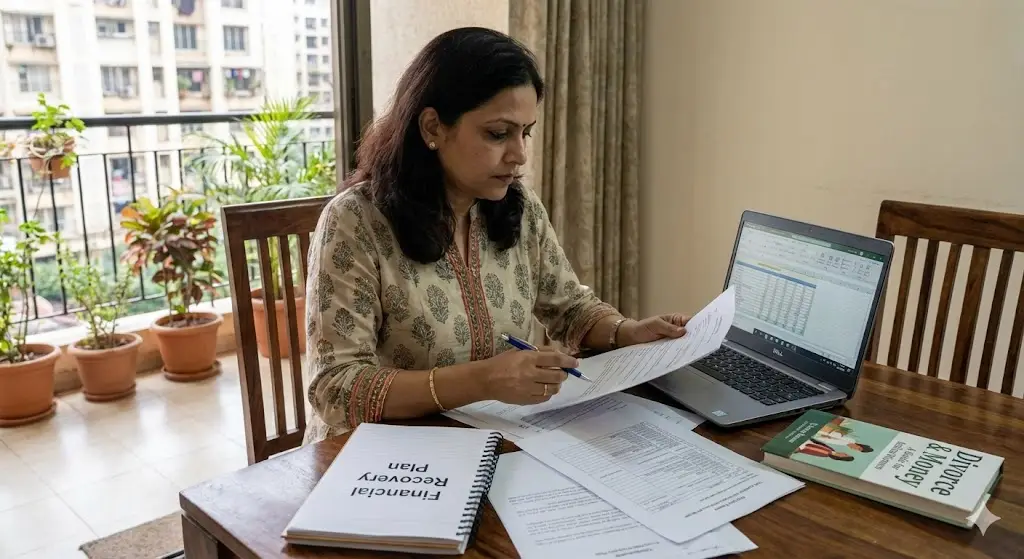
Managing Finances After Divorce in India: Your Complete 2026 Recovery Guide
📘 Financial Reality of Divorce in India
Divorce in India is not just an emotional upheaval — it is a complete financial restructuring event. Two income streams, joint assets, shared loans, and combined insurance become single-income budgets, contested ownership, and individual coverage overnight. With India’s divorce rate rising to 1.1 per 1,000 population (Ministry of Statistics, 2024) and average divorce proceedings taking 2-5 years, the financial decisions made in the immediate aftermath of separation determine the next decade of financial health for both parties.
📊 Divorce and Finance — India Statistics
- Ministry of Statistics, 2024: India’s divorce rate: 1.1 per 1,000 population — up 30% in a decade. Urban metros see 3-5× higher rates than rural India.
- Family Court Data, 2025: Average divorce settlement time: 2-5 years. Mutual consent divorces under Section 13B (Hindu Marriage Act): 6-18 months typically.
- IRDAI, 2024: Only 14% of divorced women in India have independent health insurance. 67% depend on ex-spouse’s employer group cover — which ends at divorce.
- RBI Household Finance Report, 2025: Single-income households post-divorce face 38-55% reduction in disposable income on average. Emergency fund depletion within 6 months is common without advance planning.
1. Immediate Financial Steps After Separation
The 30-90 days following separation are the most financially critical. Decisions made or missed in this window — account separations, insurance gaps, missed EMIs — compound into larger problems over the next years. Here is a prioritised action list:
Week 1-2: Protect and Document
- Open an individual bank account immediately if you don’t have one. Ensure your salary, freelance income, or maintenance payments route here directly.
- Download and save all financial records: joint bank statements (last 3 years), investment account statements (MF, stocks, FD), property documents, IT returns, loan statements, insurance policies. These are essential for asset division and may become inaccessible later.
- Change passwords on all individual financial accounts — banking, investment apps, email tied to financial accounts.
- Notify your employer’s HR to update emergency contacts, nominee details, and salary credit account. Change PF/NPS nominee immediately.
Month 1: Separate All Joint Accounts
- Apply to remove your name from joint bank accounts you are not the primary holder of (or close them if mutual consent exists).
- Cancel all joint credit cards. Split outstanding balances and apply for individual cards separately.
- For joint home loans: begin discussions with the lender about refinancing. The person staying in the property should refinance in their name alone; the other should be released from the obligation formally — verbal agreements are not sufficient for credit score protection.
- Update nominees on all individual investments — MF folios, DMAT account, PPF, EPF, insurance policies. A spouse remains nominee until you change it regardless of divorce decree.
⚠️ Joint Loan Liability Survives Divorce
If you are co-borrower on a home loan, car loan, or personal loan, your CIBIL score is affected by that loan regardless of what your divorce agreement says. Courts cannot legally override loan contracts — lenders can pursue both co-borrowers. Get yourself removed from the loan agreement formally (through refinancing) — a divorce decree saying “spouse will pay the loan” does not protect your credit score if they default.
2. Understanding Asset Division in India
India’s asset division at divorce is governed by personal law statutes — not a single uniform code. The key principle: there is no automatic 50-50 split. Courts have wide discretion, and the outcome depends heavily on which law applies to your marriage, the duration of the marriage, and whether the non-earning spouse contributed to the household.
| Asset Type | Likely Outcome | Legal Basis |
|---|---|---|
| Self-acquired property (either spouse) | Retained by owner in most cases | Property law; court discretion in long marriages |
| Jointly-owned property | Split by contribution ratio or court order | Co-ownership deed, court discretion |
| Stridhan (wife’s gifts from marriage) | 100% wife’s — non-negotiable | Supreme Court settled law |
| FD / bank balance (individual) | Individual account holder retains | Account ownership; court may order offset |
| Mutual fund investments (individual) | Individual investor retains folio | SEBI folio ownership rules |
| EPF / PPF | Account holder retains; court may direct cash offset | Non-transferable by statute |
| Business/professional assets | Highly variable — needs valuation | Court discretion, partnership deeds |
💡 Get a Comprehensive Financial Affidavit
Courts require both parties to file a financial affidavit disclosing all assets, liabilities, income, and expenses. This affidavit is the foundation of fair asset division. Ensure yours is complete and your spouse’s is complete — undisclosed assets (offshore accounts, business interests, benami property) can be challenged even after settlement if discovered later. A forensic CA can help identify undisclosed assets in complex cases.
3. Maintenance and Alimony — Knowing Your Rights
The word “maintenance” in Indian family law covers two types: interim maintenance (paid during divorce proceedings) and permanent alimony (paid after divorce is finalised). Both are awarded based on need and capacity — not automatically.
Who Can Claim Maintenance?
Contrary to popular belief, maintenance is not exclusively for wives. Under Section 25 of the Hindu Marriage Act, either spouse can claim permanent alimony from the other. A stay-at-home husband, or a husband in significantly lower income, can claim maintenance from a higher-earning wife. Children always have the right to maintenance from both parents regardless of custody arrangements.
How Is Maintenance Amount Determined?
Indian courts consider: the claimant’s reasonable monthly needs (rent, food, medical, children’s expenses), the payer’s net monthly income and existing obligations, the standard of living during the marriage, the claimant’s own earning capacity and assets, and duration of marriage. There is no formula — amounts typically range from 15-30% of the paying spouse’s net income for long marriages where the other spouse was non-earning.
4. Rebuilding on a Single Income
The most immediate financial challenge post-divorce is restructuring an entire lifestyle around one income. The household budget that worked for two incomes needs fundamental redesign — not just cutting expenses, but reprioritising what actually matters financially.
The 50-30-20 Rule — Adjusted for Post-Divorce Reality
Standard personal finance recommends 50% needs, 30% wants, 20% savings. Post-divorce, modify this to:
- 55-60% Needs: Rent/home loan, utilities, groceries, children’s school fees, transport, insurance premiums — these expand as a single person since costs don’t halve when the household income halves.
- 15-20% Wants: Dining out, entertainment, travel, clothing — deliberately reduced for 12-24 months during financial stabilisation.
- 20-25% Financial recovery: Emergency fund rebuild (priority 1), then debt elimination, then investment restart.
Housing Decision: Stay or Move?
If you are in a joint property or rented accommodation as a couple, you face an immediate housing decision. Staying in an overpriced home to maintain lifestyle on a single income is one of the most common post-divorce financial mistakes. A practical rule: housing cost should not exceed 30% of your individual net monthly income. If your rent or home loan EMI exceeds this, downsize — the financial breathing room is worth the emotional difficulty of moving.
💡 Emergency Fund: Your First Financial Goal
Before any investment, any loan prepayment, or any major financial decision post-divorce: build a 6-month emergency fund. Single-income households have zero buffer if income stops — there’s no second income to cover a job loss or health emergency. Target: 6× your monthly expenses in a liquid instrument (savings account or liquid mutual fund). Once you have this, everything else becomes manageable.
5. Insurance Restructuring After Divorce
Insurance is typically the most neglected financial element in divorce. Gaps in coverage discovered during a medical emergency or death after divorce can be catastrophic.
Health Insurance — Immediate Priority
If you were covered under your spouse’s employer group health insurance, that coverage ends at divorce. Do not let there be a single day of coverage gap. Steps: (1) Apply for an individual health policy immediately — before the divorce is finalised if possible, while you’re still healthy. (2) Choose ₹10-15 lakh family floater if you have children in custody. (3) If you have pre-existing conditions, prioritise insurers with shorter waiting periods even at higher premium.
Term Life Insurance — Update or Buy Fresh
If you were a nominee on your spouse’s term policy — you are likely removed after divorce (or should formally notify the insurer). More importantly: if you are the custodial parent of children, you need your own term life insurance. Your children depend on your income. A ₹1-1.5 crore term plan (10× income) costs ₹8,000-15,000/year at age 30-38.
| Insurance Type | Action Required | Timeline |
|---|---|---|
| Health insurance | Buy independent policy immediately | Before/during divorce proceedings |
| Term life insurance | Buy if dependent children exist; update nominee | Within 30 days of separation |
| Vehicle insurance | Transfer or reregister vehicle; update insurance | Within 60 days of vehicle transfer |
| Home insurance | Update ownership details; separate if joint | After property settlement |
| All policies — nominee | Remove ex-spouse as nominee everywhere | Immediately |
6. Protecting and Rebuilding Your Credit Score
Divorce often causes credit score damage — joint loans, closed joint credit cards, and the financial stress of the transition period all leave marks. Here is how to protect and systematically rebuild:
The CIBIL Score Recovery Timeline
- Month 1-3: Close or transfer joint accounts. Ensure all EMIs are paid on time — even during the emotional chaos. This is not negotiable; missed EMIs stay on credit report for 7 years.
- Month 3-6: Get a secured credit card (₹25,000-50,000 FD as collateral). Use it for small regular purchases (groceries, fuel) and pay full balance every month.
- Month 6-12: Credit score begins recovering with 6+ months of clean payment history. Apply for an individual personal loan (small amount) and repay it on schedule — this adds positive credit history.
- Month 12-18: Score should be at or above pre-divorce levels if the above is followed consistently.
7. Financial Planning When You Have Children
Children’s financial needs survive divorce entirely. School fees, tuition, medical expenses, college funding, and marriage provisions are shared parental responsibilities legally — regardless of custody arrangements.
Child Support and Education
Under Indian personal laws, both parents are obligated to contribute to children’s maintenance in proportion to their income. If formal child support is not in the divorce agreement, you can apply to Family Court under Section 26 of the Hindu Marriage Act or the Guardians and Wards Act. Amounts should cover: school/tuition fees, medical insurance, annual clothing, extra-curricular activities, and a proportion of future college costs.
Child Education Fund
Even on a reduced single income, begin a dedicated SIP for your children’s education costs immediately. Engineering or medical degree at a top private college in 2038 will cost ₹50-80 lakh at current inflation. A ₹5,000/month SIP started today at 12% CAGR grows to ₹57 lakh in 15 years. Start small — even ₹2,000/month — and step up annually.
8. Restarting Your Investment Journey After Divorce
Many people pause investing entirely during divorce proceedings — understandably, given the financial and emotional stress. But even a 2-3 year investment gap costs disproportionately: ₹10,000/month missed for 3 years at 13% CAGR is ₹4.2 lakh in foregone growth, compounding to ₹35+ lakh by retirement.
Investment Restart Priority Order
- Emergency fund first — 6 months’ expenses in liquid mutual fund or savings account
- EPF/NPS contributions — Don’t reduce these; they are tax-efficient and compounding continues
- SIP restart — Even ₹2,000-5,000/month in Nifty 50 index fund. Consistency over amount.
- Insurance premiums — Health and term insurance before any investment
- Debt elimination — High-interest personal loans and credit card debt above 15% before equity investing
- PPF — ₹500/month minimum to keep account active; increase when cash flow improves
💡 One-Year Financial Review After Divorce
Set a calendar reminder for 12 months after your divorce is finalised. By then, you should have: individual bank and investment accounts fully set up, nominees updated everywhere, health and term insurance in place, an emergency fund started, and at least one SIP running. The first year is survival mode — the second year is rebuilding. Don’t compare your current financial position to pre-divorce; compare to where you were 6 months ago. Progress, not perfection.
🧮 Free Calculators — Use Them Now
No login required. Updated for FY 2025-26.
Frequently Asked Questions
India does not have a universal community property law. Asset division depends on the applicable personal law (Hindu Marriage Act, Special Marriage Act, Muslim Personal Law, etc.) and court discretion. Generally: (1) Self-acquired property by either spouse is usually retained by that spouse unless the other spouse contributed directly. (2) Joint property (co-owned) is split based on contribution ratio or 50-50 as directed by court. (3) Stridhan (gifts received by wife at marriage) belongs exclusively to the wife. (4) Courts increasingly award wives a share of the husband’s self-acquired property in long marriages, especially when the wife was non-earning. Always consult a family law advocate — generalised rules don’t apply uniformly across personal laws.
Under Section 25 of the Hindu Marriage Act, either spouse (not just the wife) can claim permanent alimony. The court considers: monthly income and assets of both parties, reasonable needs of the claimant, duration of marriage, standard of living, and whether the claimant has independent income. There is no fixed formula — courts have full discretion. Amounts in Indian metros typically range from 15-30% of the earning spouse’s net income for long marriages. Maintenance stops if the recipient remarries or the payer can prove changed financial circumstances.
If joint loans existed: immediately apply to refinance them in the responsible party’s name only. Your CIBIL score is affected by loans you are co-signed on regardless of the divorce decree. Steps: (1) Get a credit report (CIBIL, Experian, CRIF) and identify all joint accounts. (2) Close joint credit cards — divide the balance and apply for individual cards. (3) Ensure all EMIs are paid on time — even one missed EMI drops score by 50-100 points. (4) Apply for a secured credit card (against FD) if you have no credit history. (5) Allow 12-18 months of on-time payments to restore score above 700.
If you were covered under your spouse’s employer group health insurance, coverage ends at divorce. You must immediately: (1) Buy an independent health insurance plan — ideally a family floater covering yourself and any children in your custody. (2) If you have PEDs, buy immediately before any health issue is diagnosed. (3) Port any individual policy you had — portability preserves PED waiting period credit. Don’t let a gap in coverage happen — even one month uninsured with an unexpected hospitalisation can set back finances by 2-5 years.
EPF: The EPFO does not allow division of EPF between spouses on divorce — the account belongs to the subscriber. However, court can order the subscriber to pay a lump sum to the ex-spouse equivalent to a share of the EPF balance, funded from other assets or bank accounts. PPF: Similarly non-transferable. The court can direct compensatory payment from other assets. Practically: EPF/PPF division is usually handled by adjusting other asset splits — one party takes more liquid assets while the other retains retirement accounts.