
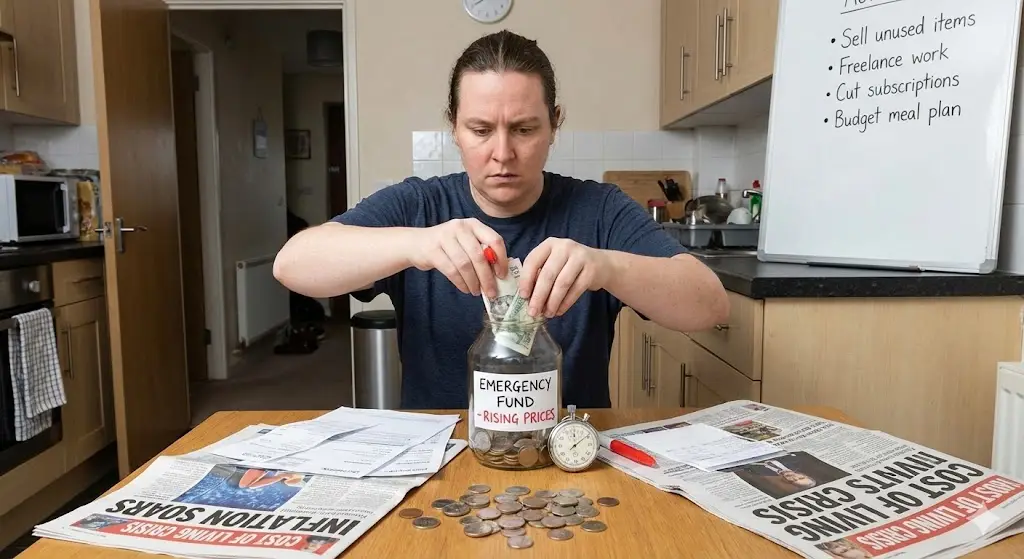
Emergency Fund Strategies for Rising Inflation — India 2026 Complete Guide
📘 Emergency Fund — The Foundation of Every Financial Plan
An emergency fund is a dedicated reserve of liquid savings equal to 6-12 months of essential expenses, held in safe, instantly accessible instruments. Without it, every financial emergency — job loss, medical crisis, car breakdown, urgent home repair — forces you to break investments, take high-interest loans, or use credit cards at 36-48% interest. India’s economic volatility (5.5% inflation in FY 2025-26, rising healthcare costs at 14% annually, and tech sector layoffs affecting 85,000+ workers in FY 2024-25) makes the emergency fund not optional but the mandatory first layer of financial security.
📊 Emergency Preparedness Data — India 2025-26
- RBI Household Finance Survey, 2025: 58% of urban Indian households have less than 1 month of expenses in liquid savings. Only 22% have the recommended 6-month emergency fund.
- SEBI, FY 2024-25: IT sector layoffs in India: 85,000+ workers. Average job search duration: 3-6 months for experienced professionals. 6-month emergency fund = zero financial disruption during job transition.
- National Sample Survey, 2024: 28% of Indian households reduce food expenditure to fund medical emergencies. An adequate emergency fund eliminates this choice entirely.
- AMFI, 2026: Liquid mutual fund AUM: ₹7.8 lakh crore. Average 1-year return: 7.1%. Compared to savings account (3-4%): liquid funds earn 3-4% more on the same emergency money.
1. How Much Emergency Fund Do You Need?
The formula: 6 × Monthly Essential Expenses (for salaried employees) or 9-12 × Monthly Essential Expenses (for self-employed, freelancers, commission-earners).
| Monthly Essential Expenses | Salaried Target (6mo) | Self-Employed Target (9mo) | With Medical Buffer (+₹1.5L) |
|---|---|---|---|
| ₹30,000 | ₹1.8 lakh | ₹2.7 lakh | ₹3.3–4.2 lakh |
| ₹50,000 | ₹3.0 lakh | ₹4.5 lakh | ₹4.5–6.0 lakh |
| ₹75,000 | ₹4.5 lakh | ₹6.75 lakh | ₹6.0–8.25 lakh |
| ₹1,00,000 | ₹6.0 lakh | ₹9.0 lakh | ₹7.5–10.5 lakh |
Essential expenses only — not total spending. Essential = rent/EMI + groceries + utilities + school fees + insurance premiums + minimum loan EMIs. Not essential (can be cut during emergency): dining out, entertainment, gym, travel, clothing, subscriptions.
💡 Separate Medical Emergency Buffer
Add ₹1-2 lakh over and above your 6-month fund specifically for medical emergencies. Health insurance covers hospitalisation but not: OPD visits, medicines, co-payment (10-20% of claims), ambulance costs, and non-covered treatments. This medical buffer prevents your emergency fund from being depleted by a single hospitalisation episode.
2. Where to Keep Your Emergency Fund in India
| Instrument | Return (2026) | Liquidity | Risk | Best For |
|---|---|---|---|---|
| Liquid Mutual Fund | 7.0–7.5% | T+1 day | Very Low | Bulk of emergency fund (₹1L+) |
| Ultra Short Duration Fund | 7.2–7.8% | T+2 days | Very Low | Slightly higher return, 2-day lag ok |
| High-Yield Savings A/c | 6.5–7.5% | Instant | Zero | First month buffer (instant access) |
| Sweep-in FD | 7.0–7.25% | Same day | Zero | Good alternative to liquid fund |
| Regular FD (no sweep) | 7.0–7.5% | 2–3 days + penalty | Zero | Avoid for primary emergency fund |
| Equity Mutual Fund | Unpredictable | 2 days but market risk | HIGH | Never — wrong instrument |
Recommended setup: ₹50,000–1,00,000 in a high-yield savings account (IDFC First Bank at 7%, DBS Digibank at 7%, Kotak 811 at 6%) for instant access. Remaining 4-5 months of fund in Nippon India Liquid Fund or HDFC Liquid Fund (direct plan) — T+1 withdrawal, 7%+ returns, zero credit risk.
3. How to Build Your Emergency Fund Fast
The Emergency Fund Sprint Strategy
- Calculate your exact target: Monthly essential expenses × 6. Write this number down as a fixed goal.
- Declare a 6-month spending freeze on non-essentials: No dining out, no new gadgets, minimal clothing, pause subscriptions. Redirect every rupee saved to the emergency fund.
- Redirect all one-time income: Bonus, tax refund, gift money, freelance income — 100% goes to emergency fund until target is hit.
- Sell idle assets: Old phones, laptops, watches, unused gym equipment, extra furniture. Even ₹25,000-50,000 from asset sales accelerates the timeline significantly.
- Set up a dedicated auto-transfer: On salary day, auto-transfer your target monthly emergency fund contribution to a separate account. Treat this exactly like an EMI — non-negotiable.
| Monthly Savings Capacity | Target ₹3L | Target ₹5L | Target ₹8L |
|---|---|---|---|
| ₹10,000/month | 30 months | 50 months | 80 months |
| ₹20,000/month | 15 months | 25 months | 40 months |
| ₹30,000/month | 10 months | 17 months | 27 months |
| ₹50,000/month | 6 months | 10 months | 16 months |
4. Inflation-Proofing Your Emergency Fund
At 5.5-6% inflation, your ₹3 lakh emergency fund’s real value drops to ₹2.83 lakh in a year if it earns nothing. Liquid funds at 7%+ beat inflation — your real return is +1 to +1.5% annually. This means your emergency fund should grow slightly in real terms, automatically providing inflation-proofing without any action.
Review your emergency fund target annually — as your expenses grow with inflation, so should the target. If your monthly expenses were ₹60,000 in 2024 and are now ₹65,000 in 2026 (8% growth), your 6-month fund should be ₹3.9L not ₹3.6L. Top up accordingly.
5. The Two-Layer Emergency Fund Strategy
Don’t keep all emergency funds in one place — layer for instant access and optimised returns:
| Layer | Amount | Instrument | Access Time | Purpose |
|---|---|---|---|---|
| Layer 1 (Quick) | 1–2 months expenses | High-yield savings account | Instant via UPI/ATM | Hospital deposit, urgent ticket, immediate cash need |
| Layer 2 (Core) | 4–5 months expenses | Liquid mutual fund | T+1 business day | Job loss income replacement, large medical bill, home repair |
Layer 1 earns 6.5-7.5% (savings account); Layer 2 earns 7-7.5% (liquid fund). Blended return: ~7.2% on the total fund — beating inflation while maintaining complete liquidity.
6. What to Do After Using the Emergency Fund
After using your emergency fund (as intended — for a genuine emergency), replenishing it becomes your immediate financial priority — before resuming investments, before buying discretionary items, before anything non-essential.
- Calculate how much was used and set a replenishment timeline (maximum 6 months)
- Temporarily pause or reduce SIP amounts — emergency fund replenishment takes priority over new investments
- Redirect any one-time income (bonus, freelance, tax refund) entirely to replenishment
- Once replenished, resume all suspended investments with any step-up you had planned
7. Emergency Fund Mistakes to Avoid
- Investing emergency fund in equity: Equity crashes when job losses and medical emergencies are most common. Your emergency fund will be lowest when you need it most. Use only capital-safe instruments.
- Not separating emergency fund from regular savings: If it’s in the same account as your spending money, it will gradually be spent. Separate account, separate label.
- Using emergency fund for non-emergencies: A holiday sale, a gadget deal, or a wedding gift is not an emergency. Define “emergency” strictly: job loss, medical crisis, essential home/vehicle repair. If in doubt — not an emergency.
- Setting and forgetting — not reviewing annually: Expenses grow. Your fund target should grow. Review every April and top up if your monthly expenses have increased.
- Building emergency fund after starting investments: Many people start SIP first, then emergency fund later. Wrong order. Emergency fund first, then investment. An emergency without a fund forces you to redeem SIP at the worst time.
🧮 Free Calculators — Use Them Now
No login required. Updated for FY 2025-26.
Frequently Asked Questions
The standard recommendation is 6 months of essential monthly expenses (not income). Essential expenses include: rent/EMI, groceries, utilities, insurance premiums, children’s school fees, and minimum loan EMIs. For a family spending ₹60,000/month on essentials: target ₹3.6 lakh emergency fund. Self-employed, freelancers, and commission-based earners should keep 9-12 months due to income volatility. Add ₹1-2 lakh specifically for medical emergencies beyond what insurance covers. Total target for a salaried family of four in a metro: ₹4-5 lakh.
Best options: (1) Liquid mutual funds — 7-7.5% annual return, withdraw in T+1 business day, no exit load after 7 days, SEBI-regulated. Better than savings account for any amount above ₹1 lakh. (2) Ultra-short duration debt funds — slightly higher return than liquid funds, 2-3 day withdrawal. (3) Sweep-in FD (linked to savings account) — FD rates on idle money, instant liquidity. (4) High-yield savings account (DBS, IDFC First, RBL offer 6.5-7.5% on savings balance above ₹1 lakh). Avoid: regular equity mutual funds (market risk, illiquid during a crash when you most need funds), long-term FDs with premature withdrawal penalties.
With focused effort: set a temporary ’emergency fund sprint’ goal. Calculate your current savings capacity. If you can save ₹25,000/month, ₹3 lakh in 12 months. To accelerate: sell unused assets (old gadgets, clothing, jewellery), redirect one-time income (bonus, tax refund, gifts) entirely to the fund, cut non-essential spending temporarily (OTT subscriptions, dining out, vacation) until fund is built. Once target is reached, revert to normal spending and redirect savings to investments. Building emergency fund is a sprint, not a marathon.
No — this is one of the most common personal finance mistakes. Equity markets can fall 30-50% during a crisis (2008, 2020), often simultaneously with job losses or medical emergencies. The moment you most need your emergency fund is often when the market is at its lowest. Withdrawing ₹3 lakh from an equity fund during a 40% crash means getting only ₹1.8 lakh effectively (the rest is paper loss that would have recovered). Emergency funds must be in instruments that cannot lose principal: liquid funds, sweep FDs, high-yield savings accounts.
Split into two layers: Layer 1 — 1-2 months of expenses in a high-yield savings account (instant access, zero friction). Layer 2 — 4-5 months of expenses in liquid mutual funds or sweep FD (T+1 withdrawal, slightly better return). Keep Layer 1 at your primary bank for emergencies needing cash within hours (hospital admission, urgent travel). Layer 2 handles larger emergencies where you have 24-48 hours notice. This layered approach balances instant access with better returns on the larger portion.