
Building an Inflation-Proof Retirement Corpus in India — 2026 Complete Guide
📘 Inflation — The Silent Destroyer of Retirement Security
At 6% annual inflation, Rs1 lakh today becomes the equivalent of Rs33,000 in purchasing power in 20 years. A retirement corpus that looks generous at age 60 becomes inadequate by age 75-78 if it’s not inflation-proofed. India’s structural inflation (averaging 6.4% CPI over 2005-2025) combined with a 22+ year retirement horizon creates a retirement sustainability challenge that most Indians — conditioned to think of FDs and savings accounts as “safe” — are unprepared for. This guide covers the specific inflation risks in Indian retirement, the corpus calculation that accounts for them, and the portfolio structure that sustains 30+ years of purchasing power.
📊 India Retirement & Inflation Data — 2025-26
- CSO / MoSPI, FY 2025-26: India CPI inflation (FY 2025-26 average): 4.8%. 20-year CPI CAGR (2005-2025): 6.4%. Healthcare inflation: 12-15%/year. Education inflation: 10%/year. These sector-specific inflations hit retirees harder than the headline CPI number.
- Retirement corpus math: Rs50,000/month essential expenses at age 60, growing at 6% annually. By age 70: need Rs89,542/month. By age 75: Rs1,19,828/month. By age 80: Rs1,60,357/month. A static Rs50,000/month SWP from FD loses 50% of purchasing power in 12 years.
- PFRDA, 2026: NPS corpus at retirement (average PFRDA data): Rs18.4 lakh — significantly below the Rs2-6 crore needed for comfortable urban retirement. Highlights the systemic under-saving problem.
- AMFI SWP data, 2025: Step-up SWP accounts (SWP with annual increase) growing 38% YoY as awareness of inflation-adjusted withdrawal spreads. Average step-up rate chosen: 6% annually.
1. Why India Needs the 30× Rule, Not the 25× Rule
| Parameter | USA (4% rule origin) | India (adjusted) | Impact |
|---|---|---|---|
| Inflation | 2-3% average | 5-6% structural | Corpus depletes faster |
| Bond yield vs inflation | Positive real yield | Near-zero real yield | Debt component loses purchasing power |
| Retirement horizon | 30 years (65→95) | 22-25 years (60→82-85) | Slightly shorter but offset by higher inflation |
| Healthcare cost inflation | 5-6% | 12-15% | Largest single retirement spending risk |
| Safe withdrawal rate | 4% | 3-3.5% (use 30× corpus rule) | Larger corpus required |
| Monthly Expenses at 60 | Annual (inflation-adjusted) | 30× Corpus Needed |
|---|---|---|
| Rs40,000 | Rs4,80,000 | Rs1.44 crore |
| Rs60,000 | Rs7,20,000 | Rs2.16 crore |
| Rs80,000 | Rs9,60,000 | Rs2.88 crore |
| Rs1,00,000 | Rs12,00,000 | Rs3.60 crore |
| Rs1,50,000 | Rs18,00,000 | Rs5.40 crore |
2. Equity Allocation in Retirement — The Glidepath
The equity glidepath in retirement — reducing equity gradually as age increases — balances inflation protection (need equity) with capital preservation (avoid large drawdowns late in retirement):
| Age Range | Equity % | Debt % | Instrument for Equity | Instrument for Debt |
|---|---|---|---|---|
| 60-65 | 40-45% | 55-60% | Balanced Advantage Fund | SCSS + FD + debt MF |
| 65-70 | 30-35% | 65-70% | BAF or conservative hybrid | SCSS + FD |
| 70-75 | 20-25% | 75-80% | Conservative hybrid | SCSS + FD + POMIS |
| 75+ | 10-15% | 85-90% | Minimal equity hybrid | FD + SCSS + POMIS |
💡 Balanced Advantage Funds Auto-Manage Equity-Debt in Retirement
Balanced Advantage Funds (HDFC Balanced Advantage, Edelweiss BAF, ICICI Pru Balanced Advantage) automatically shift between equity and debt based on market valuations — increasing equity when markets are cheap, reducing when expensive. For retirees who don’t want to actively rebalance: BAF is ideal. It provides the inflation-beating equity component while automatically de-risking in expensive markets. Returns: 11-13% CAGR over 10 years with significantly lower drawdowns than pure equity.
3. Step-Up SWP — Inflation-Adjusted Monthly Income
Scenario analysis: Rs3 crore corpus at age 60, Balanced Advantage Fund (10% return), 6% annual SWP step-up:
| Age | Monthly SWP | Annual Withdrawal | Corpus Remaining |
|---|---|---|---|
| 60 (start) | Rs75,000 | Rs9,00,000 (3% of corpus) | Rs3,00,00,000 |
| 65 | Rs1,00,400 | Rs12,04,800 | Rs3,28,00,000 |
| 70 | Rs1,34,400 | Rs16,12,800 | Rs3,45,00,000 |
| 75 | Rs1,79,800 | Rs21,57,600 | Rs3,41,00,000 |
| 80 | Rs2,40,700 | Rs28,88,400 | Rs3,18,00,000 |
| 85 | Rs3,22,200 | Rs38,66,400 | Rs2,52,00,000 |
The corpus never depletes over a 25-year horizon — and the monthly income keeps pace with inflation throughout. This is the power of the step-up SWP from a growth-oriented fund vs a static FD.
4. SCSS as Income Anchor in Retirement Portfolio
Structure SCSS to cover exactly your essential fixed expenses — so you never need to touch equity in a market downturn to pay bills:
- Monthly essential expenses (food, medicine, utilities, insurance): Rs25,000-40,000
- SCSS at maximum Rs30L per person: generates Rs20,500/month (7.4% quarterly payout)
- If married, spouse SCSS adds Rs20,500/month: total Rs41,000/month guaranteed income
- Essential expenses fully covered by guaranteed SCSS income
- Equity/balanced fund corpus (SWP): covers discretionary spending + grows over time
- Market crash scenario: equity portion falls 30% — you don’t need to sell; SCSS income covers all essentials while equity recovers
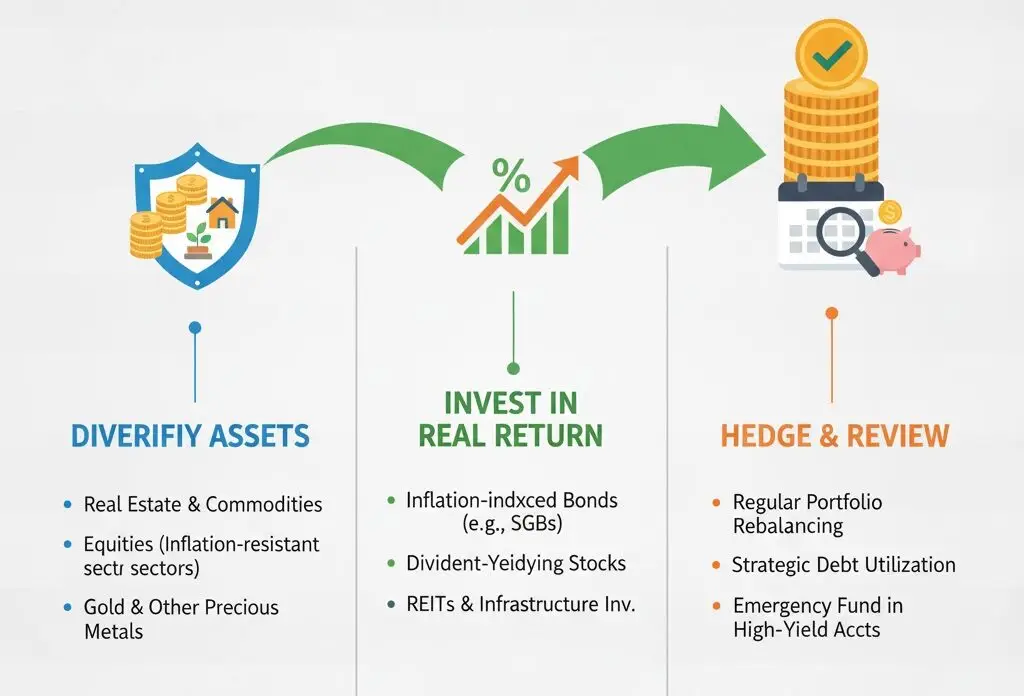
5. Specific Inflation Risks and How to Hedge Each
| Inflation Risk | Rate | Hedge Strategy |
|---|---|---|
| Healthcare costs | 12-15%/year | Rs25L+ health insurance + Rs5L dedicated medical emergency fund (grow separately at 10%+ via equity SIP) |
| Housing / rent | 8-10%/year | Own home debt-free at retirement. Or: factor rent escalation into corpus calculation explicitly. |
| General consumption | 5-6%/year | Equity allocation (40% at 60) provides inflation-beating growth on corpus |
| Education (grandchildren) | 10%/year | Separate Rs10-20L education SGB earmark; don’t use retirement corpus |
| Longevity (outliving corpus) | Risk not rate | 3% withdrawal rate + NPS annuity component (40% of NPS) for lifetime pension |
6. Complete Inflation-Proof Retirement Portfolio
Model portfolio for Rs4 crore corpus at retirement (age 60):
| Component | Amount | Instrument | Monthly Income/Growth |
|---|---|---|---|
| Guaranteed income anchor | Rs60L (couple) | SCSS (2 accounts × Rs30L) | Rs41,000/month income |
| Growth + discretionary SWP | Rs2.4 crore | Balanced Advantage Fund | Rs60,000/month SWP (3% rate) |
| Medical emergency fund | Rs20L | Short-duration debt MF + FD | Not for regular income |
| Gold / inflation buffer | Rs20L | SGB (inflation hedge) | Rs50,000/year interest + gold price growth |
| Total monthly income | Rs4 crore deployed | Rs1,01,000/month + step-up |
7. Longevity Risk — Planning to Age 90+
Urban Indian life expectancy at 60 (2026): 82 years average; 90th percentile: 91 years. Planning for the average means a 50% chance of outliving the plan. Longevity-proofing strategies:
- NPS annuity (40% component): Provides lifetime income regardless of how long you live. Even at lower annuity rates (5.5-6.5%), the lifetime guarantee eliminates longevity risk for this portion.
- Conservative withdrawal rate: 3% initial (30× corpus) vs 4% (25× corpus) adds approximately 8-10 years of additional corpus sustainability.
- Maintain 15% equity even at 75+: A small equity allocation keeps the corpus growing and offsets longevity risk for the long-lived 15-20% of retirees.
- Reverse mortgage: For property-rich, cash-poor retirees — NHB’s Reverse Mortgage Loan scheme converts home equity into monthly income without selling the home. Available through SBI, Union Bank, and other NHB-approved lenders.
🧮 Free Calculators — Use Them Now
No login required. Updated for FY 2025-26.
Frequently Asked Questions
The standard US ’25× rule’ (4% safe withdrawal rate) was built for US conditions: 2-3% inflation, 3.5-4% long-term bond yields, and 30-year retirement horizon. India’s conditions are fundamentally different: 5-6% structural inflation (CPI average 2005-2025: 6.4%), 22+ year retirement horizon (life expectancy at 60: 82 years urban), lower bond yields relative to inflation, and higher equity premium. Using the US 4% rule on an Indian portfolio at 6% inflation: a corpus that looks adequate at retirement depletes by age 78-80. India-specific rule: use 30× annual expenses (at retirement, inflation-adjusted) = 3.33% safe withdrawal rate. This lower withdrawal rate, combined with a hybrid equity-debt portfolio, provides high probability of not outliving your corpus over a 25-year retirement.
The conventional advice of ‘shift to all-debt at retirement’ is a wealth-destroying mistake for Indian retirees. The evidence: a Rs1 crore corpus at 60 invested entirely in FD (7%) depletes by age 80 (25-year horizon) if withdrawing Rs50,000/month with 6% inflation step-up. Same corpus with 40% equity (balanced advantage fund, 10% return) + 60% debt (FD/SCSS, 7.5%): sustains 35+ years. Recommended equity allocation in retirement by age: Age 60-65: 40-45% equity. Age 65-70: 30-35% equity. Age 70-75: 20-25% equity. Age 75+: 15% equity (rebalance slowly, not suddenly). This glidepath maintains inflation-beating potential while progressively de-risking as the time horizon shortens.
SWP (Systematic Withdrawal Plan) from a balanced advantage or equity-oriented hybrid fund generates regular retirement income while keeping corpus invested. Inflation step-up SWP: start at a monthly withdrawal that represents approximately 3-3.5% annual withdrawal rate. Increase SWP by 5-6% annually (matching inflation). Example: Rs5 crore corpus at 60. Initial SWP: Rs1,25,000/month (3% annual rate). Year 2: increase to Rs1,32,500/month (+6%). Year 5: Rs1,58,000/month. This inflation step-up preserves purchasing power. Portfolio scenario at 10% balanced fund return: corpus grows from Rs5 crore at 60 to Rs7.2 crore by age 80 despite all withdrawals — proving the sustainability of this approach. The step-up SWP is superior to fixed SWP (which loses real value annually) and FD interest (which doesn’t compound the underlying corpus).
SCSS at 8.2% (current rate) is the highest-yielding guaranteed income instrument available to Indian retirees. In an inflation-proof retirement portfolio, SCSS serves as the income anchor: Maximum Rs30L per person (Rs60L for couple). Annual income at maximum: Rs2,46,000 (Rs20,500/month). SCSS income should cover your essential fixed expenses (food, utilities, medicine, insurance premiums) — predictable, guaranteed, non-equity-dependent. The equity component (40%) in a balanced fund covers discretionary spending, inflation protection, and corpus growth. The combination: SCSS (Rs30L) covering essential costs + SWP from balanced fund (Rs70L at 3.5% withdrawal) for discretionary + corpus growth. This structure ensures you never need to sell equity in a market downturn to cover essentials.
India-specific retirement inflation risks: (1) Healthcare inflation (12-15%/year): medical costs rising fastest. Hedge: adequate health insurance (Rs25L+ cover at retirement), Ayushman Bharat if eligible, dedicated medical emergency fund Rs3-5L separate from retirement corpus. (2) Housing cost inflation: rental increases, maintenance, property tax escalation. Hedge: own home (debt-free at retirement eliminates rental risk), or factor 8% annual rental increase into corpus calculation. (3) Education inflation (10%/year): for grandchildren support if expected. Hedge: create specific education SGB earmark separate from main corpus. (4) General consumption inflation (5-6%): managed through equity allocation in portfolio as described. (5) Longevity risk: outliving corpus (living beyond age 85-90 in urban India, increasingly possible). Hedge: NPS annuity component (40% of NPS at maturity), SCSS extension at maturity, and conservative 3% withdrawal rate.