
GST Rates in India
— Complete 2026 Guide
September 2025 two-tier GST reform explained, items cheaper and costlier, full rate schedule by category, what 28% GST covers, rates on services, gold, vehicles, and how rate changes affect your business and wallet.
India’s GST Rate Structure — Overview
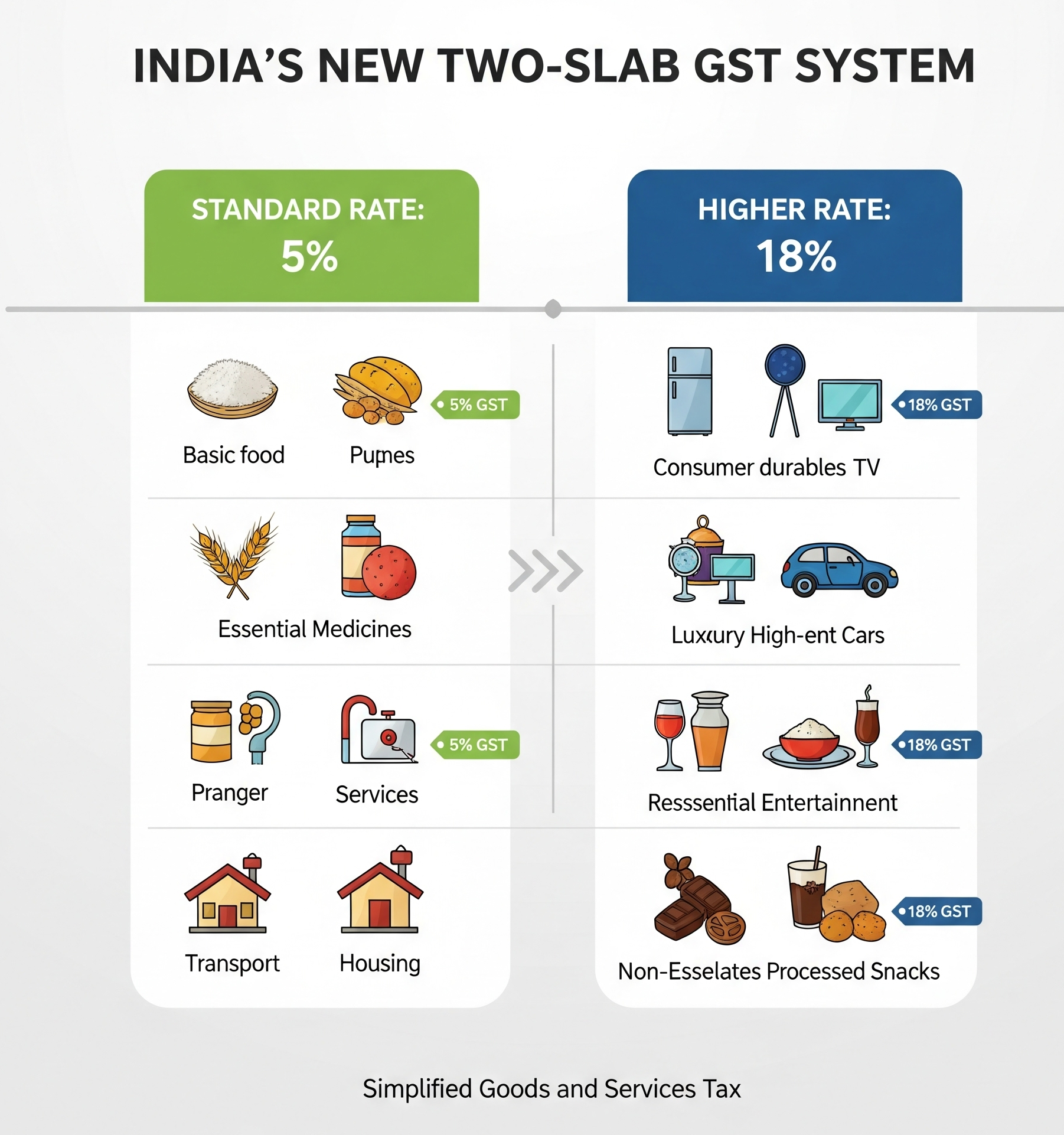
GST replaced 17+ taxes with a unified rate structure. The September 2025 GST Council reform simplified this further into a cleaner two-tier approach, reducing the number of items in the 12% slab by moving them to either 5% or 18%. India’s current GST rates: 0% (nil), 5%, 12%, 18%, and 28% — with additional cess on select luxury and sin goods.
Complete GST Rate Schedule by Category
| Rate | Category | Key Examples |
|---|---|---|
| 0% (Nil) | Essential and exempt | Fresh fruits, vegetables, milk, eggs, unbranded grains, live animals, exports, educational services |
| 5% | Essential goods and services | Packaged food, LPG, economy air tickets, metro rail, basic medicines, solar panels, EVs |
| 12% | Standard goods (reduced tier) | Smartphones below Rs 15,000, processed food, bicycles, furniture, business equipment |
| 18% | Standard goods and services | Most manufactured goods, professional services, telecom, IT services, restaurants (AC), banks |
| 28% | Luxury and sin goods | Cars, tobacco, aerated drinks, cement, premium hotels, casinos, pan masala |
| 28% + Cess | Demerit goods (extra cess) | Cigarettes, SUVs, pan masala — effective rate 40-55% |
The September 2025 GST Reform — Key Changes
The GST Council’s landmark September 2025 restructuring was the most significant rate rationalisation since GST’s launch in 2017. The reform’s primary goals: simplification (fewer rate tiers means simpler classification disputes), relief to small manufacturers, and addressing industry demands for rate reductions on essential intermediate goods.
Major Rate Reductions (September 2025)
| Sector | Old Rate | New Rate | Impact |
|---|---|---|---|
| Business software and IT licenses | 18% | 12% | Reduced cost for MSMEs using software |
| Commercial kitchen equipment | 18% | 12% | Lower setup cost for restaurants |
| Agricultural machinery parts | 12% | 5% | Reduced cost for farmers |
| Organic agricultural inputs | 5% | Nil | Encourages organic farming |
| Healthcare equipment (specific) | 18% | 12% | Reduced cost for hospitals |
| Specified life-saving medicines | 5% | Nil | Direct patient benefit |
GST Rates on Vehicles
| Vehicle Type | GST Rate | Cess | Total Effective Rate |
|---|---|---|---|
| Electric vehicles (EVs) | 5% | None | 5% |
| Two-wheelers (under 350cc) | 28% | None/2% | 28-30% |
| Two-wheelers (350cc+) | 28% | 3% | 31% |
| Small cars (under 4m, petrol under 1200cc) | 28% | 1% | 29% |
| Mid-size cars | 28% | 15% | 43% |
| Large cars / Sedans | 28% | 20% | 48% |
| SUVs (over 4m, above 1500cc) | 28% | 22% | 50% |
| Luxury cars | 28% | 22% | 50%+ |
GST Rates on Common Services
| Service | GST Rate |
|---|---|
| Restaurant (non-AC, no alcohol) | 5% |
| Restaurant (AC or serving alcohol) | 5% |
| Hotel room (Rs 1,000-7,499/night) | 12% |
| Hotel room (Rs 7,500+/night) | 18% |
| Economy air ticket | 5% |
| Business class air ticket | 12% |
| Telecom (mobile recharge) | 18% |
| Banking and financial services | 18% |
| Health insurance premium | 18% |
| Life insurance premium | 18% (term); 5% (endowment) |
| Professional services (CA, doctor, lawyer) | 18% |
| Coaching services | 18% |
| School and college education | Nil |
| Construction (affordable housing) | 5% |
| Construction (commercial) | 18% |
GST Rates on Financial Products
| Product | GST on? | Rate |
|---|---|---|
| Mutual fund investment | Not applicable on investment amount | Nil (on principal) |
| Mutual fund expense ratio | AMC’s fund management charges | 18% (included in stated expense ratio) |
| Stock brokerage | Brokerage fee charged by broker | 18% |
| Health insurance premium | Entire premium charged to policyholder | 18% |
| Term insurance premium | Entire premium | 18% |
| Home loan processing fee | Processing fee amount | 18% |
| Fixed deposit interest | Not applicable | Nil (bank FD interest is not supply) |
Anti-Profiteering — Your Right When Rates Fall
When GST rates are reduced, businesses are legally obligated to pass the benefit to consumers through lower prices. The Anti-Profiteering provisions under Section 171 of the CGST Act require that: any reduction in GST rate on goods or services must be passed on to consumers by reducing the selling price commensurately; and any ITC benefit gained due to rate changes must also be passed on. Consumers who believe a business has not reduced prices after a GST rate cut can file a complaint with the National Anti-Profiteering Authority (NAA) or their state-level screening committee. Businesses found guilty of profiteering can be ordered to refund excess amounts collected plus 18% interest.
GST Rate Finder — How to Check the Right Rate
The official GST rate search tool is available at: cbic.gov.in under the GST portal’s goods/services rate search. Steps: (1) Go to Services → Rate Finder on the GST portal (gst.gov.in); (2) Enter the product or service description; (3) Select the closest matching HSN (goods) or SAC (services) code; (4) The applicable GST rate, ITC eligibility, and exemptions are displayed. For disputes on classification and rate, the GST portal provides advance ruling application facility to get a binding rate determination from the relevant authority.
GST Rate Checklist for Businesses
- Verify the exact HSN/SAC code for each product or service you supply — rate depends on classification
- Update your billing software whenever GST rates change — use notifications from CBIC for timely updates
- If GST on your inputs is reduced, review and adjust selling prices to pass on benefit (anti-profiteering compliance)
- If GST rate on your output product is increased, revise MRP before the effective date
- For products you purchase: verify updated GST rate on supplier invoices — ITC depends on correct rate being charged
- Use the GST Calculator to quickly compute GST at any rate for quotations and invoices
- When in doubt about classification: file for Advance Ruling from GST authority — binding ruling prevents future disputes
🧮 Free Calculators — Use Them Now
No login required. Updated for FY 2025-26.
Frequently Asked Questions
The GST Council’s September 2025 restructuring simplified India’s rate structure into a cleaner two-primary-tier system. The revised framework: (1) Nil rate (0%) — fresh vegetables, fruits, milk, eggs, grains, cereals, bread, unbranded salt, live animals, exports; (2) Essential tier at 5% — packaged food items, edible oils, domestic LPG, economy air travel, metro/rail tickets, specified medicines, renewable energy devices; (3) Standard goods tier at 12% — processed and packaged food, business equipment, furniture, bicycles, smartphones below Rs 15,000 — many items moved down from 18%; (4) Standard services tier at 18% — most professional services, restaurants, telecom, financial services, IT services, construction services, luxury goods, and most manufactured products; (5) Luxury and sin goods at 28% — automobiles, premium real estate, tobacco, aerated drinks, lottery — with additional cess on top for highest categories. The merger simplified compliance for businesses operating across multiple product lines.
The September 2025 GST Council reform resulted in significant rate reductions for several categories. Moved from 18% to 12%: business software licenses, computer hardware for educational institutions, commercial kitchen equipment, agricultural machinery parts, textile processing machinery, industrial consumables used in manufacturing, certain healthcare equipment and devices, and some financial instruments. Moved from 12% to 5%: organic agricultural inputs, biogas plants and equipment, certain handicrafts, regional language stationery products. Moved from 5% to nil: additional essential food preparations, fortified nutrition products, and specific life-saving medicines notified by the government. The reform aimed to ease the burden on small manufacturers, educational institutions, and essential goods sectors while maintaining revenue neutrality.
Items attracting 28% GST (the highest slab) include: all motor vehicles except electric vehicles; tobacco and tobacco products (with additional compensation cess); aerated beverages and energy drinks; pan masala; casinos, online gaming platforms, and horse racing; cement (remains at 28% despite industry lobbying); luxury hotels (room tariff above Rs 7,500/night); yachts, aircraft, and helicopters for private use; paint and varnish; and certain consumer electronics classified as luxury goods. On top of 28% GST, additional Compensation Cess applies on: cigarettes (per unit plus ad valorem cess), cars (based on engine capacity and length), and pan masala (ad valorem). The effective tax on premium cigarettes and cars can reach 40-50% when GST plus cess is combined.
GST rates on common services in India: Banking and financial services — 18%; insurance premium — 18%; restaurant (non-AC) — 5%; restaurant (AC) — 5% (reduced from 18% in 2022); hotel room tariff Rs 1,000-7,499 — 12%; hotel room tariff Rs 7,500+ — 18%; professional services (CA, lawyer, doctor) — 18%; telecom services (mobile recharge, broadband) — 18%; construction services (residential) — 5% (affordable housing) or 12% (other); construction services (commercial) — 18%; transport by road (for hire) — 5%; air travel (economy) — 5%; air travel (business class) — 12%; courier services — 18%; entertainment/amusement parks — 18%; educational services (recognised schools, colleges) — nil; coaching and tutorial services — 18%.
When GST rates change, businesses must revise their MRP to reflect the new rate. If GST is reduced, the MRP should ideally decrease — the Anti-Profiteering provision under GST law requires businesses to pass rate reduction benefits to consumers. If a product’s MRP does not decrease after a rate cut, consumers can file complaints with the National Anti-Profiteering Authority. In practice, price changes from GST rate revisions are gradual — businesses first clear existing inventory at old MRP then reprice new stock. For example: if a product’s pre-tax value is Rs 1,000 and GST moves from 18% to 12%, old MRP = Rs 1,180, new MRP should be Rs 1,120 — saving Rs 60. Track such changes in FMCG products where rate reductions frequently occur in budget announcements.
Gold and jewellery attract: 3% GST on raw gold, gold coins, and gold bars (below a threshold purity); 3% GST on making charges and gold jewellery; additionally, a 10% customs duty applies on gold imports. So the total tax incidence on imported gold jewellery sold in India: customs duty (10%) + GST (3%) = approximately 13% above the global gold price. GST on silver: 3% on silver bullion and silver jewellery. GST on diamonds: 0.25% on raw diamonds; 1.5% on cut and polished diamonds; 3% on diamond jewellery. The relatively low GST rate on gold (3%) compared to most manufactured goods reflects gold’s dual role as a commodity and traditional wealth storage in India.