
You’ve done the hard work: you understand what GST is, you’ve completed your GST registration, and you’re issuing proper GST invoices to your clients. Now comes the most important recurring task for any GST-registered business: filing your GST returns.
A GST return is a document containing details of your income, sales, expenses, and tax liabilities that you must file with the tax authorities. It’s a way of reporting your transactions to the government and paying any tax that you owe. For many new entrepreneurs, the world of GST returns, with its various forms and due dates, can seem intimidating.
This guide is here to simplify it all. We will focus on the two most important and frequently filed returns for a regular taxpayer: **GSTR-1** and **GSTR-3B**. We’ll explain what they are, what information goes into them, and provide a clear overview of the filing process.
What are GST Returns? The Big Picture
Think of GST filing as a monthly or quarterly conversation with the government. You tell them:
- “Here are all the sales I made this period.” (This is your **outward supply**).
- “Here is all the GST I collected from my customers on these sales.” (This is your **output tax liability**).
- “Here are all the business purchases I made and the GST I paid on them.” (This is your **inward supply**).
- “Here is the GST I want to claim back as a credit on my purchases.” (This is your **Input Tax Credit or ITC**).
Based on this information, you calculate your final tax liability, which is essentially **(GST Collected) – (Input Tax Credit)**, and pay the balance to the government. This entire process is managed through different return forms.
The Two Key Returns: GSTR-1 and GSTR-3B
For a regular taxpayer, the filing process primarily revolves around two forms. It’s crucial to understand that they serve different purposes and must both be filed.
GSTR-1: The Return for Your Sales (Outward Supplies)
**What it is:** GSTR-1 is a detailed, invoice-level statement of all the sales you have made during a month or quarter. You are not paying any tax with this return; you are simply reporting your sales transactions.
**What it contains:** You need to upload details of every single B2B (Business-to-Business) invoice. For B2C (Business-to-Consumer) sales, you need to provide a consolidated summary.
**Why it’s important:** The information you file in your GSTR-1 is used to auto-populate the purchase records (GSTR-2A/2B) of your customers. This is how they are able to claim their Input Tax Credit. If you don’t file your GSTR-1 on time, your customers can’t claim their ITC, which can hurt your business relationships.
GSTR-3B: The Summary Return and Tax Payment
**What it is:** GSTR-3B is a monthly summary return. It’s where you declare your total sales, total purchases, and calculate your final tax liability after claiming ITC.
**What it contains:** Unlike GSTR-1, you don’t need to provide invoice-level details. You provide consolidated figures for your sales, purchases eligible for ITC, and tax payable.
**Why it’s important:** This is the return through which you actually **pay your GST**. You must file GSTR-3B and pay the tax due for that month to be considered compliant.
The Filing Sequence: GSTR-1 First, then GSTR-3B
It’s critical to remember the sequence. You must file your GSTR-1 for a period **before** you can file the GSTR-3B for that same period. The system is designed this way to ensure sales are reported before the summary tax payment is made.
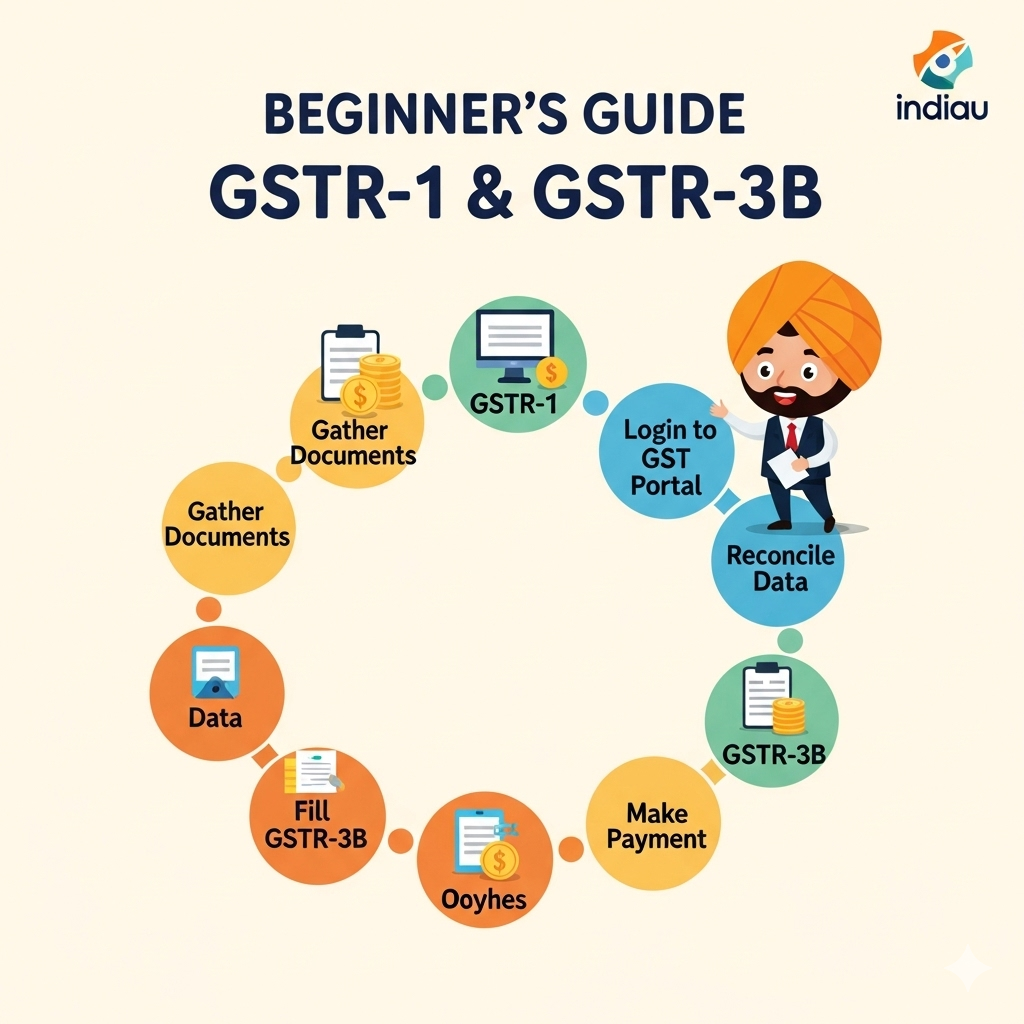
How to File GST Returns: A Step-by-Step Overview
The entire process is done online through the official GST Portal. While the interface has many options, the basic steps for filing GSTR-1 and GSTR-3B are as follows.
Steps for Filing GSTR-1:
- Login to the GST Portal: Use your credentials to log in.
- Navigate to the Returns Dashboard: Go to ‘Services’ > ‘Returns’ > ‘Returns Dashboard’.
- Select the Filing Period: Choose the financial year and the month/quarter for which you are filing.
- Prepare Online/Offline: You will see the GSTR-1 tile. You can either ‘Prepare Online’ to enter invoice data directly on the portal or use the ‘Offline Tool’ to prepare a file and upload it.
- Add Invoice Details: In the online mode, you’ll see different sections to add B2B invoices, B2C sales, credit/debit notes, etc. Fill in the required details for each invoice.
- Generate Summary and Submit: Once all details are entered, generate the GSTR-1 summary to verify the data. If everything is correct, submit the return.
- File with EVC or DSC: Finally, file the return using an Electronic Verification Code (EVC) sent to your registered mobile or with a Digital Signature Certificate (DSC).
- Login and Navigate: Follow the first three steps as above to reach the Returns Dashboard for the correct period.
- Select GSTR-3B: Choose to ‘Prepare Online’ for GSTR-3B.
- Auto-populated Data: The system will ask if you want to file a ‘Nil’ return. If not, you’ll see that some data related to your sales and ITC is auto-populated from your GSTR-1 and your suppliers’ GSTR-1 filings.
- Verify and Confirm: Carefully check all the auto-populated figures. You can edit them if needed, but you must have a valid reason. Confirm the values.
- Make Payment: The system will calculate your tax liability. You can use the cash in your Electronic Cash Ledger or your ITC balance to pay the tax. If there’s a shortfall, you must first deposit cash via a challan.
- File the Return: Once the tax is paid, you can proceed to file the GSTR-3B using EVC or DSC.
- GSTR-1: 11th of the next month. (e.g., the due date for August is September 11th).
- GSTR-3B: 20th of the next month. (e.g., the due date for August is September 20th).
Steps for Filing GSTR-3B:
Due Dates and Penalties for Late Filing
Timely filing of GST returns is non-negotiable. Missing the deadlines leads to penalties that can add up quickly.
Due Dates (for a regular monthly filer):
Penalties for Late Filing:
If you miss the due date, you are liable to pay a late fee of **₹50 per day** (₹25 for CGST and ₹25 for SGST) for each return. For nil returns, this fee is reduced to ₹20 per day. In addition to the late fee, you must also pay **interest at 18% per annum** on the outstanding tax amount.
The Final Word: A Discipline for Business Success
Filing GST returns is a core discipline of running a compliant business in India. While it may seem complex initially, it becomes a routine activity once you understand the purpose of GSTR-1 and GSTR-3B.
Always prioritize filing on time to avoid unnecessary penalties and maintain a good compliance rating. Using accounting software can greatly simplify the process of generating these returns. By staying organized and diligent, you can ensure that this crucial aspect of your business runs smoothly every month.