
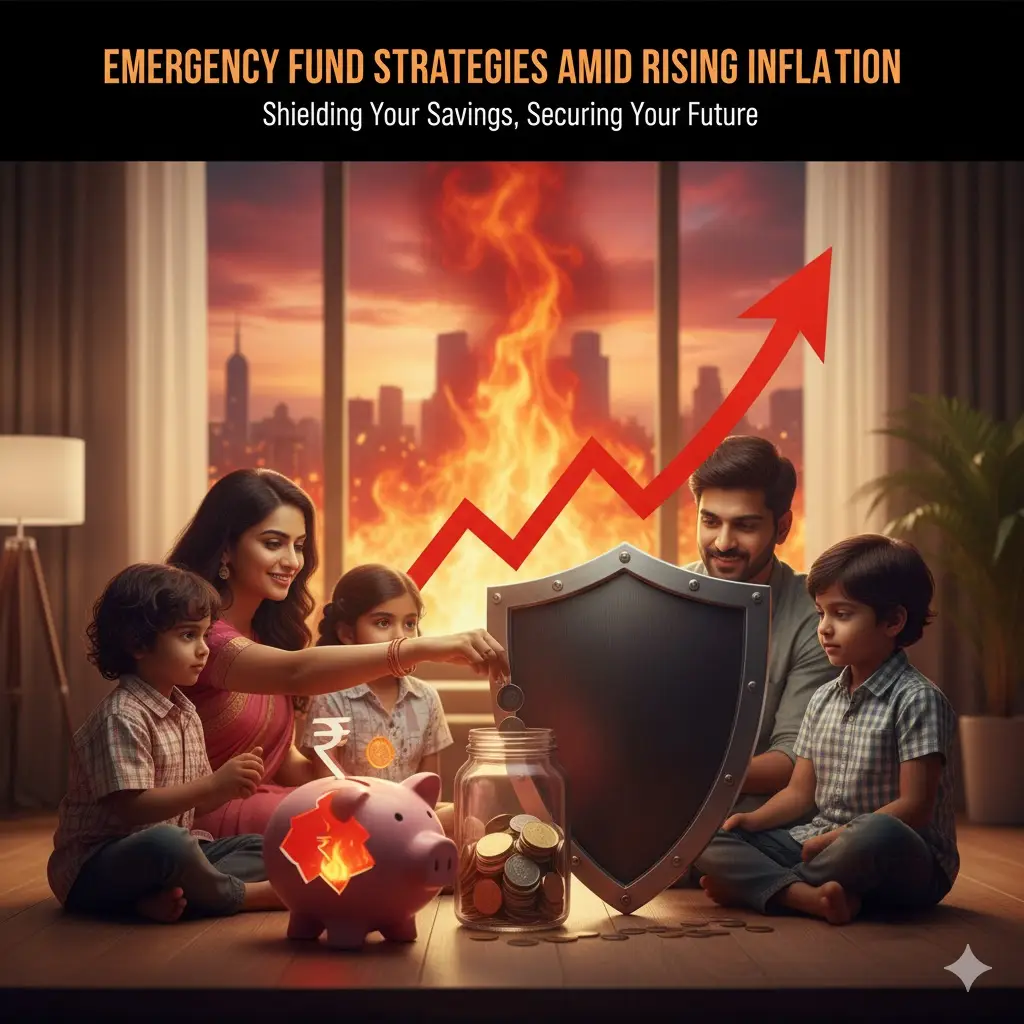
Building an Emergency Fund Fast in India — Practical 2026 Strategies
📘 Emergency Fund — India’s Most Neglected Financial Foundation
58% of urban Indian households have less than one month’s expenses in liquid savings (RBI Household Finance Survey, 2025). The emergency fund — 6 months of essential expenses in instantly accessible, risk-free instruments — is the most important financial product that most Indian families don’t have. Without it: every job loss, medical crisis, or urgent repair becomes a financial crisis requiring high-interest debt. With it: you handle emergencies without disrupting investments, taking loans, or suffering the psychological toll of financial instability. This guide focuses on how to build one fast, regardless of current income.
📊 Emergency Savings Data — India 2025-26
- RBI Household Finance Survey, 2025: 58% of urban Indian households have less than 1 month of expenses liquid. 22% have 6+ months target (recommended level). The gap is largest in 25-35 age group — high spending, moderate income, low emergency savings.
- SEBI, 2025: 34% of retail MF investors redeemed funds during 2020 COVID crisis to cover emergency expenses. Average redemption: ₹85,000 — significantly below the ₹6L-8L medical bills many faced. Inadequate emergency fund forced selling investments at the market bottom.
- TransUnion CIBIL, 2025: Personal loan applications spike 28% in October (post-festive season) and 42% in July (school admission fees) — indicating systematic lack of emergency/periodic expense buffers.
- AMFI Liquid Fund Data, 2026: Liquid fund AUM: ₹7.8 lakh crore. Average 1-year return: 7.1%. HDFC Liquid Fund, Nippon Liquid Fund, SBI Liquid Fund — all delivering 7%+ with T+1 liquidity and no credit risk.
1. Setting Your Emergency Fund Target
The 6-month calculation uses essential expenses only — what you absolutely must spend to survive. Not your full lifestyle budget:
| Category | Essential? | Include in Calculation? |
|---|---|---|
| Rent / home loan EMI | Yes | Yes |
| Groceries (basic) | Yes | Yes |
| Insurance premiums | Yes | Yes |
| School fees / children’s education | Yes | Yes |
| Utilities (electricity, water, phone) | Yes | Yes |
| Minimum loan EMIs | Yes (to protect CIBIL) | Yes |
| Dining out | No | No — can be eliminated in crisis |
| OTT subscriptions | No | No |
| Clothing / entertainment | No | No |
| SIP / investments | No (pause during crisis) | No |
💡 Add a Medical Buffer on Top
Over and above your 6-month essential expenses: add ₹1-2L specifically for medical emergencies (insurance deductibles, OPD costs, ambulance, non-covered treatment). Most emergency fund calculations forget this. A single hospitalisation without adequate buffer forces you to use your income replacement fund for medical bills — leaving you doubly vulnerable during a health-plus-income crisis.
2. Fastest Ways to Build the Fund
The Three-Source Approach
Emergency fund building happens fastest when you combine three sources simultaneously:
- Monthly surplus (slow but steady): ₹3,000-8,000/month identified through expense reduction. Auto-transfer on salary day.
- Asset liquidation (one-time surge): Sell idle physical assets (electronics, furniture, clothing). Can inject ₹20,000-80,000 in one weekend.
- Windfall capture (event-based): Tax refund, bonus, freelance income, gift money — 100% goes to emergency fund until target hit.
Combined: ₹5,000/month regular + ₹30,000 asset sale + ₹25,000 tax refund = ₹1,15,000 in year 1. Add second-year surplus of ₹60,000 = ₹1,75,000 by month 24. With higher income or more aggressive cuts: ₹3L target in 18 months.
3. Income Hacks for Fund Building
During the emergency fund build phase (typically 12-24 months), adding small income streams accelerates the timeline without permanent lifestyle change:
| Income Hack | Monthly Potential | Time Required | Skill Needed |
|---|---|---|---|
| Tutoring / online teaching (Unacademy, UrbanPro) | ₹5,000-15,000 | 5-10 hrs/week | Subject expertise |
| Content writing / copywriting (Upwork, Truelancer) | ₹8,000-25,000 | 10-15 hrs/week | Writing |
| Weekend market stall / selling | ₹3,000-10,000 | 2 days/month | Product sourcing |
| Renting parking space / room (OYO, Airbnb) | ₹5,000-15,000 | Setup only | Asset to rent |
| Delivery gig (Swiggy, Zomato, Blinkit) | ₹8,000-18,000 | 15-20 hrs/week | Vehicle + smartphone |
| Survey / research participation (Toluna, Swagbucks India) | ₹500-2,000 | 2-5 hrs/week | Time only |
4. Strategic Expense Cuts — The 90-Day Sprint
A temporary, intensive 90-day expense reduction sprint can inject ₹15,000-40,000 into your emergency fund. Temporary means it ends at day 90 — making it psychologically bearable:
- Dining out freeze: Zero restaurant spending (except work requirements) for 90 days → ₹4,000-15,000 saved
- OTT subscription audit: Keep 1 platform, cancel rest for 90 days → ₹500-2,000 saved
- Clothing and shopping freeze: Zero discretionary purchases for 90 days → ₹3,000-10,000 saved
- Entertainment budget zero: Free parks, YouTube, free events for 90 days → ₹2,000-6,000 saved
- Grocery optimisation: Plan meals, buy in bulk, reduce food waste → ₹2,000-5,000 saved
90-day sprint total saving: ₹11,500-38,000. After the sprint: restore the 1-2 lifestyle items that genuinely matter to you. Continue the ones you didn’t miss.
5. Windfall Allocation Protocol
The single most effective emergency fund building rule: 100% of every windfall goes to the emergency fund until the target is reached. No exceptions. Windfall events in a typical Indian year:
| Windfall Event | Typical Amount | Emergency Fund Priority |
|---|---|---|
| Income tax refund | ₹5,000-50,000 | 100% until fund target reached |
| Annual salary bonus | 1-3 months salary | 100% until fund target reached |
| Birthday / Diwali gifts (cash) | ₹2,000-20,000 | 100% until fund target reached |
| Freelance project payment | ₹5,000-50,000 | 100% until fund target reached |
| Asset sale proceeds | ₹5,000-50,000 | 100% until fund target reached |
6. Where to Keep Your Emergency Fund
| Instrument | Return | Liquidity | Fund Layer |
|---|---|---|---|
| High-yield savings account (IDFC First, DBS) | 7.0% | Instant (UPI/ATM) | Layer 1: 1-2 months expenses |
| Liquid mutual fund (Nippon, HDFC) | 7.0-7.5% | T+1 business day | Layer 2: 3-4 months expenses |
| Sweep-in FD (SBI Savings Plus, HDFC) | 7.0-7.25% | Same day | Layer 1 or 2 alternative |
| Regular FD | 7.0-7.5% | 2-3 days + possible penalty | Avoid for primary emergency fund |
| Equity mutual fund | Unpredictable | 2 days but market risk | Never — wrong instrument |
7. The Psychology of Saving When Money Feels Tight
Financial research identifies three psychological barriers to emergency fund building and evidence-backed solutions for each:
- Present bias (“I’ll start next month”): The future self feels abstract; present comfort feels concrete. Solution: automate the transfer to happen the second salary arrives — before you can make a present-moment decision. What you never see, you never miss.
- Mental accounting (“That’s my holiday money”): Separate accounts for different goals feel psychologically distinct. Solution: name your emergency fund account literally — “EMERGENCY ONLY: JOB LOSS/HOSPITAL” — and open it at a different bank so it’s less visible in daily banking. Out of sight, out of spend.
- Progress frustration (“₹8,000 feels pointless towards ₹3L”): The gap between current state and target feels demotivating. Solution: set micro-milestones — celebrate reaching ₹25,000, then ₹50,000, then ₹1L. Each milestone is a genuine achievement worth acknowledging. Progress, not perfection.
🧮 Free Calculators — Use Them Now
No login required. Updated for FY 2025-26.
Frequently Asked Questions
Paycheck-to-paycheck emergency fund building requires a different approach than standard budgeting advice: (1) Find ₹2,000-5,000/month that currently disappears unnoticed — dining out less 2 times/week (₹1,500 saved), cancelling 2 unused subscriptions (₹500), reducing impulse online shopping (₹1,000-3,000). (2) Add any irregular income — overtime pay, freelance income, birthday money, cash gifts — 100% to emergency fund. (3) Sell idle assets — old phone (₹5,000-15,000), clothing, books, electronics — to seed the fund. (4) Set up a ₹100 auto-transfer the day salary arrives — so small it’s invisible, but it starts the account. Within 6 months of discipline: ₹10,000-15,000 accumulated. Within 18 months: ₹50,000-1,00,000. Build in stages — ₹25,000 first, then ₹50,000, then ₹1L. The first ₹25,000 is the hardest.
Fastest path to ₹3 lakh emergency fund: (1) Audit and liquidate: sell assets you don’t use or need — old phone (₹8,000-25,000), old laptop (₹10,000-30,000), books, clothing, sports equipment, extra furniture. One weekend of selling can seed ₹20,000-60,000 immediately. (2) Bank windfall: redirect your next tax refund (average ₹18,000-45,000 for salaried Indians), entire festival bonus, and any performance increment difference to emergency fund first. (3) Temporary spending sprint: commit to 90 days of zero restaurant spending, zero clothing purchases, zero entertainment subscriptions. Save ₹8,000-20,000/month during the sprint. (4) Freelance sprint: one consulting project or weekend freelance gig per month for 3-6 months — add 100% to emergency fund. ₹1,00,000 in 3-6 months is achievable with combined approach.
The ideal emergency fund is split across two instruments: Layer 1 (1-2 months expenses): high-yield savings account (IDFC First 7%, DBS Digibank 7%, Kotak 811 6.5%) — instantly accessible via UPI/ATM for true emergencies requiring same-day cash. Layer 2 (4-5 months expenses): liquid mutual fund (Nippon/HDFC Liquid Fund, direct plan) — 7-7.5% return, T+1 withdrawal, no exit load after 7 days. Better return than FD with near-equal liquidity. Avoid: regular FD for emergency fund — premature withdrawal penalty (0.5-1% interest penalty) and 2-3 day withdrawal delay are problematic in genuine emergencies. Use FD only if the penalty clause is waived by your bank for emergency withdrawals.
Research-backed obstacles and solutions: (1) ‘I’ll start next month’: The Zeigarnik effect — incomplete tasks feel more stressful than not-started ones. Start today with ₹500 transfer to a separate account. The act of starting is the breakthrough. (2) ‘I don’t have anything to save’: Track every rupee for 30 days using Walnut (auto SMS tracking). Most people discover ₹3,000-8,000/month they genuinely don’t know where they spend. (3) ‘I keep dipping into it’: Give the account a vivid name — ‘JOB LOSS FUND’ or ‘HOSPITAL FUND’ — not ‘savings.’ Research shows goal-labelled accounts are 40% less likely to be accessed for non-emergencies. (4) ‘Savings aren’t growing fast enough’: Move emergency fund to a 7%+ instrument (liquid fund or high-yield savings). Watching it grow faster is psychologically motivating.
For government employees (central or state), the emergency fund calculation differs significantly from private sector: (1) Job loss risk: near zero for permanent government employees. Emergency fund doesn’t need to cover income replacement. (2) Pension and gratuity: defined benefits provide post-service income security — reduces retirement emergency fund need. (3) Government medical facilities: many government employees have CGHS (Central Government Health Scheme) or state health scheme coverage — reduces medical emergency fund need. Recommended for government employees: 2-3 months expenses emergency fund (vs 6 months for private sector), focused on: medical emergencies not covered by CGHS, urgent home/vehicle repairs, family member income emergencies. Keep it liquid and accessible — the purpose is acute cash needs, not income replacement.