
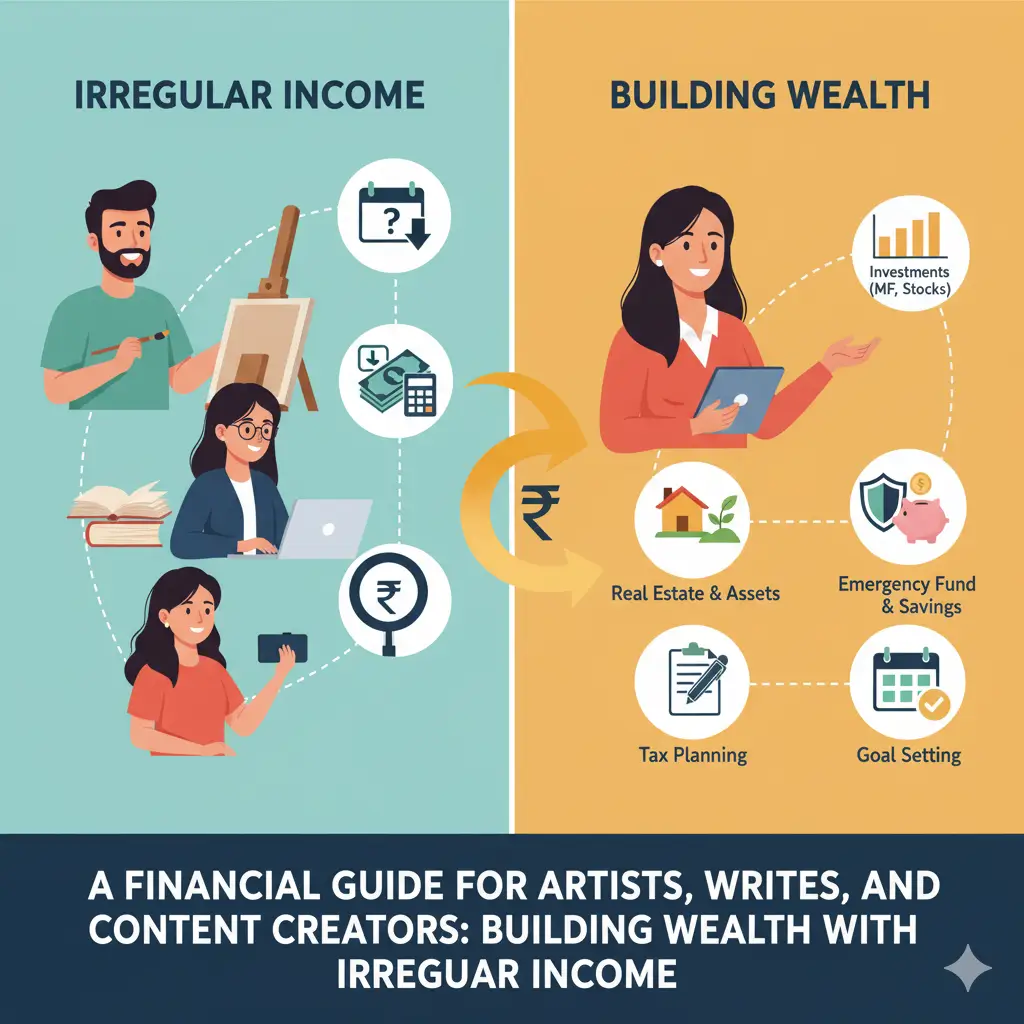
It’s 11 PM. Priya, a freelance illustrator, just completed a commission that took three weeks. The client paid ₹45,000. She’s elated—this is good money. But as she updates her expenses spreadsheet, reality hits: this is her only income for the month. Next month, she has two potential projects, but neither is confirmed. The month after? Nothing yet. Meanwhile, her rent is ₹18,000 monthly, GST return is due, and her parents keep asking when she’ll get a “real job.”
Across town, Arjun refreshes his YouTube Studio dashboard. His finance education channel just crossed 100K subscribers. Last month’s AdSense: ₹1.2 lakhs. This month: ₹85,000. One video went viral and paid ₹40,000 alone, but he can’t predict which video will pop next. His friends in IT jobs get ₹1.2 lakhs every single month like clockwork. He gets anywhere from ₹60,000 to ₹2 lakhs, and never knows which.
This is the creative professional’s reality. No steady paycheck. No employer EPF. No company insurance. No predictability. But also: unlimited earning potential, creative freedom, location independence, and the ability to turn passion into profit. This guide will show you how to build rock-solid financial stability despite the roller coaster income.
The Creative Professional’s Financial Reality
Income sources: Client projects, royalties, AdSense, sponsorships, commissions, licensing, teaching workshops. Monthly variation: 100-400% (yes, that extreme). GST threshold: ₹20 lakhs for services, ₹40 lakhs for goods. Tax filing: Quarterly advance tax if income exceeds ₹10,000 annually. Expense tracking: Critical for tax deductions (30-50% savings possible). Emergency fund needed: 12-18 months (not 6 like salaried). Retirement planning: Your responsibility entirely. The freedom is real, but so is the financial complexity.
Understanding Your Creative Income Streams
Before we plan finances, let’s map out how creative professionals actually earn money in India today. Your income likely comes from multiple sources, each with different tax implications.
Direct Client Work: The Foundation
Whether you’re a freelance writer charging ₹3 per word, a photographer shooting weddings at ₹50,000 per event, or a graphic designer creating logos for ₹15,000 each, direct client work is probably your primary income. You invoice clients, they pay you, and this is straightforward business income.
Tax treatment: This is “Profits and Gains of Business or Profession” income. You can claim all business expenses—laptop depreciation, software subscriptions, internet bills, co-working space rent, equipment purchases. Keep every receipt, every bill. These expenses directly reduce your taxable income.
Copyright and Royalty Income: The Passive Dream
Book royalties, music streaming income from Spotify, stock photo sales on Shutterstock, YouTube AdSense revenue—these are copyright royalties. The beauty here is that you create once and earn multiple times. A YouTube video from 2020 can still generate income in 2025.
Tax treatment: Copyright royalties get a special benefit—30% standard deduction before you even start claiming expenses. So if you earn ₹10 lakhs in book royalties, ₹3 lakhs is automatically deducted, and you only pay tax on ₹7 lakhs. Plus, you can claim actual expenses on top of this 30%. This is huge.
Brand Sponsorships and Collaborations
Instagram influencers doing brand collaborations, YouTubers with sponsored videos, podcast hosts with ad reads—this is straightforward professional income. A brand pays you ₹50,000 to feature their product in your content. This is business income, similar to client work.
Teaching and Workshops
Many creatives supplement income by teaching—conducting photography workshops, online courses on Udemy, live classes on Unacademy, or one-on-one mentorship. This is professional income. If teaching is occasional (under 25% of your total income), you can treat it under the same business head as your creative work.
Product Sales: Merchandise and Art
Selling your artwork, merchandise, handmade products on Instagram, or through your website involves goods and services. If you’re manufacturing/creating products yourself, this is business income. If you’re just reselling, it might be trading income. The GST threshold here is ₹40 lakhs (double the services threshold).
| Income Type | Examples | Tax Treatment | Special Benefits |
|---|---|---|---|
| Client Projects | Freelance writing, design work, photography | Business income, claim all expenses | Standard business deductions |
| Copyright Royalties | YouTube AdSense, book royalties, music streaming | Business income with 30% standard deduction | 30% automatic deduction + actual expenses |
| Brand Sponsorships | Instagram collabs, sponsored content | Professional income | Can claim all business expenses |
| Teaching Income | Workshops, online courses, mentorship | Professional income | Travel, materials deductible |
| Product Sales | Art prints, merchandise, handmade goods | Business income from manufacturing | ₹40L GST threshold (vs ₹20L services) |
Real Example: Neha’s Multiple Income Streams
Profile: Neha, 29, full-time content creator and freelance writer.
Annual Income Breakdown: YouTube AdSense ₹8.5 lakhs (copyright royalty), Brand sponsorships ₹6 lakhs (professional income), Freelance article writing ₹4.5 lakhs (professional income), Digital products (ebooks, templates) ₹2 lakhs (business income). Total: ₹21 lakhs annually.
Business Expenses Claimed: Camera and equipment ₹1.2 lakhs (depreciation), Laptop and accessories ₹80,000, Software subscriptions (Adobe, Canva, hosting) ₹65,000, Internet and phone bills ₹36,000, Co-working space rent ₹1.5 lakhs, Travel for content ₹45,000, Professional fees (CA, lawyer) ₹40,000. Total expenses: ₹4.6 lakhs.
Tax Calculation: YouTube income ₹8.5L gets 30% standard deduction = ₹2.55L deducted automatically. Other income ₹12.5L – Business expenses ₹4.6L = ₹7.9L taxable. Total taxable income: ₹5.95L + ₹7.9L = ₹13.85L. After 80C (₹1.5L ELSS) and 80D (₹25K insurance) deductions, taxable income: ₹12.1L. Tax: ₹1.95L approximately. Effective tax rate: just 9.3% on ₹21 lakhs income! Proper expense tracking saved her ₹3+ lakhs in taxes.
Managing Cash Flow: The Feast and Famine Cycle
The hardest part of creative finances isn’t earning money, it’s managing the unpredictability. In March, you earn ₹2.5 lakhs from three projects. You feel rich. In April, you earn ₹35,000 from one small project. Panic sets in. This is why cash flow management is more critical for creatives than anyone else.
The 12-Month Emergency Fund: Non-Negotiable
Salaried employees need a 6-month emergency fund. You need 12-18 months. Why? Because dry spells can last. A writer might go three months without landing a good client. A YouTuber’s channel might see sudden algorithm changes killing views. An illustrator might have project delays from clients.
Calculate your bare minimum monthly expenses—rent, food, utilities, loan EMIs if any, insurance premiums. Let’s say it’s ₹35,000. Your emergency fund should be ₹4.2-6.3 lakhs. Keep this in liquid investments: ₹2 lakhs in savings account for immediate access, ₹2 lakhs in liquid mutual funds (1-2 days access), rest in short-term FDs. Use the Emergency Fund Calculator to determine your exact requirement.
The Income Averaging Method
Never budget based on your best month or most recent income. Calculate your average monthly income over the last 12 months. If you earned ₹18 lakhs over the past year, your average monthly income is ₹1.5 lakhs. Budget your lifestyle for ₹1.2 lakhs (80% of average), not ₹1.5 lakhs. This buffer absorbs the variations.
Every month, transfer funds to different buckets: 40% to bare expenses account, 30% to tax and GST account (you’ll need this for quarterly advance tax and annual GST returns), 20% to investment account (auto-SIP from here), 10% to lifestyle and growth account (this is your guilt-free spending money).
The Peak Month Discipline
When you have a ₹3 lakh month, the urge to upgrade your lifestyle is overwhelming. Resist. Follow this rule: In peak months, live normally. Put 70% of the “extra” income (above your average) directly into investments or debt prepayment. So if your average is ₹1.5 lakhs and you earn ₹3 lakhs, the extra ₹1.5 lakhs should see ₹1.05 lakhs going to savings, ₹45,000 to lifestyle upgrade or treats.
This discipline during good months is what carries you through dry months without panic. Many creatives blow through peak months and then struggle in lean months. Don’t be that person.
⚠️ The Creative’s Cashflow Killer: Taking on expensive monthly commitments (high rent, car EMI, lifestyle subscriptions) based on your best month’s income. You earn ₹2 lakhs one month, get excited, upgrade to ₹40,000 rent from ₹25,000. Then average monthly income over next 6 months is ₹1.1 lakhs. That ₹15,000 extra rent becomes suffocating. Always commit to monthly expenses based on your minimum reliable income, not average, definitely not peak.
GST Registration and Compliance for Creatives
Once your annual income crosses ₹20 lakhs from services (or ₹40 lakhs from goods), GST registration becomes mandatory. But many freelancers voluntarily register even at ₹10-12 lakhs annual income. Why? Because it adds credibility with corporate clients who prefer GST-registered vendors.
Understanding GST for Your Work
Most creative services attract 18% GST. When you invoice a client ₹50,000 for design work, if you’re GST registered, you charge ₹59,000 (₹50,000 + ₹9,000 GST). You collect this ₹9,000 from the client and deposit it with the government monthly or quarterly (depending on your turnover).
The advantage? Input Tax Credit. If you bought a laptop for ₹80,000 + ₹14,400 GST, you paid ₹94,400. But you can claim that ₹14,400 back against the GST you collect from clients. This reduces your GST liability. Same for software subscriptions, equipment, everything with GST.
GST Filing: The Reality
Under the regular scheme, you file GSTR-3B monthly (summary of sales and purchases) and GSTR-1 monthly/quarterly (detailed invoice-level sales). For most freelancers with annual turnover under ₹1.5 crores, quarterly filing is allowed. Hire a CA for ₹12,000-20,000 annually to handle this. Trying to do it yourself rarely works out—the portal is complex, and mistakes are costly.
The Composition Scheme Alternative
If your turnover is under ₹1.5 crores, you can opt for the Composition Scheme. You pay flat 6% GST on total turnover, file returns quarterly instead of monthly, and have much less compliance burden. The catch? You can’t claim input tax credit and can’t issue regular GST invoices. This works for creatives who don’t have many business purchases and whose clients don’t need input credit (individuals, small businesses).
Calculate Your Income Tax & Plan Investments
Understand your tax liability and start goal-based investing despite irregular income.
Expense Tracking: Your Tax-Saving Superpower
Every rupee you spend on your creative business reduces your taxable income. But only if you can prove it. This is where most freelancers lose thousands in potential tax savings—they simply don’t track expenses properly.
The Must-Track Expenses
Start with the obvious: Equipment purchases (camera, laptop, tablet, microphone, lighting), Software and app subscriptions (Adobe Creative Cloud, Canva Pro, website hosting, domain renewal), Internet and phone bills (you can claim 80% as business expense), Co-working space or home office rent (if you have dedicated space, claim proportional rent as expense), Travel for client meetings or content creation (flights, hotels, cabs—all deductible with proper bills).
Don’t forget: Professional fees (lawyer for contracts, CA for tax filing), Books and courses (skill development directly related to your work), Business meals (meeting potential clients over coffee, yes, these count!), Marketing expenses (Instagram ads, Google ads, website SEO), Printing and stationery (business cards, notebooks, portfolios).
The Documentation System
Use apps like Zoho Expense or simple Google Drive folders. Create a folder structure: Equipment, Software, Travel, Meals, Professional Services. Every time you make a business purchase, take a photo of the bill immediately and upload to the correct folder. At month end, update your expense sheet.
Your CA will thank you during tax filing, and you’ll be shocked at how much you can claim. Most freelancers can legitimately claim 25-40% of gross income as business expenses. On ₹15 lakhs income, that’s ₹3.75-6 lakhs in deductions, saving ₹1.12-1.8 lakhs in taxes.
Deductible Expense Checklist for Creatives: ✓ Equipment and gadgets (laptop, camera, tablet, phone), ✓ Software subscriptions (Creative Cloud, hosting, tools), ✓ Internet and phone bills (80% business use), ✓ Co-working space or home office rent (proportional), ✓ Travel for work (with proper bills and purpose documentation), ✓ Professional development (courses, books, conferences), ✓ Marketing and advertising costs, ✓ Professional fees (CA, lawyer, consultant), ✓ Business meals and client meetings, ✓ Insurance (professional liability, health, equipment). Keep every bill, receipt, invoice. Digital copies are fine.
Retirement Planning Without Employer EPF
This is the scary part for creative professionals. No employer is contributing to your retirement. No automatic EPF accumulating every month. Your retirement is 100% your responsibility.
The NPS Advantage for Self-Employed
National Pension System allows you to contribute any amount (as low as ₹500, as high as you want) and gives you the special ₹50,000 tax deduction under 80CCD(1B) over and above the ₹1.5 lakh 80C limit. For someone in 30% tax bracket, contributing ₹50,000 to NPS saves ₹15,600 in taxes. That’s a 31% immediate return!
Plus, NPS invests in equity and debt based on your age and risk appetite, offering market-linked returns typically 10-12% long-term. Start with ₹5,000 monthly NPS contribution. Increase by ₹1,000 every year. By the time you’re 60, you’ll have a significant corpus. Use the NPS Calculator to see projections.
The PPF Safety Net
Public Provident Fund is your safe, government-guaranteed investment. Currently offering 7.1% returns, completely tax-free at maturity. Contribute ₹12,500 monthly (₹1.5 lakhs annually, maxing out both 80C deduction and PPF limit). This becomes your financial safety net—an investment you absolutely cannot touch for 15 years, growing steadily regardless of your income fluctuations.
Equity Mutual Funds: The Growth Engine
With irregular income, traditional monthly SIP is challenging. Use a goal-based SIP with variable amounts. Set up an SIP of ₹5,000 as your bare minimum. But create the discipline to invest extra in good months. Earned ₹2 lakhs this month? Put an additional ₹30,000 lump sum in your mutual funds. The Goal-Based SIP Calculator helps plan for specific goals like house down payment or child’s education.
Over 15-20 years, equity mutual funds have delivered 12-15% returns. A ₹10,000 average monthly investment (some months ₹5,000, some months ₹20,000) compounds to ₹60-80 lakhs over 20 years. Add your NPS and PPF, and you’re looking at a ₹1.5-2 crore retirement corpus despite never having EPF.
Health Insurance: Not Optional for Freelancers
Without company health insurance, a single hospitalization can wipe out years of savings. A 5-day ICU stay at a private hospital in Mumbai or Bengaluru easily costs ₹5-8 lakhs. Without insurance, you’re one medical emergency away from financial devastation.
The Right Coverage
Get a ₹10 lakh individual health insurance policy if you’re single (costs ₹10,000-15,000 annually at age 30). If you have family, get ₹15 lakh family floater (costs ₹22,000-32,000 annually). Additionally, get a super top-up of ₹20 lakhs with ₹5 lakh deductible (costs just ₹6,000-9,000 annually).
This gives you effective coverage of ₹30 lakhs. First ₹10-15 lakhs from base policy, next ₹20 lakhs from top-up. Total outflow: ₹28,000-40,000 annually. And remember, this premium is tax-deductible under 80D, saving you ₹8,000-12,000 in taxes. Real cost: ₹20,000-28,000 annually for ₹30 lakh coverage. Not optional.
Building Multiple Income Streams: The Creative Professional’s Strategy
The most successful creative professionals don’t rely on one income source. They build a portfolio of income streams, so if one dries up, others continue.
The Income Stream Pyramid
Base layer (40-50% of income): Your primary skill—client projects, commissions. This requires active work but pays well. Middle layer (30-40% of income): Semi-passive streams—online courses, digital products, YouTube AdSense, affiliate marketing. You create once, earn repeatedly. Top layer (10-20% of income): Passive streams—book royalties, stock photography sales, music streaming, licensing your past work.
The goal isn’t equal distribution but resilience. When client work is slow, your digital products and passive income cushion the fall. When passive income dips, client work picks up slack. This diversification is your financial stability in an unstable profession.
Complete Financial Plan: Rohit’s Content Creator Journey
Profile: Rohit, 32, YouTube tech creator + freelance video editor. Average monthly income: ₹1.8 lakhs (₹1-3 lakhs variation).
Income Sources: YouTube AdSense ₹12 lakhs annually, Freelance video editing ₹6 lakhs, Brand sponsorships ₹3 lakhs, Online course on video editing ₹1.5 lakhs. Total: ₹22.5 lakhs (₹1.875L monthly average).
Monthly Budget (Based on ₹1.5L minimum comfortable income): Rent ₹30,000, Food and utilities ₹18,000, Internet and phone ₹2,000, Equipment and software ₹8,000, Health insurance ₹2,500, CA and professional fees ₹2,000, Personal expenses ₹12,000. Total fixed: ₹74,500. Buffer: ₹75,500 available for savings/taxes/lifestyle.
Savings and Investment Strategy:
- Emergency fund: Built to ₹12 lakhs (16 months expenses) in liquid investments
- Tax and GST reserve: ₹35,000 monthly set aside (covering advance tax and GST)
- NPS: ₹5,000 monthly auto-debit (₹60,000 annually, claiming 80CCD(1B) benefit)
- PPF: ₹12,500 monthly (₹1.5L annually, max 80C benefit)
- Equity mutual funds: Base SIP ₹10,000 + Extra ₹20,000-40,000 in good months (averaging ₹20,000 monthly over year)
- Term insurance: ₹1 crore cover (₹12,000 annually)
- Health insurance: ₹10L individual + ₹20L top-up (₹18,000 annually)
Business Expenses Claimed: Equipment depreciation ₹1.8L, Software and tools ₹1.2L, Home office rent (30% of actual) ₹1.1L, Internet and utilities ₹48K, Professional fees ₹30K. Total: ₹5.1 lakhs.
Tax Calculation: Gross income ₹22.5L, YouTube income ₹12L with 30% standard deduction = ₹3.6L. Other income ₹10.5L – Business expenses ₹5.1L = ₹5.4L. Taxable: ₹8.4L + ₹5.4L = ₹13.8L. After 80C (₹1.5L) and 80CCD(1B) (₹50K) and 80D (₹25K), taxable income: ₹11.55L. Tax: ₹1.82L. Effective rate: 8% only!
Wealth Projection: Current age 32, investing ₹47,500 monthly (PPF ₹12.5K + NPS ₹5K + MF ₹30K average). By age 55 (23 years): PPF ₹1.2Cr, NPS ₹75L, Equity MF ₹2.8Cr. Total: ₹4.75 crores despite never having employer EPF. This is the power of disciplined investing with irregular income.
Common Financial Mistakes Creative Professionals Make
The biggest mistake is treating every rupee earned as spendable income. When ₹1 lakh hits your account, you don’t have ₹1 lakh. You have ₹75,000 after setting aside for taxes, ₹60,000 after reserving for GST if applicable, ₹40,000 after emergency fund top-up and investments. Understanding this prevents the painful realization at tax time that you’ve spent money that wasn’t yours to spend.
Another trap is not maintaining separate business and personal accounts. Every rupee that enters your account looks like “your money” and spending becomes chaotic. Have a business account for all client payments and income. Pay yourself a monthly “salary” transfer to personal account. This clarity prevents overspending in good months.
Many creatives also delay GST registration past the mandatory threshold, thinking they’ll avoid it. When the notice comes (and it will), the penalties and back-taxes are brutal. Register when you hit ₹18 lakhs, not ₹25 lakhs. Be compliant from the start.
Your Creative Financial Action Plan
First, calculate your average monthly income over the last 12 months. Not your best month, not last month—the average. This is your baseline for budgeting. If you haven’t tracked for 12 months, start now and use your best estimate for previous months.
Second, open three accounts: Business account (all income flows here), Tax reserve account (transfer 30-35% of every payment immediately), Personal account (pay yourself monthly from business account). This separation is game-changing for financial discipline.
Third, build your emergency fund aggressively. Until you have 12 months expenses saved, this is priority over aggressive investing. Start with 6 months as immediate goal, then push to 12 months. This fund is your freedom to say no to bad clients and low-paying projects.
Fourth, track every single business expense starting today. Create a simple spreadsheet or use expense tracking app. At year-end, you’ll have ₹3-6 lakhs in legitimate deductions that would have been lost otherwise.
Fifth, automate minimum investments. ₹5,000 monthly in equity SIP, ₹5,000 in NPS, ₹12,500 in PPF. These auto-debits force saving even in lean months. In good months, manually add extra to equity mutual funds. This variable-but-disciplined approach works with irregular income.
Finally, don’t try to DIY your taxes. A good CA costs ₹12,000-25,000 annually but saves you ₹50,000-2 lakhs in taxes through proper planning and deductions. This is the best ROI expense in your budget. Use the Income Tax Calculator to understand your liability, but let a professional handle filing.
✓ Creative Professional Success Formula: Track every expense religiously. Separate business and personal money. Build 12-month emergency fund before aggressive investing. Automate minimum savings (PPF + NPS + SIP). Claim 30-40% expenses to reduce taxable income. Don’t live off peak months—save 70% of extra income. Register for GST at ₹18L, not ₹25L. Get ₹30 lakh health coverage (₹10L base + ₹20L top-up). Diversify income streams (active + semi-passive + passive). Hire CA for taxes (saves 4-10X their fee). Most importantly: Trust the process. Irregular income doesn’t mean unstable wealth—it just requires different strategies.
Frequently Asked Questions
How do I manage finances with irregular creative income? +
Build a 12-18 month emergency fund (not 6 months like salaried jobs), calculate your average monthly income over last 12 months and budget on 80% of that (not your best month), automate minimum savings in good months, separate business and personal bank accounts, track every expense religiously for tax deductions, and maintain a tax reserve account where you immediately transfer 30-35% of every payment. The key is living on your minimum reliable income, not average, definitely not peak. Peak months are for building buffers, not lifestyle upgrades.
How is copyright and royalty income taxed in India? +
Copyright royalties (YouTube AdSense, book royalties, music streaming, stock photos) are taxed as business income under “Profits and Gains of Business or Profession” but get a special 30% standard deduction automatically. So on ₹10 lakhs royalty income, ₹3 lakhs is deducted before calculating tax. Plus, you can claim actual business expenses on top of this 30%. YouTube, Spotify, book publishers—all fall under this beneficial treatment. This is significantly better than regular professional income taxation.
Do I need GST registration as a freelance creative? +
Yes, if your annual income from services exceeds ₹20 lakhs (writing, design, consulting, content creation). For selling goods (artwork, merchandise, products), threshold is ₹40 lakhs. Once registered, you charge 18% GST on invoices, file monthly or quarterly returns, and can claim input tax credit on business expenses. Many freelancers voluntarily register even at ₹12-15 lakhs income because corporate clients prefer GST-registered vendors and you can claim ITC on equipment purchases, reducing costs 15-20%.
What business expenses can I claim as a creative professional? +
Almost everything used for your work: Equipment (camera, laptop, tablet, microphone), Software subscriptions (Adobe, Canva, hosting), Internet and phone bills (80% if mixed use), Co-working space or proportional home office rent, Travel for client meetings or content (with bills and purpose), Professional development (courses, books, conferences), Marketing costs (ads, SEO, website), Professional fees (CA, lawyer), Business meals with clients, Insurance (health, equipment, professional liability). Keep every receipt. Most creatives can legitimately claim 30-40% of gross income as expenses, saving ₹1-2 lakhs in taxes on ₹10 lakhs income.
How much should I save monthly with irregular income? +
Aim for 35-40% of average monthly income, but implemented differently than salaried people. Set up minimum automated investments: ₹5,000 equity SIP, ₹5,000 NPS, ₹12,500 PPF (₹22,500 total). These run even in lean months from emergency fund if needed. In good months earning above average, invest 50-70% of the “extra” amount as lump sum in equity mutual funds. Example: If average income is ₹1.5L and you earn ₹2.8L one month, invest additional ₹50,000 as lump sum. This variable-but-disciplined approach works better than fixed high SIPs that fail in dry months.
Do I need to pay advance tax as a freelancer? +
Yes, if your total tax liability exceeds ₹10,000 in a financial year, you must pay advance tax in four installments: 15% by June 15, 45% by September 15, 75% by December 15, and 100% by March 15. Failure attracts interest under sections 234B and 234C. With irregular income, estimate conservatively based on average of last year. Set aside 30-35% of every payment in a separate “tax reserve” account. Your CA will help calculate exact amounts. Many freelancers miss this and face ₹15,000-50,000 interest penalties at year-end.
Should I register a company or continue as individual freelancer? +
Continue as individual/proprietor until income crosses ₹25-30 lakhs annually or you need significant liability protection. Individual status gives you the 30% royalty deduction, simpler tax filing, lower compliance costs (no separate company returns), and full control. Downside: Personal liability for business debts. Company (Private Limited) offers liability protection, better credibility with large clients, easier to raise funding, but needs separate balance sheets, higher CA fees (₹50,000-1 lakh vs ₹12,000-25,000), and you lose the 30% royalty benefit. For most creatives under ₹30L income, proprietorship is optimal.
How do I plan for retirement without employer EPF? +
Build a three-pillar approach: (1) PPF ₹12,500 monthly (safe, tax-free, guaranteed 7%+), (2) NPS ₹5,000-10,000 monthly (market-linked, extra ₹50K tax deduction, 10-12% returns), (3) Equity mutual funds ₹15,000-30,000 monthly average through variable SIP (12-15% long-term returns). This mix of safety (PPF), tax efficiency (NPS), and growth (equity) replaces employer EPF. Starting at age 30 with ₹30,000 monthly average across these three, you’ll build ₹2-3 crore corpus by 60. The key is starting early and being consistent despite income irregularity. Minimum monthly investment is non-negotiable; extra in good months is bonus.
Essential Tools for Creative Professionals
- → Income Tax Calculator for Freelancers
- → Freelancer Tax Calculator
- → Goal-Based SIP Calculator
- → Emergency Fund Calculator
- → NPS Retirement Calculator
- → Complete Freelancer Financial Planning Guide
- → Content Creator Money Management Guide
- → Financial Planning for Artists
- → All Financial Planning Guides
Disclaimer: This guide provides general financial planning information for creative professionals and should not be considered personalized financial advice. Tax laws, GST regulations, and deduction rules are subject to change and interpretation. Income figures, expense percentages, and tax calculations mentioned are illustrative and vary significantly by individual circumstances, income sources, and expense patterns. The 30% standard deduction on copyright royalties and expense deductibility depends on proper documentation and may be subject to scrutiny. GST thresholds and rates mentioned are current as of September 2025 but check latest government notifications. Always maintain proper documentation for all income and expenses. Consult qualified chartered accountants for tax filing, GST compliance, and personalized financial planning. Investment returns mentioned are historical averages and not guaranteed. Past performance does not predict future returns. Every creative professional’s financial situation is unique. CalcWise is not responsible for any financial or tax decisions made based on this information.