
Your offer letter says “₹18 lakhs CTC + ESOPs worth ₹6 lakhs at current valuation.” You’re excited. Your friend at another startup says his ESOPs made him ₹40 lakhs when the company got acquired. Your colleague says she exercised her options, paid ₹3 lakhs in taxes, and the company shut down six months later—those shares are now worthless, and she’s out ₹3 lakhs.
You Google “ESOPs explained” and drown in jargon: vesting schedule, cliff, strike price, fair market value, perquisite tax, capital gains, illiquidity discount. Your HR can’t explain beyond “it’s equity in the company, very valuable.” Your CA friend says “don’t exercise early, you’ll pay huge taxes.” Your neighbor who works at Flipkart says “best decision I made was exercising early.”
So what’s the truth? Are ESOPs the wealth-creation magic that startup recruiters promise, or are they lottery tickets that usually expire worthless? The answer is: both. They can make you crores, or cost you lakhs. This guide will help you understand what you actually own, when to exercise, how taxation works, and most importantly, when ESOPs are worth the bet and when they’re not.
ESOP Reality Check
ESOPs are options to buy company shares at a fixed low price (strike price), vesting over time (typically 4 years). Taxation: Double whammy – taxed at exercise (perquisite income at slab rate up to 30%), taxed again at sale (capital gains 20% LTCG for unlisted if held 24+ months). Value: ₹6 lakhs “ESOP value” in offer letter is often fiction – actual realizable value depends on exit, which happens in 10% of startups. Risk: Illiquid, company might fail, dilution happens. Upside: Genuine wealth creation if company succeeds – ₹10 lakhs ESOPs can become ₹1 crore+ in unicorn exits. Know what you’re getting into.
ESOP Basics: What Exactly Are You Getting?
Let’s strip away the jargon. An ESOP (Employee Stock Option Plan) gives you the option to buy a certain number of company shares at a pre-decided low price (called exercise price or strike price). You don’t get shares immediately. You get the option to buy them in the future, after they vest.
The Key Terms You Must Understand
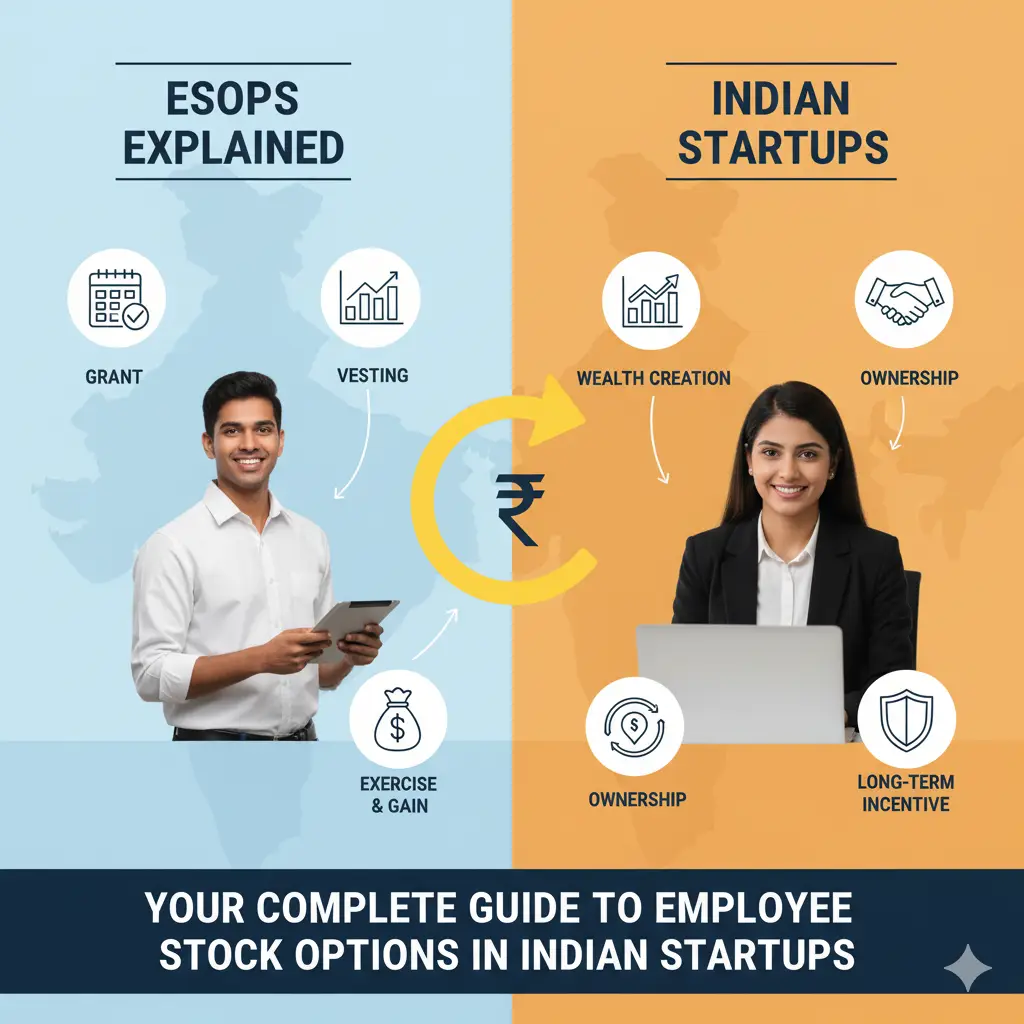
Grant Date: The day company says “we’re granting you 10,000 stock options.” You don’t own anything yet. You own the right to buy shares in the future.
Exercise Price / Strike Price: The price per share you’ll pay to convert your options into actual shares. Let’s say ₹10 per share. This is fixed at grant date and doesn’t change.
Vesting Schedule: The timeline over which you earn the right to exercise your options. Most common: 4-year vesting with 1-year cliff. This means: nothing vests in first year (the cliff), then 25% vests after year 1, and remaining 75% vests monthly or quarterly over next 3 years.
Vesting Date: The specific date when a batch of your options becomes exercisable. After year 1, you might have 2,500 options vested (25% of 10,000). You can now choose to exercise these.
Exercise: The act of paying the strike price to convert your vested options into actual shares. If you have 2,500 vested options at ₹10 strike price, you pay ₹25,000 to the company and get 2,500 shares.
Fair Market Value (FMV): The current value per share as determined by the company (usually based on latest funding round). If company recently raised Series B at ₹100 per share valuation, the FMV is ₹100. This number matters hugely for taxes.
Real Example: Rahul’s ESOP Journey
Grant Date: Jan 1, 2021. Rahul joins a Series A startup as Senior Engineer. Offer letter: ₹18 lakhs salary + 10,000 ESOPs. Strike price: ₹20 per share. Company valuation: ₹200 crores (FMV at that time: ₹100 per share).
Year 1 (Jan 2021 – Dec 2021): Rahul works hard. No options vest (1-year cliff). If he leaves, he gets zero equity.
Jan 2022: Year 1 completed! 2,500 options vest (25% of 10,000). Rahul can now exercise these if he wants. To exercise: pay ₹50,000 (2,500 × ₹20). Company has raised Series B, new FMV is ₹200 per share. Should he exercise? We’ll answer this later.
Jan 2022 – Dec 2024: Remaining 7,500 options vest monthly (208 options per month). By end of year 4, all 10,000 are vested.
The Decision Point: Rahul now owns 10,000 vested options. Strike price ₹20, current FMV ₹250 (Series C raised). To exercise all: pay ₹2 lakhs (10,000 × ₹20). But there’s also tax…
The Double Taxation Nightmare: How ESOPs Are Taxed in India
This is where dreams meet reality. ESOPs in India face double taxation, and it’s brutal. You pay tax twice: once when you exercise, again when you sell. Let’s understand both.
First Tax Hit: At Exercise (Perquisite Income)
When you exercise your options, the difference between Fair Market Value and your Strike Price is considered “perquisite income” – basically, the discount you’re getting on shares. This is added to your salary income and taxed at your slab rate (which could be 30% + cess if you’re in highest bracket).
Math: You exercise 2,500 options. Strike price ₹20, FMV ₹200. Perquisite = (₹200 – ₹20) × 2,500 = ₹4.5 lakhs. This ₹4.5 lakhs is added to your salary. If you’re in 30% tax bracket, you pay ₹1.4 lakhs tax immediately. Yes, you pay ₹1.4 lakhs in cash taxes for shares you can’t even sell yet.
Many employees don’t understand this. They exercise thinking “I’m buying shares cheap.” Then tax bill comes and they’re shocked. You need cash for both strike price payment AND perquisite tax. In this example: ₹50,000 strike price + ₹1.4 lakhs tax = ₹1.9 lakhs cash needed to exercise 2,500 options.
Second Tax Hit: At Sale (Capital Gains)
Years later, company gets acquired or goes public. You finally sell your shares. The profit from sale price minus your FMV at exercise time is capital gains.
For unlisted companies (most startups): If you held shares for more than 24 months after exercise, it’s Long-Term Capital Gains (LTCG) taxed at 20% with indexation benefit. If less than 24 months, Short-Term Capital Gains (STCG) taxed at your slab rate (up to 30%).
For listed companies (post-IPO): If held more than 12 months, LTCG at 10% without indexation on gains above ₹1 lakh. If less than 12 months, STCG at 15%.
Complete Tax Calculation: From Grant to Exit
2021: Granted 10,000 options at ₹20 strike price. FMV ₹100.
2023: Exercise all 10,000 vested options. FMV now ₹250. Pay ₹2 lakhs strike price (10,000 × ₹20). Perquisite income: (₹250 – ₹20) × 10,000 = ₹23 lakhs. Perquisite tax: ₹23L × 30% = ₹6.9 lakhs. Total cash needed: ₹2L + ₹6.9L = ₹8.9 lakhs to exercise.
2026: Company gets acquired at ₹800 per share. Sell all 10,000 shares for ₹80 lakhs. Held for 3 years since exercise (LTCG). Cost base for capital gains: ₹250 (FMV at exercise). Capital gains: (₹800 – ₹250) × 10,000 = ₹55 lakhs. With indexation (assume 15% over 3 years): Indexed cost ₹287. Taxable gain: ₹51.3 lakhs. LTCG tax: ₹51.3L × 20% = ₹10.26 lakhs.
Final Math: Received ₹80 lakhs. Paid ₹2L strike price + ₹6.9L perquisite tax + ₹10.26L capital gains tax = ₹19.16L total. Net gain: ₹80L – ₹19.16L = ₹60.84 lakhs. Not bad! But notice: you paid ₹8.9 lakhs in 2023 for shares you couldn’t sell. If company had failed between 2023-2026, that ₹8.9L was gone forever.
| Tax Event | What’s Taxed | Tax Rate | When Paid |
|---|---|---|---|
| At Exercise (Perquisite) | FMV – Strike Price | Your salary slab rate (up to 30% + cess) | Immediately when you exercise |
| At Sale (LTCG – Unlisted) | Sale Price – FMV at exercise | 20% with indexation (if held 24+ months) | When you actually sell shares |
| At Sale (STCG – Unlisted) | Sale Price – FMV at exercise | Your slab rate (up to 30%) | When you sell (if held under 24 months) |
| At Sale (LTCG – Listed/IPO) | Sale Price – FMV at exercise | 10% (no indexation) on gains above ₹1L | When you sell (if held 12+ months) |
⚠️ The Exercise Tax Trap: You exercise options paying ₹5 lakhs strike price + ₹8 lakhs perquisite tax. Total ₹13 lakhs cash out of pocket. Six months later, company faces problems, valuation crashes or company shuts down. Your shares are now worthless or worth far less than ₹13 lakhs you paid. This happens to thousands of startup employees. The perquisite tax is based on FMV at exercise, not eventual sale price. If you exercise and company fails, you lose both the strike price and the tax paid. This is why exercising early is extremely risky.
When Should You Exercise Your ESOPs?
This is the million-dollar question. Or more accurately, the decision that could cost you lakhs or make you crores. There’s no universal answer, but here’s the framework.
Exercise Only If ALL These Conditions Are Met:
1. Company is very close to exit (IPO or acquisition within 12 months): Don’t exercise based on hope. Exercise based on concrete plans. Company filed DRHP with SEBI? Acquisition term sheets signed? That’s when you consider exercising.
2. You have cash to pay strike price AND perquisite tax without stress: If exercising requires taking a loan or depleting emergency fund, don’t do it. You need ₹5-10 lakhs lying around that you can afford to lose completely.
3. You’re confident about company’s prospects and valuation being maintained or growing: If company just raised Series C at ₹500 crore valuation but isn’t growing revenue, that valuation might not hold at exit. Your FMV-based tax might be on inflated valuation.
4. You’ve been at the company 2+ years and understand the business deeply: Don’t exercise based on recruiter’s pitch. Exercise based on your inside knowledge of company’s real health.
Do NOT Exercise If:
Company is pre-Series B or struggling to raise next round. No clear path to exit in next 18-24 months. You don’t have spare cash to pay strike price and taxes. Company’s growth has stalled or declining. You’re planning to leave company soon. Your vesting period just started (wait till you’re more vested).
The Conservative Strategy: Wait Till Exit Is Imminent
For most startup employees, the right strategy is: Let options vest but don’t exercise. Wait till company announces IPO or acquisition. Then exercise right before exit if the math makes sense. Yes, you might pay higher perquisite tax if FMV increased. But you avoid the massive risk of exercising early and company failing.
The only exception: If company is doing extremely well, has clear path to IPO in 12-18 months, and FMV is still reasonable, early exercise might save you taxes by locking in lower FMV. But this is rare and risky.
The 90-Day Exit Trap: Most ESOP agreements say if you leave the company, you have 60-90 days to exercise your vested options or they expire worthless. This creates golden handcuffs – you can’t leave without either exercising (paying huge cash + taxes for illiquid shares) or losing your vested equity. Many employees stay in mediocre jobs because leaving means forfeiting ₹10-20 lakhs worth of vested options they can’t afford to exercise. Read your ESOP agreement carefully for this clause before accepting the offer.
Calculate Your ESOP Taxes and Returns
Understand the tax implications and potential returns on your stock options before exercising.
Understanding Your ESOP’s Real Value
Your offer letter says “ESOPs worth ₹8 lakhs at current valuation.” What does this actually mean?
The Calculation Behind That Number
You’re granted 10,000 options. Company’s current FMV is ₹100 per share. Strike price is ₹20. HR calculates: 10,000 × (₹100 – ₹20) = ₹8 lakhs “value.” This is the paper value, not realizable value.
To realize this ₹8 lakhs, multiple things must happen: Company must succeed and exit (90% of startups fail – your probability of realizing anything is 10%), FMV must hold or grow (often doesn’t in down markets), You must stay long enough for options to vest (4 years), You must have cash to exercise when the time comes, Company must not dilute your ownership significantly in future rounds.
The Real Value Calculation
A more honest valuation applies discount factors: Success probability discount (70-90% reduction for early stage startups), Illiquidity discount (30-50% because you can’t sell for years), Time value discount (money in 5 years is worth less than money today), Dilution discount (your percentage will reduce in future funding rounds).
Applying these: ₹8 lakhs “ESOP value” with 10% success probability, 40% illiquidity discount, 30% time value discount = Real expected value ₹3.36 lakhs. That’s dramatically different from ₹8 lakhs headline number. Not saying don’t take ESOPs, but understand what you’re getting is a lottery ticket, not guaranteed wealth.
The Success Stories: When ESOPs Actually Work
Let’s balance the doom and gloom with reality: when startups succeed, ESOPs can be life-changing wealth. Here are real patterns from successful exits in India.
The Flipkart Windfall
When Walmart acquired Flipkart in 2018 for $16 billion, many early and mid-level employees made crores. Engineers who joined in 2010-2014 with ₹8-15 lakhs salary packages and modest ESOPs saw their stock options turn into ₹2-8 crores. Senior folks made ₹20-50 crores. The key factors: They stayed 6-10 years (full vesting and more), Company grew from Series A to acquisition, They exercised strategically (many waited till acquisition was imminent).
The Freshworks IPO
Freshworks went public in 2021. Employees could finally liquidate their shares. Many who joined pre-2018 with moderate salaries saw ₹10-15 lakhs worth of granted ESOPs turn into ₹50 lakhs to ₹2 crores at IPO. The wealth was real and liquid post-IPO.
The Common Pattern in Success Stories
Join early (pre-Series B ideally), when valuations are lower and your option grant is larger relative to company value. Stay long term (5+ years minimum) to fully vest and benefit from multiple valuation increases. Pick companies with genuine product-market fit and path to profitability, not just funding rounds. Don’t exercise early unless exit is imminent (most successful employees waited). Have patience (7-12 years from joining to exit is normal in successful startups).
✓ When ESOPs Made Sense: Priya’s Story Priya joined a B2B SaaS startup in 2017 as Product Manager at ₹14 lakhs salary + 15,000 ESOPs (strike price ₹15). She didn’t exercise for 5 years, just let them vest. Company grew steadily, raised Series B and C. In 2023, global company acquired them at ₹1,200 crore valuation. Her 15,000 options worth ₹250 per share at acquisition. She exercised 30 days before acquisition close: paid ₹2.25L strike price + ₹5.5L perquisite tax (FMV was ₹200 at exercise). Sold immediately post-acquisition at ₹250 = ₹37.5 lakhs. After short-term capital gains tax on ₹7.5L gain, she netted ₹29 lakhs. Total investment ₹7.75L, return ₹29L in 6 years. This is the dream scenario – it happens, just rarely.
The Failure Stories: When ESOPs Become Worthless
For every success story, there are nine failures. Let’s talk about the other 90%.
The Premature Exercise Disaster
Amit joined a hot edtech startup in 2020. Company raised Series B at ₹800 crore valuation during COVID boom. Amit had 8,000 options vested, strike price ₹30, FMV ₹180. His friend who worked at HR told him to exercise now before FMV goes higher. Amit paid ₹2.4 lakhs strike price + ₹3.6 lakhs perquisite tax. Total ₹6 lakhs invested. By 2023, edtech funding dried up. Company struggled, couldn’t raise Series C, pivoted multiple times, finally shut down in 2024. Amit’s shares: worthless. His ₹6 lakhs: gone forever. He still has the share certificates as expensive wall decoration.
The Dilution Trap
Neha joined a startup at Series A with 12,000 options representing 0.15% of company. Over 4 years, company raised Series B (10% dilution), Series C (15% dilution), Series D (12% dilution). Her 0.15% became 0.09% without her doing anything. The absolute number of shares stayed same, but percentage of company shrank. When company got acquired, her shares were worth 40% less than she expected purely due to dilution.
The Preference Share Wipeout
Most funding rounds include preference shares with liquidation preferences. This means: investors get paid first at exit before common shareholders (employees). Vikram’s company raised ₹300 crores total across multiple rounds with 1X liquidation preference. Company got acquired for ₹350 crores (sounds good!). But after investors took their ₹300 crores first, only ₹50 crores left for common shareholders. Vikram’s “worth ₹12 lakhs” ESOPs became worth ₹2 lakhs at exit. The bulk of exit value went to preference shareholders.
Your ESOP Decision Framework
Here’s a practical framework for every stage of your ESOP journey:
When Evaluating Job Offer
Don’t value ESOPs at face value. Apply 70-90% discount for risk. Choose between: Higher cash salary at stable company vs Lower cash + ESOPs at high-growth startup. If choosing startup, ensure cash salary covers living expenses. Treat ESOPs as lottery bonus, not guaranteed income.
During Vesting Period
Track your vesting schedule (put reminders). Understand company’s financial health (ask for metrics in all-hands). Watch for red flags: declining revenue, inability to raise funding, mass attrition. Don’t exercise during vesting unless exit is imminent. Consider your personal liquidity needs (don’t tie up cash in illiquid shares).
When Options Are Fully Vested
Wait for exit catalyst (IPO filing, acquisition talks, secondary sale opportunity). If company is struggling, don’t throw good money after bad. If leaving company, calculate: cost to exercise vs potential upside. Often better to let options expire than exercise in dying company.
At Exit Time
Exercise only when exit is certain (signed acquisition agreement or IPO pricing decided). Calculate all taxes before exercising. Consider selling immediately post-exit vs holding for LTCG (depends on company prospects post-exit).
Questions to Ask Before Accepting ESOP Offer: (1) What’s the strike price and current FMV? (2) What’s the vesting schedule and cliff period? (3) How many total shares outstanding (to calculate your percentage)? (4) What’s the liquidation preference structure? (5) What happens to vested options if I leave? (6) Is there a secondary market or have there been secondary sales? (7) What’s the company’s plan for employee liquidity? (8) Has company done any ESOP buybacks? Don’t accept an offer without clear answers to all these. HR might not know—ask to speak with CFO or senior leadership.
Comparing ESOPs Across Companies
Not all ESOPs are created equal. Here’s how to compare offers:
The Key Metrics
Percentage ownership: 10,000 options means nothing without knowing total shares outstanding. 10,000 out of 10 million (0.1%) is very different from 10,000 out of 100 million (0.01%).
Strike price vs FMV spread: Larger spread means higher paper value but also higher perquisite tax when exercising. Strike price ₹10 with FMV ₹200 (₹190 spread) is better than ₹150 strike with ₹200 FMV (₹50 spread) from value perspective, but worse from immediate tax perspective if you exercise.
Company stage: Earlier stage = more risk but higher potential upside and usually lower FMV. Series A ESOPs have 90% failure risk but 100X potential. Series C ESOPs have 70% failure risk but maybe 10X potential.
Vesting terms: 4-year vesting with 1-year cliff is standard. Anything worse (like 5-year vesting) is unfavorable. Some companies offer accelerated vesting on exit—that’s favorable.
Your ESOP Action Plan
If you have ESOPs today, here’s what to do:
First, read your ESOP grant agreement completely. Understand your vesting schedule, strike price, exercise window, and what happens if you leave. Put reminders for vesting dates.
Second, calculate your actual percentage ownership. Ask HR for total shares outstanding. Your options divided by total shares = your percentage. This is more meaningful than absolute number.
Third, track your company’s financial health. In all-hands meetings, pay attention to revenue growth, burn rate, runway, and funding plans. These predict whether your options will be worth anything.
Fourth, build personal liquidity outside your startup. Don’t tie up all wealth in illiquid ESOPs. Invest in mutual funds, PPF, other liquid assets. ESOPs should be 20-30% of your net worth maximum, not 80-90%.
Fifth, don’t exercise until exit is imminent unless you have very strong conviction and spare cash. The perquisite tax on early exercise is a real cash cost for shares you can’t sell.
Finally, use the Capital Gains Calculator to model different scenarios before exercising. Understand your total tax liability before committing.
Frequently Asked Questions
How are ESOPs taxed in India? +
ESOPs face double taxation in India: (1) At exercise – the difference between Fair Market Value and Exercise Price is taxed as perquisite/salary income at your slab rate (up to 30% + cess). You pay this tax immediately when exercising, before selling shares. (2) At sale – the profit from selling shares (Sale Price minus FMV at exercise) is taxed as capital gains. For unlisted companies, if held 24+ months, it’s LTCG at 20% with indexation. For listed companies post-IPO, if held 12+ months, it’s LTCG at 10% without indexation. This double taxation is why ESOPs can be expensive—you pay significant taxes even before realizing any actual money from selling shares.
When should I exercise my ESOPs? +
Exercise only when: (1) Company is very close to IPO or acquisition (within 12 months), (2) You have spare cash to pay strike price + perquisite tax without financial stress, (3) You’re highly confident about company’s exit prospects based on inside knowledge. For most employees, the conservative strategy is waiting till exit is imminent before exercising. Don’t exercise early based on hope—you’re paying real cash and immediate taxes for illiquid shares you can’t sell. If company fails after you exercise, you lose both the strike price payment and the taxes paid. Only exercise early if you have very high conviction and money you can afford to lose completely.
What happens to my ESOPs if I leave the company? +
Typically: (1) Unvested options are forfeited immediately upon resignation—you lose them completely. (2) Vested options usually must be exercised within 60-90 days of leaving, or they expire worthless. This creates “golden handcuffs”—you can’t leave without either exercising (paying significant cash + taxes for illiquid shares) or forfeiting your vested equity. If you have 5,000 vested options with ₹8 lakhs total cost to exercise (strike price + taxes) but no exit in sight, leaving means either paying ₹8 lakhs for shares you can’t sell, or losing the equity. Read your ESOP agreement carefully—the exact terms vary by company but this 60-90 day exercise window is standard and very restrictive.
How do I know if my ESOPs are actually valuable? +
Calculate your actual percentage ownership (your options ÷ total shares outstanding), not just absolute number. Assess company’s realistic exit probability—only 10% of startups successfully exit. Check company’s financial health: growing revenue, path to profitability, successful funding rounds. Understand liquidation preferences—investors might get paid first at exit, leaving less for employees. Apply discount factors: 70-90% for startup risk, 30-50% for illiquidity, time value discount. Example: ₹10 lakhs “ESOP value” at 10% success probability = ₹1 lakh expected value. Don’t value ESOPs at face value in offer letters—it’s usually optimistic fiction. Real value depends on exit happening at good valuation, which is rare.
Should I take lower salary for more ESOPs? +
Only if: (1) Cash salary still covers your living expenses comfortably, (2) You have 12+ months emergency fund saved, (3) Company is Series A or earlier with genuine high-growth potential, (4) You’re young (under 30) with time to recover if startup fails, (5) The ESOP grant is significant (0.1-0.5%+ ownership). Never take a salary that doesn’t cover expenses—ESOPs are illiquid and might be worthless. Better strategy: Take market salary at Series C+ company, or take 20-30% salary cut at promising Series A startup for meaningful equity. Don’t take 50% salary cut for ESOPs unless you’re a co-founder level early employee. Cash salary is guaranteed wealth. ESOPs are lottery tickets.
What is vesting and why does it matter? +
Vesting is the schedule over which you earn the right to exercise your options. Standard is 4-year vesting with 1-year cliff: Nothing vests in first year. If you leave before year 1, you get zero equity. After 1 year, 25% vests. Remaining 75% vests monthly or quarterly over next 3 years. This creates retention—company wants you to stay 4 years to earn full equity. It matters because: You get nothing if you leave before cliff completes, You only earn equity gradually over time, Leaving early means forfeiting unvested options (could be lakhs of value), Your negotiating power is highest at job offer—negotiate better vesting terms then, not later. Some companies offer accelerated vesting on acquisition/IPO—that’s very favorable as you don’t need to wait full 4 years.
Can I sell my ESOPs before company exit? +
Usually no, unless company allows it. Some well-funded startups (Series C+) organize ESOP buyback programs or allow secondary sales where existing investors buy employee shares. This provides liquidity before exit. But this is rare—most startups don’t allow selling until IPO or acquisition. Your shares in private company are highly illiquid. Even if you exercise, you own shares you can’t sell. There are emerging secondary markets for startup shares, but company typically has right of first refusal and must approve any sale. For most employees, ESOPs are locked until company exit, which might be 7-12 years from joining, or never if company fails. This illiquidity is a major risk factor many employees underestimate.
What questions should I ask about ESOPs during offer negotiation? +
Critical questions: (1) What’s the total shares outstanding? (need this to calculate your ownership %), (2) What’s current FMV per share?, (3) What’s the strike price for my options?, (4) What’s the vesting schedule and cliff period?, (5) What’s the liquidation preference structure from funding rounds?, (6) What happens to vested options if I leave? (60 days? 90 days?), (7) Is there accelerated vesting on acquisition/IPO?, (8) Has company done any ESOP buybacks or secondary sales?, (9) What’s the typical time to exit for companies in your sector?, (10) Can I see the ESOP agreement before accepting? Don’t accept offer without clear answers to all these. If HR doesn’t know, insist on speaking with CFO or senior leadership. These terms massively impact whether your ESOPs are valuable or worthless.
Essential Tools for ESOP Planning
Disclaimer: This guide provides general educational information about ESOPs and should not be considered personalized financial or tax advice. ESOP terms, taxation rules, vesting schedules, and company policies vary significantly. Tax treatment described is based on current Indian tax law which is subject to change. The examples and scenarios mentioned are illustrative and actual outcomes depend on company success, market conditions, and individual circumstances. Exercise prices, FMV, and valuations mentioned are hypothetical. The 90% failure rate for startups is an industry estimate—your specific situation may vary. Always read your ESOP grant agreement completely and consult with qualified chartered accountants for tax implications before exercising options. Consult with financial advisors for decision-making on ESOP exercise timing and strategy. The guide’s emphasis on risks is based on startup failure statistics and should not deter you from considering ESOPs, but should inform realistic expectations. Success stories mentioned are real but not representative of typical outcomes. CalcWise is not responsible for any financial or career decisions made based on this information.