
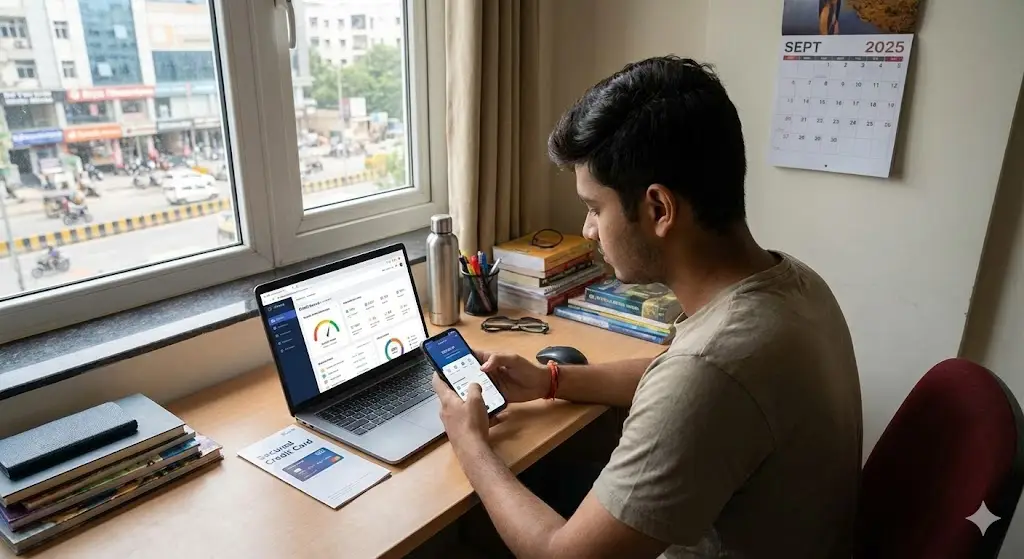
How to Build Credit Score as a Student in India — From 0 to 750+ CIBIL Guide
📘 Credit Score for Students — Why Starting Early Matters
A CIBIL credit score is a 3-digit number (300-900) that determines your eligibility for home loans, car loans, personal loans, and even rental agreements in India. Building a strong credit score from student age (18-22) means you arrive at your first home loan application with 5-6 years of clean credit history — qualifying for the best rates (8.50% vs 9.25% for someone with no credit history, saving ₹11+ lakh over 20 years on a ₹50L home loan). This guide shows Indian students exactly how to build credit responsibly from zero.
📊 Credit Score India — Key Data
- TransUnion CIBIL, 2025: India has 60+ crore credit profiles. Average CIBIL score: 738. Borrowers with 750+ score get home loans 0.5-1.0% lower interest rate than those with 650-700 score — saving ₹5-12 lakh on a ₹50L loan.
- RBI Financial Inclusion, 2025: Only 28% of Indians aged 18-25 have any credit history. Building credit young gives a significant advantage in India’s credit-dependent financial ecosystem.
- CIBIL Study, 2024: Average time to reach 750+ score from zero credit history: 18-24 months with disciplined credit card usage. With student loan repayment: 12-18 months.
- Loan Market Study, 2025: Home loan applicants with 750+ CIBIL score: 95%+ approval rate, best rate offers. 650-700: 60-70% approval rate, 0.5-1% higher rates. Below 650: high rejection rates across most banks.
1. How CIBIL Score Is Calculated
| Factor | Weight | What It Measures | Student Impact |
|---|---|---|---|
| Payment History | 35% | On-time vs late payments | Most critical — one missed payment = -50 to -100 points |
| Credit Utilisation | 30% | Balance used / credit limit | Keep below 30% at all times |
| Length of History | 15% | Age of oldest account | Starting young gives lifelong advantage |
| Credit Mix | 10% | Credit cards + loans + secured | Add a small personal loan after 12 months |
| New Credit Inquiries | 10% | Recent credit applications | Don’t apply for multiple cards simultaneously |
The formula is clear: pay on time, keep utilisation low, build history over years. Everything else is secondary. A student who opens one secured credit card at 18, pays it in full every month for 5 years, and never misses a payment will have a 780+ CIBIL score by age 23 — before taking any significant loan.
2. Secured Credit Card — The Student’s Best First Step
A secured credit card is issued against a Fixed Deposit. You deposit ₹10,000-25,000 as collateral; the bank issues a credit card with a limit of 80-90% of the FD. The FD earns 6.5-7% interest; the card works like any regular credit card for transactions and credit building.
Best Secured Credit Cards for Students in India 2026
| Card | Min FD | Annual Fee | Credit Limit | Perks |
|---|---|---|---|---|
| SBI Unnati | ₹25,000 | ₹0 (first 4yr) | ₹20,000 | 1% cashback on spends |
| Axis Bank Insta Easy | ₹10,000 | ₹500 | ₹8,000 | Reward points |
| ICICI Instant Platinum | ₹10,000 | ₹0 | ₹8,000 | No-cost EMI option |
| HDFC Secured | ₹25,000 | ₹500 | ₹20,000 | Airport lounge (limited) |
💡 Use the Secured Card Like a Debit Card
The safest way to use a secured credit card: only spend what you already have in your bank account. When you spend ₹800 on groceries, immediately transfer ₹800 from savings to a mental “credit card repayment” bucket. Pay the full statement balance 3 days before the due date — not on the due date. This discipline, practiced for 12-18 months, builds a flawless payment record that follows you for decades.
3. Student Loan — Build Credit While Funding Education
An education loan for your college fees (even a small ₹1-3 lakh loan from your bank) serves double purpose: funds education and builds credit history through regular repayment. If you have a parent with good credit history as co-borrower, education loan approval is straightforward even with no individual credit history.
Repaying the education loan EMI regularly for 2-3 years builds payment history — the most impactful factor in CIBIL scoring. Repaying consistently builds credit faster than any credit card because loan repayment shows discipline over a longer timeline.
4. Credit Card Do’s and Don’ts for Students
| ✅ DO This | ❌ Never Do This |
|---|---|
| Pay full outstanding balance by due date | Pay only the minimum due (interest starts immediately) |
| Use for budgeted monthly expenses (groceries, fuel) | Use for impulsive luxury purchases you can’t afford |
| Set a self-imposed monthly spending limit | Spend up to the bank’s approved credit limit |
| Set up auto-pay for the full balance | Rely on manual payment and risk forgetting |
| Check statement every week for errors | Ignore statements until due date |
| Keep utilisation below 30% | Use 80-90% of credit limit consistently |
| Apply for one card, use it responsibly for 12+ months | Apply for 3 cards simultaneously to get “more credit” |
5. Credit Utilisation — The Metric Most Students Get Wrong
Credit utilisation ratio = (Total credit card outstanding / Total credit limit) × 100. Keep this below 30% at all reporting dates. For a ₹20,000 credit limit card: never let the outstanding balance exceed ₹6,000 when CIBIL checks (typically month-end).
If your limit is low (₹10,000) and you spend ₹7,000/month on the card (70% utilisation), pay an interim payment mid-month before the statement is generated. Multiple mid-cycle payments are fine — each one reduces the reported utilisation. This is the most overlooked credit score optimisation for students.
6. The 12-Month Student Credit Building Plan
- Month 1: Open an FD of ₹15,000-25,000. Apply for a secured credit card against it. Get PAN (if not already done). Check free CIBIL score (likely “NH” — no history).
- Month 1-6: Use secured card for 2-3 budgeted transactions/month (groceries, phone bill, online subscription). Pay full balance 3 days before due date every month. Keep utilisation below 20%.
- Month 6: Check CIBIL score — should be 650-700 range now. First score established based on 6 months of clean history.
- Month 6-12: Continue same discipline. Score builds to 720-750+ range with 12 months of clean history.
- Month 12+: Apply for an unsecured credit card (regular card without FD collateral) — your 12-month secured card history makes you eligible. Get a slightly higher limit, which helps utilisation ratio.
- Year 2: Score should be 750-780 with 18-24 months of clean history. At this point, consider a small personal loan (₹25,000-50,000) and repay it over 12 months — adds credit mix diversity to further boost score.
7. Credit Mistakes That Take Years to Fix
- Missing even one EMI or minimum payment: A single missed payment stays on CIBIL report for 7 years. Even one 30-day late payment drops your score by 50-100 points and takes 12-24 months of perfect payment to recover.
- Settling a loan (instead of closing it): “Settled” in CIBIL means you paid less than full amount. This marks stays on your report for 7 years and banks treat it as near-default. Always close loans fully, never settle partially.
- Applying for multiple credit cards simultaneously: Each application = one hard inquiry = -5 to -10 points. Four applications in a month = -20 to -40 points AND signals financial desperation to lenders.
- Closing your oldest credit account: Length of credit history matters. Closing your first secured card after getting an unsecured one reduces average account age — hurting score. Keep the oldest account active with minimal usage.
- Becoming guarantor or co-borrower carelessly: If your parent or friend defaults on a loan you’ve co-signed, it appears on YOUR CIBIL report as your default. Only co-sign for people whose financial discipline you fully trust.
🧮 Free Calculators — Use Them Now
No login required. Updated for FY 2025-26.
Frequently Asked Questions
You can start building a credit score as soon as you get your first credit product — credit card, loan, or overdraft facility. There is no minimum age specified by CIBIL for a score, but practically: credit cards require age 18+ (add-on card on parent’s account is possible from any age). Student loans are the most common first credit product for students aged 18-24. CIBIL generates your report once you have at least one credit account that has been active for 6 months.
Fastest path from zero to 700+ CIBIL score: (1) Get a secured credit card against your FD (₹10,000-25,000 FD, card limit = 80-90% of FD). (2) Use it for small regular purchases — groceries, fuel, online bills. (3) Pay the full outstanding balance on or before the due date every month — never just the minimum. (4) Keep credit utilisation below 30% of limit at all times. (5) Don’t apply for any other credit for 6-12 months. Following this strictly: 700+ score in 12 months from a zero baseline.
A credit card is safe for students who understand one rule: never spend more than you can pay in full at month end. A credit card is not a loan — it is a 30-45 day interest-free period. Paying only the minimum due at 36-48% annual interest is how students fall into debt traps. Safe usage: (1) Set a low self-imposed limit (₹5,000-10,000/month) regardless of the bank’s approved limit. (2) Auto-pay the full statement balance every month — never manual minimum payment. (3) Use for budgeted expenses only, not lifestyle inflation.
Your parents’ credit score does NOT affect yours — CIBIL scores are individual. However: if you are an add-on cardholder on your parent’s credit card, their payment history on that card may appear on your CIBIL report (depends on how the bank reports). This can be beneficial (inheriting their good payment history) or harmful (if they miss payments). A student loan taken in your own name with a co-borrower parent: your repayment behaviour is what primarily determines your score for that account.
Free CIBIL score checks: (1) CIBIL.com — one free credit report per year. (2) BankBazaar, PaisaBazaar — free soft-pull score check (doesn’t affect your score) with monthly updates. (3) Paytm app — free CIBIL score visible in the home screen after PAN verification. (4) INDmoney app — free credit score monitoring with monthly updates. (5) Your bank’s mobile app — many Indian banks (HDFC, ICICI, SBI) now show CIBIL score free to account holders. Note: CIBIL soft inquiry (checking your own score) does NOT reduce your score — only hard inquiries by lenders when you apply for credit affect the score.