
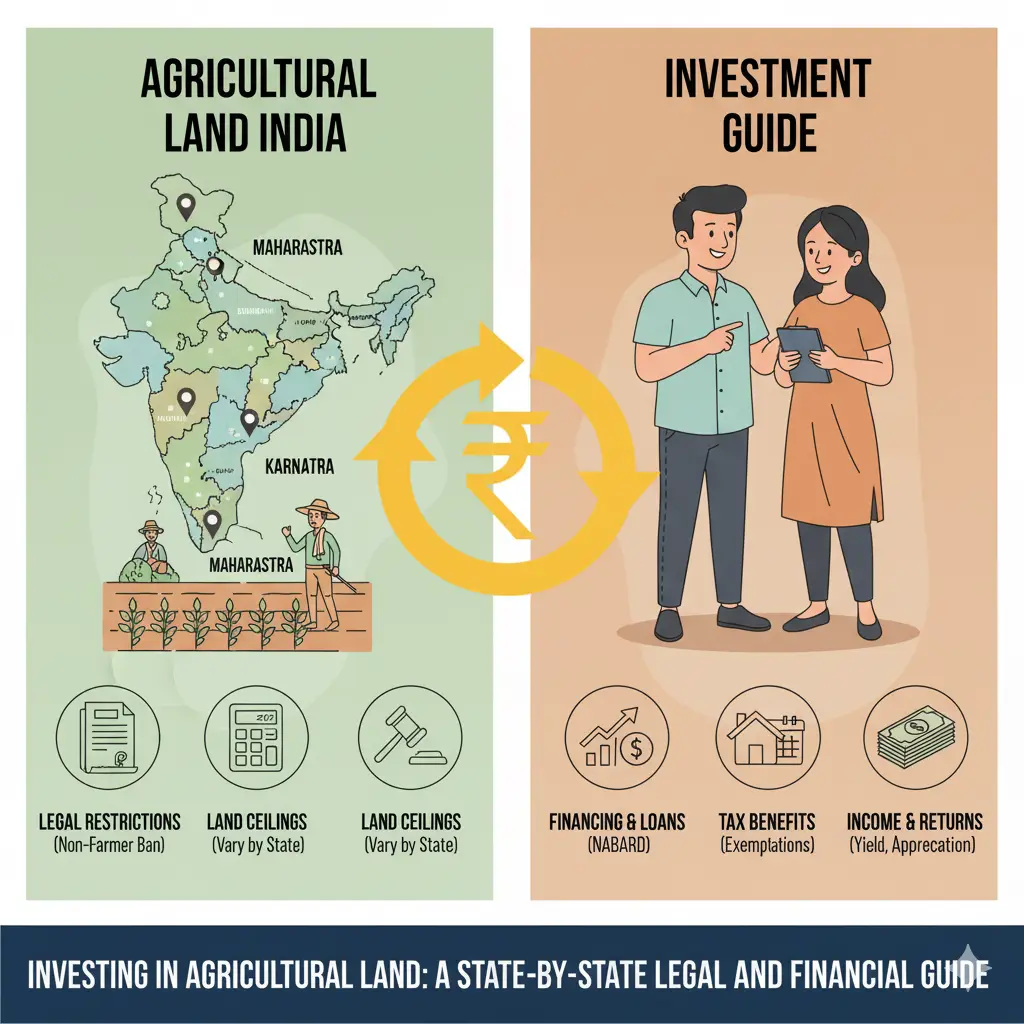
Your uncle in Punjab just sold his 5-acre farmland for ₹2 crores—land his father bought for ₹50,000 in the 1980s. Your colleague’s family in Karnataka earns ₹8 lakhs annually from just 3 acres of mango orchards. Meanwhile, your friend who bought “agricultural land” near Pune three years ago is stuck in a legal mess because he didn’t understand the rules.
Agricultural land investment in India is like walking through a maze where every state has different walls, different exits, and different rules. What works in Maharashtra won’t work in Rajasthan. What’s legal in Haryana might be impossible in Tamil Nadu. And the tax rules? They’re a world unto themselves.
This guide cuts through the confusion. Whether you’re a city-dweller looking to diversify your portfolio, a farmer wanting to expand, or an NRI trying to understand inheritance rules for your family’s ancestral land, we’ll walk through everything you need to know—state by state, rule by rule.
The Big Question: Can You Even Buy Agricultural Land?
Let’s start with the most fundamental question. Unlike buying an apartment or a shop, purchasing agricultural land (what many call kheti ki zameen) isn’t open to everyone. Each state in India has its own Agricultural Land Ceiling Act and Transfer of Land Acts that determine who can and cannot buy farmland.
The Three Categories of Buyers
Category 1: Farmers and Agricultural Families
If you come from a farming family, own existing agricultural land, or can prove agricultural income in your ITR, you generally have the easiest path. Most states prioritize farmer-to-farmer transfers. In states like Punjab and Haryana, you might need to show that farming is your primary occupation.
Category 2: Non-Agricultural Residents
This is where it gets tricky. You’re a salaried person living in Bangalore and want to buy farmland for investment or weekend farming. In Karnataka, you can—but with conditions. In Maharashtra, you need special permission from the collector. In some states, it’s outright forbidden unless you convert the land use.
Category 3: Non-Residents and Companies
NRIs cannot buy agricultural land in India except through inheritance. Companies and trusts face similar restrictions in most states. The logic is simple: the government wants to prevent large-scale land grabbing and keep farmland in the hands of actual farmers.
Critical Warning
Many property consultants will tell you “Don’t worry, we’ll handle the paperwork” when you’re not eligible. This usually means they’ll show the transaction as if you’re eligible (maybe using a farmer as a benami) or they’ll promise to convert the land later. Both are illegal and can result in the entire transaction being void, with you losing your money and facing criminal charges. Always verify eligibility before paying a single rupee.
State-by-State Rules: The Essential Guide
Here’s what you need to know about key states. We’ll cover eligibility, restrictions, and special conditions for each.
Maharashtra
Eligibility: Only Maharashtra residents can buy agricultural land. You need to be a resident for at least 6 years.
Ceiling Limit: 54 acres for individual, 216 acres for family (5 members).
Special Rules: If you’re a non-agriculturist, you need permission from the District Collector. This process can take 6-12 months. Many urban buyers purchase land on the outskirts of cities hoping for future conversion to non-agricultural use, but this is risky.
Key Point: The NA (Non-Agricultural) conversion process is complex and expensive. Budget an additional 20-30% of land value for conversion costs and stamp duty.
Karnataka
Eligibility: More liberal than Maharashtra. Non-agriculturists can buy agricultural land, but with a ceiling limit.
Ceiling Limit: 10 acres of irrigated land or 20 acres of dry land for non-agriculturists.
Special Rules: If you’re buying land within 8 km of any municipal corporation limit, it’s considered “investment land” and you can’t claim agricultural income exemption easily. The state is strict about this.
Key Point: Karnataka is one of the few states where IT professionals and other urban workers can legitimately own farmland for weekend farming or long-term investment.
Punjab & Haryana
Eligibility: Very restrictive. Only bonafide farmers can buy agricultural land. You must prove farming is your primary occupation.
Ceiling Limit: Punjab: 17.5 acres per person. Haryana: 27.5 acres per person.
Special Rules: Both states require a “No Objection Certificate” (NOC) for land transactions. These states have some of India’s highest agricultural land prices due to excellent irrigation and productivity.
Key Point: If you’re not from a farming family, buying agricultural land here for investment purposes is nearly impossible through legal means.
Rajasthan
Eligibility: Relatively flexible. Non-agriculturists can buy with certain limits.
Ceiling Limit: Varies by region and irrigation status. Generally 15-70 acres depending on land type.
Special Rules: If you’re buying in tribal areas, additional restrictions apply. Many urban investors buy agricultural land near Jaipur, Udaipur, and Jodhpur for future development or farmhouse construction.
Key Point: Good option for diversification, but ensure you understand local water rights—water scarcity is a major issue in many parts.
Tamil Nadu
Eligibility: One of the most liberal states. No specific restrictions on non-agriculturists buying agricultural land.
Ceiling Limit: 15 acres of dry land or 7.5 acres of wet land per person.
Special Rules: However, claiming agricultural income tax exemption requires proof of actual cultivation. Simply owning land isn’t enough.
Key Point: Popular with investors due to clear title systems and relatively straightforward processes. Good agricultural productivity in many regions.
Uttar Pradesh & Madhya Pradesh
Eligibility: Restrictions vary by district. Generally, non-agriculturists can buy with limitations.
Ceiling Limit: UP: 12.5 acres. MP: Varies by region (10-80 acres).
Special Rules: Both states have seen significant farmland price appreciation near major cities and expressways. However, land disputes and unclear titles are more common here—extra due diligence is crucial.
Key Point: Cheap compared to Punjab/Haryana, but higher risk. Always get a thorough title search done by a qualified lawyer.
The Buying Process: Step-by-Step
Once you’ve confirmed you’re eligible to buy agricultural land in your chosen state, here’s the process you’ll go through. This isn’t like buying an apartment where everything is standardized.
Step 1: Find the Land and Verify Ownership
Start by getting the survey number or khasra number of the land. This is like the land’s address. Then:
- Get the 7/12 extract (Maharashtra), Encumbrance Certificate (Tamil Nadu), or equivalent document from the land records office
- Verify the seller is the actual owner listed in revenue records
- Check if there are any mortgages, liens, or legal disputes on the property
- Visit the actual physical land with the survey map to ensure boundaries match
Real Story: The Boundary Dispute
Suresh bought 2 acres in Maharashtra based on documents that looked perfect. When he visited the land with a surveyor, he discovered the seller had shown him only 1.5 acres—the remaining 0.5 acres was actually part of a neighboring property that had a 10-year-old boundary dispute. The documents didn’t mention this. He narrowly escaped losing ₹15 lakhs by insisting on a physical survey before payment.
Step 2: Legal Due Diligence
Hire a lawyer who specializes in agricultural land transactions in that specific state. They should verify:
- Chain of title: Who owned the land for the last 30 years? Are all past transactions properly documented?
- Land use classification: Is it really agricultural, or has it been reclassified?
- Ceiling compliance: Is the seller within the ceiling limit? Are you within it after this purchase?
- Tribal or protected land: Some lands have special protections that prevent sale to non-tribals
- Court cases: Any pending litigation involving this land?
This due diligence typically costs ₹10,000-50,000 depending on the state and complexity. Never skip this step to save money. It’s the best investment you’ll make in the entire process.
Step 3: Negotiation and Agreement
Agricultural land prices vary wildly—from ₹5 lakhs per acre in remote areas of UP to ₹2 crores per acre in Punjab’s prime regions. Factors affecting price:
- Irrigation availability and water source
- Soil quality and current cultivation
- Road access and distance from markets
- Proximity to cities (speculation value)
- Existing crops or plantations
Once you agree on price, draft a clear sale agreement. This should include payment terms, possession date, and conditions. Typically, you pay 10-20% as token money and the rest after document verification.
Step 4: Registration and Stamp Duty
Agricultural land attracts lower stamp duty rates than residential property in most states, typically 3-5% compared to 5-7% for residential. Use our Stamp Duty Calculator to estimate costs for your state.
Registration process:
- Both parties appear before sub-registrar with sale deed
- Pay stamp duty and registration charges
- Biometric verification and document submission
- Collect registered sale deed (usually within 7-15 days)
- Update mutation records at tehsil office to reflect you as new owner
Step 5: Post-Purchase Actions
After registration, immediately:
- Get updated land revenue records in your name
- Mark physical boundaries clearly
- Inform electricity and water authorities if applicable
- Consider getting the land surveyed and fenced
- Start documentation for agricultural income if you plan to cultivate
The Tax Maze: Understanding Agricultural Income
This is where agricultural land investment gets really interesting. Under Section 10(1) of the Income Tax Act, agricultural income is completely tax-free. But—and this is a massive but—there are strict conditions.
What Qualifies as Agricultural Income?
Income from Cultivation
If you grow crops on your land, the income from selling those crops is agricultural income. This includes everything from wheat and rice to coffee and rubber. The key requirement: you or your tenant must be doing actual cultivation involving basic operations like tilling, sowing, and harvesting.
Income from Agricultural Processing
Income from processing agricultural produce you’ve grown on your own land can be considered agricultural income, but only up to a certain extent. For example, if you grow sugarcane and process it into jaggery, that’s agricultural income. But if you process it into refined sugar using complex machinery, only a portion may qualify.
Rental Income from Agricultural Land
If you lease your land to a farmer for cultivation, the rent you receive is agricultural income and tax-free. You must have a proper lease agreement and the tenant must use it for actual farming.
What Doesn’t Qualify (Common Mistakes)
These Are NOT Agricultural Income
- Selling the land itself: If you sell agricultural land, any profit is capital gains (long-term or short-term), not agricultural income. It’s fully taxable.
- Leasing land for non-agricultural use: If someone sets up a cell tower, warehouse, or farmhouse on your agricultural land, that rental income is taxable as “income from other sources.”
- Just owning land without cultivation: You can’t claim tax exemption simply because you own land classified as agricultural. You must prove actual agricultural activity.
- Urban agricultural income: If your land is within the municipal limits of a city with population over 10,000, income from it is NOT considered agricultural income for tax purposes (though it’s exempt from state land revenue).
Capital Gains on Sale of Agricultural Land
When you sell agricultural land, tax treatment depends on the location:
| Location | Tax Treatment | Holding Period |
|---|---|---|
| Rural agricultural land (outside municipal limits) | Completely exempt from capital gains tax | Any period |
| Urban agricultural land (within municipal limits of population 10,000+) | Long-term capital gains at 20% with indexation | More than 24 months |
| Urban agricultural land (within municipal limits of population 10,000+) | Short-term capital gains at slab rate | Less than 24 months |
Use our Capital Gains Tax Calculator to estimate your tax liability if you’re planning to sell urban agricultural land.
Proving Agricultural Income to Income Tax Department
If you’re claiming agricultural income exemption, maintain proper documentation:
- Land ownership documents (sale deed, 7/12 extract)
- Evidence of cultivation (photos, receipts for seeds/fertilizers/labor)
- Sale bills if you sold agricultural produce
- Lease agreement if land is leased to a farmer
- Bank statements showing agricultural transactions
While agricultural income is tax-exempt, if your total agricultural income exceeds ₹5,000, you must still report it in your ITR. This is crucial for loan applications and maintaining clean tax records.
Financial Returns: What to Expect Realistically
Let’s talk numbers. Everyone has heard stories of agricultural land giving 500% returns. But what’s the realistic expectation?
Return Source 1: Land Appreciation
Historical data suggests agricultural land near developing cities appreciates at 8-15% annually over 10-15 year periods. Remote agricultural land grows slower, maybe 4-6% annually. This is significantly lower than what people imagine.
Realistic Scenario
You buy 2 acres of agricultural land 20 km from Coimbatore city center for ₹30 lakhs (₹15 lakhs per acre) in 2025. Assuming 10% annual appreciation, by 2035 it could be worth ₹78 lakhs. That’s a decent 160% return over 10 years, but it requires patience and the land remaining in demand.
Return Source 2: Agricultural Operations
If you actually farm the land or lease it out, expect:
- Annual crop income: ₹20,000-60,000 per acre depending on crop, irrigation, and location. Deduct 40-50% for cultivation costs.
- Leasing income: ₹5,000-25,000 per acre annually. Lower risk, lower return.
- Horticulture/plantations: Higher returns (₹80,000-2,00,000 per acre) but requires 3-7 years before trees start producing.
Use our Property Valuation Calculator to estimate the total value of agricultural land including income-generating potential.
The Hidden Costs Nobody Tells You About
Agricultural land isn’t a “buy and forget” investment. Budget for:
- Annual property tax: Minimal compared to urban property, but still exists
- Maintenance: Clearing weeds, maintaining fences, protecting from encroachment
- Irrigation costs: Borewells can cost ₹2-5 lakhs, and they may dry up
- Security: Remote lands need watching to prevent illegal occupation
- Liquidity cost: Selling agricultural land takes time. Plan for 6-18 months to find a genuine buyer
Common Mistakes That Cost Lakhs (Learn From Others’ Pain)
Mistake 1: Buying Without Physical Verification
Documents can be forged. Online satellite images can be old. Always visit the land multiple times, talk to neighbors, and verify boundaries with a licensed surveyor before paying. Stories of people buying land that turns out to be riverbed, forest land, or even non-existent are disturbingly common.
Mistake 2: Ignoring Water Availability
A beautiful 5-acre plot is worthless if there’s no water. Check groundwater levels, existing wells, and proximity to canals. In states like Rajasthan and Karnataka, water scarcity can make agricultural land practically valueless.
Mistake 3: Believing Conversion Promises
Agents love to say, “This agricultural land will be converted to residential soon.” Maybe. Maybe not. Maybe in 20 years. Never pay agricultural land prices based on speculative conversion. If you want investment property, buy NA land and pay the higher price upfront.
Mistake 4: Underestimating Legal Complications
Agricultural land laws are complex and constantly changing. What was legal five years ago might not be today. Always consult a local lawyer who practices in that specific district. Don’t rely on Google or advice from friends in different states.
Mistake 5: Ignoring Ceiling Limits
If you already own agricultural land elsewhere in the state and you’re crossing the ceiling limit with this new purchase, the transaction can be declared void. Calculate your total holdings carefully. Some people buy land in their spouse’s or children’s names to stay within limits, but this has its own complications regarding succession.
Essential Financial Tools for Land Investment
Loan Comparison Calculator
Compare agricultural loan options from different banks
Simple Interest Calculator
Calculate returns on land value appreciation
Compound Interest Calculator
Compare land investment vs mutual fund returns
Inflation Calculator
Understand real returns after adjusting for inflation
Should You Actually Invest in Agricultural Land?
After all this information, here’s the honest answer: it depends entirely on your situation, goals, and risk tolerance.
Agricultural Land Makes Sense If:
- You’re looking for very long-term wealth preservation (10+ years)
- You have genuine interest in farming or rural development
- You’re diversifying from pure financial assets (stocks, bonds, mutual funds)
- You have the time and patience to deal with illiquidity
- You understand the specific state’s laws and are eligible to buy
- You have visited and verified the land multiple times
- You’re not borrowing heavily to buy (land doesn’t generate immediate cash flow)
Avoid Agricultural Land If:
- You need liquidity or regular income
- You’re buying based on speculative conversion hopes
- You can’t verify clear title or eligibility
- You’re looking for quick returns (under 5 years)
- You don’t understand taxation and legal implications
- You’re buying sight unseen based on agent promises
For most urban investors, a diversified portfolio of mutual funds, PPF, and perhaps some residential real estate offers better risk-adjusted returns with far more liquidity. Use our Goal-Based Financial Planner to see where agricultural land fits in your overall wealth strategy.
Your Action Plan: Next Steps
If after reading all this you still want to proceed with agricultural land investment, follow this sequence:
- Verify your eligibility in your target state by consulting a local lawyer specializing in agricultural transactions
- Calculate your investment capacity using our loan eligibility calculators if you need financing
- Identify 3-5 potential properties and visit each one physically at least twice
- Commission thorough legal due diligence for your top choice (budget ₹25,000-50,000 for this)
- Negotiate price based on comparable sales (ask the local sub-registrar office for recent transaction values)
- Structure payment to protect yourself (never pay full amount before registration)
- Complete registration and immediately update revenue records
- Plan post-purchase management (cultivation, leasing, or simply maintenance)
- Document everything for tax purposes and future sale
For official information about agricultural land policies, check your state’s Revenue Department website or the Department of Land Resources portal.
Final Thoughts
Agricultural land investment in India isn’t for everyone. It’s complex, illiquid, and fraught with legal complications. But for those who do their homework, understand the rules, and have realistic expectations, it can be a valuable part of a diversified portfolio.
The most important lesson: there are no shortcuts. Every rupee saved by skipping due diligence or buying without eligibility verification is a potential lakh lost in future legal battles or void transactions.
Take your time. Do your research. Consult experts. And remember—the best investment is the one where you sleep peacefully at night, knowing you’ve followed every rule and verified every claim.
Quick Checklist Before Buying Agricultural Land
- ✓ Verified eligibility to purchase in this state
- ✓ Confirmed clear title for last 30 years
- ✓ Physically visited land and verified boundaries
- ✓ Checked water availability and soil quality
- ✓ Confirmed no ceiling violation
- ✓ Verified land is not tribal/protected/forest land
- ✓ Calculated stamp duty and registration costs
- ✓ Understood tax implications clearly
- ✓ Have lawyer and surveyor lined up
- ✓ Budget allows for 6-12 months of carrying costs