
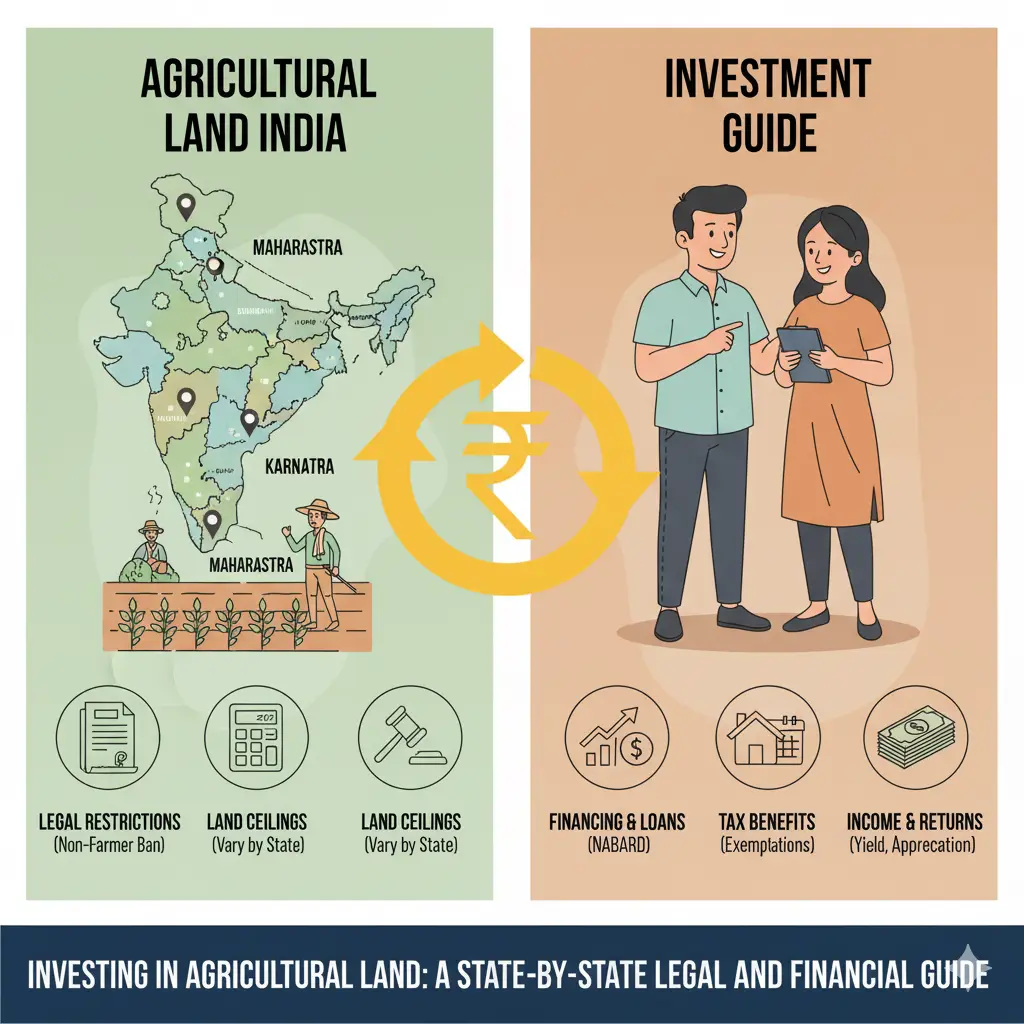
Investing in Agricultural Land India — State-by-State Legal & Financial Guide 2026
📘 Agricultural Land — Potentially Tax-Free Capital Gains with High Location Variance
Agricultural land in India offers two unique advantages unavailable in any other asset class: (1) completely tax-free capital gains on rural agricultural land (beyond 8km from municipalities) under Section 2(14), and (2) tax-free agricultural income from leasing under Section 10(1). These features make agricultural land one of the most tax-efficient investments in India — but only for those who navigate the state-specific purchase restrictions, title verification requirements, and conversion potential analysis correctly. This guide covers the complete legal, tax, and financial framework for agricultural land investment in 2026.
📊 India Agricultural Land Data — 2025-26
- Ministry of Agriculture, 2025: Total agricultural land in India: 18.1 crore hectares. Land holdings: 14.6 crore farmers. Average holding: 1.24 hectares (declining). Land under ownership dispute: estimated 23% (NITI Aayog) — highlighting the critical importance of title due diligence.
- NIC Bhulekh Portal, 2025: States with fully digitised land records: 26. States with partial digitalisation: 10. Digital records have significantly reduced (but not eliminated) agricultural land fraud and fake title creation.
- CBDT, AY 2024-25: Agricultural income (Section 10(1)) declared: Rs8.4 lakh crore — completely tax-free. This includes genuine farming income and land lease income. Agricultural land capital gains (rural): exempt from capital gains tax under Section 2(14).
- DMIC and PM Gati Shakti, 2025: Peri-urban agricultural land near new highway corridors appreciating 15-25% annually. Successful speculation pattern: NH6-laning announcements drive 40-60% price jumps in adjacent agricultural land within 12-18 months of announcement.
1. Who Can Buy Agricultural Land — State by State
| State | Non-Farmer Can Buy? | Key Restriction |
|---|---|---|
| Goa | Yes — no restriction | Ceiling limits apply |
| Kerala | Yes — with ceiling limits | Kerala Land Reforms Act ceiling |
| Rajasthan | Conditional — intent to farm | Must declare agricultural intent |
| Maharashtra | Farmers only (or converted to NA) | MLRC Section 63 — strict enforcement |
| Karnataka | Farmers or family with agricultural income | KLR Act Section 79A/79B |
| Gujarat | Farmers or persons with agricultural background | Tenancy and Agricultural Land Act |
| Tamil Nadu | Restricted — farmers only | Tamil Nadu Land Reforms Act |
| Andhra Pradesh / Telangana | Non-farmers need special permission | AP Land Reforms Act |
| Himachal Pradesh | With collector permission for cultivation | Proof of cultivation intent required |
| Punjab / Haryana | Farmers only | Punjab Security of Land Tenures Act |
2. Returns on Agricultural Land
| Land Type | Location | Capital Appreciation (CAGR) | Annual Lease Income |
|---|---|---|---|
| Peri-urban (within 20km of tier-1 city) | High growth corridor | 15-25% | Rs5,000-20,000/acre/year |
| Tier-2 city fringe (5-20km) | Infrastructure path | 10-18% | Rs3,000-10,000/acre/year |
| Agricultural (productive, irrigated) | Punjab/Haryana/UP | 6-10% | Rs15,000-40,000/acre/year |
| Remote dryland | Semi-arid regions | 3-5% (inflation level) | Rs500-2,000/acre/year |
3. Tax Treatment — The Rural Agricultural Land Exemption
| Type of Income/Gain | Tax Treatment | Section |
|---|---|---|
| Agricultural income (crops, lease for farming) | 100% exempt | Section 10(1) |
| Capital gains — rural agricultural land (beyond 8km from municipality) | 100% exempt — not a capital asset | Section 2(14) |
| Capital gains — urban/peri-urban agricultural land (within 8km) | LTCG 12.5% (if 24+ months) / STCG slab | Normal capital gains provisions |
| Agricultural land converted to NA then sold | Capital gains on NA land at normal rates | No agricultural exemption post-conversion |
| Stamp duty on purchase | State-specific (3-7%); some states offer agricultural land concessions | State Stamp Acts |
💡 Rural Agricultural Land Capital Gains Are Completely Tax-Free
Rural agricultural land (beyond 8km of a municipality with 10,000+ population) is not classified as a “capital asset” under the Income Tax Act. Therefore, any gain from its sale is not taxable at all — not 12.5%, not slab rate, zero. This makes remote and peri-rural agricultural land one of the few completely tax-free investment gains available to Indian taxpayers. Before selling, confirm the land’s exact distance from the nearest qualifying municipality to determine tax status.
4. Land Records Verification by State
| State | Bhulekh Portal | Key Document |
|---|---|---|
| Maharashtra | mahabhulekh.maharashtra.gov.in | 7/12 Utara (Satbara) |
| Karnataka | landrecords.karnataka.gov.in | RTC (Record of Rights) |
| Tamil Nadu | eservices.tn.gov.in | Patta + A-Register |
| Andhra Pradesh | meebhoomi.ap.gov.in | Adangal + 1B |
| Rajasthan | apnakhata.raj.nic.in | Jamabandi |
| Uttar Pradesh | upbhulekh.gov.in | Khatauni |
| Odisha | bhulekh.ori.nic.in | ROR (Record of Rights) |
5. Land Conversion — The Value Multiplier Event
Converting agricultural land to non-agricultural (NA) use is how peri-urban land investors realise the largest gains. Conversion triggers: government announces highway, metro, or industrial park → adjacent agricultural land converts to commercial or residential NA → price multiplies 3-10×. Process: apply to tehsildar/district collector → pay conversion charges → obtain NA permission → update revenue records → sell as NA or develop. Conversion charges: vary by state (Rs5-50 per sqft typical). Strategic angle: identify agricultural land in the announced path of infrastructure projects. Buy before conversion pressure builds. Wait for demand. The highest-return agricultural land investments in India (Gurgaon, Magarpatta Pune, HITEC Hyderabad) all followed this exact pattern.
6. Key Risks in Agricultural Land Investment
- Title risk: 23% of agricultural land has disputed title (NITI Aayog). Fake documents, inheritance disputes, and boundary conflicts are extremely common. Only professional legal due diligence reduces this risk.
- Liquidity risk: Agricultural land takes months to years to sell. Not suitable for money needed within 5 years.
- Regulatory risk: Conversion approval may be denied, infrastructure projects may be cancelled or rerouted, state laws can change to restrict sales.
- State restriction risk: Purchasing agricultural land as a non-farmer in restricted states = purchase can be declared void and land repossessed. Serious legal consequence.
- Encroachment risk: Rural agricultural land is subject to encroachment by neighbours or tenants in prolonged absence. Physical verification and local agent management is required.
7. Agricultural Land Due Diligence Checklist
- ☐ Confirm state law — can non-farmer purchase in this state?
- ☐ Obtain and verify Patta/RTC/7-12 from online land records portal
- ☐ Obtain Encumbrance Certificate (EC) for 30 years from sub-registrar
- ☐ Hire licensed surveyor to physically measure and mark boundaries
- ☐ Verify seller’s identity against revenue records (Aadhaar + owner name match)
- ☐ Check for any government acquisition notifications on the land
- ☐ Confirm rural vs urban classification (8km rule) for capital gains tax planning
- ☐ Engage local property lawyer for full title search
- ☐ Visit land physically before finalising purchase
- ☐ Register sale deed at sub-registrar office (no registration = no legal ownership)
🧮 Free Calculators — Use Them Now
No login required. Updated for FY 2025-26.
Frequently Asked Questions
Agricultural land purchase restrictions in India vary dramatically by state. There is no central law — each state governs agricultural land ownership independently: States where non-farmers CAN buy agricultural land (with conditions): Goa (no restriction), Himachal Pradesh (for cultivation purpose, with collector permission), Kerala (with ceiling limits). States where non-farmers face restrictions but can buy with conditions or intent declarations: Rajasthan, Uttarakhand, Jharkhand, Chhattisgarh (intent to farm, with some conditions). States with STRICT restrictions — agricultural land only for farmers: Maharashtra (Agricultural Lands (Ceiling and Holdings) Act), Karnataka (farmers or those with family agricultural income only), Gujarat, Tamil Nadu, Andhra Pradesh, Telangana, West Bengal, Punjab, Haryana, UP. Most Indian states effectively prevent non-agricultural persons from purchasing agricultural land. Before investing: consult a local property lawyer about your state’s specific rules. The definition of ‘farmer’ and how it is verified also varies by state.
Agricultural land returns have two components: (1) Capital appreciation: historically 8-15% CAGR over 10+ years in peri-urban locations (land near highways, industrial corridors, upcoming towns). In remote areas: 3-6% CAGR (roughly inflation-level). (2) Agricultural income from leasing: leasing to farmers generates Rs3,000-15,000 per acre per year in most states. More productive land (Maharashtra, Punjab) earns more. Agricultural income is completely TAX-FREE under Section 10(1) — one of the most significant tax advantages of agricultural land. Investment caveat: land is highly illiquid (months to sell), requires physical management or trusted local agent, subject to title disputes, conversion restrictions, and regulatory risk. Total return on investment over 10 years: peri-urban land near highway/industrial park: 15-25% CAGR (including appreciation + minimal lease income). Remote agricultural: 5-8% CAGR. The wide variance makes location the dominant factor in agricultural land investment returns.
Agricultural land tax treatment depends on classification: (1) Agricultural income from farming: completely exempt under Section 10(1) — no income tax on crop income, lease income from agricultural use. (2) Capital gains on rural agricultural land: land beyond 8km from municipality boundary (population above 10,000) — exempt from capital gains tax entirely under Section 2(14). This is one of India’s few remaining fully tax-exempt capital assets. (3) Capital gains on urban/peri-urban agricultural land: land within 8km of municipality OR land that has been converted to non-agricultural use — taxable as LTCG (12.5% if held 24+ months) or STCG (slab rate if less than 24 months). Classification check is critical before purchase: the rural/urban classification determines whether you pay zero tax or 12.5% on appreciation. (4) Stamp duty on purchase: varies by state, typically 3-7% of guideline value (some states have agricultural land concessions). (5) GST: sale of agricultural land is exempt from GST.
Land record verification is the most critical step before any agricultural land purchase. Digital land records portals by state (search ‘bhulekh [state name]’): Maharashtra: mahabhulekh.maharashtra.gov.in. Karnataka: landrecords.karnataka.gov.in. Tamil Nadu: eservices.tn.gov.in. Rajasthan: apnakhata.raj.nic.in. Uttar Pradesh: upbhulekh.gov.in. Odisha: bhulekh.ori.nic.in. Andhra Pradesh: meebhoomi.ap.gov.in. What to verify: (1) Patta (ownership record): confirms current owner and history of ownership. (2) Khasra/Survey number: identifies exact plot in revenue records. (3) Encumbrance certificate: 15-30 years history of mortgages, legal attachments, and sales on the land. Obtain from sub-registrar office. (4) No objection for sale (in restricted states): verify the seller is legally classified as a farmer and has right to sell. (5) Physical measurement: hire a licensed land surveyor to confirm plot boundaries match revenue records — boundary disputes are extremely common. Professional help: hire a local property lawyer with land record experience — this is not DIY territory. Budget Rs15,000-30,000 for thorough due diligence on any land above Rs20L value.
Land conversion (change of land use from agricultural to non-agricultural/NA) is the primary value-creation event in agricultural land investment. When peri-urban agricultural land is converted to residential, commercial, or industrial use: value multiplies 3-10× in many cases. Conversion process varies by state: requires application to district collector/tehsildar, payment of conversion charges (varies by state — typically Rs5-25/sqft), obtaining NA (non-agricultural) permission, updating revenue records. Conversion time: 6 months to 3 years depending on state and political environment. Conversion triggers: government land acquisition for highway, industrial park, airport → adjacent land becomes more valuable and convertible. Developer purchase (farmland acquired by developer for residential project) → conversion + development → 5-8× land price appreciation. Strategic investment: buy agricultural land in the path of announced infrastructure (new highway, metro extension, industrial corridor). Wait for conversion demand to develop. This strategy has generated spectacular returns in India historically (Gurgaon, HITEC City Hyderabad, Hinjewadi Pune — all former agricultural land). Risk: conversion may not happen, announced infrastructure may be delayed 10-20 years or cancelled.