
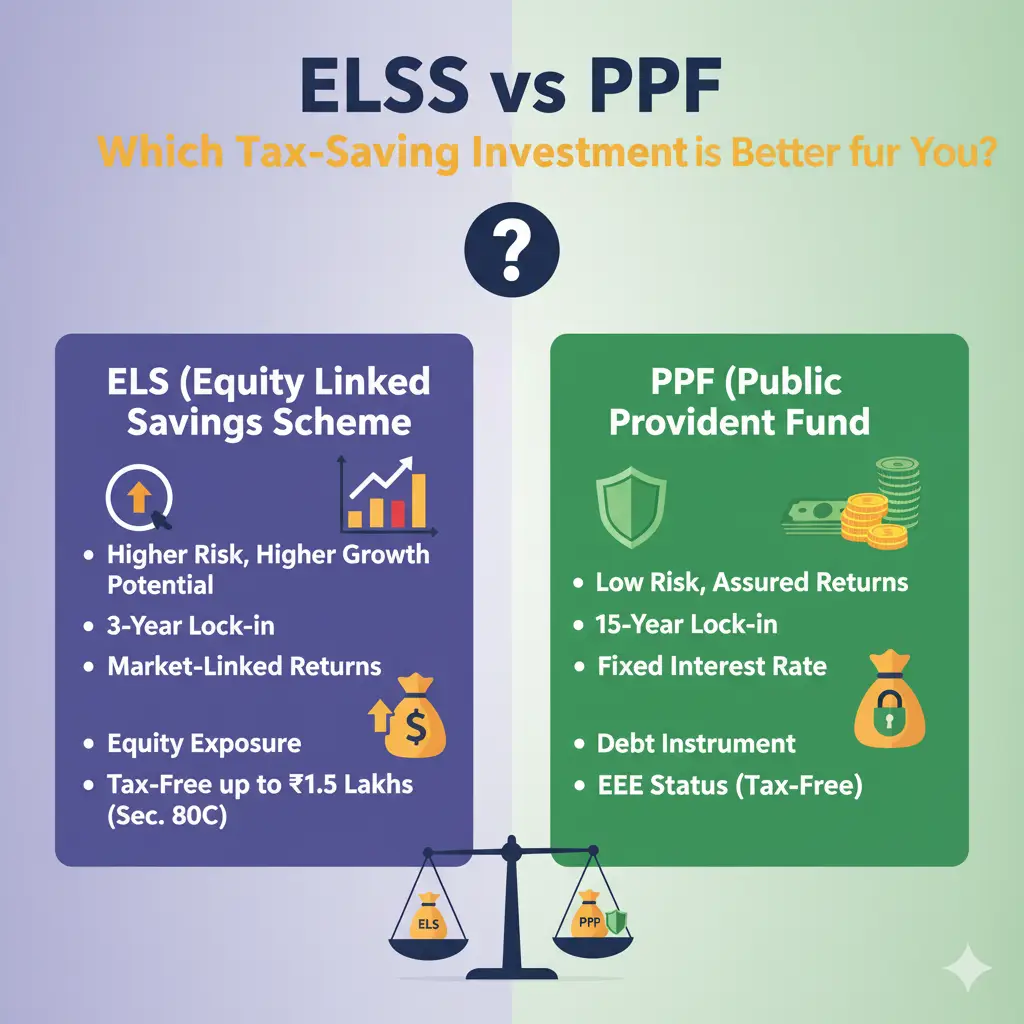
When it comes to tax saving under Section 80C, two names come to mind first – ELSS (Equity Linked Savings Scheme) and PPF (Public Provident Fund). Both are excellent options, but which one suits you depends on your financial goals, risk appetite, and investment horizon.
In this comprehensive guide, we’ll understand both investments in detail, compare them with real-life examples, and help you make the right choice. Let’s dive in and solve your tax-saving investment dilemma once and for all.
💡 Quick Answer
If you’re young and have 10-15 year long-term goals, ELSS is better. If you’re a conservative investor wanting guaranteed returns, choose PPF.
What is ELSS (Equity Linked Savings Scheme)?
Equity Linked Savings Scheme (ELSS) is a type of mutual fund that primarily invests in equity shares. It provides tax benefits under Section 80C and has the shortest lock-in period of just 3 years among all 80C investment options.
Key Features of ELSS
- Lock-in Period: Only 3 years (shortest among all 80C options)
- Investment Range: Minimum ₹500 per month SIP, no maximum limit
- Expected Returns: 12-15% annually in the long term
- Risk Level: High (due to market volatility)
- Liquidity: Complete liquidity after 3 years
🏠 Example: Rohit’s ELSS Journey
Rohit invested ₹1.5 lakh in ELSS in 2019. By 2024 (5 years), his investment grew to ₹2.8 lakh – that’s 13.2% annual returns! Plus, he got complete tax deduction of ₹1.5 lakh on his investment.
What is PPF (Public Provident Fund)?
Public Provident Fund (PPF) is a government-backed long-term savings scheme that offers guaranteed returns. It’s completely tax-free and considered ideal for retirement planning by many Indian families.
Key Features of PPF
- Lock-in Period: 15 years (extension possible)
- Investment Range: Minimum ₹500 per year, Maximum ₹1.5 lakh per year
- Current Interest Rate: 7.1% per annum (tax-free)
- Risk Level: Zero (government guarantee)
- Liquidity: Partial withdrawal after 7th year, loan facility available
👩💼 Example: Priya’s PPF Planning
Priya deposits ₹1.5 lakh in PPF every year. After 15 years, her total contribution will be ₹22.5 lakh, but maturity value will be approximately ₹40 lakh – completely tax-free! That’s ₹17.5 lakh extra gain.
ELSS vs PPF: Detailed Comparison
| Parameter | ELSS | PPF |
|---|---|---|
| Lock-in Period | 3 years | 15 years |
| Expected Returns | 12-15% (market-linked) | 7.1% (guaranteed) |
| Risk Level | High | Zero |
| Tax on Maturity | LTCG tax if gains > ₹1 lakh | Completely tax-free |
| Minimum Investment | ₹500 per month | ₹500 per year |
| Maximum Investment | No limit | ₹1.5 lakh per year |
| Loan Facility | Not available | Available from 3rd year |
| Partial Withdrawal | Not allowed during lock-in | Allowed from 7th year |
Real Returns Comparison: 15-Year Analysis
Let’s see what happens if you invest ₹1.5 lakh every year for 15 years in both options:
PPF Scenario
- Total Investment: ₹22.5 lakh
- Maturity Value (7.1% interest): ₹39.5 lakh
- Tax-free Gain: ₹17 lakh
- Effective Annual Return: 7.1%
ELSS Scenario (assuming 12% annual return)
- Total Investment: ₹22.5 lakh
- Expected Value: ₹78 lakh
- Gross Gain: ₹55.5 lakh
- LTCG Tax (approx): ₹5.5 lakh
- Net Gain: ₹50 lakh
📊 Result Analysis
ELSS can give you approximately ₹33 lakh more than PPF! However, this depends on market performance and isn’t guaranteed.
When to Choose ELSS?
ELSS is suitable for you if:
- Age Factor: You’re in the 25-40 years age group
- Risk Appetite: You can handle market volatility
- Investment Horizon: You have 7+ years long-term goals
- Liquidity Need: You might need money after 3-5 years
- Higher Returns: You want returns that beat inflation
- SIP Discipline: You can maintain monthly SIP discipline
Advantages of ELSS
- Shortest lock-in period (3 years)
- Higher wealth creation potential
- Professional fund management
- Benefit of rupee cost averaging
- Complete liquidity post lock-in
Disadvantages of ELSS
- Market risk exposure
- Returns are not guaranteed
- LTCG tax applicable
- Short-term volatility
When to Choose PPF?
PPF is perfect for you if:
- Conservative Approach: You can’t take risks
- Guaranteed Returns: You want fixed returns
- Retirement Planning: You’re building long-term retirement corpus
- Tax-free Income: You don’t want any tax on maturity
- Loan Facility: You might need emergency loans
- Stable Income: You have government job or stable income
Advantages of PPF
- Safety with government guarantee
- Complete tax exemption (EEE status)
- Loan and partial withdrawal facility
- Powerful effect of compounding
- Extension possible after 15 years
Disadvantages of PPF
- Long lock-in period (15 years)
- Interest rates may fall over time
- Limited liquidity options
- Inflation risk in long term
- ₹1.5 lakh annual investment limit
Smart Strategy: Combination Approach
Many financial experts recommend a balanced approach – investing in both options to get benefits of diversification:
70-30 Strategy (For Young Investors)
- 70% allocation to ELSS (₹1.05 lakh)
- 30% allocation to PPF (₹45,000)
- Total Section 80C benefit: ₹1.5 lakh
- Best for aggressive wealth building
50-50 Strategy (For Moderate Risk)
- 50% ELSS + 50% PPF split
- Balanced mix of risk and return
- Diversified portfolio approach
- Suitable for most Indian families
💼 Real Case Study: Amit’s Smart Planning
Amit (32 years) adopted the combination approach. He invests ₹1 lakh in ELSS and ₹50,000 in PPF annually. After 10 years, his ELSS portfolio became ₹18 lakh and PPF reached ₹7.5 lakh. Total wealth: ₹25.5 lakh on investment of ₹15 lakh!
Common Mistakes to Avoid
Don’t make these mistakes when choosing between ELSS and PPF:
ELSS Related Mistakes
- Redeeming immediately after 3 years
- Panicking during market volatility
- Selecting funds without proper research
- Discontinuing SIP during market downturns
- Investing lump sum at market peaks
PPF Related Mistakes
- Depositing only minimum amount (₹500)
- Missing due dates for deposits
- Closing account before 15 years
- Not updating nomination details
- Ignoring extension benefits
Understanding Tax Implications in Detail
For effective tax planning, it’s crucial to understand taxation aspects:
ELSS Taxation
- Investment: Section 80C deduction (up to ₹1.5 lakh)
- Dividend: Tax-free in investor’s hands
- Maturity: LTCG tax at 10% if gains exceed ₹1 lakh (without indexation)
- Exit Load: Usually nil after lock-in period
PPF Taxation
- Investment: Section 80C deduction
- Interest: Tax-free accumulation throughout
- Maturity: Completely tax-free (EEE status)
- Withdrawal: No TDS on partial withdrawals
Practical Steps to Get Started
Starting ELSS Investment
- Research and shortlist top-performing ELSS funds
- Complete your KYC documentation
- Choose between lump sum or SIP investment
- Set up automatic monthly SIP payments
- Monitor performance regularly but avoid frequent changes
Opening PPF Account
- Visit nearest bank or post office
- Fill PPF account opening form
- Submit required documents (Aadhaar, PAN, photos)
- Make initial deposit (minimum ₹500)
- Plan your annual contribution schedule
Performance in Different Market Scenarios
Understanding how both investments perform in various market conditions:
During Bull Markets
- ELSS: Excellent returns possible (15-20% annually)
- PPF: Steady 7.1% returns regardless
During Bear Markets
- ELSS: Temporary negative returns possible
- PPF: Consistent 7.1% returns unaffected
During Volatile Markets
- ELSS: Benefits from rupee cost averaging through SIP
- PPF: Completely unaffected by market movements
Choosing Based on Your Financial Goals
Child’s Education (10-15 years)
Recommendation: ELSS preferred – higher growth potential to beat education inflation
Retirement Planning (20+ years)
Recommendation: Both – ELSS for growth, PPF for stability and tax-free income
House Down Payment (5-7 years)
Recommendation: ELSS with systematic withdrawal planning
Emergency Fund Building
Recommendation: PPF (loan facility available from 3rd year)
Recent Changes and Updates
Important changes in 2024-25 that affect your decision:
- PPF interest rate maintained at 7.1% (subject to quarterly review)
- LTCG tax rate remains at 10% for equity mutual funds
- Section 80C benefits available in both old and new tax regimes
- Digital PPF account opening made easier through online platforms
- ELSS funds showing strong performance post-pandemic recovery
Expert Tips and Recommendations
For Young Professionals (25-35 years)
- Allocate 80% to ELSS for aggressive growth
- Maintain 10-15 year investment horizon
- Don’t try to time the market
- Use systematic investment approach
For Mid-career Professionals (35-45 years)
- Maintain 50-50 split for balanced approach
- Prioritize risk management over aggressive returns
- Gradually increase diversification
- Plan for children’s education expenses
For Pre-retirement (45+ years)
- Increase PPF allocation to 70-80%
- Focus on capital protection
- Start systematic withdrawal planning
- Reduce exposure to market volatility
Industry Trends and Future Outlook
Current trends affecting ELSS vs PPF choice:
- Interest Rate Environment: PPF rates may face pressure if government borrowing costs fall
- Market Growth: Indian equity markets showing strong long-term growth potential
- Inflation Impact: ELSS better positioned to beat inflation over long term
- Digital Adoption: Easier access to both investment options through apps and online platforms
Final Recommendation: Making Your Choice
The ELSS vs PPF choice is purely individual and depends on your specific circumstances. If you’re young, can take risks, and want to wait for higher returns, ELSS is the better option. If you’re a conservative investor wanting guaranteed returns with complete tax exemption, choose PPF.
The best strategy for most investors is balanced allocation in both options. This gives you growth potential and stability together. Remember – the key to successful investing is long-term commitment, regular monitoring, and staying disciplined during market ups and downs.
🎯 Your Action Plan
Define your financial goals today, assess your risk appetite, and start investing in ELSS or PPF accordingly. Time in the market beats timing the market every time!
For detailed calculations and personalized advice, use our SIP Calculator and PPF Calculator. Our Section 80C Investment Planner will also help with comprehensive tax planning.
For more information, explore our investing guides or check out our tax planning section for comprehensive financial planning strategies.