
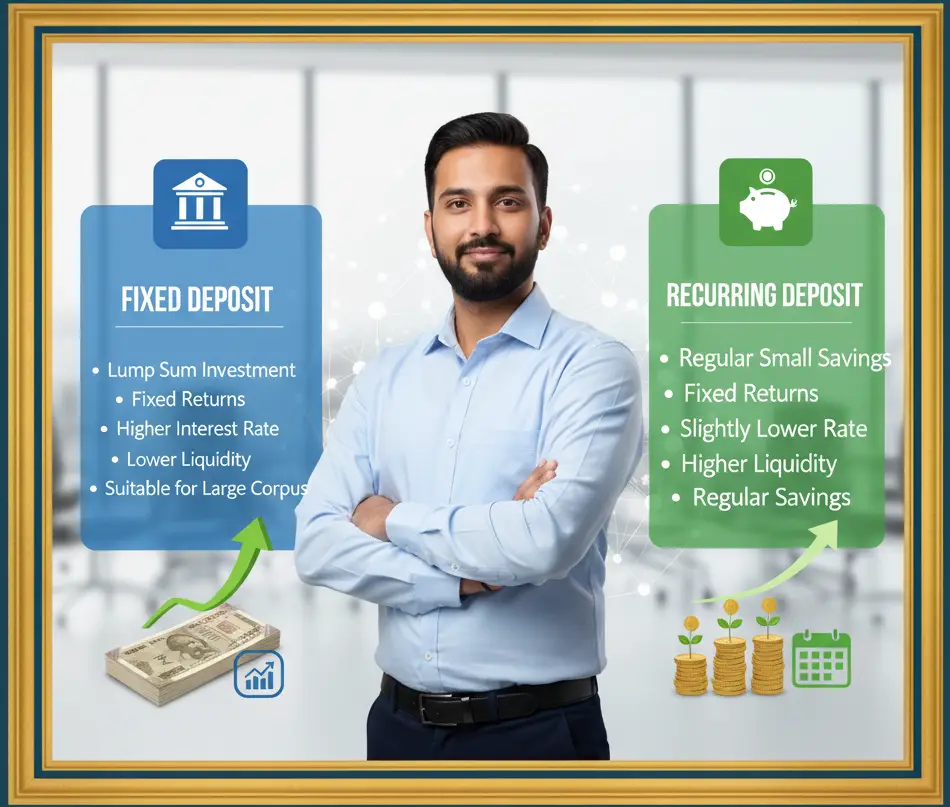
Every month, millions of Indians face a simple yet crucial financial decision: where to park their hard-earned money for safe returns? The debate often boils down to two trusted options – **Fixed Deposit (FD)** and **Recurring Deposit (RD)**. Both offer guaranteed returns and capital protection, but which one truly serves your financial goals better?
Whether you have a lump sum of 5 lakhs sitting in your savings account or you can save 10,000 rupees every month from your salary, this comprehensive guide will help you make the right choice. We’ll break down everything from interest rates and flexibility to tax implications and real-world scenarios that every Indian saver encounters.
Quick Reality Check
Did you know that the choice between FD and RD can make a difference of lakhs of rupees over a 10-year period? For example, investing 2 lakhs in FD versus saving 20,000 monthly in RD for 10 months can yield different results depending on interest rates and compounding frequency.
Understanding the Basics: FD vs RD
What is a Fixed Deposit (FD)?
A Fixed Deposit is a lump sum investment where you deposit a specific amount for a predetermined period at a fixed interest rate. Think of it as lending money to the bank for a specific time, and they pay you interest for this favor.
Real-life example: Raj deposits 5 lakh rupees in an FD for 3 years at 7% annual interest. His money stays locked for 3 years, and he earns approximately 1.1 lakh rupees as interest over this period.
What is a Recurring Deposit (RD)?
A Recurring Deposit allows you to save a fixed amount every month for a predetermined period. It’s perfect for salaried individuals who want to build a corpus gradually through systematic monthly savings.
Real-life example: Priya saves 15,000 rupees monthly in an RD for 3 years at 6.8% annual interest. Her total investment is 5.4 lakh rupees, and she earns approximately 60,000 rupees as interest.
Interest Rates: The Numbers Game
Current Market Scenario (2025)
Interest rates for both FDs and RDs vary based on the bank, deposit amount, and tenure. Here’s what you can typically expect:
| Bank Type | FD Interest Rate | RD Interest Rate | Difference |
|---|---|---|---|
| Public Sector Banks | 6.5% – 7.5% | 6.3% – 7.3% | FD typically 0.1-0.2% higher |
| Private Banks | 7.0% – 8.0% | 6.8% – 7.8% | FD typically 0.2% higher |
| Small Finance Banks | 8.0% – 9.0% | 7.8% – 8.8% | FD typically 0.2% higher |
| Post Office | 7.1% (5-year) | 6.7% (5-year) | FD 0.4% higher |
Why Do FDs Generally Offer Higher Rates?
FDs typically offer slightly higher interest rates because banks receive the entire amount upfront, allowing them to plan their lending activities better. With RDs, banks receive money gradually, which provides less immediate liquidity for lending.
The Flexibility Factor: When Life Happens
Fixed Deposit Flexibility
Pros:
- Immediate large investment if you have lump sum available
- Can be used as collateral for loans
- Partial withdrawal allowed in some banks (with penalty)
- Auto-renewal options available
Cons:
- Requires large upfront amount
- Premature withdrawal penalties (typically 0.5-1% reduction in interest)
- No option to increase investment during tenure
Recurring Deposit Flexibility
Pros:
- Start with as low as 500 rupees monthly
- Builds disciplined saving habit
- Perfect for salaried individuals
- Some banks allow increasing monthly deposit amount
Cons:
- Penalty for missing monthly deposits
- Lower overall returns due to staggered investment
- Cannot make lump sum additions during tenure
Important Penalty Information
FD Premature Withdrawal: Most banks charge 0.5% to 1% penalty on applicable interest rate. Some banks don’t pay any interest if withdrawn within 7 days.
RD Missed Payment: Banks typically charge 1-2 rupees per 100 rupees for each day of delay. Multiple defaults may lead to account closure.
Tax Implications: What the Government Takes
Tax Treatment for Both FD and RD
Both FD and RD interest income is treated identically under income tax laws:
- Taxable Income: Interest earned is added to your total income and taxed as per your income tax slab
- TDS Threshold: Banks deduct TDS @ 10% if interest exceeds 10,000 rupees annually from a single bank
- Form 15G/15H: Submit these forms to avoid TDS if your total income is below taxable limit
Smart Tax Planning Example
Suppose Amit is in the 30% tax bracket and earns 1 lakh rupees annually from his deposits:
- Tax liability: 1,00,000 × 30% = 30,000 rupees
- Effective return: If he earned 7% gross return, his net return after tax = 7% – (7% × 30%) = 4.9%
Real-World Scenario Analysis
Scenario 1: The Lump Sum Dilemma
**Situation:** Ravi received 8 lakh rupees from property sale and wants safe investment for 5 years.
FD Option: 8 lakh @ 7.5% for 5 years = Final amount: 11.46 lakh (using compound interest)
RD Alternative: If he splits into monthly investments of approximately 13,333 rupees for 5 years @ 7.3% = Final amount: approximately 10.85 lakh
Winner: FD by approximately 61,000 rupees due to higher interest rate and immediate compounding on full amount.
Scenario 2: The Salary Saver’s Choice
Situation: Sunita can save 20,000 rupees monthly and wants to build corpus for home down payment in 3 years.
RD Option: 20,000 monthly for 36 months @ 7% = Final amount: approximately 7.76 lakh
FD Alternative: Not possible as she doesn’t have lump sum available initially
Winner: RD is the only viable option, and it perfectly suits her systematic saving approach.
Step-by-Step Investment Process
How to Open a Fixed Deposit
Step 1: Choose Your Bank
- Compare interest rates across banks
- Check bank’s credit rating and stability
- Consider convenience factors like branch network
Step 2: Decide Investment Parameters
- Investment amount (minimum varies from 1,000 to 25,000 rupees)
- Tenure (7 days to 10 years typically)
- Interest payout frequency (monthly, quarterly, annually, or cumulative)
Step 3: Submit Documents
- PAN card (mandatory for deposits above 50,000 rupees)
- Address proof
- Bank account details for auto-debit
How to Open a Recurring Deposit
Step 1: Determine Monthly Capacity
- Analyze your monthly expenses and surplus
- Start with comfortable amount (can increase later in some banks)
- Choose deposit date convenient with your salary credit
Step 2: Set Up Auto-Debit
- Link your savings account for automatic monthly transfer
- Ensure sufficient balance on deposit date
- Keep 2-3 days buffer for processing
Advanced Strategies: Maximizing Returns
FD Laddering Strategy
Instead of putting all money in one FD, create multiple FDs with different maturity dates. This provides regular liquidity and opportunity to reinvest at potentially higher rates.
Example: Instead of 10 lakh FD for 5 years, create:
- 2 lakh FD for 1 year
- 2 lakh FD for 2 years
- 2 lakh FD for 3 years
- 2 lakh FD for 4 years
- 2 lakh FD for 5 years
RD Plus Investment Strategy
Combine RD with other investments for better overall returns while maintaining discipline.
Example Portfolio for 30,000 monthly savings:
- 15,000 in RD (safety and discipline)
- 10,000 in SIP mutual funds (growth potential)
- 5,000 in PPF (tax saving and long-term wealth)
Digital Banking Revolution: Online FD vs RD
Digital FD Benefits
- Higher interest rates on digital FDs (0.1-0.25% extra)
- Instant account opening
- 24/7 access and monitoring
- Paperless documentation
Digital RD Advantages
- Automated monthly deposits
- SMS/email reminders
- Easy tracking of corpus growth
- Flexible payment modes (UPI, net banking, mobile apps)
Pro Tip for Digital Savvy Investors
Many banks offer **sweep-in FDs** where excess amount in your savings account automatically gets converted to FD. This ensures you never miss earning higher interest on idle money while maintaining liquidity for emergencies.
Special Categories and Benefits
Senior Citizen Benefits
Citizens above 60 years get additional 0.25% to 0.5% interest on both FDs and RDs. This small difference compounds significantly over time.
Example: 10 lakh FD for 5 years:
- Regular rate @ 7%: Maturity value = 14.03 lakh
- Senior citizen @ 7.5%: Maturity value = 14.36 lakh
- Extra benefit: 33,000 rupees just for being a senior citizen!
Women-Specific Schemes
Many banks offer special FD and RD schemes for women with slightly higher interest rates or additional benefits like insurance coverage.
Common Mistakes to Avoid
FD Mistakes
- Not comparing rates: 0.5% difference can mean thousands in returns
- Auto-renewal trap: Blindly renewing without checking current rates
- Ignoring inflation: 7% FD return becomes 4% real return with 3% inflation
- Wrong tenure choice: Locking money for too long without considering future needs
RD Mistakes
- Overcommitting monthly amount: Leading to frequent defaults and penalties
- Not linking with salary account: Missing auto-debit due to insufficient balance
- Choosing wrong bank: Going for convenience over better rates
- Not planning for inflation: Fixed monthly amount loses purchasing power over time
FD vs RD vs Other Investment Options
| Investment Option | Expected Returns | Risk Level | Liquidity | Tax Efficiency |
|---|---|---|---|---|
| Fixed Deposit | 6.5% – 8% | Very Low | Low (penalty on early withdrawal) | Poor (fully taxable) |
| Recurring Deposit | 6.3% – 7.8% | Very Low | Very Low (committed monthly saving) | Poor (fully taxable) |
| PPF | 7.1% (current) | Very Low | Very Low (15-year lock-in) | Excellent (EEE status) |
| Debt Mutual Funds | 7% – 9% | Low to Medium | High | Better (indexation benefit) |
| Equity Mutual Funds | 12% – 15% (long-term) | High | High | Good (LTCG @ 12.5%) |
The Verdict: When to Choose What
Choose Fixed Deposit When:
- You have a lump sum amount available for investment
- You want guaranteed returns with capital protection
- You can commit money for the entire tenure without early withdrawal
- You prefer simplicity and don’t want to monitor investments regularly
- You’re near retirement and prioritize safety over growth
Choose Recurring Deposit When:
- You want to build disciplined saving habits
- You have regular monthly income but no large lump sum
- You’re saving for a specific goal with a defined timeline
- You want guaranteed returns on your monthly savings
- You’re just starting your investment journey and prefer safety
Consider Other Options When:
- You have investment horizon of 10+ years (consider equity mutual funds)
- You want tax-free returns (consider PPF or tax-free bonds)
- You can handle moderate risk for potentially higher returns (consider balanced funds)
- You need high liquidity with decent returns (consider liquid funds)
Golden Rule for Indian Savers
**The 50-30-20 Rule with FD/RD Integration:** Allocate 50% for needs, 30% for wants, and 20% for savings. Within the 20% savings portion, you can use:
- 5-8% in emergency fund (FD for liquidity)
- 5-7% in systematic savings (RD for discipline)
- 5-8% in growth investments (SIP in mutual funds)
Future of Bank Deposits in India
The landscape of bank deposits is evolving with digital banking, fintech innovations, and changing customer preferences. Here’s what to expect:
Emerging Trends
- Flexible FDs: Banks offering partial withdrawal without penalty
- Step-up RDs: Monthly deposit amount increases annually with inflation
- Goal-based deposits: Customized products for specific financial goals
- AI-powered advisory: Automated recommendations based on spending patterns
Interest Rate Outlook
With RBI’s monetary policy focusing on inflation control and economic growth, deposit rates are expected to remain in the 6-8% range for the medium term. However, competition from fintech and new banking licenses may drive innovation in deposit products.
Ready to Make Your Choice?
Use our comprehensive calculators to make informed decisions:
- FD Calculator – Calculate returns and compare different scenarios
- RD Calculator – Plan your monthly savings and projection
- Goal-based Financial Planner – Align your deposits with life goals
- Income Tax Calculator – Calculate tax impact on your deposit returns
- Inflation Calculator – Understand real returns after inflation
Final Recommendations: Your Action Plan
The choice between FD and RD isn’t always black and white. Here’s a practical framework to guide your decision:
For Young Professionals (Age 25-35)
Recommended Strategy: Hybrid approach with growth focus
- 30% in RD for disciplined saving and emergency fund building
- 50% in SIP mutual funds for long-term wealth creation
- 20% in short-term FDs for specific goals (vacation, gadgets, etc.)
For Mid-Career Professionals (Age 35-50)
Recommended Strategy: Balanced approach with goal-based allocation
- 40% in longer-tenure FDs for child education and home down payment
- 35% in equity investments for retirement corpus
- 25% in RD for ongoing goals and emergency fund top-up
For Pre-Retirees (Age 50-60)
Recommended Strategy: Safety-first with steady income focus
- 60% in FD laddering for regular income post-retirement
- 25% in conservative hybrid funds
- 15% in RD for final retirement corpus accumulation
For Retirees (Age 60+)
Recommended Strategy: Income generation with capital protection
- 70% in senior citizen FDs with quarterly interest payout
- 20% in Post Office Monthly Income Scheme
- 10% in liquid funds for emergency needs
Don’t Forget the Basics
Before investing in any FD or RD, ensure you have:
- 3-6 months emergency fund in easily accessible savings account
- Adequate term life insurance coverage
- Comprehensive health insurance for family
- Clear understanding of your financial goals and timeline
The Bottom Line: Smart Saving for Smart Indians
Both Fixed Deposits and Recurring Deposits have their place in a well-rounded financial portfolio. FDs excel when you have lump sum amounts and want to maximize returns on guaranteed investments. RDs shine when you want to build disciplined saving habits and create wealth gradually.
The key is not to see them as competing options but as complementary tools in your financial toolkit. A software engineer might use RD to save for a car while parking his annual bonus in an FD for a home down payment. A business owner might use FD laddering for tax planning while maintaining an RD for his child’s education fund.
Remember, the best investment is the one that aligns with your financial goals, risk appetite, and life stage. Whether you choose FD, RD, or a combination of both, the most important thing is to start saving and investing consistently. As they say in the investment world, “Time in the market beats timing the market,” and this applies to bank deposits as much as any other investment.
Your financial journey is unique, and your deposit strategy should reflect that uniqueness. Use this guide as a starting point, but don’t hesitate to adjust based on your specific circumstances, changing life goals, and evolving financial markets.
Stay Updated and Keep Learning
Financial markets and regulations keep evolving. Stay updated with the latest developments through our comprehensive financial planning guides and make informed decisions for your financial future.
For official information about deposit insurance and banking regulations, visit the Reserve Bank of India (RBI) website.