
Risk in Mutual Funds
You’ve done your homework. You know what a SIP is, you’ve seen the power of compounding, and you’ve even explored the different types of mutual funds. You’re ready to invest. But there’s one word that often stops beginners in their tracks: **RISK**.
The word “risk” can sound scary. It brings up images of losing all your hard-earned money in the stock market. This fear often leads to “analysis paralysis,” where people get so worried about making the wrong choice that they end up making no choice at all, leaving their money sitting in a low-return savings account.
But here’s the secret: risk isn’t something to be feared. It’s something to be **understood and managed**. In the world of investing, risk and return are two sides of the same coin. You cannot expect high returns without taking on some level of risk. The key is to take the *right amount* of risk that you are comfortable with.
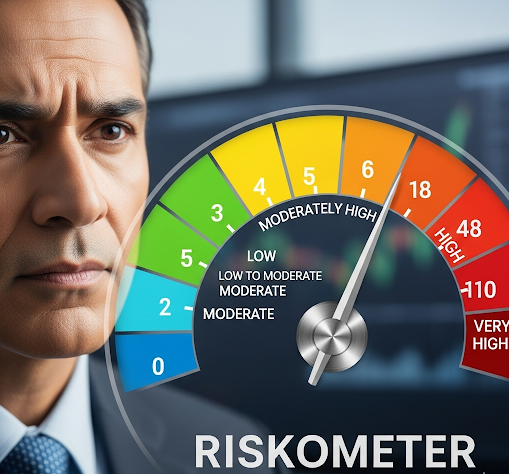
Thankfully, you don’t have to be a financial expert to do this. In India, the market regulator SEBI has created a simple, brilliant tool to help every investor. It’s called the **Riskometer**. In this in-depth guide, we will demystify investment risk and show you how to use this simple tool to choose mutual funds with confidence.
What is Investment Risk, in Simple Terms?
In the context of investing, risk simply means **uncertainty**. It’s the chance that the actual return on your investment will be different from what you expected. This could mean earning less than you hoped, or in the worst case, losing some of your original investment.
Think of it like driving a car. A Formula 1 car can go incredibly fast (high return), but it’s also very risky to drive. A simple family car is much slower (lower return), but it’s also much safer and more stable. Neither is “bad” – they are just designed for different purposes and different types of drivers. Similarly, different mutual funds are designed for different types of investors with different risk appetites.
Introducing the Riskometer: Your Investment Speedometer
To make this easy for everyone, the Securities and Exchange Board of India (SEBI) has made it compulsory for every single mutual fund scheme in India to display a **Riskometer**.
The Riskometer is a simple, graphical meter that shows the level of risk associated with a particular mutual fund. It looks like a speedometer and has six levels, from “Low” to “Very High.” Its job is to give you a clear, visual indication of a fund’s risk level at a single glance, without you having to read through complicated documents.
Why is this tool so important?
The Riskometer is updated every month based on the fund’s portfolio. This means it provides a current and accurate picture of the risk you are taking. It is a powerful tool designed by the regulator to protect the interests of small investors like us.
Decoding the 6 Levels of the Riskometer
Let’s break down what each of the six risk levels actually means for you as an investor.
1. Low Risk
What it means: These are the safest funds available. The primary goal here is capital protection, not high growth. The chances of losing your original investment are extremely low.
- Where they invest: In very safe, short-term instruments like government treasury bills and overnight money market instruments.
- Example Fund Types: Overnight Funds, Liquid Funds.
- Who should invest? People who are extremely risk-averse or who want to park a large sum of money (like an emergency fund) for a very short period (a few days to a few months).
2. Low to Moderate Risk
What it means: These funds take on slightly more risk than the “Low” category to generate slightly better returns. They are still considered very safe.
- Where they invest: In short-term debt instruments like high-quality corporate bonds and government securities.
- Example Fund Types: Short Duration Funds, Money Market Funds.
- Who should invest? Investors with short-term financial goals (1 to 3 years), like saving for a down payment on a car or a vacation.
3. Moderate Risk
What it means: This is the middle ground, offering a balance between safety and growth. These funds aim for stable returns without taking on too much volatility.
- Where they invest: In a mix of high-quality debt and a small portion of equity stocks.
- Example Fund Types: Conservative Hybrid Funds, Corporate Bond Funds.
- Who should invest? New investors who want a taste of equity with a strong safety net, or retirees who want a regular income.
4. Moderately High Risk
What it means: Now we are entering the world of wealth creation. These funds take on a significant amount of risk for the potential of good, long-term growth.
- Where they invest: Primarily in the stock market, focusing on large, stable companies.
- Example Fund Types: As we saw in our guide to mutual fund types, this category includes **Large Cap Funds, Flexi Cap Funds, and Index Funds**.
- Who should invest? This is the ideal starting point for most long-term, goal-based investors. If you are investing for goals that are more than 5 years away, this is the category for you.
5. High Risk
What it means: These funds take on substantial risk in pursuit of high returns. They can be very volatile in the short term, meaning their value can go up and down sharply.
- Where they invest: Primarily in the shares of medium-sized companies.
- Example Fund Types: Mid Cap Funds, Aggressive Hybrid Funds.
- Who should invest? Investors who have a good understanding of the market, a higher risk appetite, and a long time horizon (7+ years).
6. Very High Risk
What it means: This is the highest level of risk. These funds have the potential for explosive, multi-fold returns, but they also carry the risk of significant losses.
- Where they invest: Primarily in the shares of small companies or focused on a single sector of the economy.
- Example Fund Types: Small Cap Funds, Sectoral/Thematic Funds (e.g., Technology Funds, Infrastructure Funds).
- Who should invest? Only experienced, aggressive investors who have a very long time horizon (10+ years) and who are comfortable with extreme volatility.
How to Use the Riskometer: A Simple Checklist
The Riskometer is a great tool, but it’s most effective when you use it in the context of your own financial life. Here’s how.
1. First, Know Your Own Risk Profile
Before you even look at a fund, you need to understand your own “risk appetite.” Ask yourself: How would I feel if my investment of ₹1 Lakh became ₹80,000 in one year? If that thought gives you sleepless nights, you are a conservative investor. If you see it as a buying opportunity, you are an aggressive investor. Your age, income stability, and financial dependents all play a role in this.
2. Align the Fund’s Risk with Your Financial Goal
The risk level of the fund should match the timeline of your goal.
- Long-Term Goals (10+ years), like retirement: You can afford to take higher risk. A “Moderately High” or “High” risk fund is suitable.
- Medium-Term Goals (3-5 years), like a car down payment: You need more stability. A “Moderate” risk fund is a good choice.
- Short-Term Goals (less than 1 year), like an emergency fund: You cannot afford any risk. Only “Low” risk funds should be considered.
3. Don’t Just Chase High Returns
It’s tempting to look at the past returns of a “Very High Risk” fund and think it’s the best. But remember, high returns come with high volatility. A fund’s potential is useless if you can’t handle the journey and panic-sell at the first sign of a market dip. It’s always better to choose a fund whose risk level lets you stay invested peacefully.
The Riskometer is Just the Starting Point
While the Riskometer is an excellent first filter, it’s not the only thing you should look at. Once you’ve shortlisted funds based on their risk level, you should also consider other factors like the fund’s expense ratio, the fund manager’s track record, and its historical performance. You can find all this information on trusted financial portals like Moneycontrol or Value Research.
The Final Word: Risk is Not a Monster to Be Feared
In the world of investing, risk is not your enemy. It is a characteristic of an investment, just like speed is a characteristic of a car. The goal is not to find a “no-risk” investment that gives high returns – that does not exist. The goal is to find an investment whose risk level you understand and are comfortable with.
The Riskometer is a simple, transparent, and powerful tool that empowers you to do just that. Use it to filter out funds that don’t match your personality and goals. By doing so, you can build a mutual fund portfolio that not only helps you grow your wealth but also lets you sleep peacefully at night. Make a wise choice!