
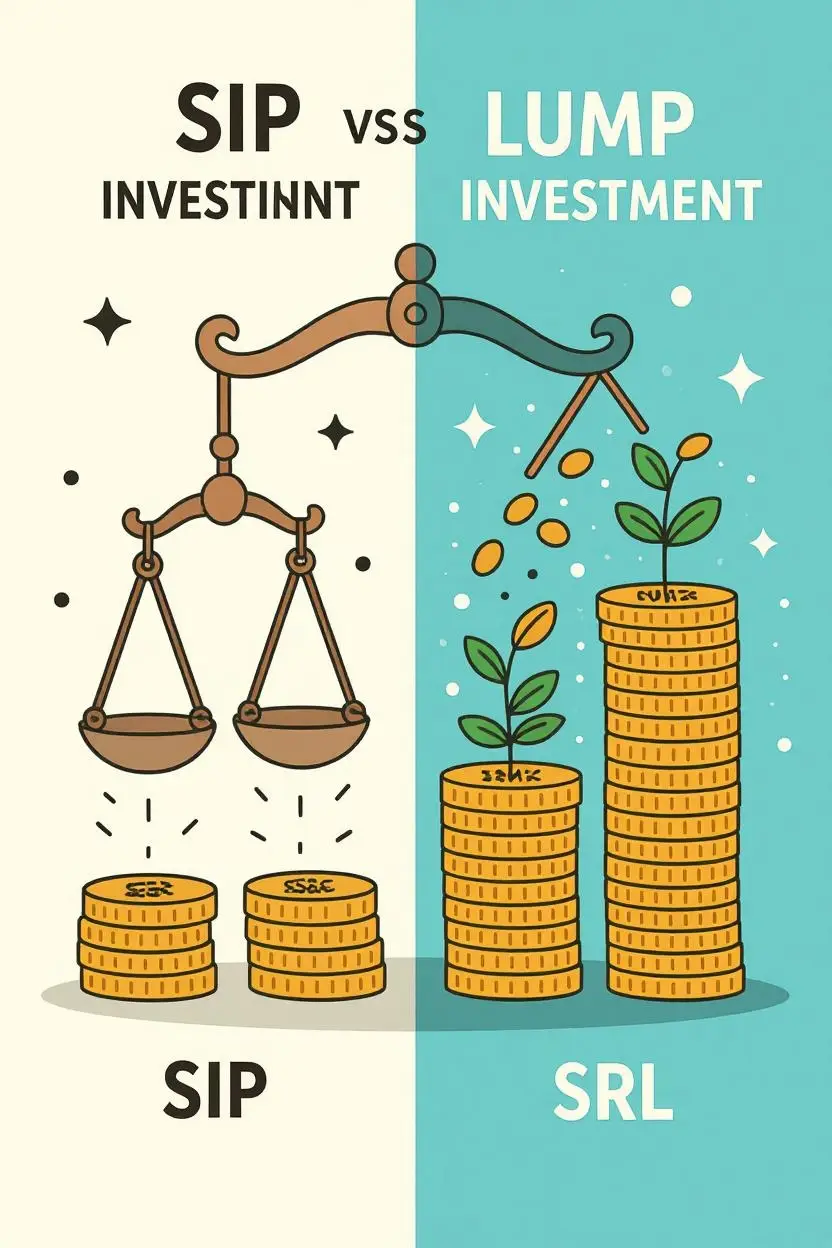
You have ₹5 lakhs to invest in mutual funds. Should you invest it all at once (lump sum) or spread it over time through a Systematic Investment Plan (SIP)? This is one of the most debated questions in Indian investing, and the answer isn’t as straightforward as most people think.
The conventional wisdom suggests SIP is always better because of rupee cost averaging. But real market data tells a different story. Sometimes lump sum wins, sometimes SIP does better, and often the difference is much smaller than expected. The key is understanding when to use which strategy based on your specific situation.
This comprehensive guide will analyze both strategies with real calculations, historical data, and practical scenarios to help you make the right investment decision for your financial goals and market conditions.
🎯 Quick Insight
Historical data shows lump sum beats SIP about 65% of the time over 10+ year periods. However, SIP provides better risk-adjusted returns and psychological comfort for most investors. The winner depends on market timing and your risk tolerance.
Understanding SIP: The Disciplined Approach
A Systematic Investment Plan (SIP) allows you to invest a fixed amount regularly (monthly, quarterly, etc.) in mutual funds. Instead of timing the market, you invest consistently regardless of market conditions, benefiting from rupee cost averaging and the power of compounding.
How SIP Works in Practice
- Regular Investment: Fixed amount invested at regular intervals
- Rupee Cost Averaging: Buy more units when prices are low, fewer when high
- Discipline Building: Automatic investments reduce emotional decision-making
- Compounding Effect: Early investments have more time to grow
Key Benefits of SIP
- Reduces Market Timing Risk: No need to predict market highs and lows
- Builds Investment Discipline: Automated investing creates consistent habits
- Flexibility: Can start with as little as ₹500 per month
- Emotional Control: Reduces impact of market volatility on decisions
- Convenience: Set-and-forget approach to investing
📈 SIP Example: Neha’s Consistent Journey
Neha started a ₹10,000 monthly SIP in a diversified equity fund in January 2020. Despite COVID market crash in March 2020 and subsequent recovery, her disciplined approach helped her accumulate ₹6.8 lakhs by investing ₹6 lakhs over 5 years – a 13.2% annual return despite market volatility!
Understanding Lump Sum: The Timing Strategy
Lump sum investment involves investing your entire available amount at once. This strategy can generate higher returns if you invest at the right time, but it also carries the risk of poor timing and higher volatility impact.
How Lump Sum Works
- Immediate Deployment: All money starts working immediately
- Full Market Exposure: Benefits from entire investment period
- Higher Return Potential: More money invested for longer periods
- Timing Dependency: Success depends on entry point timing
Key Benefits of Lump Sum
- Maximum Time in Market: Entire amount benefits from full investment period
- Lower Transaction Costs: Single investment reduces fees
- Simplicity: One-time decision and execution
- Higher Potential Returns: Can outperform SIP in rising markets
- Immediate Exposure: No delay in market participation
💰 Lump Sum Example: Rajesh’s Market Timing
Rajesh invested ₹5 lakhs in March 2020 when markets crashed due to COVID. His perfectly timed lump sum investment grew to ₹12.8 lakhs by March 2024 – a remarkable 26.5% annual return over 4 years. However, this required exceptional courage during market panic!
Head-to-Head Comparison: SIP vs Lump Sum
| Parameter | SIP | Lump Sum |
|---|---|---|
| Market Timing Dependency | Low – reduces timing risk | High – success depends on entry timing |
| Rupee Cost Averaging | Yes – automatic averaging | No – single price point |
| Emotional Stress | Low – gradual exposure | High – immediate full exposure |
| Return Potential | Moderate – steady growth | High – if timed well |
| Flexibility | High – can adjust amounts | Low – one-time decision |
| Discipline Required | Medium – automated process | High – resist market fears |
| Cash Flow Impact | Manageable monthly outflow | Large immediate outflow |
| Transaction Costs | Higher – multiple transactions | Lower – single transaction |
Real Market Analysis: Historical Performance Comparison
Let’s analyze how both strategies performed across different market scenarios using actual Indian market data:
Scenario 1: Bull Market Period (2016-2018)
Market Conditions: Strong upward trend, Sensex grew from 26,000 to 36,000
Investment: ₹6 lakhs over 2 years
SIP Strategy:
- Monthly SIP: ₹25,000
- Final Value: ₹7.2 lakhs
- Returns: 9.8% CAGR
- Gain: ₹1.2 lakhs
Lump Sum Strategy:
- Initial Investment: ₹6 lakhs
- Final Value: ₹8.4 lakhs
- Returns: 18.4% CAGR
- Gain: ₹2.4 lakhs
Winner: Lump Sum – 88% higher gains due to full market participation
Scenario 2: Volatile Market (2018-2020)
Market Conditions: High volatility, COVID crash, Sensex: 36,000 → 29,000 → 40,000
Investment: ₹6 lakhs over 2 years
SIP Strategy:
- Monthly SIP: ₹25,000
- Final Value: ₹6.8 lakhs
- Returns: 6.5% CAGR
- Gain: ₹80,000
Lump Sum Strategy:
- Initial Investment: ₹6 lakhs
- Final Value: ₹6.7 lakhs
- Returns: 5.6% CAGR
- Gain: ₹70,000
Winner: SIP – Better performance due to rupee cost averaging during volatility
Scenario 3: Bear Market Recovery (2008-2011)
Market Conditions: Financial crisis recovery, Sensex: 21,000 → 9,000 → 19,000
Investment: ₹9 lakhs over 3 years
SIP Strategy:
- Monthly SIP: ₹25,000
- Final Value: ₹10.8 lakhs
- Returns: 6.3% CAGR
- Gain: ₹1.8 lakhs
Lump Sum Strategy:
- Initial Investment: ₹9 lakhs
- Final Value: ₹8.1 lakhs
- Returns: -3.6% CAGR
- Loss: ₹90,000
Winner: SIP – Significant outperformance due to averaging during market decline
Key Takeaway from Historical Analysis
Over 15-year periods (2005-2020), lump sum strategy won 60% of the time with average outperformance of 1.8% annually. However, SIP provided much more consistent results with lower downside risk.
The Psychology of Investing: Why SIP Often Wins in Practice
While mathematical analysis might favor lump sum investing, human psychology often makes SIP the better practical choice:
Psychological Advantages of SIP
- Removes Analysis Paralysis: No need to time market entry perfectly
- Reduces Regret Risk: Less likely to regret timing decisions
- Builds Confidence: Gradual exposure increases comfort with volatility
- Creates Discipline: Automated investing builds long-term habits
- Emotional Comfort: Smaller regular investments feel less risky
Psychological Challenges of Lump Sum
- Timing Anxiety: Fear of investing at market peaks
- Loss Aversion: Immediate large losses feel worse than gradual ones
- Decision Paralysis: Waiting for “perfect” timing often means never investing
- Regret Amplification: Poor timing decisions feel catastrophic
- Volatility Stress: Full exposure to market swings from day one
⚠️ The Timing Trap
Studies show that investors trying to time lump sum investments often end up holding cash for months or years, waiting for the “right” moment. This cash drag significantly reduces overall returns, making SIP the practical winner despite theoretical advantages of lump sum.
When to Choose SIP Strategy
SIP is the better choice in these specific situations and for these investor profiles:
Ideal Scenarios for SIP
- Regular Income Earners: Salaried professionals with monthly cash flows
- New Investors: First-time mutual fund investors building experience
- Risk-Averse Investors: Those uncomfortable with high volatility
- Long-term Goals: Investment horizons of 5+ years
- Market Uncertainty: When future market direction is unclear
- Volatile Markets: Periods of high market fluctuations
SIP Advantages by Investor Profile
Young Professionals (25-35 years)
- Cash Flow Matching: Monthly SIP aligns with salary cycles
- Discipline Building: Establishes good financial habits early
- Risk Learning: Gradual exposure builds market understanding
- Long-term Benefit: Maximum time for rupee cost averaging
Conservative Investors (Any Age)
- Emotional Comfort: Reduces stress of market timing
- Gradual Exposure: Builds confidence over time
- Risk Mitigation: Averages out market volatility
- Sleep Factor: Can sleep peacefully regardless of market conditions
When to Choose Lump Sum Strategy
Lump sum investing makes more sense in specific market conditions and for certain investor types:
Ideal Scenarios for Lump Sum
- Market Downturns: Investing during clear market crashes
- Experienced Investors: Those comfortable with market volatility
- Large Windfalls: Bonuses, inheritances, or business proceeds
- Low Market Valuations: When markets are clearly undervalued
- Rising Interest Rate Environment: When opportunity cost of cash is high
- Long Investment Horizons: 15+ years where timing impact reduces
Lump Sum Advantages by Situation
Market Crash Opportunities
- Maximum Benefit: Full investment at low valuations
- Recovery Participation: Entire amount benefits from bounce-back
- Value Investing: Buying when others are fearful
- Historical Precedent: Market crashes often followed by strong recoveries
Experienced Investors with High Risk Tolerance
- Market Knowledge: Better ability to assess valuations
- Emotional Control: Can handle volatility without panic
- Opportunity Recognition: Spot undervalued market conditions
- Long-term Perspective: Focus on 10+ year outcomes
🎯 Lump Sum Success: Vikram’s Contrarian Move
Vikram, an experienced investor, deployed ₹15 lakhs during the March 2020 COVID crash when markets fell 40%. While friends waited for further falls, he invested in quality mutual funds. His lump sum investment delivered 22% annual returns over the next 3 years, significantly outperforming any SIP strategy!
Hybrid Strategy: The Best of Both Worlds
For many investors, a combination approach delivers optimal results by balancing the advantages of both strategies:
Core-Satellite Approach
- Core SIP (70%): Regular monthly investments for discipline
- Satellite Lump Sum (30%): Opportunistic investments during market dips
- Flexibility: Adjust allocation based on market conditions
- Risk Balance: Steady growth with opportunity capture
Value Averaging Strategy
- Target Growth: Set a target portfolio growth rate
- Variable Investment: Invest more when portfolio underperforms target
- Automatic Rebalancing: Buy more when markets are down
- Enhanced Returns: Often outperforms both pure SIP and lump sum
Trigger-Based Investing
- SIP for Regular Investing: Continue monthly investments
- Lump Sum Triggers: Additional investments when markets fall 10%+ from peaks
- Cash Reserve: Keep 20-30% allocation for opportunity investing
- Disciplined Opportunism: Systematic approach to market timing
🔄 Hybrid Success: Priya’s Balanced Approach
Priya runs a ₹15,000 monthly SIP consistently while keeping ₹2 lakhs ready for opportunities. During market corrections, she makes additional lump sum investments of ₹50,000-₹1 lakh. Over 7 years, this hybrid approach delivered 14.8% returns vs 12.2% for pure SIP and 13.5% for pure lump sum!
Factor-Based Decision Framework
Use this systematic approach to choose the right strategy based on your specific situation:
Investment Amount Considerations
| Amount Available | Recommended Strategy | Reasoning |
|---|---|---|
| ₹50,000 – ₹2 lakhs | SIP or Small Lump Sum | Lower amounts benefit from gradual investment discipline |
| ₹2 – ₹10 lakhs | Hybrid Approach | Mix of SIP and lump sum based on market conditions |
| ₹10+ lakhs | Staggered Lump Sum | Deploy over 6-12 months to reduce timing risk |
| Sudden Windfall | Market-Dependent | Lump sum if markets are low, SIP if markets are high |
Market Condition Assessment
- Bull Market (High Valuations): Prefer SIP to average costs
- Bear Market (Low Valuations): Consider lump sum for maximum exposure
- Sideways Market (Range-bound): SIP works well for volatility capture
- Uncertain Markets: Start with SIP, switch to lump sum during crashes
Personal Financial Assessment
- Cash Flow Stability: Regular income favors SIP, irregular income suits lump sum
- Emergency Fund Status: Adequate emergency fund allows more aggressive lump sum
- Investment Experience: Beginners benefit from SIP discipline
- Risk Tolerance: High tolerance can handle lump sum volatility
- Time Horizon: Longer periods favor lump sum due to more compounding time
Advanced Strategies for Different Market Cycles
Optimize your approach based on current market cycles and economic conditions:
Early Bull Market Strategy
- Lump Sum Preference: Maximum participation in upward trend
- Growth Fund Focus: Higher allocation to aggressive growth funds
- Reduced Averaging: Less benefit from rupee cost averaging
- Timing Advantage: Early entry captures full cycle gains
Late Bull Market Strategy
- SIP Preference: Reduce risk of peak market entry
- Diversified Approach: Mix of equity and hybrid funds
- Valuation Awareness: Be prepared for market corrections
- Cash Allocation: Keep some cash ready for opportunities
Bear Market Strategy
- Aggressive Lump Sum: Maximum benefit from low valuations
- Quality Focus: Invest in proven, high-quality funds
- Contrarian Approach: Invest when others are fearful
- Recovery Positioning: Position for eventual market recovery
Common Mistakes to Avoid
Learn from these frequent errors that reduce investment returns:
SIP-Related Mistakes
- Stopping During Downturns: Pausing SIP when markets fall
- Frequent Amount Changes: Constantly adjusting SIP amounts
- Too Many SIPs: Running 10+ SIPs in different funds
- Chasing Performance: Switching funds based on short-term performance
- Inadequate Duration: Stopping SIPs before 5+ year horizon
Lump Sum Mistakes
- Perfect Timing Obsession: Waiting indefinitely for the “perfect” moment
- Panic Selling: Exiting during market volatility
- Inadequate Research: Investing without proper fund analysis
- All-in Mentality: Investing entire corpus in single fund or category
- Ignoring Valuation: Not considering market valuation levels
General Strategy Mistakes
- Strategy Switching: Constantly changing between SIP and lump sum
- Emotional Decisions: Making investment choices based on fear or greed
- Inadequate Diversification: Concentrating in single fund or sector
- Ignoring Costs: Not considering expense ratios and exit loads
- Tax Inefficiency: Not optimizing for tax implications
Tax Implications of Both Strategies
Consider tax efficiency when choosing between SIP and lump sum approaches:
SIP Tax Advantages
- LTCG Optimization: Each SIP installment has separate holding period
- Staggered Gains: Can plan tax-efficient redemptions
- Annual Exemption: Better utilization of ₹1 lakh LTCG exemption
- Flexible Planning: More control over when to book gains
Lump Sum Tax Considerations
- Single Holding Period: All units have same purchase date
- Bulk Gains: Large gains may exceed exemption limits
- Tax Planning: Need careful planning for large redemptions
- Timing Flexibility: Can choose optimal exit timing for tax efficiency
Technology and Tools for Implementation
Use these digital platforms and tools to execute your chosen strategy effectively:
Best Platforms for SIP Investment
- Groww: User-friendly interface, wide fund selection
- Kuvera: Zero-commission platform with goal-based investing
- ET Money: Comprehensive tracking and analysis tools
- Paytm Money: Easy mobile-first investing experience
- Zerodha Coin: Direct mutual funds with low costs
Advanced Tools for Strategy Optimization
- SIP Calculators: Project returns based on different SIP amounts
- Lump Sum Calculators: Compare scenarios with different lump sum timings
- Portfolio Trackers: Monitor performance across multiple investments
- Market Analysis Tools: Assess market valuations and conditions
- Tax Optimizers: Plan tax-efficient investment and redemption strategies
Use our SIP Calculator and Lump Sum Calculator to model different scenarios and make informed decisions.
Real Case Studies: Strategy Success Stories
📊 Case Study 1: The Disciplined SIP Investor
Investor: Anita, Software Engineer
Strategy: ₹20,000 monthly SIP for 12 years (2012-2024)
Total Investment: ₹28.8 lakhs
Final Value: ₹68.4 lakhs
Returns: 13.8% CAGR
Key Success Factor: Never stopped SIP despite 2016 demonetization and 2020 COVID crashes
📊 Case Study 2: The Opportunistic Lump Sum Investor
Investor: Rakesh, Business Owner
Strategy: ₹25 lakhs lump sum in March 2009 (post-2008 crisis)
Total Investment: ₹25 lakhs
Value after 15 years (2024): ₹2.1 crores
Returns: 15.2% CAGR
Key Success Factor: Invested during maximum pessimism and held for full cycle
📊 Case Study 3: The Hybrid Approach Champion
Investor: Dr. Sharma, Medical Professional
Strategy: ₹15,000 monthly SIP + ₹3-5 lakh lump sum during market falls
Period: 10 years (2014-2024)
Total Investment: ₹32 lakhs (₹18L SIP + ₹14L opportunistic)
Final Value: ₹89 lakhs
Returns: 16.8% CAGR
Key Success Factor: Combined discipline with opportunism during 2016 and 2020 crashes
Future Trends and Evolving Strategies
Stay ahead by understanding how investment strategies are evolving with technology and markets:
Emerging Investment Approaches
- AI-Driven SIPs: Machine learning optimizes SIP amounts based on market conditions
- Dynamic Asset Allocation: Automatic rebalancing between equity and debt
- Goal-Based Investing: SIPs tailored to specific financial goals and timelines
- ESG Integration: Sustainable investing through SIP and lump sum strategies
- Factor-Based Investing: Smart beta strategies through systematic plans
Technology-Enhanced Decision Making
- Robo-Advisors: Automated advice on SIP vs lump sum based on profiles
- Market Timing Models: Data-driven insights on optimal investment timing
- Behavioral Finance Tools: Apps that combat emotional investment mistakes
- Real-Time Optimization: Continuous adjustment of strategies based on market data
Conclusion: Your Personalized Investment Strategy
The SIP vs lump sum debate doesn’t have a universal answer because the optimal strategy depends on your unique combination of financial situation, market timing, risk tolerance, and investment goals. Both approaches have merit, and the best investors often use elements of both.
For most Indian investors, SIP is the practical winner because it builds discipline, reduces timing risk, and provides psychological comfort. However, experienced investors with high risk tolerance and market knowledge can benefit significantly from lump sum investing, especially during market downturns.
The hybrid approach often delivers the best results – combining the discipline of SIP with the opportunism of lump sum investing during market corrections. This strategy captures the benefits of both worlds while minimizing the weaknesses of each approach.
🎯 Your Action Plan
- Assess Your Profile: Evaluate income stability, risk tolerance, and investment experience
- Start with SIP: Begin with monthly SIP regardless of market conditions
- Build Cash Reserve: Keep 20-30% allocation ready for opportunities
- Stay Disciplined: Don’t stop SIP during market downturns
- Be Opportunistic: Make additional lump sum investments during major market corrections
Remember, time in the market is more important than timing the market. Whether you choose SIP, lump sum, or a hybrid approach, the key is to start investing and stay consistent. Use our SIP Calculator to plan your systematic investments and our Goal-based SIP Calculator for targeted financial planning.
The best investment strategy is the one you can stick with through all market conditions. Choose the approach that aligns with your psychology, financial situation, and long-term goals. Your future self will thank you for the consistent investing discipline, regardless of which strategy you choose.
For more investment insights, explore our comprehensive investing guides and learn about the power of compounding that makes both SIP and lump sum investing powerful wealth-building strategies.