
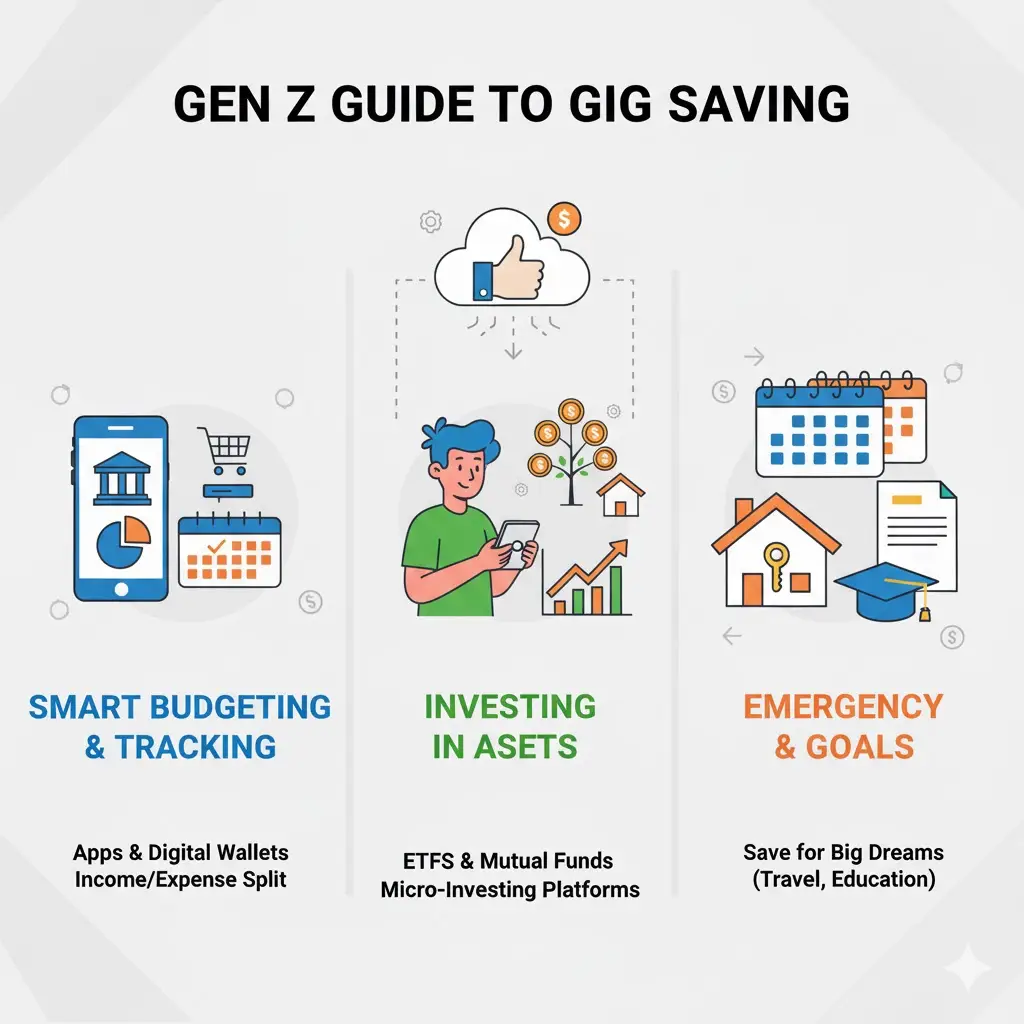
Gen Z’s Complete Guide to Gig Economy Savings & Investments in India 2026
📘 Gig Economy Finance — The Gen Z Financial Reality
India’s Gen Z (born 1997-2012) is the first generation to normalise gig work as a primary career path, not a side hustle. 7.7 crore gig workers nationally, growing 15% annually (NITI Aayog) — and Gen Z accounts for 42% of this workforce. Gig work offers freedom, flexibility, and income potential that can exceed salaried equivalents — but it strips away the financial scaffolding that salaried employment provides: stable income, employer EPF contributions, group health insurance, structured tax deduction at source, and retirement benefits. This guide builds that scaffolding from scratch for Gen Z gig workers.
📊 Gen Z Gig Economy Data — India 2025-26
- NITI Aayog, 2025: Platform gig workers: 2.35 crore (projected). Non-platform gig/freelance workers: 5.35+ crore. Gen Z share: 42%. Top gig categories: content creation, software development, delivery, digital marketing, online tutoring.
- Payoneer 2025: Indian Gen Z freelancers on international platforms earn average $24/hour. Top earners (AI/ML, full-stack development): $60-120/hour. India’s 18-25 age group is Upwork’s fastest-growing segment globally.
- CBDT FY 2024-25: 44ADA filers aged 18-30: 28 lakh — 47% YoY growth. Gen Z is the largest adopter of presumptive taxation — the most favourable tax structure for gig income.
- IRDAI, 2025: Only 11% of gig workers under age 30 have individual health insurance. 89% are uninsured or dependent on family coverage — creating catastrophic financial risk from one health event.
1. Creating Financial Stability from Variable Gig Income
The foundational challenge of gig income: ₹2 lakh one month, ₹40,000 the next. Standard monthly budgeting fails on variable income. The solution: income smoothing.
The Income Smoothing System
- All gig income lands in a “Income Buffer” savings account — not your spending account.
- Transfer a fixed “salary” to your spending account on the 1st of each month — equal to your 3-month average income, or your minimum comfortable monthly budget.
- Anything above your salary in the buffer: allocate systematically — 50% emergency fund (until target), 30% investments, 20% variable bonus to yourself.
- Low-income months: Your spending account still receives the fixed “salary” — funded by the buffer. No lifestyle disruption.
| Month | Gig Income | Fixed Salary (₹60K) | Buffer Change | Emergency Fund Action |
|---|---|---|---|---|
| January | ₹1,20,000 | ₹60,000 paid | +₹60,000 | Add ₹40,000 |
| February | ₹35,000 | ₹60,000 paid | -₹25,000 | No change |
| March | ₹90,000 | ₹60,000 paid | +₹30,000 | Add ₹20,000 |
2. Tax Planning for Gen Z Gig Workers
Section 44ADA — The Gig Worker’s Tax Lifeline
Section 44ADA presumptive taxation is the most favourable tax structure available to Gen Z gig workers in skilled professions (IT, design, content, consulting, legal, medical, engineering). It deems 50% of gross receipts as profit — automatically — without maintaining books or proving expenses.
| Annual Gig Income | 44ADA Deemed Profit | New Regime Tax (Budget 2025) | Effective Tax Rate on Revenue |
|---|---|---|---|
| ₹8 lakh | ₹4 lakh | ₹0 | 0% |
| ₹15 lakh | ₹7.5 lakh | ₹0 (below ₹12L with std deduction) | 0% |
| ₹24 lakh | ₹12 lakh | ₹0 (exactly at zero-tax threshold) | 0% |
| ₹36 lakh | ₹18 lakh | ₹3,00,000 | 8.3% |
| ₹50 lakh | ₹25 lakh | ₹5,25,000 | 10.5% |
💡 Pay Advance Tax — Don’t Get Caught in March
Under 44ADA: pay 100% of your estimated annual tax by March 15 (single instalment allowed). Budget for it throughout the year: set aside 10-15% of every payment received in a dedicated “Tax Bucket” savings account or liquid fund. When March comes, transfer from the bucket and pay via Challan 280. No surprises, no penalties, no stress.
3. Insurance Without an Employer
This is the biggest financial vulnerability of gig workers. Without employer group insurance, one hospitalisation without coverage can wipe out a year of savings. Build your insurance stack in this order:
| Insurance Type | Why Critical for Gig Workers | Recommended Cover | Annual Cost (Age 25) |
|---|---|---|---|
| Health Insurance | No employer group cover — any hospitalisation hits your savings directly | ₹10L individual policy | ₹8,000–12,000 |
| Term Life Insurance | If you have financial dependants (parents, siblings) | ₹1 Cr (10-15× income) | ₹6,000–9,000 |
| Hospital Cash Benefit | Replaces lost gig income during hospitalisation | ₹2,000-3,000/day rider | ₹2,000–3,500 |
| Personal Accident | Disability can end gig career permanently | ₹25-50L cover | ₹2,000–3,500 |
4. Investing with Irregular Income
The key insight: SIP flexibility matters more than the amount when income is variable. Choose platforms and instruments that allow stopping, pausing, and restarting without penalty:
The Gig Worker Investment Hierarchy
- Emergency fund first: 9-12 months expenses in liquid fund (larger than salaried because income can stop entirely). Non-negotiable before any market investment.
- NPS contribution (irregular): Contribute to NPS whenever you have surplus — minimum ₹500, any time. No SIP commitment needed. Tax benefit under 80CCD(1B) under old regime.
- ELSS lump sums: Instead of monthly SIP (hard to maintain on variable income), invest ELSS lump sums in high-income months. 3-year lock-in with LTCG treatment. 80C deduction (old regime).
- Index fund SIP (flexible): Set up ₹3,000-5,000/month minimum SIP. In high-income months, do additional lump sum investments. In low months, the minimum continues from buffer.
- PPF: Contribute any amount above ₹500 whenever possible. Annual maximum ₹1.5L. EEE tax treatment. Flexible timing — no monthly commitment.
5. Retirement Planning for Gen Z Gig Workers
Without employer EPF (which forces retirement savings for salaried workers), gig workers must build retirement corpus entirely through voluntary savings. The good news: gig work’s higher income potential often means more money available for retirement savings.
| Retirement Instrument | Gig Worker Access | Annual Limit | Best Feature for Gig Workers |
|---|---|---|---|
| NPS Tier I (self-employed) | Full access, eNPS | No limit | Irregular contributions ok, 80CCD(1B) deduction |
| PPF | Full access | ₹1.5L/year | EEE, flexible timing, government guaranteed |
| Equity SIP (index fund) | Full access | No limit | Flexible pause/stop, highest long-term returns |
| EPF (voluntary) | Not available (no employer) | N/A | — |
| ELSS | Full access | ₹1.5L (80C) | Lump sum friendly, 3-year lock-in |
Target retirement savings rate: 20-25% of average monthly income. At 13% CAGR on equity investments: ₹10,000/month from age 22 grows to ₹3.9 crore by age 60. Starting at 28 with the same amount: ₹2.1 crore. Every year of gig income not saved for retirement costs disproportionately.
6. Best Financial Tools for Gen Z Gig Workers
| Need | Best Tool | Why |
|---|---|---|
| Tax filing (44ADA) | Quicko or official ITD portal | Purpose-built for ITR-4, 44ADA calculation |
| Invoice creation | Refrens, Vyapar, or Zoho Invoice | Professional invoices with GST, track payments |
| Expense tracking | Walnut + INDmoney | Auto-track + full financial dashboard |
| Health insurance | Policybazaar, Ditto Insurance | Compare policies; Ditto offers advisory for right coverage |
| MF investment (flexible SIP) | Groww or Zerodha Coin | Best SIP pause/modify flexibility |
| NPS (self-employed) | eNPS (enps.nsdl.com) | Direct NPS registration, no intermediary |
| GST filing | ClearTax GST | Simplest GSTR-1 and GSTR-3B filing |
7. Five Financial Mistakes Gen Z Gig Workers Make
- No emergency fund before investing: Starting SIP while having zero emergency buffer. One slow client month + unexpected expense = SIP stopped, debt taken. Emergency fund first, always.
- Lifestyle inflation in high-income months: ₹2L month leads to ₹2L expenses — then ₹40K month feels like a crisis. Fix budget to 3-month average income; save the rest.
- Skipping health insurance: “I’m young and healthy” is the most expensive assumption in personal finance. Buy health insurance before any health condition develops. After a diagnosis, premiums double and waiting periods restart.
- Not saving for taxes throughout the year: Receiving full payment without setting aside tax leads to a March 15 advance tax crisis. Set 10-15% of every payment aside in a liquid fund the day you receive it.
- No documentation of income and expenses: Even under 44ADA (no books required), maintain basic records — client invoices, payment receipts, bank statements. GST registration requirements, bank loan applications, and occasional tax scrutiny all require documentation that verbal records can’t satisfy.
🧮 Free Calculators — Use Them Now
No login required. Updated for FY 2025-26.
Frequently Asked Questions
Variable income budgeting for gig workers requires a different framework than salaried budgeting: (1) Calculate your 3-month average income — use this as your ‘base’ monthly budget, not your highest month. (2) In high-income months: save 50%+ of the surplus above your base. Build emergency fund first (9-12 months for gig workers vs 6 months for salaried — income stops entirely between projects). (3) In low-income months: draw from the high-month surplus, not from investments. (4) Pay yourself a fixed ‘salary’ from your bank account each month — the surplus above this goes to a separate savings account. This creates artificial income stability for budgeting purposes.
Gen Z gig workers earning from professional services (IT freelancing, content creation, design, consulting) qualify for Section 44ADA: 50% of gross receipts is deemed profit — automatically deducting half your revenue as expenses without maintaining books. Combined with Budget 2025’s zero tax below ₹12L income: gig receipts up to ₹24L = ₹12L deemed income = ₹0 tax under new regime. Additional deductions under old regime: Section 80C (₹1.5L ELSS/PPF), Section 80D (health insurance ₹25,000+), 80CCD(1B) NPS (₹50,000). For platform-based gig work (Swiggy Delivery, Ola/Uber): income is taxed as business income under Section 44AD, not 44ADA.
NPS is excellent for self-employed Gen Z gig workers for three reasons: (1) Section 80CCD(1B): ₹50,000 additional tax deduction beyond the 80C limit (old regime only). (2) Built-in discipline: NPS Tier I is locked until 60 — prevents the common gig worker temptation of dipping into investments during low-income periods. (3) Strong returns: NPS equity scheme historical CAGR of 14.5% since 2009. (4) No employer needed: self-employed individuals can open NPS directly through eNPS (enps.nsdl.com) with just PAN + Aadhaar + bank account. Contribution can be as low as ₹500/month and irregular — no fixed monthly commitment required.
Without employer group health insurance, gig workers must buy individual/family health insurance. Recommendations: (1) Niva Bupa ReAssure, Care Supreme, or Aditya Birla Activ One — comprehensive individual policies with restoration benefit and no room rent limits. (2) Sum insured: minimum ₹10L for individual, ₹15-20L family floater. (3) Buy young (22-25) — premiums are lowest before any health conditions develop, and 4-5 year waiting periods for PEDs are served without disruption. (4) Include hospital cash benefit rider — pays daily cash during hospitalisation, compensating for lost gig income during recovery. (5) Section 80D: ₹25,000 deduction on premium under old regime.
For irregular income investors: (1) Zerodha Coin / Groww — allow pausing, increasing, or stopping SIP anytime without penalty — crucial for gig workers who can’t commit to fixed monthly amounts. (2) ELSS funds (3-year lock-in) — invest lump sums from high-income months rather than fixed SIP. Better than rigid monthly commitments. (3) PPF — minimum ₹500/year (not per month) — invest any amount whenever you can, flexible timing. (4) NPS eNPS — minimum ₹500/contribution, no fixed frequency. (5) Liquid mutual fund — park high-income month surplus here first, then do SIP transfers monthly from this buffer (creating artificial salary regularity).