
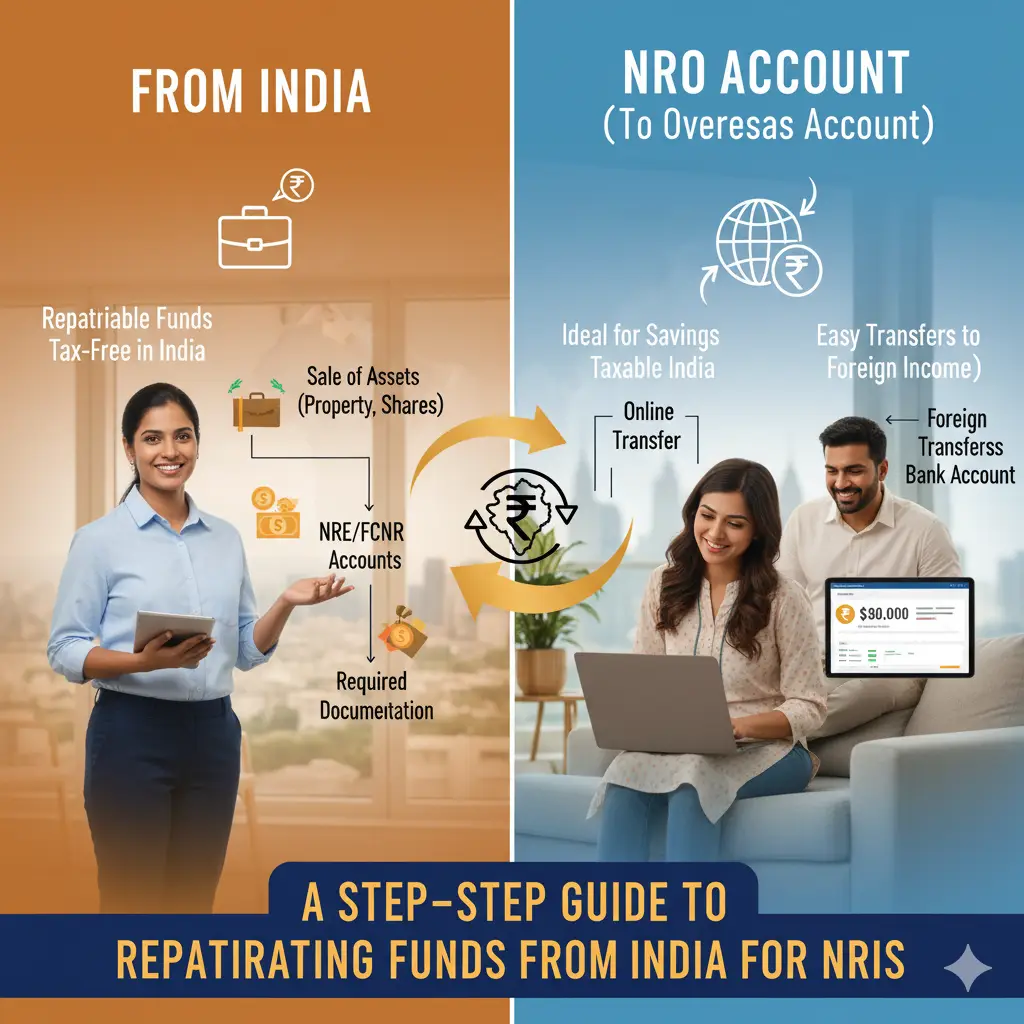
You just sold your apartment in Bangalore for ₹1.2 crores. The money is sitting in your NRO account in India. You’re in London, and you want to transfer this money to your UK bank account. But when you call your bank, they start talking about Form 15CA, Form 15CB, CA certificates, RBI approval, and USD 1 million limits. What seemed like a simple bank transfer suddenly feels like navigating a bureaucratic maze.
Or maybe you’ve been collecting rent from your Mumbai property for five years. You have ₹35 lakhs accumulated in your NRO account. Can you send it all at once? Do you need permission? Will the bank just transfer it, or are there forms to fill?
Welcome to the world of fund repatriation—the process of legally transferring money from India to your overseas bank account. It’s not complicated once you understand the rules, but those rules are different based on which account the money is in, where it came from, and how much you’re sending.
This guide will walk you through the entire process, from understanding the basic rules to actually receiving the money in your foreign account.
Understanding Repatriation: The Basics
What is Repatriation?
In simple terms, repatriation means transferring money from India to your overseas bank account. But in banking and RBI terminology, it specifically refers to converting Indian rupees to foreign currency and sending them abroad.
Why Are There Rules?
India’s foreign exchange is regulated by FEMA (Foreign Exchange Management Act) under the Reserve Bank of India. The RBI wants to:
- Prevent money laundering and black money movement
- Track large capital outflows from India
- Ensure taxes are paid before money leaves the country
- Maintain proper documentation for all foreign transactions
This is why you can’t just walk into a bank and ask them to send ₹1 crore to your US account without paperwork.
The Fundamental Rule: NRE vs NRO
Everything about repatriation depends on which account your money is in. Let’s break down the two accounts:
| Feature | NRE Account | NRO Account |
|---|---|---|
| Full Form | Non-Resident External | Non-Resident Ordinary |
| Source of Funds | Foreign income earned abroad | Indian income (rent, interest, sale proceeds) |
| Repatriation | Fully and freely repatriable – no limit, no forms needed | Limited repatriation – up to USD 1 million per FY, requires documentation |
| Interest Taxability | Tax-free | Taxable at 30% + surcharge |
| Ease of Repatriation | Very easy – online transfer possible | Moderate – requires CA certificate and forms |
Key Takeaway
If you want hassle-free repatriation in the future, fund your property purchases or investments from your NRE account. The sale proceeds will then go back to NRE, and you can repatriate freely without limits.
Smart Planning: Rajesh bought property in 2015 for ₹50 lakhs using funds from his NRE account. When he sold it in 2024 for ₹1.3 crores, the entire amount went to his NRE account. He transferred all ₹1.3 crores (after tax) to his Singapore account in one day with no paperwork. No Form 15CA, no CA certificate, no hassle.
Repatriation from NRE Account: The Easy Route
The Simple Rule
Money in your NRE account is freely and fully repatriable. There is no limit on how much you can transfer, no forms required, and no RBI permission needed.
How to Repatriate from NRE
- Log in to your net banking
- Go to “Wire Transfer” or “International Transfer”
- Enter beneficiary details (your overseas account SWIFT/IBAN)
- Enter amount in rupees (bank converts to foreign currency)
- Submit and authorize
- Money reaches your account in 1-3 working days
That’s it. No paperwork, no forms, no CA certificate.
Charges for NRE Repatriation
- Wire transfer fee: ₹500-2,000 depending on bank
- SWIFT charges: Deducted by intermediate banks (usually $10-50)
- Exchange rate margin: Banks add 0.25%-1% margin on RBI rate
Tax Implications of NRE Repatriation
None. Since the money came from abroad (foreign-sourced), sending it back is not a taxable event. No TDS, no tax reporting, nothing.
Repatriation from NRO Account: The Detailed Process
This is where most NRIs get stuck. NRO repatriation is possible but requires proper documentation.
The USD 1 Million Rule
You can repatriate up to USD 1 million per financial year from your NRO account. As of today (October 2025), this is approximately ₹8.3 crores.
What’s Included in This Limit?
- Property sale proceeds
- Accumulated rental income
- Interest earned on NRO deposits
- Dividend income from Indian companies
- Sale proceeds from shares/mutual funds
- Any other India-sourced income
What If I Need to Send More Than USD 1 Million?
You have three options:
- Split across financial years: Send $1M in March, another $1M in April (next FY)
- Apply for RBI permission: For amounts exceeding the limit, you can apply to RBI with justification. Approval takes 4-8 weeks.
- Use the money in India: Invest in Indian assets, keep it for future use, or use for family expenses
Property Sale Planning: If you’re selling property worth ₹10 crores, you cannot repatriate the full amount in one financial year. Plan your sale timing accordingly, or consider keeping some funds invested in India. This is why many NRIs keep their property sale proceeds in India and use them to buy another property.
Understanding Form 15CA and Form 15CB
These are the most important documents for NRO repatriation. Let’s demystify them.
What is Form 15CA?
Form 15CA is an online declaration you file on the Income Tax Department’s portal before making any foreign remittance above ₹5 lakhs. It’s essentially a statement that says:
- I am sending X amount of money abroad
- I am sending it for Y purpose (property sale, rental income, etc.)
- I have paid all applicable taxes in India
- I have a CA certificate (Form 15CB) certifying the tax calculation
What is Form 15CB?
Form 15CB is a certificate issued by a Chartered Accountant. The CA verifies:
- The nature and source of the money being remitted
- Whether the remittance is a capital or current account transaction
- Whether tax has been deducted/paid as per Indian tax laws
- Whether the remittance complies with Income Tax Act and DTAA provisions
When Do You Need These Forms?
| Remittance Amount | Forms Required |
|---|---|
| Below ₹5 lakhs | No forms required for most transactions |
| ₹5 lakhs to ₹50 lakhs (current account) | Only Form 15CA (Part A or B, no CA certificate needed) |
| Above ₹50 lakhs or any capital account transaction | Both Form 15CB (CA certificate) + Form 15CA (Part C) |
What’s a Capital Account Transaction?
Property sale proceeds, shares sale proceeds, repayment of loans taken abroad—these are capital account transactions and always require Form 15CB regardless of amount.
What’s a Current Account Transaction?
Rental income, interest income, dividend income—these are current account transactions. Below ₹50 lakhs, only Form 15CA is needed.
Step-by-Step Repatriation Process from NRO
Let’s walk through the entire process with a real example.
Example Scenario
Meera sold her Pune property for ₹95 lakhs. After paying ₹18 lakhs TDS and ₹5 lakhs capital gains tax, she has ₹72 lakhs in her NRO account. She wants to repatriate this to her Canada account.
1 Gather All Documents
Before starting the process, collect:
2 Engage a Chartered Accountant
Since this is a capital account transaction (property sale), you need Form 15CB. Find a CA who specializes in NRI matters. They will:
- Review all your documents
- Verify tax calculation and payment
- Check if DTAA benefits apply (if you’re in a treaty country)
- Prepare and sign Form 15CB
Cost: ₹5,000 to ₹15,000 depending on complexity and CA’s experience.
Time: 5-7 working days
3 File Form 15CA Online
Once you have Form 15CB from the CA:
- Log in to www.incometax.gov.in with your PAN
- Go to “e-File” → “Income Tax Forms” → “Form 15CA”
- Select Part C (for remittances requiring CA certificate)
- Enter remittance details:
- Amount: ₹72 lakhs
- Country: Canada
- Purpose: Sale proceeds of immovable property
- CA’s details and Form 15CB certificate number
- Upload Form 15CB (scanned copy)
- Submit and download acknowledgment
You’ll receive a unique Form 15CA acknowledgment number. Save this—your bank needs it.
4 Submit Application to Your Bank
Now go to your bank (in person or via email/courier) with:
- Outward remittance application form (bank provides this)
- Form 15CA acknowledgment
- Form 15CB original signed by CA
- Property sale deed copy
- Tax payment proof (Form 26QB, challan, ITR)
- Your passport, visa, overseas address proof
- Overseas bank account details (SWIFT code, IBAN, account number)
The bank will verify all documents. If everything is in order, they’ll process the remittance.
5 Bank Processing and RBI Reporting
Your bank will:
- Verify all documents (2-3 days)
- Convert INR to CAD at the prevailing exchange rate
- Deduct their charges (₹1,000-3,000)
- Process the SWIFT transfer
- Report the transaction to RBI through the XBRL system
Time: 7-15 working days from submission to money in your overseas account
6 Receive Funds in Your Overseas Account
The money will be credited to your Canada account. You’ll receive:
- A credit advice from your Canadian bank
- Foreign Inward Remittance Certificate (FIRC) from Indian bank—keep this safe for tax filing in Canada
Meera’s Result: Total repatriated: ₹72 lakhs = CAD 118,000 approximately. Bank charges: ₹2,500. CA fees: ₹8,000. Total time: 12 working days. She filed this as capital receipt in her Canadian tax return and claimed foreign tax credit for the ₹5 lakhs tax paid in India.
Special Scenarios and How to Handle Them
Scenario 1: Repatriating Rental Income
You’ve accumulated ₹25 lakhs in rental income over 5 years in your NRO account.
Process:
- This is current account transaction, so only Form 15CA (Part B) is needed—no CA certificate required
- Log in to IT portal, file Form 15CA declaring rental income remittance
- Submit to bank with rent agreements, ITR acknowledgments showing rental income declared and tax paid
- Bank processes in 3-7 days
Scenario 2: Repatriating Gift from Parents
Your parents gifted you ₹50 lakhs, which is in your NRO account.
Bad News:
Gifts received in India (in rupees) are generally not repatriable. The RBI considers this as money that originated in India, not from your foreign earnings.
Exceptions:
- If your parents transferred money from their own NRE/FCNR account to your NRO, you can repatriate with proper documentation
- If you inherited property/money from a will, repatriation is allowed with succession certificate
Gift Trap: Many NRIs receive cash gifts from family during India visits and deposit in NRO accounts. This money cannot be repatriated. The workaround: Ask family to transfer to your NRE account directly, or use the NRO money for India expenses.
Scenario 3: Repatriating Proceeds from Shares/MF Sale
You sold stocks worth ₹18 lakhs and mutual funds worth ₹12 lakhs.
Process:
- This is capital account transaction—needs Form 15CB + 15CA
- Get CA to certify capital gains calculation and tax payment
- File Form 15CA online
- Submit to bank with:
- Demat account statements showing sale
- Bank statements showing sale proceeds credit
- Capital gains tax payment proof
Scenario 4: Repatriating After Becoming Resident Again
You moved back to India permanently. Your NRO account has ₹40 lakhs from old rental income.
Challenge:
Once you become resident, you lose the USD 1 million repatriation benefit. You need to repatriate while you’re still NRI, or seek special RBI permission as a returning Indian.
Solution:
Plan your repatriation before returning to India permanently. If you’ve already returned, apply under RBI’s “Returning Indians” scheme—allows repatriation of assets acquired during NRI period.
Documents Required: The Complete Checklist
Common Documents for All Repatriations
Additional Documents for Property Sale Proceeds
Additional Documents for Rental Income
Calculate Before You Repatriate
Know your exact tax liability and post-tax repatriable amount
Capital Gains Calculator Income Tax CalculatorCommon Mistakes and How to Avoid Them
Mistake 1: Not Keeping Original Documents
Many NRIs don’t have original purchase deeds, payment receipts, or home loan documents. Without these, proving the source of funds becomes difficult, and banks may reject your repatriation request.
Solution: Keep all property and investment documents in digital + physical format. Store copies with family in India and in cloud storage.
Mistake 2: Filing ITR After Repatriation Request
You sold property in March, applied for repatriation in April, but haven’t filed ITR yet. Banks want to see ITR acknowledgment showing the transaction was reported to the Income Tax Department.
Solution: File your ITR immediately after the transaction (don’t wait for July deadline). Then start repatriation process.
Mistake 3: Exceeding USD 1 Million Without Planning
You sold property for ₹10 crores (USD 1.2 million) and applied to repatriate the full amount. Bank informs you that you can only send USD 1 million this financial year.
Solution: Plan your property sale timing. If selling high-value property, consider selling in March and repatriating part proceeds in that FY and remaining in April (next FY).
Mistake 4: Wrong Form 15CA Part Selection
You selected Part A (for remittances where no tax is applicable) when you should have selected Part C (requiring CA certificate). Bank rejects your application.
Solution: Consult a CA before filing Form 15CA. They’ll tell you which part is applicable for your transaction.
Mistake 5: Using Agents Who Promise “Faster” Repatriation
Some agents claim they can bypass the Form 15CA/15CB requirement or repatriate without tax clearance. This is illegal and can lead to:
- RBI penalties
- Bank account freezing
- FEMA violations with imprisonment
- Money being stuck in transit
Solution: Always follow the legal process. It takes a few weeks but ensures your money reaches safely and legally.
Timeline: What to Expect
| Stage | Time Required |
|---|---|
| Gathering documents | 1-3 days (if all documents available) |
| CA preparing Form 15CB | 5-7 working days |
| Filing Form 15CA online | 1 day (instant acknowledgment) |
| Bank verification of documents | 3-5 working days |
| Bank processing remittance | 2-5 working days |
| SWIFT transfer time | 2-3 working days |
| Total Time | 14-25 working days (3-5 weeks) |
From NRE account: 1-3 working days (no forms needed)
Costs Involved in Repatriation
- CA fees for Form 15CB: ₹5,000-15,000
- Bank wire transfer charges: ₹1,000-3,000
- SWIFT charges: $10-50 (deducted by intermediate banks)
- Currency conversion margin: 0.25%-1% (bank’s profit on exchange rate)
- GST on bank charges: 18% on wire transfer fee
Example: Repatriating ₹50 lakhs
CA fee: ₹8,000
Bank charges: ₹2,000
SWIFT charges: ~₹3,000
Currency margin (0.5%): ₹25,000
Total cost: ~₹38,000 (0.76% of remitted amount)
Working with Banks: Best Practices
Choose the Right Bank
Not all banks are equally efficient for NRI remittances. Best banks for NRI repatriation:
- HDFC Bank: Fast processing, good NRI desk support
- ICICI Bank: Online application possible, dedicated NRI managers
- SBI: Largest network, competitive rates, but slower processing
- Axis Bank: Good for high-value remittances
Maintain Good Relationship with Your Branch
Have a dedicated relationship manager at your branch. They can:
- Guide you on documentation
- Fast-track your application
- Help with any RBI queries
- Provide better exchange rates
Submit Complete Documentation First Time
Incomplete documentation means back-and-forth with the bank, adding weeks to the process. Use the checklists in this guide to ensure you submit everything together.
Real-Life Case Study: Anil’s Property Sale Repatriation
Anil, an NRI in Australia, sold his Delhi apartment for ₹1.85 crores in January 2024. Here’s his complete repatriation journey:
Transaction Details
- Property purchase: 2012 for ₹45 lakhs (from rupee funds, not NRE)
- Sale price: ₹1.85 crores
- TDS deducted by buyer: ₹37 lakhs (20%)
- Actual capital gains after indexation: ₹88 lakhs
- Section 54EC investment: ₹50 lakhs in REC bonds
- Net taxable gains: ₹38 lakhs
- Tax payable: ₹7.8 lakhs (20% + cess)
- TDS refundable: ₹29.2 lakhs
Repatriation Strategy
- March 2024: Filed ITR claiming Section 54EC exemption
- June 2024: Received ITR refund of ₹29.2 lakhs in NRO account
- July 2024: Total in NRO: ₹1.85 cr – ₹7.8L tax = ₹1.77 crores
- Repatriation plan: USD 1 million (~₹8.3 cr) limit not exceeded, so single remittance possible
Process Followed
- Hired CA in Delhi: ₹12,000
- CA prepared Form 15CB: 6 days
- Filed Form 15CA online: Same day
- Submitted to HDFC Bank NRI branch with all documents
- Bank verification: 4 days
- Remittance processed: 3 days
- Money in Australia: 2 days
Result
- Amount remitted: ₹1.77 crores = AUD 327,000
- Bank charges: ₹2,500
- CA fees: ₹12,000
- Total time: 15 working days
- Amount received in Australia: AUD 326,200 (after SWIFT charges)
Anil claimed foreign tax credit in his Australian tax return for the ₹7.8 lakhs paid in India, avoiding double taxation.
The Bottom Line
Repatriating funds from India as an NRI is not complicated—it’s just process-driven. The key is understanding which account your money is in (NRE = easy, NRO = documented process), gathering the right paperwork, and working with a good CA and bank.
Don’t let the fear of paperwork keep your money locked in India. Thousands of NRIs successfully repatriate billions of dollars every year following these exact processes. With proper planning—especially around property purchases (use NRE funds if possible)—you can make future repatriation much easier.
Remember the golden rules:
- Keep all original documents safe and organized
- File your ITR immediately after any transaction
- Engage a CA specializing in NRI taxation
- Submit complete documentation to bank in first attempt
- Plan large repatriations around the USD 1 million annual limit
For more guidance on managing your finances as an NRI, explore our complete guides on NRI taxation, buying property, selling property, and filing ITR.
Official Resources: For the latest repatriation rules and forms, visit the Reserve Bank of India website under “Foreign Exchange Management” section. For Form 15CA/15CB, check the Income Tax Department portal.