
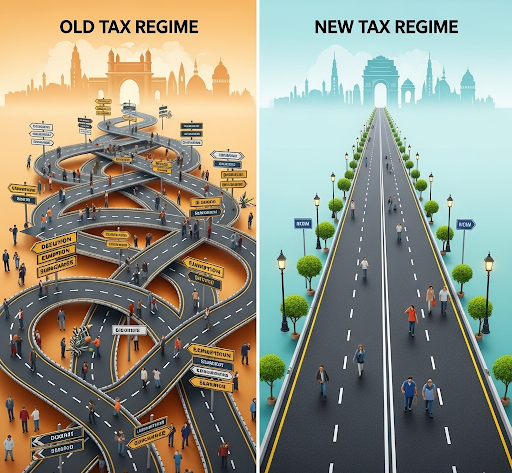
Every year, as the financial year comes to a close, taxpayers across India face a critical decision: should they stick with the familiar Old Tax Regime or switch to the streamlined New Tax Regime? Introduced in the Union Budget 2020 and updated since, the New Tax Regime was designed to simplify the tax filing process.
However, “simple” doesn’t always mean “better” for your wallet. The right choice depends entirely on your income, your investments, and the deductions you are eligible for. Choosing the wrong regime could mean paying thousands of rupees in extra tax. For the Financial Year 2024-25 (Assessment Year 2025-26), the New Tax Regime is the **default option**, which means if you don’t make a choice, you will be taxed under this system according to the rules set by the Income Tax Department.
This in-depth guide will compare the Old and New Tax Regimes head-to-head. We’ll explore the pros and cons of each, show you who benefits most from each system, and provide a clear framework to help you make the most tax-efficient decision.
The Core Difference Old vs New Tax Regime: Lower Rates vs. More Deductions
The fundamental trade-off between the two regimes is simple:
- The **Old Tax Regime** has higher tax slab rates but allows you to claim a wide range of deductions and exemptions (around 70 of them).
- The **New Tax Regime** offers lower, more attractive tax slab rates but requires you to give up most of those popular deductions.
The best way to see the impact of this choice is by using an Income Tax Calculator, which computes your liability under both systems simultaneously.
A Quick Look at the Tax Slabs (FY 2024-25)
Let’s start by comparing the tax slabs for individuals below 60 years of age.
| Income Slab | Old Regime Tax Rate | New Regime Tax Rate |
|---|---|---|
| Up to ₹2,50,000 | No Tax | – |
| Up to ₹3,00,000 | – | No Tax |
| ₹2,50,001 – ₹5,00,000 | 5% | – |
| ₹3,00,001 – ₹6,00,000 | – | 5% |
| ₹5,00,001 – ₹10,00,000 | 20% | – |
| ₹6,00,001 – ₹9,00,000 | – | 10% |
| ₹9,00,001 – ₹12,00,000 | – | 15% |
| ₹10,00,001 – ₹12,00,000 | 30% | 15% |
| ₹12,00,001 – ₹15,00,000 | 30% | 20% |
| Above ₹15,00,000 | 30% | 30% |
Note: Health and Education Cess of 4% is applicable on the tax amount in both regimes.
The Power of Deductions: What You Give Up in the New Regime
On the surface, the New Regime’s rates look much more appealing. However, to get those lower rates, you have to forgo most of the popular tax-saving deductions that people have used for decades. Here are the most significant ones you lose:
- Section 80C: The biggest one. You cannot claim the ₹1.5 lakh deduction for investments in PPF, ELSS, NSC, Life Insurance Premiums, or home loan principal repayment.
- Section 80D: Deduction for health insurance premiums paid for self, family, and parents.
- HRA Exemption: You cannot claim the exemption for House Rent Allowance.
- Section 24(b): Deduction on interest paid on a home loan for a self-occupied property.
- Leave Travel Allowance (LTA): The exemption for travel expenses is not available.
What Deductions Are Still Allowed in the New Regime?
While most deductions are gone, a few key ones remain:
- Standard Deduction: A flat ₹50,000 deduction is available for salaried individuals and pensioners.
- Employer’s contribution to NPS: Deduction under Section 80CCD(2).
- Deduction for Agniveer Corpus Fund: Under Section 80CCH.
Who is the Old Tax Regime Best For?
The Old Tax Regime is generally more beneficial for individuals who make full use of the available tax deductions and exemptions. You should strongly consider staying with the Old Regime if:
- You have a high amount of deductions: If your total claimable deductions (80C, 80D, HRA, home loan interest, etc.) are significant, they will likely reduce your taxable income enough to make the higher slab rates of the Old Regime more beneficial. A common rule of thumb is if your deductions exceed 25-30% of your gross income, the Old Regime is often better.
- You have a home loan: The deduction for interest paid (up to ₹2 lakh) and principal repayment (up to ₹1.5 lakh) is a massive benefit that is lost in the New Regime. For most homeowners, this alone makes the Old Regime the clear winner.
- You have high medical insurance premiums: If you pay significant health insurance premiums for your family and senior citizen parents, the 80D deduction can be substantial.
Who is the New Tax Regime Best For?
The New Tax Regime is designed for simplicity and benefits those who do not have many investments or expenses to claim as deductions. It is likely the better choice for you if:
- You don’t have many deductions: If you are early in your career, don’t have many financial liabilities, and prefer not to lock your money into tax-saving investments, the lower tax rates of the New Regime will likely be more advantageous.
- You don’t have a home loan or pay rent: If you live in your own house (without a loan) or with your parents and don’t pay rent, you cannot claim the two biggest deductions (HRA and home loan interest), making the New Regime more attractive.
- You prioritize liquidity and simplicity: If you prefer financial freedom over forced savings and want a simple tax filing process without the hassle of collecting proofs, the New Regime is a great fit.
The Final Word: Do the Math Every Year
There is no single right answer in the Old vs. New Tax Regime debate. The “best” regime for you can change from year to year as your income, investments, and life circumstances change. A promotion, a new home loan, or getting married can all shift the calculation.
The most crucial advice is to **not make assumptions**. At the beginning of every financial year, take a few minutes to estimate your income and potential deductions. Use a reliable online tax calculator to run the numbers for both regimes. This simple exercise can save you a significant amount of money and ensure you are making the smartest possible choice for your finances.