
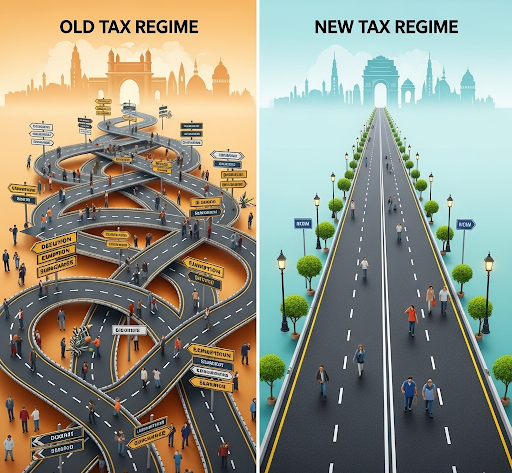
Old vs New Tax Regime
— Which Should You Choose?
Tax slabs compared side by side, who benefits from each regime, the Rs 12 lakh zero-tax threshold, break-even deduction analysis by income, and how to switch regimes each year in India.
India’s Two Tax Systems — What Changed and Why It Matters
Since its introduction in Budget 2020, India’s new tax regime has become the default tax system for all individuals from FY 2024-25. Unless you actively opt for the old regime, you are automatically assessed under the new regime. This makes the old vs new tax regime decision the most critical annual tax planning choice for salaried Indians and self-employed professionals alike.
The regimes represent fundamentally different philosophies: the old regime rewards disciplined long-term investing and homeownership through deductions; the new regime rewards simplicity and lower rates without requiring investment planning. Neither is universally better — the answer depends entirely on your specific financial situation.
Tax Slab Comparison — FY 2025-26
| Income Range | Old Regime Rate | New Regime Rate |
|---|---|---|
| Up to Rs 2,50,000 | Nil | — |
| Up to Rs 4,00,000 | — | Nil |
| Rs 2,50,001 – Rs 5,00,000 | 5% | — |
| Rs 4,00,001 – Rs 8,00,000 | — | 5% |
| Rs 5,00,001 – Rs 10,00,000 | 20% | — |
| Rs 8,00,001 – Rs 12,00,000 | — | 10% |
| Rs 10,00,001 – Rs 15,00,000 | 30% | — |
| Rs 12,00,001 – Rs 16,00,000 | 30% | 15% |
| Rs 16,00,001 – Rs 20,00,000 | 30% | 20% |
| Rs 20,00,001 – Rs 24,00,000 | 30% | 25% |
| Above Rs 24,00,000 | 30% | 30% |
The new regime’s 87A rebate makes income up to Rs 12 lakh completely tax-free. Adding the Rs 75,000 standard deduction, anyone with gross salary up to Rs 12,75,000 pays zero income tax under the new regime — a highly significant benefit for the Rs 10-13 lakh income segment.
Deductions Allowed in Each Regime
| Deduction | Old Regime | New Regime |
|---|---|---|
| Standard Deduction | Rs 50,000 | Rs 75,000 |
| Section 80C (EPF, PPF, ELSS, LIC, Home Loan Principal) | Rs 1,50,000 | Not available |
| Section 24(b) Home Loan Interest (self-occupied) | Rs 2,00,000 | Not available |
| HRA Exemption | Actual exempt amount | Not available |
| Section 80D Health Insurance | Rs 25,000–Rs 1,00,000 | Not available |
| Section 80CCD(1B) NPS additional | Rs 50,000 | Not available |
| Section 80CCD(2) Employer NPS | No upper cap | No upper cap (available) |
| LTA (Leave Travel Allowance) | Exempt on actual travel | Not available |
| Professional Tax | Deductible | Not available |
| Section 80G Donations | Available | Not available |
Break-Even Deduction Analysis by Income Level
The break-even deduction is the total deduction needed in the old regime for it to become equal to the new regime tax. If your actual deductions exceed this, old regime wins:
| Gross Income | New Regime Tax | Old Regime Break-Even Deductions | Typical Salaried Person’s Deductions | Better Regime |
|---|---|---|---|---|
| Rs 8 lakh | Rs 0 (87A rebate) | Any deduction | Any | New Regime |
| Rs 12 lakh | Rs 0 (87A rebate) | Any deduction | Any | New Regime |
| Rs 15 lakh | Rs 45,000 (approx) | Rs 2.5 lakh | Rs 4L+ (home loan + 80C) | Old Regime |
| Rs 20 lakh | Rs 90,000 (approx) | Rs 3.5 lakh | Rs 5L+ (home loan + HRA + 80C) | Old Regime |
| Rs 30 lakh | Rs 2,10,000 (approx) | Rs 5 lakh | Rs 6L+ if home loan + HRA | Old if deductions Rs 6L+ |
Practical Examples — Side by Side
Scenario A: Rs 15 Lakh Income, Home Loan, HRA
| Item | Old Regime | New Regime |
|---|---|---|
| Gross Income | Rs 15,00,000 | Rs 15,00,000 |
| Standard Deduction | Rs 50,000 | Rs 75,000 |
| Section 80C | Rs 1,50,000 | Nil |
| Section 24(b) Home Loan Interest | Rs 2,00,000 | Nil |
| HRA Exemption | Rs 1,20,000 | Nil |
| Section 80D | Rs 50,000 | Nil |
| Taxable Income | Rs 9,30,000 | Rs 14,25,000 |
| Tax Payable | Rs 87,000 | Rs 1,53,750 |
| Savings (Old Regime Wins By) | Rs 66,750 per year | |
Scenario B: Rs 12 Lakh Income, No Home Loan, Minimal Deductions
| Item | Old Regime | New Regime |
|---|---|---|
| Gross Income | Rs 12,00,000 | Rs 12,00,000 |
| Standard Deduction | Rs 50,000 | Rs 75,000 |
| 80C (EPF only) | Rs 72,000 | Nil |
| Taxable Income | Rs 10,78,000 | Rs 11,25,000 |
| Tax Payable | Rs 1,33,560 | Rs 0 (87A rebate — income below Rs 12L) |
| Savings (New Regime Wins By) | Rs 1,33,560 per year | |
Employer NPS — The Common Benefit in Both Regimes
One deduction available in both regimes is 80CCD(2) — employer’s contribution to employee’s NPS account. This is available without any upper cap in both old and new regimes. This makes negotiating a higher employer NPS contribution (instead of equivalent salary increase) tax-efficient regardless of which regime you choose. If your employer currently contributes nothing to NPS, request restructuring of CTC — shifting 10% of basic salary as employer NPS contribution saves tax under both regimes and builds retirement corpus simultaneously.
How to Make the Switch
For Salaried Employees:
- At the start of each financial year (April), estimate your total eligible deductions under the old regime
- Compare your tax under both regimes using the Old vs New Tax Regime Calculator
- Inform your employer HR/payroll team which regime to use for TDS deduction
- If you miss informing employer, employer applies new regime by default
- You can still switch to old regime when filing your ITR before July 31 — the difference in TDS is either refunded or claimed at filing
For Business Owners:
- Cannot switch freely — once switching from new to old regime, you cannot switch back to new regime while having business income
- Choose carefully if you have business income and are considering the new regime
- Individuals with only salary income have the flexibility to switch every year
Old vs New Regime Decision Checklist
- List all deductions: 80C, 24(b), HRA, 80D, NPS 80CCD(1B), LTA, professional tax
- Use Old vs New Tax Regime Calculator for exact tax under both regimes with your numbers
- If income is below Rs 12.75 lakh and deductions are limited: new regime almost always better
- If income above Rs 15 lakh with home loan + HRA + full 80C: old regime typically saves Rs 30,000-70,000+ more
- Inform employer of regime choice before April 1 each year
- Recalculate every year — income changes and life events (home purchase, having children) can flip the optimal regime
- When in doubt, spend 5 minutes with the calculator — this decision is worth Rs 20,000-80,000 annually
🧮 Free Calculators — Use Them Now
No login required. Updated for FY 2025-26.
Frequently Asked Questions
The old tax regime has higher tax slabs but allows numerous deductions — Section 80C (Rs 1.5L), Section 24(b) home loan interest (Rs 2L), HRA exemption, 80D health insurance (Rs 25-50K), NPS 80CCD(1B) (Rs 50K), LTA, and professional tax. The new tax regime has lower, simplified slabs but removes almost all deductions except standard deduction (Rs 75,000) and employer’s NPS contribution under 80CCD(2). The choice depends on whether your eligible deductions under the old regime reduce your tax below what you pay under the new regime’s lower rates.
New tax regime slabs for FY 2025-26: up to Rs 4 lakh — nil; Rs 4-8 lakh — 5%; Rs 8-12 lakh — 10%; Rs 12-16 lakh — 15%; Rs 16-20 lakh — 20%; Rs 20-24 lakh — 25%; above Rs 24 lakh — 30%. Section 87A rebate makes income up to Rs 12 lakh effectively tax-free. Adding standard deduction of Rs 75,000, gross income up to Rs 12.75 lakh results in zero tax under the new regime. Old regime slabs: up to Rs 2.5L nil, Rs 2.5-5L 5%, Rs 5-10L 20%, above Rs 10L 30% — with full suite of deductions available.
Choose the old tax regime if your total eligible deductions exceed roughly Rs 3.75 lakh for Rs 15 lakh income. Key deductions: 80C (Rs 1.5L) + home loan interest Section 24(b) (Rs 2L) + HRA (Rs 1-2L) + 80D (Rs 50K) + NPS 80CCD(1B) (Rs 50K). Combined easily crosses Rs 5.5L for a salaried person with home loan and HRA. For income of Rs 15-30 lakh with these deductions, old regime saves significantly more tax. The bigger the home loan interest and HRA, the more the old regime benefits.
Choose new tax regime if: income is up to Rs 12.75 lakh with minimal deductions — zero tax under new regime; you are self-employed with income Rs 8-15 lakh and limited investment record; you have no home loan and negligible HRA; your 80C is barely covered by EPF alone with no additional investments; or you prefer simplicity without tracking multiple deductions. New regime also suits high earners above Rs 30 lakh whose deductions don’t cross the break-even threshold — at 30% flat rate both regimes converge for the highest slab.
Salaried individuals can switch between old and new tax regime every financial year — simply inform your employer at the start of the year. If you miss informing employer, new regime is applied by default from FY 2024-25. You can still switch to old regime while filing ITR before the due date (July 31). For business owners and those with business income, switching is restricted — you can shift from new to old only once and cannot switch back to new regime while continuing business income. Cessation of business allows re-evaluation.
The new tax regime allows: standard deduction of Rs 75,000 for salaried employees; employer’s NPS contribution under 80CCD(2) without any upper cap; interest on home loan for let-out property under Section 24(b) — the loss can still be set off against income; Agniveer Corpus Fund deduction under 80CCH; gratuity and leave encashment exemption at retirement; and retrenchment compensation. Notably NOT available: 80C investments, 80D health insurance, HRA exemption, LTA, Section 24(b) for self-occupied home loan, NPS 80CCD(1B) extra Rs 50K, and professional tax deduction.