
“Congratulations! You’ve got the job offer from our SEZ unit. One of the perks is that you’ll pay less income tax since we’re in a Special Economic Zone.”
This was the line that excited Rohan when he received his offer letter from a major IT company in Pune’s SEZ. He immediately called his father: “Dad, I’m going to save so much on taxes working in an SEZ!”
Six months later, when Rohan filed his first Income Tax Return, he was confused. His Form 16 showed full tax deducted at source on his entire salary. “Where’s my SEZ tax exemption?” he asked his HR. The response: “There’s no personal income tax exemption for SEZ employees. The tax benefits are for the company, not individual employees.”
Rohan isn’t alone. Thousands of employees working in India’s 425+ SEZs labor under the misconception that SEZ employment comes with automatic tax breaks. This guide will clear the confusion, explain what benefits actually exist, and help you understand your true tax position as an SEZ employee.
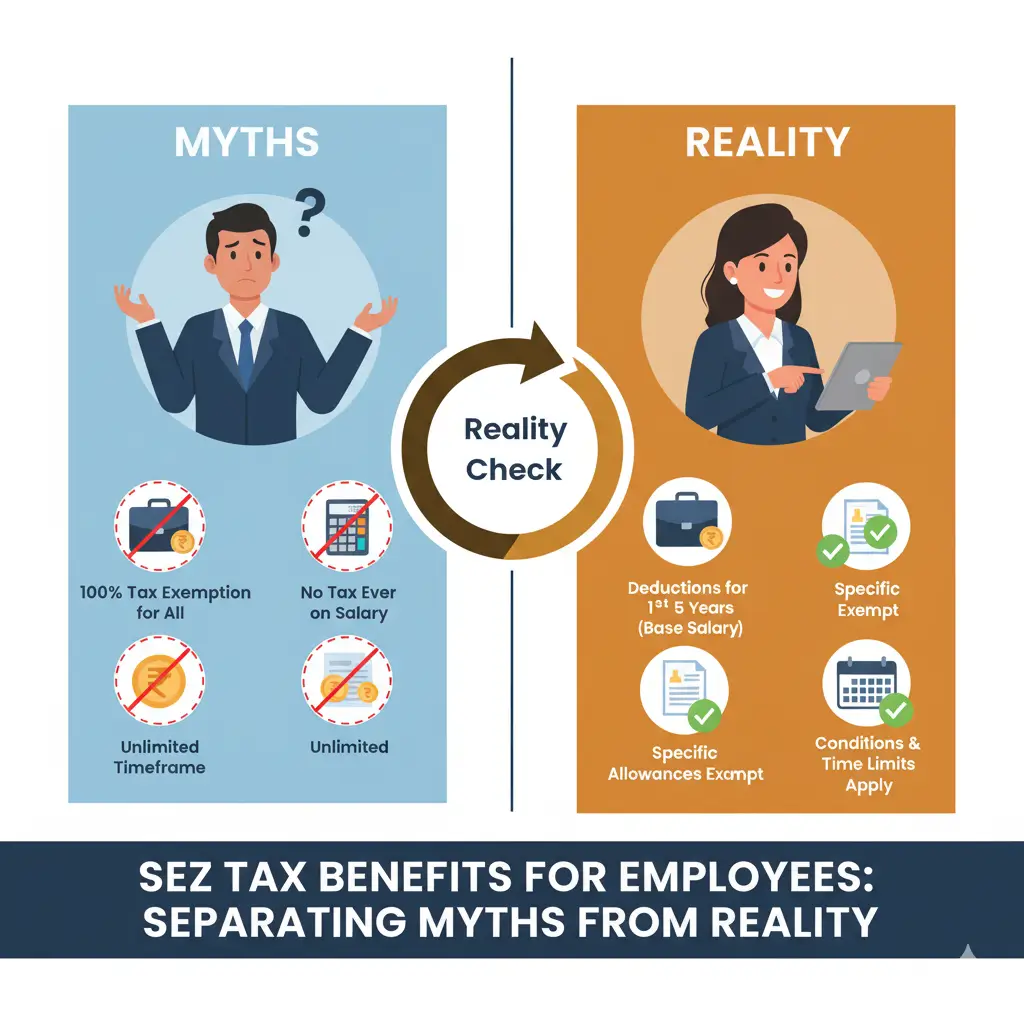
The Big Myth vs. Reality
❌ MYTH
Employees working in SEZ get income tax exemption on their salary and pay less tax than employees in regular companies.
✓ REALITY
There is NO personal income tax exemption for SEZ employees. You pay income tax on your salary exactly like any other employee in India, as per standard tax slabs.
Critical Clarification: The income tax benefits under Section 10AA of the Income Tax Act apply to SEZ units (companies), not to individual employees. Your salary is taxed normally regardless of whether your employer is in an SEZ or outside.
What is an SEZ and Why Do They Exist?
Special Economic Zones are designated areas in India with special economic regulations that are more liberal than the country’s typical economic laws. They were created to:
- Boost exports and foreign exchange earnings
- Attract foreign direct investment (FDI)
- Create employment opportunities
- Develop world-class infrastructure
Major SEZ hubs exist in Mumbai, Pune, Bengaluru, Hyderabad, Chennai, Noida, Gurgaon, and Kochi. They house IT companies, pharmaceutical manufacturers, automotive units, and various other export-oriented businesses.
What Tax Benefits Do SEZ Companies Get?
Understanding company-level benefits helps you see why your employer might offer better compensation, even if you don’t get direct tax breaks:
Section 10AA: Corporate Tax Exemption
SEZ units that begin operations are eligible for:
- First 5 years: 100% income tax exemption on export profits
- Next 5 years: 50% income tax exemption on export profits
- Next 5 years: 50% exemption on ploughed-back export profits
This means an SEZ company can save 30-40% of its export profits (corporate tax rate) for up to 15 years. These savings can translate into better employee benefits, though not direct tax exemptions for individuals.
Other Corporate Benefits
- Exemption from customs duties on imports for export operations
- Exemption from central sales tax
- Exemption from service tax
- Single window clearance for approvals
Indirect Benefits SEZ Employees May Receive
While there are no direct tax breaks, SEZ employees often enjoy indirect advantages because their employers save significantly on corporate taxes:
1. Competitive Salaries
SEZ companies, especially in IT and pharma, often offer 10-20% higher salaries compared to non-SEZ competitors for similar roles. The corporate tax savings give them room for better compensation packages.
2. Enhanced Allowances and Perks
Many SEZ companies structure salaries with generous allowances:
- Higher HRA (House Rent Allowance) components
- Special allowances for transport, meals, or shift duties
- Better medical insurance coverage (including parents/in-laws)
- Performance bonuses and ESOPs
3. Superior Infrastructure and Facilities
- World-class office spaces
- Subsidized cafeterias
- Gyms and recreational facilities
- Daycare centers
- Transportation services
4. Job Security and Growth
SEZ companies, backed by tax benefits and foreign investment, often provide better job security and faster career progression compared to smaller non-SEZ firms.
Understanding Your SEZ Salary Structure
Let’s look at how SEZ companies typically structure salaries and how it compares with non-SEZ companies:
Example: Software Engineer in SEZ vs. Non-SEZ
Scenario A: SEZ Company (Better overall package)
| CTC Component | Amount (Annual) |
| Basic Salary | ₹6,00,000 |
| HRA (50% of basic) | ₹3,00,000 |
| Special Allowance | ₹2,00,000 |
| Performance Bonus | ₹1,50,000 |
| Employer PF | ₹72,000 |
| Medical Insurance Premium | ₹28,000 |
| Total CTC | ₹13,50,000 |
Scenario B: Non-SEZ Company (Similar role)
| CTC Component | Amount (Annual) |
| Basic Salary | ₹5,00,000 |
| HRA (40% of basic) | ₹2,00,000 |
| Special Allowance | ₹1,50,000 |
| Performance Bonus | ₹1,00,000 |
| Employer PF | ₹60,000 |
| Medical Insurance Premium | ₹15,000 |
| Total CTC | ₹11,25,000 |
Key Observations:
- SEZ company offers ₹2.25 lakhs higher CTC (20% more)
- Better HRA component providing more tax savings
- Higher medical coverage extending to family
- Both pay income tax on taxable components as per normal slabs
Calculate Your Take-Home Salary
Wondering what your actual in-hand salary will be after taxes? Use our calculators to get exact figures.
Common Tax-Exempt Allowances for All Employees
Whether you work in SEZ or non-SEZ, these allowances are tax-exempt (subject to conditions):
1. House Rent Allowance (HRA)
Tax exemption is the least of:
- Actual HRA received
- 50% of salary (if metro) or 40% of salary (non-metro)
- Rent paid minus 10% of salary
2. Leave Travel Allowance (LTA)
Exemption for actual travel costs within India (twice in a block of 4 years)
3. Standard Deduction
₹50,000 automatic deduction available to all salaried employees
4. Transport/Conveyance Allowance
Usually taxable, but if reimbursement-based with bills, can be exempt
5. Meal Coupons/Vouchers
Up to ₹50 per meal (₹100 per day) can be non-taxable if provided as sodexo/ticket restaurant vouchers
What About STPI vs. SEZ?
Some confusion arises because earlier, Software Technology Parks of India (STPI) units had different tax benefits. Key differences:
| Aspect | SEZ | STPI |
|---|---|---|
| Current Tax Benefits | Section 10AA benefits (for units) | Section 10A/10B (sunset clause ended March 2011) |
| Employee Tax Status | No exemption | No exemption |
| Customs Benefits | Yes | Limited |
| Infrastructure | Dedicated zones | Can be anywhere |
Tax Planning Tips for SEZ Employees
Since you don’t get special tax breaks, focus on standard tax-saving strategies:
1. Maximize Section 80C
Invest up to ₹1.5 lakhs in 80C instruments: EPF, PPF, ELSS, life insurance, NSC
2. Optimize HRA Claims
If your company offers high HRA, ensure you’re claiming the maximum exemption by:
- Actually paying rent (even if to parents with rent agreement)
- Keeping rent receipts
- Having PAN of landlord if annual rent exceeds ₹1 lakh
3. Utilize Section 80D
Claim deduction for health insurance premiums for self, family, and parents (up to ₹1 lakh combined)
4. Home Loan Tax Benefits
If you have a home loan, claim:
- Up to ₹2 lakhs on interest under Section 24
- Up to ₹1.5 lakhs on principal under Section 80C
5. Meal Vouchers
If your company offers meal coupons, opt for them as they’re tax-free up to ₹100/day
Key Takeaways for SEZ Employees
What You Should Know:
- SEZ employment does NOT give you personal income tax exemption
- Your salary is taxed exactly like any other employee in India
- Section 10AA benefits are for the company, not you
- SEZ companies may offer better compensation due to their corporate tax savings
- Standard tax-saving strategies apply equally to you
- Form 16 from an SEZ employer looks identical to one from a non-SEZ employer
- You file ITR the same way as any salaried individual
Why the Confusion Exists
The misconception about SEZ employee tax benefits stems from:
- Conflation of company and employee benefits: People hear “SEZ tax benefits” and assume it applies to everyone working there
- Overzealous recruiters: Some hiring teams oversell SEZ perks without clarifying the distinction
- Historical memory: Export-oriented units in the past had different schemes that created precedent expectations
- Word-of-mouth: Myths perpetuate when one confused employee tells another
The Bottom Line
Working in an SEZ can be an excellent career move for reasons beyond tax:
- Exposure to global clients and standards
- Better infrastructure and work environment
- Often higher compensation packages
- Career growth opportunities with multinational corporations
- Job security with well-funded companies
But don’t take the job expecting a personal income tax exemption—it doesn’t exist. Evaluate the offer based on total CTC, work culture, growth prospects, and other tangible benefits. Calculate your actual take-home salary after standard deductions and taxes to understand what you’ll really earn.
When Rohan finally understood this, he realized his SEZ employer was still offering him a great package—₹1.5 lakhs more than competitors—just not for the tax exemption reason he initially thought. The corporate tax savings translated into better salaries and benefits, which is the real indirect advantage of SEZ employment.
For official information on SEZs and their benefits, visit the Department of Commerce SEZ website.
Frequently Asked Questions
Do SEZ employees get income tax exemption on salary?
No. This is the most common and persistent misconception. Individual employees working in SEZ do not get any personal income tax exemption on their salary. The tax benefits under Section 10AA of the Income Tax Act are exclusively for SEZ units (the companies), not for individual employees. As an employee, you pay income tax on your salary exactly like any other employee in India according to standard tax slabs. Your Form 16, tax calculation, and ITR filing process are identical to non-SEZ employees.
What indirect benefits do SEZ employees get?
While there are no direct tax benefits, SEZ employees often receive indirect advantages because their employers save on corporate taxes. These may include: (1) Higher salaries: Often 10-20% more than non-SEZ competitors for similar roles, (2) Better allowances: More generous HRA, special allowances, performance bonuses, (3) Enhanced benefits: Superior medical insurance, ESOP schemes, better facilities, (4) Infrastructure: World-class offices, subsidized cafeterias, gyms, transportation. However, these vary by company and are not legally mandated—they’re business decisions based on corporate tax savings.
Are special allowances in SEZ companies tax-free?
No. Special allowances follow the same tax rules as any other employment in India. Some standard allowances like HRA (within prescribed limits), LTA, and the ₹50,000 standard deduction are tax-exempt for all employees including SEZ employees. But there are no additional tax-free allowances specifically for SEZ employment. All taxable salary components—basic, special allowances, bonuses—are taxed as per your income tax slab just like any other employee. The myth of “tax-free SEZ allowances” has no basis in Indian tax law.
Do I file ITR differently as an SEZ employee?
No. Your Income Tax Return filing process is exactly the same as any other salaried employee in India. You use the same ITR forms (typically ITR-1 or ITR-2), report your salary income normally, claim standard deductions (80C, 80D, HRA, etc.) the same way, and pay tax as per regular slabs. Your Form 16 from an SEZ employer looks identical to one from a non-SEZ employer. There are no special ITR sections, exemptions, or procedures for SEZ employees. File your return following the same process as any salaried individual.
Is working in an SEZ better than a non-SEZ company?
It depends on factors beyond just the SEZ status. Potential SEZ advantages: Often higher CTC, better infrastructure, exposure to global clients, multinational work culture, career growth with large corporations. Considerations: Commute (SEZs are often on city outskirts), work-life balance, company culture, role fit, growth prospects. Don’t choose a job solely because it’s in an SEZ—there’s no magical tax benefit. Evaluate total compensation, role, company reputation, and career trajectory. An excellent non-SEZ offer can be far better than a mediocre SEZ offer.
Did SEZ employees ever get tax exemption?
No, individual employees never received direct tax exemption even in the early days of SEZ policy (2005 onwards). The confusion stems from: (1) Corporate tax benefits being misunderstood as employee benefits, (2) Earlier STPI/EOU schemes having different structures that created incorrect precedents, (3) Recruiters overselling “SEZ benefits” without clarifying they’re corporate, not personal. From day one of SEZ implementation, Section 10AA benefits were exclusively for units/companies, never for individuals. If someone claims they got personal tax exemption as an SEZ employee, they’re either confused about their salary structure or referring to standard deductions available to all employees.
Can my employer structure my salary to reduce tax?
Yes, but this applies to all employers (SEZ or non-SEZ). Smart salary structuring can reduce tax burden: (1) Higher HRA component (claim exemption), (2) LTA provision, (3) Meal vouchers (₹100/day tax-free), (4) Gadget/book allowances (reimbursement-based), (5) Standard deduction utilization, (6) Employer NPS contribution (additional 80C benefit). However, these strategies aren’t unique to SEZ companies—any employer can implement them. An SEZ company may be more generous with these due to their own tax savings, but the tax treatment for you remains the same as any employee.
What if my employer told me there’s an SEZ tax benefit?
Clarify immediately what they mean. They might be referring to: (1) Company-level tax benefits (Section 10AA) which don’t affect your personal taxes, (2) Better compensation package due to company’s tax savings, (3) Standard salary structuring strategies (HRA, allowances) available to all employees. If they claim personal income tax exemption for you, ask for written policy and seek clarification from HR/Finance. Chances are it’s a miscommunication. Before accepting an offer, use our take-home salary calculator to see your actual post-tax earnings. Don’t rely on vague promises of “SEZ tax benefits.”