
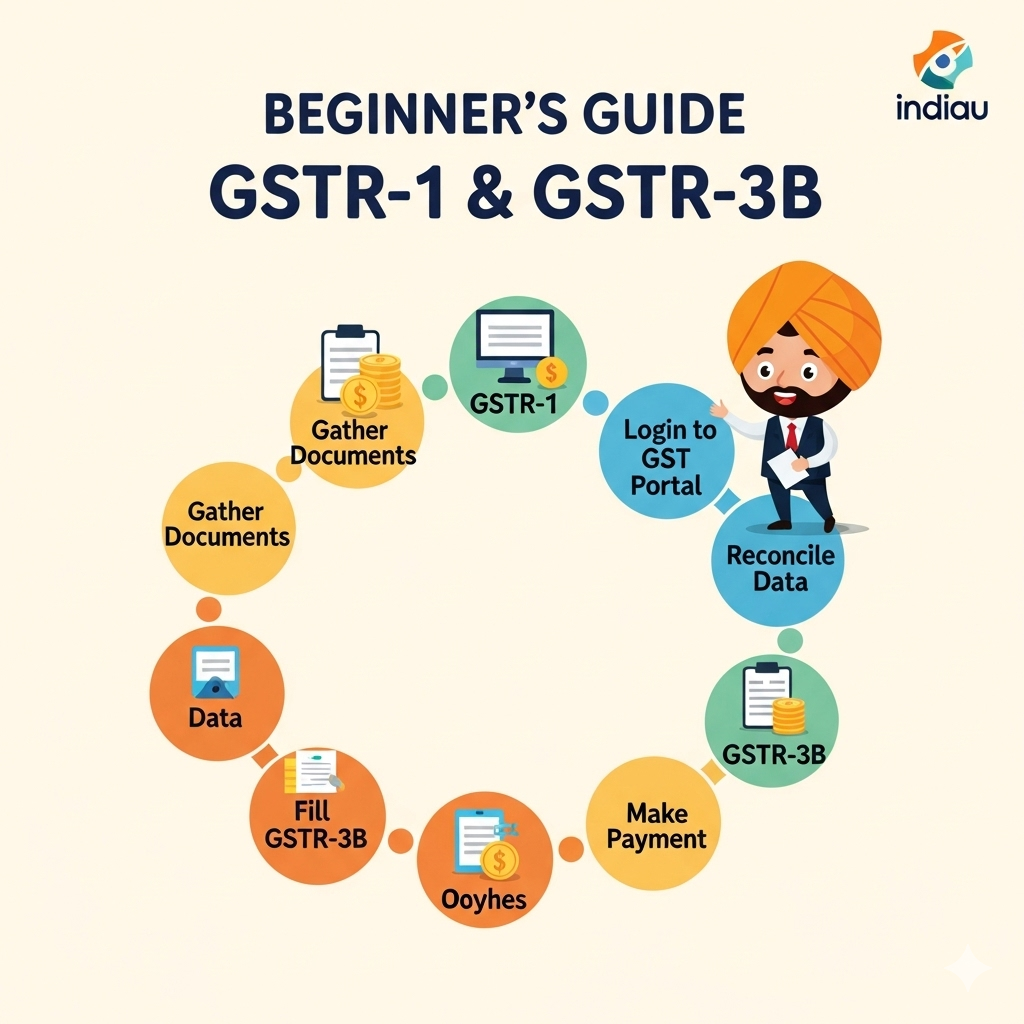
How to File
GST Returns in India
GSTR-1, GSTR-3B, and GSTR-9 explained step by step — due dates, late filing penalties, ITC reconciliation, the QRMP scheme for small businesses, and how to file nil returns correctly.
GST Return Filing — Why It Matters
Filing GST returns is not merely a compliance ritual — it has direct consequences for your cash flow, your business relationships, and your legal standing. If you fail to file GSTR-1, your buyers cannot see your invoices in their GSTR-2B, blocking their ITC claim and potentially costing them more than your entire transaction value. If you fail to file GSTR-3B, late fees and interest accumulate daily. Understanding the GST return ecosystem is essential for every registered business — whether you have Rs 50 lakh or Rs 50 crore in annual turnover.
The GST Return Ecosystem — Overview
| Return | What It Reports | Due Date | Who Files | Consequence of Not Filing |
|---|---|---|---|---|
| GSTR-1 | Details of all outward supplies (sales) | 11th (monthly) / 13th (quarterly) | All registered taxpayers | Buyers lose ITC; late fee Rs 50/day |
| GSTR-3B | Summary: GST liability + ITC claimed + tax paid | 20th (monthly) | All registered taxpayers | Late fee + 18% interest on unpaid tax |
| GSTR-9 | Annual comprehensive return | December 31 | Turnover above Rs 2 crore | Late fee Rs 200/day; maximum 0.25% of turnover |
| GSTR-9C | Annual reconciliation statement | December 31 | Turnover above Rs 5 crore | Late fee same as GSTR-9 |
| GSTR-4 | Annual return for Composition taxpayers | April 30 | Composition scheme taxpayers | Late fee Rs 200/day |
| CMP-08 | Quarterly tax payment for Composition | 18th after quarter end | Composition scheme taxpayers | Late fee + interest |
GSTR-1 — Filing Outward Supply Details
What to Report in GSTR-1
| Section | What to Enter |
|---|---|
| B2B Supplies (Table 4) | Each invoice to registered buyers — with their GSTIN, invoice details, HSN, rate, and tax |
| B2C Large (Table 5) | Each invoice above Rs 2.5 lakh to unregistered buyers — state-wise |
| B2C Small (Table 7) | Consolidated summary of all invoices below Rs 2.5 lakh to unregistered buyers |
| Exports (Table 6) | Export invoices — with/without payment of IGST |
| Amendments (Table 9/10/11) | Corrections to invoices filed in previous months |
| Debit/Credit Notes (Table 9/10) | All CDNs (Credit and Debit Notes) issued during the period |
| HSN Summary (Table 12) | HSN-wise summary of outward supplies |
GSTR-3B — Filing the Summary Return and Paying Tax
GSTR-3B is the summary return and payment form. The key sections:
Section 3.1 — Outward Supplies (Tax Liability)
Enter total value of: taxable outward supplies; zero-rated exports; exempt supplies; and nil-rated supplies. GST amounts (IGST, CGST, SGST) on taxable supplies constitute your output tax liability.
Section 4 — Eligible ITC
Enter ITC available from: IGST; CGST; and SGST from eligible purchases. Only ITC appearing in GSTR-2B can be claimed. Do not claim provisional ITC beyond what is auto-populated from GSTR-2B.
Section 6.1 — Payment of Tax
Net GST payable = Output Tax Liability (3.1) minus ITC (4). If positive, pay via Electronic Cash Ledger (deposit in advance) or Electronic Credit Ledger (ITC balance). If ITC exceeds liability, excess stays in credit ledger for future use or refund application.
ITC Reconciliation — The Most Critical Step
Since April 2022, ITC is available only on invoices appearing in GSTR-2B (auto-generated monthly based on suppliers’ GSTR-1 filings). A systematic ITC reconciliation process:
- Download GSTR-2B from GST portal on or after the 14th of each month
- Import into Excel or your accounting software
- Match every entry in GSTR-2B against your purchase register (every invoice you received)
- For invoices in GSTR-2B but not in your records: verify genuineness and add to purchase register if valid
- For invoices in your records but not in GSTR-2B: contact supplier to file/correct their GSTR-1
- Claim only the ITC that appears in GSTR-2B — do not claim invoices missing from GSTR-2B
Consequences of incorrect ITC: demand notice for excess ITC claimed; interest at 18% per annum from the date of wrongful claim; penalty up to 100% of tax for fraudulent claims. Reconcile monthly to avoid year-end surprises.
Late Filing Penalties — Complete Schedule
| Return | Late Fee (Tax Payable Return) | Late Fee (Nil Return) | Maximum Late Fee |
|---|---|---|---|
| GSTR-1 | Rs 50/day (Rs 25 CGST + Rs 25 SGST) | Rs 20/day | Rs 10,000 |
| GSTR-3B | Rs 50/day | Rs 20/day | Rs 10,000 |
| GSTR-9 | Rs 200/day | Rs 200/day | 0.25% of state turnover |
| Interest on unpaid GST | 18% per annum | N/A | No cap |
At Rs 50/day, even a 2-month filing delay costs Rs 3,000 in late fees alone — plus 18% interest on any unpaid tax. On Rs 5 lakh unpaid GST, 2-month interest = Rs 15,000. Total cost of missing one GSTR-3B by 2 months: Rs 18,000+ in penalties and interest.
Step-by-Step GSTR-3B Filing Process
- Log in to GST portal (gst.gov.in) with your GSTIN and password
- Go to Returns → Returns Dashboard → Select the month and year → GSTR-3B → Prepare Online
- Fill Section 3.1: Enter outward supply values and GST amounts (from your GSTR-1 data)
- Fill Section 4: Enter ITC available — auto-populated from GSTR-2B (verify before accepting)
- Net liability is auto-calculated: Output Tax minus ITC = Payable
- Click Proceed to Payment: pay via Electronic Cash Ledger or from Cash balance in GST portal
- Generate challan (PMT-06) and pay via net banking — funds hit your Electronic Cash Ledger
- Submit and file GSTR-3B using DSC (companies) or EVC (OTP for others)
- Download filed return acknowledgment (ARN)
Nil Return Filing
If you have no supplies (sales) and no ITC to claim in a month, you must still file a Nil GSTR-1 and Nil GSTR-3B by the respective due dates. Non-filing of nil return attracts the same late fee (Rs 20/day for nil return) and blocks your GST compliance rating. Filing nil returns via SMS is available for GSTR-3B and GSTR-1 — send SMS to 14409: type NIL (space) 3B (space) your GSTIN (space) return period (e.g., NIL 3B 27ABCDE1234F1Z5 052026 for May 2026) for simplified nil GSTR-3B filing.
GST Return Filing Checklist
- File GSTR-1 by 11th — enters your invoices into buyers’ GSTR-2B protecting their ITC
- Download GSTR-2B by 14th — reconcile with purchase register before filing GSTR-3B
- File GSTR-3B by 20th — pay net GST liability (output tax minus ITC)
- Never claim ITC without invoice in GSTR-2B — interest and penalty apply
- File nil return if no transactions — even nil return is mandatory
- For businesses below Rs 5 crore: evaluate QRMP scheme — reduces returns from 24 to 8/year
- File GSTR-9 before December 31 if turnover exceeds Rs 2 crore in the year
- Use the GST Calculator to verify your tax liability computation before filing
🧮 Free Calculators — Use Them Now
No login required. Updated for FY 2025-26.
Frequently Asked Questions
GSTR-1 is the monthly or quarterly return where every registered GST taxpayer declares details of all outward supplies (sales and income) made during the period. It includes: B2B supplies (with buyer GSTIN — affects buyer’s ITC eligibility); B2C large supplies (above Rs 2.5 lakh to unregistered buyers); B2C small consolidated supplies; exports; debit notes and credit notes; and advances received for future supply. Due dates: monthly filers must submit GSTR-1 by the 11th of the following month (April GSTR-1 due by May 11). Businesses with turnover below Rs 5 crore can opt for quarterly filing (QRMP scheme) — GSTR-1 due by the 13th after the end of each quarter (Q1 due July 13, Q2 due October 13, Q3 due January 13, Q4 due April 13). Failure to file GSTR-1 blocks your buyers from claiming ITC — damaging your business relationships.
GSTR-3B is a monthly self-declaration summary return that shows: outward supply liability (total GST to be paid); input tax credit claimed; and net GST payable after ITC offset. While GSTR-1 contains transaction-level detail (every invoice), GSTR-3B shows only summary figures. GSTR-3B is also the payment return — net GST must be paid when filing GSTR-3B. Due date: 20th of the following month (April GSTR-3B due May 20) for businesses with turnover above Rs 5 crore. For smaller businesses: 22nd for specified states, 24th for other states. GSTR-3B must be filed even if turnover is zero (nil return). Together, GSTR-1 and GSTR-3B form the core monthly GST compliance — GSTR-1 tells the government what you sold; GSTR-3B tells the government what you owe and are paying.
Late filing of GST returns attracts: (1) Late fee: Rs 50 per day (Rs 25 CGST + Rs 25 SGST) for GSTR-3B and GSTR-1 when there is tax liability. For nil returns (zero tax liability), late fee is Rs 20 per day (Rs 10 CGST + Rs 10 SGST). Maximum late fee: Rs 10,000 per return per month (Rs 5,000 CGST + Rs 5,000 SGST). (2) Interest: 18% per annum on the unpaid GST liability from the due date until actual payment. On Rs 1 lakh unpaid GST, 18% annual interest = Rs 1,500 per month. Late fees accumulate rapidly — even a 1-month delay on GSTR-3B with Rs 50/day fee = Rs 1,500 in late fees. File on time even if you need to pay the tax later.
ITC (Input Tax Credit) reconciliation is the process of matching ITC claimed in GSTR-3B against the ITC appearing in GSTR-2B (auto-generated credit ledger showing ITC from suppliers who have filed GSTR-1). Since April 2022, ITC can only be claimed in GSTR-3B for invoices that appear in GSTR-2B — meaning your supplier must have filed their GSTR-1 and included your invoice. If a supplier has not filed or has filed incorrectly, the ITC does not appear in your GSTR-2B and cannot be claimed. Reconciliation process: download GSTR-2B from portal; compare with your own purchase register; chase suppliers for unmatched invoices; only claim ITC that appears in GSTR-2B. Excess ITC claimed without GSTR-2B support attracts demand notices and 18% interest plus penalty.
GSTR-9 is the annual GST return — a comprehensive summary of all supplies made, received, ITC claimed, and taxes paid during the financial year. It reconciles monthly GSTR-1 and GSTR-3B data. Filing requirement: mandatory for businesses with aggregate annual turnover above Rs 2 crore in the financial year. Businesses below Rs 2 crore are exempted. Additionally, businesses above Rs 5 crore must also file GSTR-9C (a reconciliation statement certified by a CA or CMA). Due date: December 31 of the year following the financial year (GSTR-9 for FY 2025-26 is due December 31, 2026). GSTR-9 is critical for detecting discrepancies between monthly returns that may attract notices — errors corrected in GSTR-9 are treated more leniently than those caught in departmental audits.
QRMP (Quarterly Return Monthly Payment) scheme is designed for businesses with annual aggregate turnover up to Rs 5 crore. Under QRMP: GSTR-1 and GSTR-3B are filed quarterly (4 times per year instead of 12); but GST tax payment is made monthly using a challan (PMT-06) by the 25th of the following month. In months when quarterly return is not due, taxpayers pay a fixed payment (either 35% of last quarter’s tax liability or actual self-assessed liability). The QRMP scheme reduces the compliance burden from 24 returns per year (12 GSTR-1 + 12 GSTR-3B) to 8 quarterly returns plus monthly payment challans. Businesses can opt in or out of QRMP at the beginning of each quarter on the GST portal.