
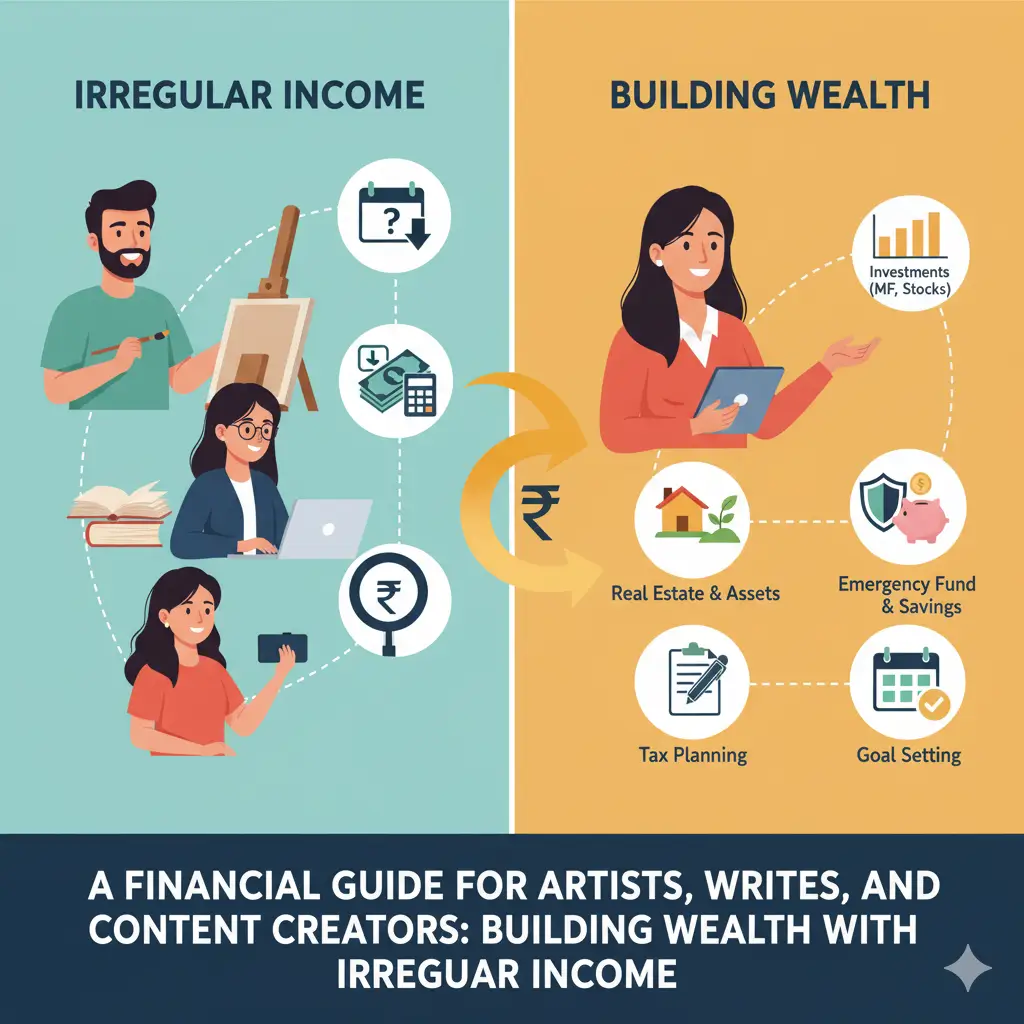
Financial Planning for Artists, Writers & Content Creators India 2026
📘 Creative Finance — Building Stability From Irregular, Unpredictable Income
India’s 2.4 lakh registered creators (YouTube, Instagram), 48,000+ published authors, and millions of freelance artists, designers, and writers face a unique financial challenge: income that ranges from Rs0 to Rs10L in a single month, with no EPF, no employer benefits, no income smoothing mechanism. Yet the creative economy is generating serious money — top YouTube channels earn Rs50-200L/year; successful authors receive Rs10-50L advances; brand partnerships pay Rs2-25L per campaign. This guide provides the complete financial system for India’s creative professionals: income management, tax optimisation (including the largely unknown Section 80QQB royalty deduction), and retirement planning without a payslip.
📊 India Creative Economy Data — 2025-26
- YouTube India, 2025: Channels with over 1 lakh subscribers: 2.4 lakh. Channels earning above Rs10L/year: 28,000. Average YouTube AdSense CPM (India): Rs200-450 per 1,000 views. Top creator annual income range: Rs50L-5Cr. All YouTube income is taxable professional income in India.
- CBDT, AY 2025-26: Content creator ITR filers: 1.8 lakh (significant under-reporting estimated). Section 44ADA users among digital creators: 82% of those who do file. Average declared income among filing creators: Rs8.4L. TDS under Section 194J by brands on creator fees: Rs1,240 crore.
- Federation of Indian Publishers, 2025: Books published in India: 2.4 lakh titles/year. Authors receiving advances above Rs5L: 2,800. Average advance for commercial fiction from major Indian publishers: Rs3-10L. Section 80QQB claims filed: only 12,000 — massively underutilised given eligible author population.
- IRDAI, 2025: Content creators with health insurance: 34% (vs 68% for salaried workers). Income protection insurance for creative professionals: less than 5% penetration — severe gap given income volatility.
1. Income Management System for Creatives
Creative income is irregular by nature — a brand deal might pay Rs5L in one month and nothing the next. The system that works:
| Account | Purpose | How Funded |
|---|---|---|
| Creative income account | All payments received here first | All clients, platforms, publishers |
| Operating expenses account | Fixed monthly costs | Transfer your baseline salary on 1st of month |
| Tax reserve (liquid MF) | 30% of all income above baseline | Auto-transfer; released at March 15 advance tax |
| Investment account | SIP, PPF, NPS | 30% of surplus; lump sum on large payments |
| Emergency buffer | 9-12 months expenses | 20% of surplus until target reached |
2. YouTube and Instagram Creator Taxation
| Income Type | Tax Treatment | TDS | Best Scheme |
|---|---|---|---|
| YouTube AdSense (Google India) | Professional income | 10% Section 194J | 44ADA if below Rs75L |
| Instagram brand collaboration | Professional income | 10% Section 194J by agency | 44ADA if below Rs75L |
| YouTube AdSense (Google US) | Foreign professional income | No TDS from abroad | 44ADA; self-declare |
| Merchandise / product sales | Business income | None if below threshold | 44AD or regular accounts |
| Affiliate commissions | Professional income | 10% or none depending on source | 44ADA if below Rs75L |
GST for creators: register if annual income exceeds Rs20L. For international brand collaborations (foreign clients): zero-rated export of service. File GST return monthly showing zero GST collected on exports. Keep GST account separate — it is not your income, it belongs to the government for domestic clients.
3. Book Advance and Royalty Taxation
Book advance: received upfront from publisher against future royalties. Taxable in the year of receipt as professional income. Budget advance tax for this year — a Rs10L advance creates Rs1.5-3L tax obligation payable by March 15. Royalty income: received per book sold — taxable when received. Both qualify for Section 44ADA (50% presumption) if total receipts below Rs75L. Combined with Section 80QQB (royalty deduction up to Rs3L) — the effective taxable income from royalties can be significantly reduced. Copyright assignment: permanent transfer of copyright for a lump sum — taxable as professional income, not capital gains. Pay advance tax in the year of assignment.
4. Section 80QQB — The Artist’s Deduction Most CAs Miss
| Feature | Detail |
|---|---|
| Who qualifies | Indian resident authors, composers, sculptors, painters of original literary, artistic, or scientific works |
| Deduction amount | Royalty income or Rs3,00,000 — whichever is lower |
| Does NOT qualify | Textbooks, guides, student books, promotional material, technical manuals |
| Foreign royalties | Covered — must be repatriated via RBI-approved channels |
| Form required | Form 10CCD (from publisher) filed with ITR |
| Regime availability | Old regime only (not available in new regime) |
Worked example: author earns Rs8L in royalties. Section 44ADA: declare 50% = Rs4L taxable. Section 80QQB: deduct Rs3L (maximum). Net taxable from royalties: Rs1L. At 30% bracket: Rs30,000 tax on Rs8L royalties vs Rs2,40,000 without these deductions. The combination of 44ADA plus 80QQB is extraordinarily powerful — and used by fewer than 12,000 taxpayers despite millions of eligible authors.
5. Insurance Stack Without Employer
| Insurance | Annual Cost | Cover | Priority |
|---|---|---|---|
| Health insurance (individual Rs10L) | Rs8,000-18,000 | Hospitalisation | 1st — non-negotiable |
| Term insurance (Rs1Cr, if dependents) | Rs8,000-15,000 | Life | 2nd — if family depends on income |
| PMJJBY + PMSBY (minimal) | Rs456/year | Rs4L combined cover | Immediate — negligible cost |
| Equipment insurance (laptop, camera) | Rs2,000-8,000 | Rs1-5L equipment value | 3rd — if equipment-dependent |
6. Retirement Planning for Creatives
Without EPF, creatives must build retirement corpus entirely from active savings. The three-pillar approach: PPF (Rs1.5L/year, EEE, 7.1%, guaranteed) + NPS Tier I self-employed (Rs50K/year extra deduction, 13% CAGR equity option) + equity index SIP (flexible amount, 13% CAGR long-term). Example starting at 28, retiring at 58: PPF 15 years maximum Rs1.5L: Rs3.9Cr. NPS Rs50K/year for 30 years at 13%: Rs1.77Cr. SIP Rs15K/month for 30 years at 13%: Rs5.76Cr. Total: Rs11.4Cr. At 3.5% withdrawal rate: Rs3.33L/month at retirement — adequate for most creative professional lifestyles. Key enabler: deposit lump sums (brand deals, advances) into PPF and SIP during peak earning months.
7. The Creative Professional’s Investment System
Because creative income is unpredictable, the investment system must be flexible: Flexi-SIP minimum amount (Rs500-1,000): invest even in lean months, increase in good months. PPF April 5 lump sum: deposit the year’s PPF contribution in one go from surplus funds in April. NPS monthly minimum Rs500: keep account active; top up in good months. Tax reserve in liquid MF: grows between advance tax dates; deployed March 15 and September 15. The creative income peak strategy: when a large project pays Rs5L+ in one month, allocate immediately: Rs1.5L to PPF (if annual limit not reached), Rs1L to SIP top-up, Rs50K to NPS, Rs1.5L to tax reserve, Rs1L to emergency buffer. Do it within 48 hours of receipt — money sitting in current account gets spent.
🧮 Free Calculators — Use Them Now
No login required. Updated for FY 2025-26.
Frequently Asked Questions
Creative income management system for India: The core challenge for artists, writers, designers, and content creators is income that arrives in irregular bursts — a large brand deal, then silence, then a book advance, then multiple smaller projects. The management system: (1) Baseline income identification: what is your guaranteed minimum monthly income? (recurring clients, retainers, platform revenue). Everything above this is surplus. (2) Fixed cost structure: keep all fixed monthly expenses (rent, EMI, insurance, subscriptions) below your baseline income. No exception. (3) Surplus allocation rule: when income above baseline arrives: 30% to tax reserve (paid to liquid MF, drawn at advance tax dates), 30% to investment (SIP top-up, PPF lump sum), 20% to emergency buffer, 20% to discretionary and lifestyle. (4) Weekly not monthly cash flow: creative income often arrives weekly (brand payments, freelance transfers). Weekly cash flow tracking via Fi Money or Walnut works better than monthly budgeting for creatives. (5) Separate bank accounts: creative income account, operating expenses account, tax reserve account, investment account. Physical separation prevents spending money meant for taxes.
YouTube and Instagram content creator taxation in India (2026): Income classification: all income from YouTube AdSense, Instagram brand collaborations, sponsorships, affiliate commissions, and merchandise sales is taxable as professional or business income. Tax scheme options: (1) Section 44ADA (presumptive for professionals): if annual gross receipts below Rs75L, declare 50% as taxable income. No books of accounts required. File ITR-4. This is the simplest and most popular option for YouTube and Instagram creators below Rs75L annual revenue. (2) Regular computation (above Rs75L): maintain books of accounts. Deduct actual expenses (production equipment, editing software, props, studio rent, internet). Hire CA for ITR-3 filing. GST: register for GST if annual income exceeds Rs20L (for services within India) or if providing services to foreign brands (zero-rated export, but registration still needed above Rs20L). TDS: brands and agencies deduct 10% TDS (Section 194J) on professional fees. Claim TDS credit in ITR. Key deduction for YouTube creators: equipment (laptop, camera, lighting, microphone) can be claimed as business expense if above Rs75L threshold using actual computation.
Book advance and royalty taxation for Indian authors: Book advance: upfront payment from publisher against future royalties. Tax treatment: taxable in the year received as professional income. Book advances are typically large lump sums — plan advance tax for the year of receipt. Royalty income: continuing payment per book sold. Also professional income, taxable when received. Section 44ADA for authors: if annual receipts below Rs75L — declare 50% as income under presumptive taxation. Simple and requires no books. However: if actual expenses are low (most writing requires minimal capital expense), 44ADA’s 50% deduction still gives significant relief. Copyright assignment income: if you permanently assign copyright of your work, the lump sum is taxed as professional income in the year of assignment. Not as capital gains (common misconception). Deductible expenses (if using regular computation): laptop, internet, books and research material, co-working space, agent fees, editing fees, travel for research. Section 80QQB: authors and composers of original literary, artistic, or scientific works (not textbooks or promotional material) get deduction of royalty income up to Rs3 lakh or actual royalty (whichever is lower). Must file Form 10CCD. A tax benefit specifically designed for artists that most CAs miss.
Section 80QQB is a specific income tax deduction for royalty income of Indian authors and composers — one of the most overlooked deductions in the Indian tax code. Eligibility: Indian resident individuals who are authors or composers of books, music, art, or scientific works. Not applicable for: textbooks for students, guides, diaries, commentaries, or purely promotional publications. Deduction amount: royalty income or Rs3 lakh, whichever is lower. For a novelist earning Rs5L in royalties: Rs3L deduction means only Rs2L is taxable (saving Rs62,400 at 30% bracket or Rs41,600 at 20% bracket). Foreign royalties: if you earn royalties from foreign publishers, Section 80QQB covers those too — but payment must be received in India via RBI-approved channels. Royalty from book sales in India AND abroad both qualify. Filing requirement: Form 10CCD (certificate from publisher confirming royalty) must be filed with ITR. Most authors claiming 44ADA also claim 80QQB separately — both are available simultaneously. The 80QQB benefit is on top of the 44ADA 50% presumption.
Retirement planning for self-employed creative professionals without EPF: The EPF-less reality: creative professionals don’t have employer EPF contributions — they must build the equivalent from scratch. Replacement strategy: (1) NPS (National Pension System) — self-employed NPS account: contribute Rs50,000/year minimum. Rs50,000 goes as extra 80CCD(1B) deduction (over 80C). At 13% CAGR (equity NPS) for 25 years: Rs50,000/year becomes Rs1.05 crore. (2) PPF Rs1.5L/year: EEE, 7.1%, 15-year anchor. Builds guaranteed Rs3.90 crore over 15 years at maximum contribution. (3) Equity SIP: Rs10,000-30,000/month depending on income. Variable via Flexi-SIP. At Rs15,000/month for 25 years at 13%: Rs2.88 crore. (4) Creative income peaks exploitation: when a large project arrives (film score, book deal, viral brand campaign) — allocate 30-40% to investments immediately. Creative income peaks fund the investment that builds long-term stability. Total target: Rs3-5 crore retirement corpus for a creative professional targeting Rs80,000-1,20,000/month in retirement. Achievable via disciplined NPS + PPF + equity SIP combination over 20-25 years.