
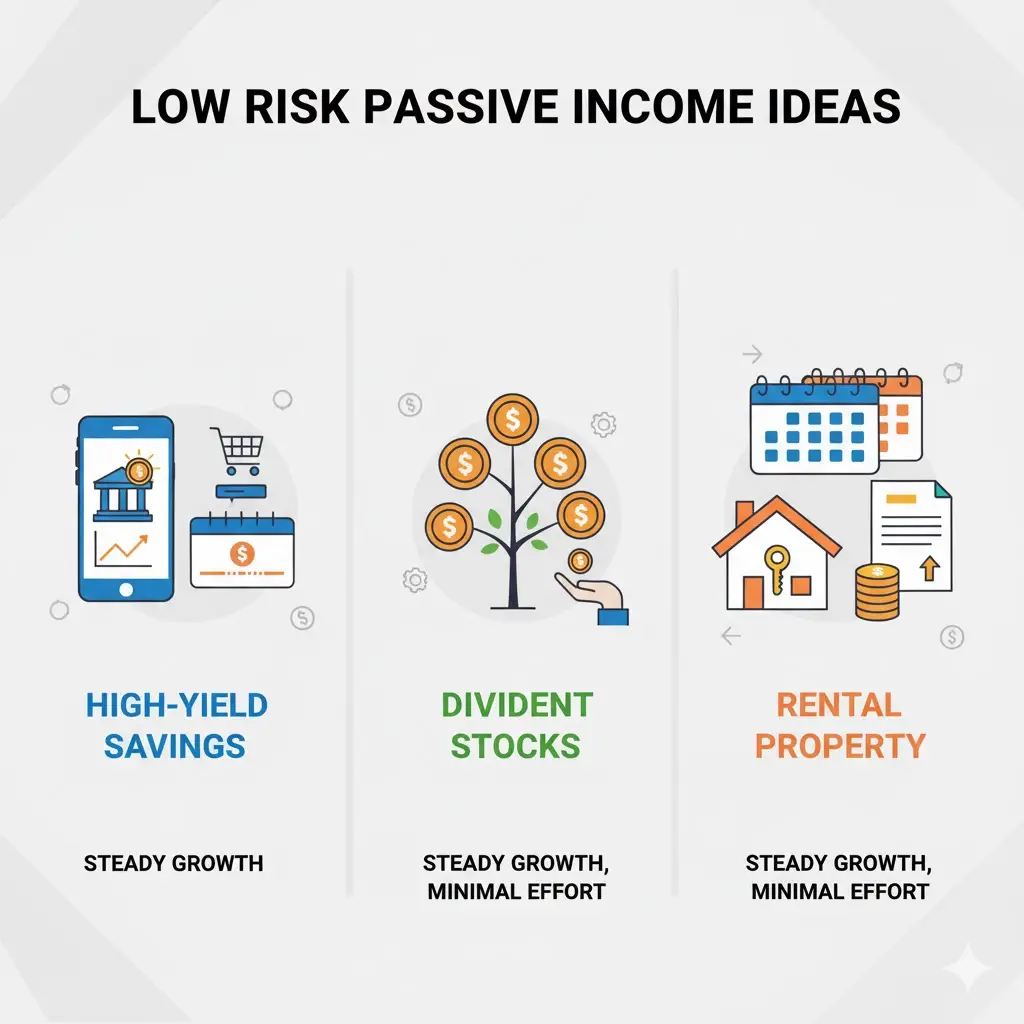
Low-Risk Passive Income Ideas in India — Complete 2026 Guide
📘 Passive Income in India — What It Really Means
Passive income is money earned from assets you own, with minimal ongoing effort. In India’s 2026 financial landscape, several instruments generate regular income streams: government-backed schemes (SCSS, POMIS, RBI Bonds), bank FDs, REIT distributions, SWP from mutual funds, and dividend-paying stocks. “Low risk” in this context means capital is largely protected — you may lose some purchasing power to inflation, but you won’t lose principal from market crashes. This guide covers every practical passive income option with current rates, tax treatment, and minimum corpus required.
📊 Passive Income Instruments — Current Rates 2026
- RBI, Q1 2026: Senior Citizen Savings Scheme: 8.2% p.a. (quarterly payouts). Post Office MIS: 7.4% p.a. (monthly). NSC: 7.7% (cumulative). RBI Floating Rate Savings Bonds: 8.05% (semi-annual).
- Bank FD rates, Q1 2026: SBI 5yr FD: 6.5%. HDFC Bank 5yr: 7.0%. Small finance banks (Unity, Jana, ESAF): 8.5-9.0% on 2-3yr tenure. DICGC insures up to ₹5L per depositor per bank.
- AMFI, 2026: Average SWP withdrawal rate from balanced advantage funds without corpus erosion: 6-7% of corpus annually. India’s 4 listed REITs: average distribution yield 6.5-7.1%.
- RBI Household Finance Survey, 2025: Only 8% of Indian households below age 60 have structured passive income beyond employment. For retirees 60+: 34% rely on FD interest + pension as sole income.
1. Government-Backed Passive Income Schemes
| Scheme | Rate (2026) | Payout | Min/Max | Eligibility | Tax on Income |
|---|---|---|---|---|---|
| SCSS (Senior Citizen Savings) | 8.2% | Quarterly | ₹1,000 / ₹30L | 60+ years (55+ retired) | Taxable; 80TTB ₹50K for seniors |
| PMVVY (PM Vaya Vandana) | 7.4% | Monthly/Qtrly/Annual | Min ₹1.5L / Max ₹15L | 60+ years (LIC) | Taxable at slab |
| Post Office MIS | 7.4% | Monthly | ₹1,000 / ₹9L (₹15L joint) | Any age | Taxable at slab |
| RBI Floating Rate Bonds | 8.05% | Semi-annual | ₹1,000 / No max | Any age | Taxable at slab |
| NSC (National Savings Certificate) | 7.7% | Cumulative (maturity) | ₹1,000 / No max | Any age | Taxable; annual interest deemed received |
💡 SCSS — India’s Best Passive Income for Senior Citizens
SCSS at 8.2% quarterly is the highest guaranteed return available to senior citizens from a government-backed instrument. ₹30L in SCSS (maximum) generates ₹2.46L/year = ₹61,500/quarter. Senior citizens also get ₹50,000 deduction on interest income under Section 80TTB — making SCSS income up to ₹50,000 effectively tax-free. For a senior citizen couple: ₹30L each in SCSS = ₹60L total = ₹4.92L/year combined, with ₹1L tax-free under dual 80TTB.
2. Bank FDs with Monthly Payout
Bank FDs with monthly interest payout option are the most familiar passive income instrument. Key considerations:
- Rate comparison (Q1 2026): Major banks: 7.0-7.5% for 1-3 year FDs with monthly payout. Small finance banks: 8.5-9.0% (DICGC insured up to ₹5L — split across multiple banks for larger amounts). Senior citizens: additional 0.25-0.50% on all FD tenures.
- Monthly payout vs cumulative: Monthly payout FDs give slightly lower effective yield than cumulative FDs (compound interest effect). If you need the monthly income: take monthly payout. If you can reinvest the interest: cumulative FD gives better overall return.
- TDS: Banks deduct TDS at 10% if annual interest from all FDs in one bank exceeds ₹40,000 (₹50,000 for senior citizens). Submit Form 15G (below 60, income below taxable limit) or 15H (above 60) to avoid TDS if not taxable.
- DICGC insurance: ₹5L per depositor per bank (including interest). For large FD amounts: split across multiple banks and use multiple family members to maximise insurance coverage.
3. SWP from Mutual Funds — The Most Flexible Passive Income
Systematic Withdrawal Plan (SWP) allows you to set a fixed monthly withdrawal from your mutual fund corpus. The fund earns returns; you withdraw a portion monthly; the remaining corpus (ideally) keeps growing.
Sustainable SWP Withdrawal Rates
| Fund Type | Expected Return | Safe SWP Rate | ₹50L Corpus → Monthly | Corpus After 15yr |
|---|---|---|---|---|
| Balanced Advantage Fund | 11-12% | 7% of corpus | ₹29,167/mo | Grows to ₹65-75L |
| Hybrid Equity (60-40) | 10-11% | 6% of corpus | ₹25,000/mo | Grows to ₹55-70L |
| Short Duration Debt Fund | 7.5-8% | 6.5% of corpus | ₹27,083/mo | Corpus slowly depletes |
| Liquid/Ultra-Short Fund | 7-7.5% | 6% of corpus | ₹25,000/mo | Corpus broadly stable |
Key advantage of SWP over FD: the principal can grow (if invested in hybrid/equity funds), providing built-in inflation protection for the income stream. Tax advantage: only the gains portion of each SWP is taxable, not the principal withdrawal.
4. REIT Distributions — Premium Real Estate Income
India’s 4 listed REITs pay quarterly distributions from rental income of their commercial properties. Embassy Office Parks, Mindspace Business Parks, Brookfield India, and Nexus Select Trust collectively distribute ₹8,000-12,000 crore annually to unit holders.
| REIT | Annual Distribution Yield | ₹10L Invested → Annual Income | Monthly Income Equivalent |
|---|---|---|---|
| Embassy Office Parks | 6.8% | ₹68,000 | ₹5,667/mo |
| Brookfield India REIT | 7.1% | ₹71,000 | ₹5,917/mo |
| Mindspace Business Parks | 6.5% | ₹65,000 | ₹5,417/mo |
| Nexus Select Trust | 6.0% | ₹60,000 | ₹5,000/mo |
5. Dividend Stocks — Supplementary Income Component
High dividend-yield stocks in India: BPCL (~5.5% yield), Coal India (~5.0%), Power Grid (~3.5%), ITC (~3.2%), NTPC (~2.8%). However, dividend yields are not guaranteed and fluctuate with company profits and payout policies. Better to treat dividend stocks as a 10-20% component of a diversified passive income portfolio — not the primary income source. Taxation: dividends are fully taxable at your slab rate (post-DDT removal). For a 30% bracket investor: ₹1L dividend income = ₹70,000 net after tax.
6. Corpus Required by Monthly Income Goal
| Monthly Income Goal | FD (7.5%) | SCSS (8.2%) | REIT (7%) | SWP — Balanced Fund (7%) |
|---|---|---|---|---|
| ₹20,000/month | ₹32L | ₹29.3L | ₹34.3L | ₹34.3L |
| ₹30,000/month | ₹48L | ₹43.9L | ₹51.4L | ₹51.4L |
| ₹50,000/month | ₹80L | ₹73.2L | ₹85.7L | ₹85.7L |
| ₹75,000/month | ₹1.2 Cr | ₹1.1 Cr | ₹1.29 Cr | ₹1.29 Cr |
| ₹1,00,000/month | ₹1.6 Cr | ₹1.46 Cr | ₹1.71 Cr | ₹1.71 Cr |
7. Tax Comparison — All Passive Income Options
| Option | Gross Yield | Tax (30% bracket) | Net Yield (30%) | Senior Citizen Net |
|---|---|---|---|---|
| FD Interest | 7.5% | Slab (30%) | 5.25% | 6.0% (80TTB ₹50K) |
| SCSS Interest | 8.2% | Slab (30%) | 5.74% | 6.88% (80TTB benefit) |
| REIT Distribution | 7.0% | ~25% effective (75% non-taxable) | 6.48% | 6.7% |
| SWP (BAF, 12 months+) | 7.0% withdrawal | 12.5% on gains only | ~6.5%+ (principal untaxed) | Same |
| Dividend Stocks | 3-5% | Slab (30%) | 2.1-3.5% | 2.4-4.0% |
REIT distributions and SWP emerge as the most tax-efficient passive income sources for investors in 30% tax bracket. Government schemes (SCSS) are most attractive for senior citizens who benefit from the ₹50,000 Section 80TTB deduction. Build a diversified passive income portfolio using multiple sources — not relying on any single instrument.
🧮 Free Calculators — Use Them Now
No login required. Updated for FY 2025-26.
Frequently Asked Questions
Safest low-risk passive income options ranked by security: (1) Senior Citizen Savings Scheme (SCSS): 8.2% quarterly, government-backed, best for 60+ age. (2) Post Office Monthly Income Scheme (POMIS): 7.4% monthly payouts, government-backed, max ₹9L individual / ₹15L joint. (3) Bank FD with monthly interest payout: 7-7.5% monthly, DICGC insured up to ₹5L. (4) Systematic Withdrawal Plan (SWP) from debt mutual funds: 7-7.5% effective, SEBI-regulated. (5) RBI Floating Rate Savings Bonds: 8.05% semi-annual (linked to NSC rate), government guaranteed. Each option has different tax treatment and suitability — see the comparison below.
Required corpus at various instrument yields: FD at 7.5%: ₹80 lakh (₹80L × 7.5% = ₹6L/year ÷ 12 = ₹50,000/month). SCSS at 8.2%: ₹73 lakh. POMIS at 7.4%: ₹81 lakh. SWP from balanced fund at 8%: ₹75 lakh. REIT distribution at 7%: ₹86 lakh. For ₹1 lakh/month: double these corpus amounts. Critical: these are pre-tax figures. FD and POMIS interest is fully taxable; SCSS interest is taxable (but 80TTB provides ₹50,000 deduction for senior citizens). Plan for post-tax income requirements when sizing your corpus.
SWP is a facility to withdraw a fixed amount monthly from your mutual fund investment. Example: ₹50L in a balanced advantage fund at 10% CAGR. Set SWP of ₹40,000/month. The fund earns ₹5L/year; you withdraw ₹4.8L/year; the remaining ₹0.2L adds to corpus. Your corpus continues growing even while generating income. Tax advantage over FD: only the gains component of each SWP withdrawal is taxed (as LTCG at 12.5% if held 12+ months) — not the principal. For a ₹50L investment with ₹10L gains over time: only ₹10L is taxable, not ₹50L. FD: 100% of interest is taxable every year regardless. SWP from equity-heavy funds has some market risk; debt fund SWP has minimal risk but similar tax treatment.
REITs (Real Estate Investment Trusts) are excellent for passive income: 6-8% annual distribution yield paid quarterly, with 70-80% of distributions being non-taxable return of capital (making post-tax yield superior to FDs for most investors). India’s 4 listed REITs (Embassy, Mindspace, Brookfield, Nexus) distribute quarterly. ₹10L invested in Embassy REIT at 6.8% yield: ₹68,000/year = ₹5,667/month in distributions. Additionally, REIT unit prices tend to appreciate with commercial real estate values — total return (income + capital) typically 10-12% CAGR. Minimum investment: 1 unit (~₹350-400). Requires demat account.
Dividend income from stocks is tax-inefficient and unreliable as primary income: dividends are not guaranteed, fluctuate with company profits, and the entire dividend is taxable at your slab rate (no preferential tax rate). Large-cap dividend stocks in India yield 1-3% — requiring ₹3-4 crore corpus for ₹50,000/month income. Better alternatives: REIT distributions (higher yield, more tax-efficient), SWP from hybrid funds (market-linked but controllable withdrawal rate), or SCSS/POMIS (guaranteed but lower yield). Build dividend income as a component of passive income (10-20% of total), not the entirety.