
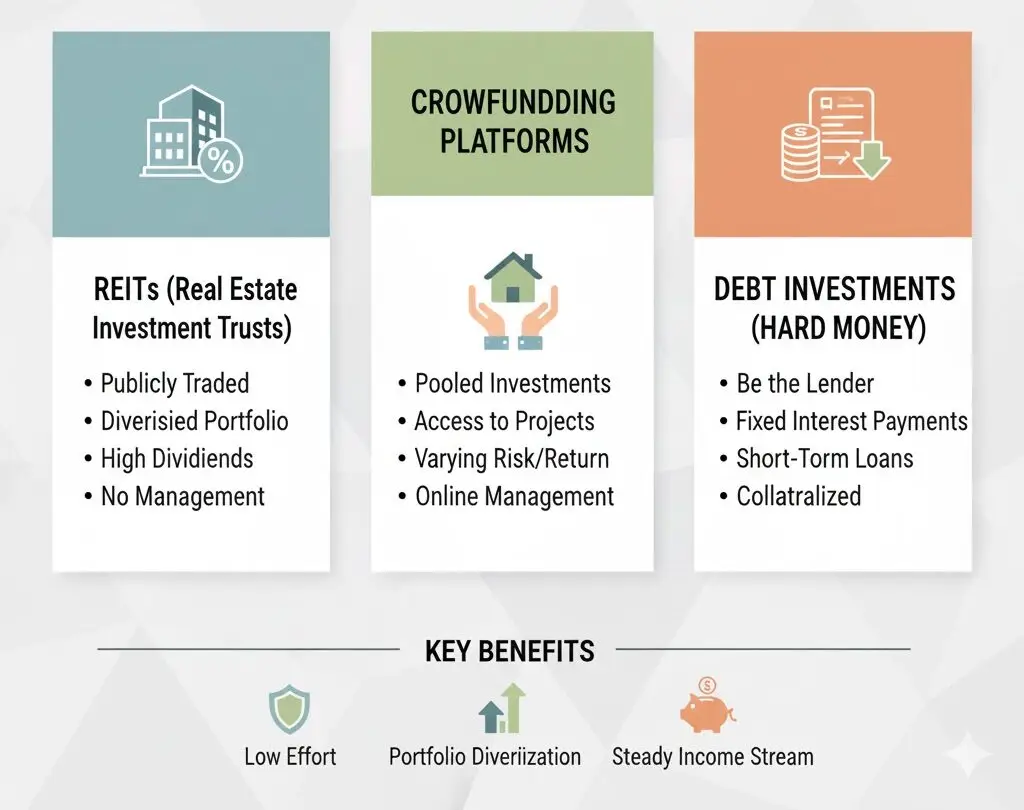
Picture this: You’re a busy software engineer in Bengaluru, juggling long office hours and family time, but you dream of owning a piece of that shiny new commercial building in the city center. Buying it outright? That’s a crore-plus headache with loans, maintenance, and tenants to handle. Sounds like too much hassle, right? That’s where REITs come in—like renting a room in a big house without worrying about the plumbing or painting. You get your share of the rent money every few months, and someone else manages the mess. My neighbor Ravi started with a small investment in one, and now he’s getting steady cheques without lifting a finger. If you’re looking for passive ways to dip into real estate, this could be your ticket to building wealth quietly.
In our daily grind, where rent and EMIs eat up half the salary, finding smart ways to grow money matters a lot. Passive real estate options like REITs let you earn from properties across India—offices in Mumbai, malls in Delhi, warehouses in Chennai—all without the usual property buying troubles. You invest once, sit back, and watch dividends roll in, much like interest from a fixed deposit but with potential for better returns. We’ll chat about how these work, why they’re good for folks like us who want low-effort income, and even run through an example where you could see 8% yield on your money. It’s all about making your savings work harder, so you can enjoy that weekend getaway or save for the kid’s education without extra stress.
Real Estate Reality Check
With property prices climbing like summer temperatures, direct buying needs big cash. REITs start from just a few thousand rupees, offering 6-8% yields—better than many bank FDs these days.
What Makes REITs a Top Passive Real Estate Choice
Understanding REITs in Simple Terms
REIT stands for Real Estate Investment Trust—basically a company that owns and runs income-making properties, like office towers or shopping complexes. You buy shares in this company, and they share the rent money with you as dividends. It’s like being a landlord without dealing with leaky roofs or late-paying tenants. In India, these are regulated by SEBI, so your money is safer than some shady schemes. Think of it as pooling money with others to own big assets you couldn’t afford alone.
Why Go Passive with Real Estate
Life is already full—office deadlines, family duties, maybe a side hustle. Who has time to hunt for properties, negotiate deals, or chase rent? Passive options let your investment run on autopilot. You get regular income, some growth if property values rise, and it’s all handled by pros. For many like my cousin in Delhi, who invested after reading about it in a newspaper, it’s become a reliable way to beat inflation without daily worry.
Benefits Over Direct Property Buying
- Low Entry Barrier: Start with ₹10,000-20,000, not lakhs for a flat.
- Diversification: Own bits of offices, malls, hotels across cities—no single property risk.
- Liquidity: Sell shares on stock exchange anytime, unlike waiting months for a buyer.
- Professional Management: Experts handle everything, from leases to upkeep.
- Tax Perks: Dividends are tax-efficient, especially in lower brackets.
Linking to Smart Investing Habits
This ties into our earlier chats on passive income ideas and sustainable real estate in tier-2 cities. For official rules, check the SEBI website.
Types of REITs Available in India
Equity REITs for Rental Income
These own physical properties and earn from rent. Most Indian REITs are this type, focusing on commercial spaces. You get dividends from the lease money, plus any property value increase when they sell assets.
Mortgage REITs for Interest Earnings
Less common here, these lend money for real estate and earn from interest. Good for steady income but sensitive to rate changes.
Hybrid REITs Mixing Both
Combine owning and lending, offering balanced risk. Not many yet in India, but growing as markets mature.
Sector-Specific REITs
- Office REITs: Like those in IT hubs, benefiting from work return post-pandemic.
- Retail REITs: Malls and shops, riding e-commerce boom but with footfall recovery.
- Industrial REITs: Warehouses, data centers—hot with online shopping surge.
Top REIT Options for Passive Investors in 2025
Evaluating REITs for Your Portfolio
Look at occupancy rates, dividend history, management team, and debt levels. High occupancy means steady rent, low debt reduces risk. Use our investment calculators to project returns.
Embassy Office Parks REIT
Key Details
- Focus: Premium offices in Bengaluru, Mumbai, Pune.
- Yield: Around 6-7%, with total returns 10-12% including growth.
- Performance: High occupancy over 90%, steady dividends.
- Best For: IT professionals seeking stable income from familiar sectors.
- Market Cap: Large, liquid for easy trading.
Mindspace Business Parks REIT
Key Details
- Focus: Offices in Hyderabad, Mumbai, Pune.
- Yield: 6-7%, strong lease renewals.
- Performance: Over 15% appreciation in recent periods.
- Best For: Diversified exposure to growing cities.
- Market Cap: Solid, with good tenant mix.
Brookfield India Real Estate Trust
Key Details
- Focus: Offices in Delhi-NCR, Kolkata, Mumbai.
- Yield: 6-7%, backed by global parent.
- Performance: 15%+ growth, resilient assets.
- Best For: Investors wanting international standards.
- Market Cap: Growing, with expansion plans.
Nexus Select Trust
Key Details
- Focus: Retail malls across India.
- Yield: Around 6%, with consumption boom.
- Performance: Recovering post-COVID, footfall up.
- Best For: Betting on shopping revival.
- Market Cap: Retail-focused, unique in India.
REIT Comparison Table
| REIT | Yield Range | Sector | Occupancy | Total Returns |
|---|---|---|---|---|
| Embassy | 6-7% | Office | 90%+ | 10-12% |
| Mindspace | 6-7% | Office | 85-90% | 15%+ |
| Brookfield | 6-7% | Office | 90%+ | 15%+ |
| Nexus | 6% | Retail | 80-85% | 10%+ |
8% Yield Example: Making It Work for You
Real-Life Scenario
Say you’re Amit from Pune, with ₹5 lakh saved from bonuses. You invest in a REIT offering 7% yield, but with capital growth, total return hits 8%. That’s ₹40,000 yearly income, like a small salary boost. Use our dividend yield calculator to see how.
Calculation Breakdown
Investment: ₹5 lakh
Yield: 8%
Annual Dividend: ₹40,000
Over 10 years, compounding at 8%, corpus grows to ₹10.79 lakh. Check with compound interest calculator.
Tax on REIT Dividends
Dividends taxed at slab rate, but long-term gains over ₹1 lakh at 10%. Plan with capital gains tax calculator.
Yield Tip
Look for REITs with strong tenants for consistent 6-8% yields. Diversify to smooth risks.
How to Start Investing in REITs
Step-by-Step Process
- Open demat account if none.
- Research on NSE or apps.
- Buy shares like stocks.
- Track dividends quarterly.
- Reinvest for growth.
Costs Involved
- Brokerage fees low.
- Management fee 0.5-1%.
- No stamp duty on shares.
Portfolio Integration
Add 10-20% REITs for balance. Use portfolio diversification calculator.
Risks and How to Handle Them
Market Volatility
Prices fluctuate with economy. Hold long-term to ride waves.
Interest Rate Changes
Rising rates hurt borrowing. Choose low-debt REITs.
Sector Downturns
Office slump post-WFH? Diversify across sectors.
Risk Tip
Don’t put all eggs in one basket. Start small, learn from dips.
Alternatives to REITs for Passive Real Estate
InvITs for Infrastructure
Similar to REITs but for roads, power. Yields 7-9%, check InvIT guide.
Fractional Ownership Platforms
Own part of a property online. More hands-on but passive income.
Real Estate Mutual Funds
Invest in property stocks. Use mutual fund returns calculator.
Frequently Asked Questions
Q1: Minimum Investment for REITs?
One unit, around ₹300-500.
Q2: Tax on REIT Income?
Dividends taxed, gains depend on holding.
Q3: REITs vs Direct Property?
REITs easier, lower cost, more liquid.
Q4: Safe for Beginners?
Yes, start with established ones.
Closing Thoughts on Passive Wealth Building
REITs offer a simple way to tap real estate growth without daily hassles. Like Ravi’s story, small steps lead to steady income. Explore more in tier-2 investments. For calculations, use real estate calculators.
Get Started: Check yields with dividend yield calculator or visit NSE for listings.