
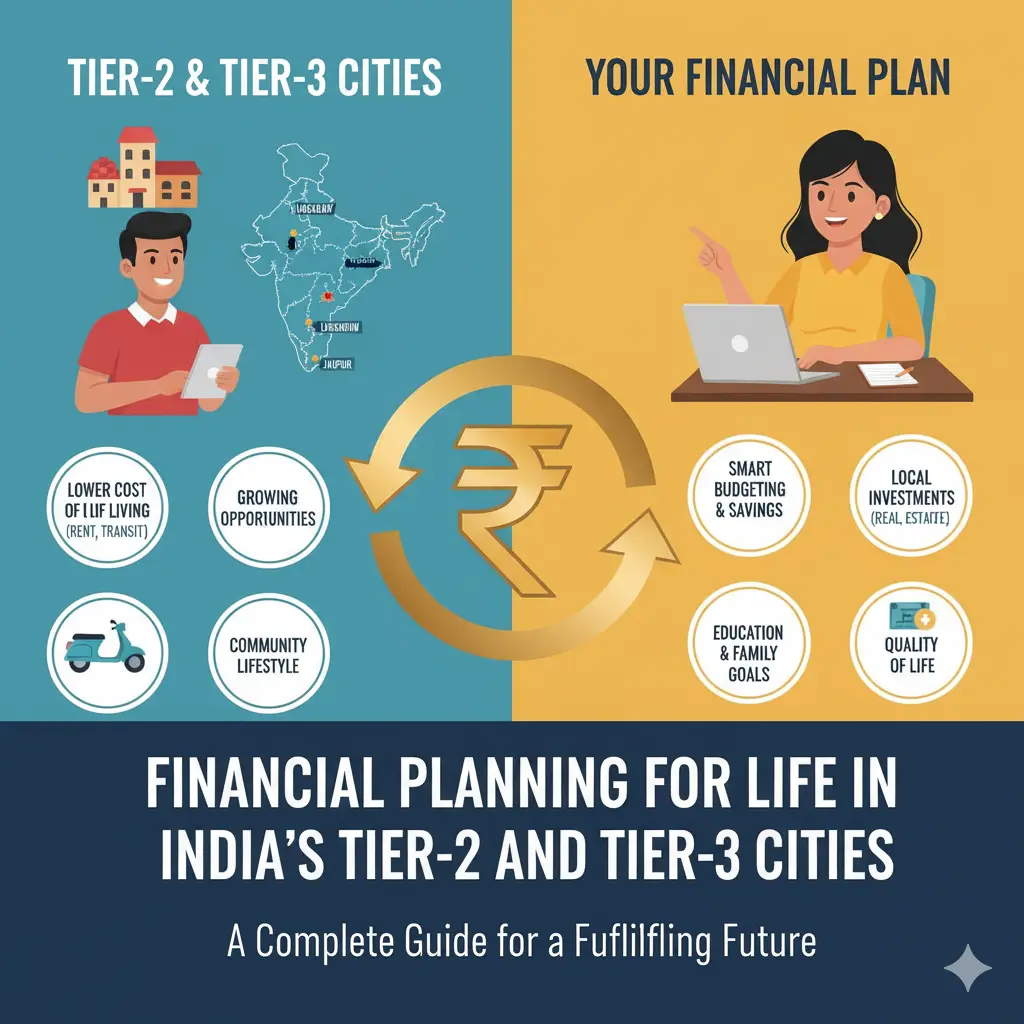
If you’re reading this from Indore, Coimbatore, Jaipur, Nashik, or any of India’s hundreds of smaller cities, you already know something that many metro dwellers are just discovering: life here is different. Not worse, not better—just different. You probably don’t spend two hours stuck in traffic every day. Your rent doesn’t consume half your salary. And when you go out for dinner, you’re not calculating whether you can afford dessert.
But here’s the thing nobody talks about enough: this different life requires a different approach to money. The financial advice you see online—whether it’s YouTube videos or Instagram reels—is almost always created by people living in Mumbai, Delhi, or Bangalore. They talk about salaries of ₹15 lakhs as “entry-level” and real estate investments starting at ₹1 crore. For most of us in tier-2 and tier-3 cities, that world feels alien.
This guide is specifically for you—the growing population choosing to build their lives and careers outside the big metros. We’ll explore how to make the most of the unique financial advantages you have, tackle the specific challenges you face, and build real wealth right where you are.
Why Smaller Cities Are Financial Goldmines (If You Play It Right)
Let me tell you about Rajesh, a software developer in Pune who recently moved back to his hometown Nagpur. His salary dropped from ₹12 lakhs to ₹8 lakhs. Sounds like a bad deal, right? But here’s what happened to his actual life:
Rajesh’s Reality Check
In Pune:
- Rent for 2BHK: ₹25,000/month
- Daily commute (cab + metro): ₹8,000/month
- Weekly groceries & eating out: ₹12,000/month
- Maid, maintenance, utilities: ₹8,000/month
- Total monthly expense: ₹53,000
- Savings from ₹12L salary: ₹28,000/month (after expenses and tax)
In Nagpur:
- Rent for 3BHK: ₹12,000/month
- Daily commute (two-wheeler): ₹2,000/month
- Weekly groceries & eating out: ₹7,000/month
- Maid, maintenance, utilities: ₹4,000/month
- Total monthly expense: ₹25,000
- Savings from ₹8L salary: ₹36,000/month (after expenses and tax)
Rajesh is actually saving ₹8,000 more every month despite earning ₹4 lakhs less annually. Over five years, that’s an extra ₹4.8 lakhs in pure savings. And that’s before we even talk about the intangible benefits—he has dinner with his family every night, plays badminton on weekends, and doesn’t spend his Sundays recovering from work stress.
The Hidden Wealth Advantages of Tier-2 and Tier-3 Cities
Lower Cost of Living Creates Higher Savings Rate
This is the biggest advantage, and most people don’t realize its power. In personal finance, the savings rate (percentage of income you save) matters more than the absolute amount. If you save 50% of ₹50,000, you’re building wealth faster than someone saving 15% of ₹1,50,000.
Better Quality of Life Means Better Financial Decisions
When you’re not exhausted from a 3-hour daily commute, when you have time to cook at home, when you’re not constantly tempted by expensive entertainment options—you naturally make better money choices. Mental space is a financial asset that nobody talks about.
Real Estate That Actually Makes Sense
In cities like Mysore, Udaipur, or Bhopal, you can buy a decent 2BHK for ₹30-50 lakhs. Compare that to metros where the same money gets you nothing or a tiny 1BHK in the outskirts. Your EMI-to-income ratio stays healthy, and you can actually afford to invest in other things too.
Stronger Family Support Systems
This isn’t just emotional—it’s financial. When your parents are around to help with childcare, when you can share resources with extended family, when medical emergencies don’t require flying someone across the country—these are all significant financial buffers that metro folks often miss.
The Challenges (And How to Beat Them)
Now, let’s be honest. Tier-2 and tier-3 cities aren’t perfect financial paradises. You will face unique challenges. But here’s the good news: every single one of them has a practical solution.
Challenge 1: Lower Salary Ceiling
Yes, the harsh truth is that most companies pay less in smaller cities. A manager earning ₹20 lakhs in Bangalore might get ₹14 lakhs for the same role in Visakhapatnam.
The Solution: Focus on Savings Rate, Not Absolute Income
Remember Rajesh’s example. But let’s go deeper. Use our Salary Take-Home Pay Calculator to understand your actual disposable income after taxes and mandatory deductions. Then use the Emergency Fund Calculator to see how quickly you can build a safety net.
The goal isn’t to earn crores. The goal is financial independence—the point where your investments generate enough passive income to cover your expenses. In a tier-2 city with ₹40,000 monthly expenses, you need roughly ₹1.2 crore invested to generate ₹40,000/month at 4% withdrawal rate. In a metro with ₹1 lakh monthly expenses, you need ₹3 crore. Which target sounds more achievable?
Challenge 2: Limited Access to Financial Advisors
Most tier-2 and tier-3 cities don’t have a wide network of certified financial planners. The “advisor” at your bank branch is usually just trying to sell you ULIPs and insurance products that benefit the bank, not you.
The Solution: Digital Tools and Self-Education
This is actually easier to solve than you think. CalcWise exists precisely for this reason. Every calculator you need—from Home Loan EMI to Retirement Planning—is available online, free, and doesn’t require any advisor.
Pair these tools with quality educational content. Our Complete Mutual Fund Guide and Tax Planning for Salaried Employees are written specifically for Indian readers who want practical, jargon-free advice.
For official government schemes, always check the National Portal of India for authentic information about savings schemes, subsidies, and benefits you’re entitled to.
Challenge 3: Peer Pressure and “Small City” Mindset
This is subtle but powerful. When your cousin in Gurgaon posts pictures from their fancy apartment or your school friend in Bangalore talks about their startup stock options, it’s easy to feel like you’re falling behind.
The Solution: Redefine What “Winning” Means
Financial success isn’t about Instagram-worthy moments. It’s about security, freedom, and peace of mind. It’s about being able to handle a medical emergency without loans. It’s about not panicking when your company announces layoffs. It’s about choosing work you enjoy because you’re not desperate for money.
Track your own financial independence score: Can you survive 6 months without income? Can you retire at 60 comfortably? Are you free from bad debt? These metrics matter infinitely more than apartment size or car brand.
Your Practical Wealth-Building Framework for Smaller Cities
Enough theory. Let’s build a concrete plan. This framework works whether you’re in Mangalore or Raipur, whether you earn ₹6 lakhs or ₹15 lakhs annually.
Step 1: Build Your Emergency Buffer (3-6 Months)
Before anything else, you need breathing room. In tier-2/3 cities, a 6-month emergency fund is often easier to build because your monthly expenses are lower.
Action Item:
Calculate your monthly essential expenses (not wants, just needs). Multiply by 6. That’s your target. Start by saving ₹5,000-10,000 every month in a liquid fund or savings account. Our Emergency Fund Calculator will show you exactly how long this will take.
Step 2: Clear All High-Interest Debt
Credit card debt at 36% interest will destroy your wealth faster than any investment can build it. Personal loans at 14-18% are also wealth killers. If you have any of these, attacking them should be priority number two.
Use our Debt Consolidation Calculator to see if combining multiple debts makes sense. Sometimes a single personal loan at 12% is better than three different credit card dues at 36%.
Step 3: Start Your SIP Journey (Even With ₹500)
Don’t wait until you have “enough money” to start investing. Start with whatever you can. Even ₹500 per month teaches you the discipline and lets you learn without big risks.
Priya’s Story: Starting Small in Jamshedpur
Priya, a schoolteacher in Jamshedpur, started with ₹1,000 monthly SIP in an index fund when she was 28. She increased it by just ₹500 every year as her salary grew. By 45, she had accumulated over ₹42 lakhs—enough to buy a house outright in her city. She never took investment advice from anyone, just stuck to her simple plan.
Use our SIP Calculator to see how your small monthly investments can grow into substantial wealth. Then use our Goal-Based SIP Calculator to plan for specific targets like your child’s education or home purchase.
Step 4: Maximize Tax-Saving Investments
Every rupee saved in tax is a rupee earned. Under Section 80C, you can save up to ₹1.5 lakhs in taxes annually. Under Section 80D, you can save another ₹25,000-50,000 on health insurance premiums.
The NPS (National Pension System) deserves special mention. It gives you an additional ₹50,000 deduction over Section 80C, making it one of the most tax-efficient retirement tools available. Our Complete NPS Guide explains everything you need to know.
Essential Calculators for Your Financial Journey
Step 5: Think Long-Term About Real Estate
Real estate in tier-2 and tier-3 cities can be a solid investment, but only if you approach it correctly. The “buy and get rich” formula rarely works anymore, even in smaller cities.
When Real Estate Makes Sense in Your City
- For self-residence: If your EMI is less than or equal to what you’d pay as rent, buying makes sense. Use our Rent vs Buy Calculator to compare objectively.
- For investment: Only if you can get at least 3-4% rental yield (annual rent ÷ property price × 100). In most tier-2 cities, this is achievable. In metros, it’s almost impossible.
- Location matters more than city: A property near a good school, hospital, or upcoming IT park in Bhubaneswar can appreciate better than a random property in Pune.
Before taking a home loan, always use our Home Loan EMI Calculator and ensure your EMI doesn’t exceed 40% of your monthly income. Also check the Stamp Duty Calculator for your state—these hidden costs can add 8-10% to your property price.
Step 6: Plan for Life’s Big Events
In Indian families, especially in smaller cities where traditions run deeper, weddings, children’s education, and medical emergencies are inevitable. The question isn’t whether these expenses will come, but whether you’ll be ready.
Marriage and Family Planning
Start a separate recurring deposit (RD) or debt fund SIP for this goal. Even ₹5,000 per month over 3-4 years builds a significant corpus. Check our Marriage Financial Planning Guide for detailed strategies.
Children’s Education
Education inflation in India runs at 10-12% annually. A degree that costs ₹10 lakhs today will cost ₹25 lakhs in 10 years. Start early with a combination of Sukanya Samriddhi Yojana (for daughters) and equity mutual funds.
Healthcare Buffer
Medical costs hit harder in smaller cities because specialized treatment often requires travel to metros. Keep health insurance worth at least 5x your annual income. Use our Health Insurance Premium Calculator to find affordable coverage. Also explore the PM Jeevan Jyoti Bima Yojana—at just ₹436/year, it gives ₹2 lakh life cover.
Making the Most of Government Schemes
One massive advantage of living in India’s smaller cities is that government schemes are actually more accessible and less crowded here. While metro residents ignore these “small” benefits, smart savers in tier-2/3 cities stack them for real impact.
Top Schemes Worth Your Attention
- PM Fasal Bima Yojana: If you or your family has any agricultural income, this crop insurance is highly subsidized and valuable.
- PM Suraksha Bima Yojana: At ₹20/year, this gives ₹2 lakh accident cover. There’s literally no reason not to have this.
- Atal Pension Yojana: Perfect for self-employed individuals in smaller cities who don’t have corporate retirement benefits.
- Post Office Monthly Income Scheme: Offers better returns than most fixed deposits with complete government backing.
Explore all available schemes on our Government Schemes page and use the respective calculators to see your actual benefits.
The Mental Game: Building Confidence in Your Path
Financial success in tier-2 and tier-3 cities isn’t just about numbers and calculators. It’s also about having the confidence to ignore noise and stay focused on your own journey.
When your friends flaunt their Bangalore salaries, remember they’re also dealing with soul-crushing commutes, tiny expensive apartments, and limited savings. When influencers talk about “aggressive wealth creation through high-risk investments,” remember that slow and steady actually wins the race—especially when you have the advantage of lower stress and expenses.
Your version of success might look like owning a house by 35, having zero debt by 40, and retiring comfortably by 55. That’s not less ambitious than someone else’s dream of building a unicorn startup. It’s just different. And different is perfectly fine.
Your Next Steps (Start Today, Not Tomorrow)
Financial planning isn’t a destination; it’s a journey. And the best time to start was yesterday. The second-best time is right now. Here’s what you should do in the next 24 hours:
- Calculate your current financial position: Use our Emergency Fund Calculator to see if you have enough safety net.
- Set one clear financial goal: Use our Goal-Based Financial Planner to define what you want to achieve and by when.
- Start your first investment: Even if it’s just ₹500 in an index fund SIP. Use our SIP Calculator to see where this can take you.
- Review your insurance: Do you have adequate term insurance and health insurance? Use our Term Insurance Calculator to find out.
- Optimize your taxes: Check if you’re using all available deductions with our Tax Planning Tools.
Living in a tier-2 or tier-3 city doesn’t mean compromising on financial success. In many ways, it means having a better shot at it—if you play your cards right. You have lower expenses, less lifestyle inflation, stronger family support, and often better work-life balance. These aren’t small advantages. They’re game-changers.
The question isn’t whether you can build wealth in Kota, Cuttack, or Warangal. The question is: will you start today?
Quick Win Action Plan
This Week:
- Calculate your savings rate (what percentage of income you save each month)
- Open one new investment account (mutual fund, PPF, or NPS)
- Set up automatic transfers of ₹2,000-5,000 to this account
This Month:
- Review and optimize all recurring subscriptions (cut what you don’t use)
- Check your credit score (it’s free on multiple platforms)
- Compare your current home loan/personal loan rates with market rates—refinance if you can save even 0.5%
This Quarter:
- Build your complete financial dashboard—list all assets, liabilities, income sources
- Set three specific financial goals with deadlines
- Review and increase your SIPs by at least ₹500 each
Bookmark this page. Share it with friends in your city who are on the same journey. And most importantly, explore CalcWise’s complete suite of financial calculators and guides—they’re specifically designed to help Indians like you take control of their financial future, no matter which city they call home.
Your city might be smaller. But your dreams don’t have to be. Let’s build wealth together, one smart decision at a time.