
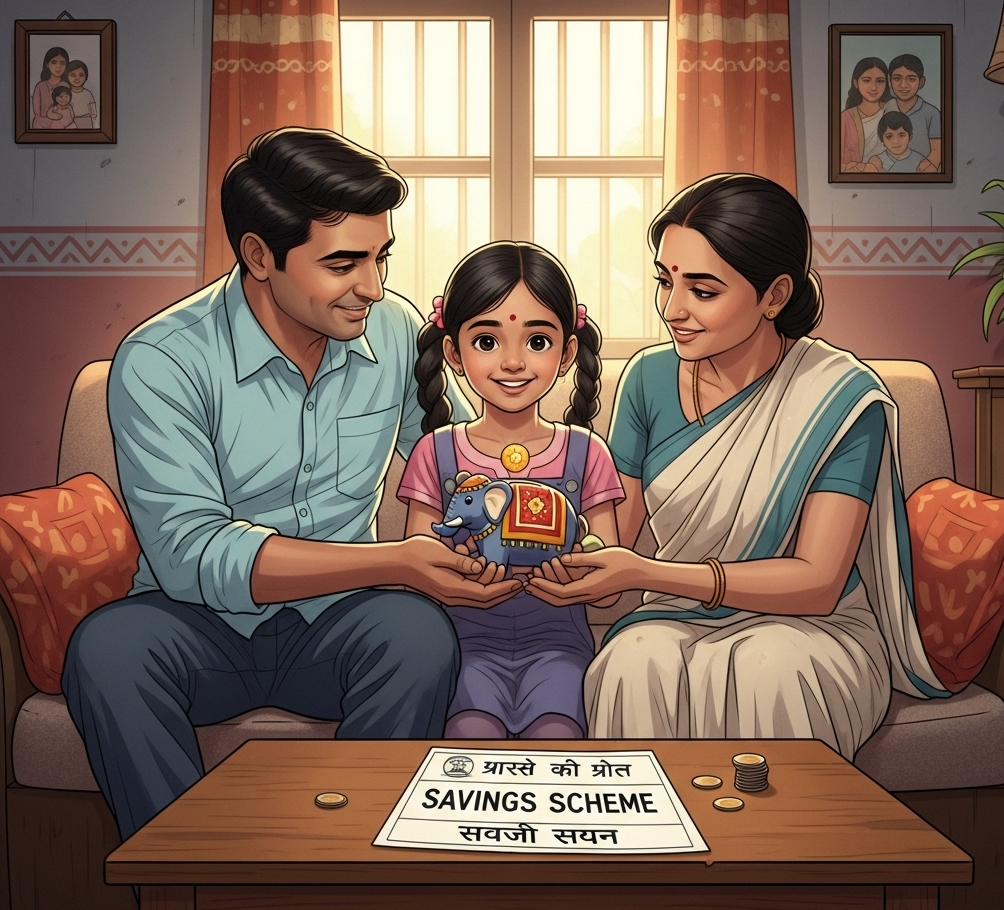
For parents in India, securing their daughter’s future, especially for major milestones like higher education and marriage, is a top financial priority. To support this goal, the Government of India launched a special small savings scheme as part of the “Beti Bachao, Beti Padhao” campaign: the **Sukanya Samriddhi Yojana (SSY)**.
The SSY scheme has quickly become one of the most popular and trusted investment options for parents of a girl child. It offers a unique combination of a high, guaranteed interest rate, unbeatable tax benefits, and the security of government backing.
While it shares some features with the Public Provident Fund (PPF), the SSY is specifically tailored to meet the long-term needs of a girl child. This in-depth guide will cover every aspect of the Sukanya Samriddhi Yojana, from eligibility and account opening to its rules on contributions, maturity, and withdrawals.
What is Sukanya Samriddhi Yojana (SSY)?
The Sukanya Samriddhi Yojana (which translates to “Girl Child Prosperity Scheme”) is a government-backed savings scheme designed exclusively for the parents or legal guardians of a girl child. The goal is to create a dedicated financial corpus that can be used to fund the child’s higher education and marriage expenses.
It is a long-term, disciplined savings plan that not only offers one of the highest interest rates among all small savings schemes but also provides the same powerful **Exempt-Exempt-Exempt (EEE)** tax status as the PPF.
Key Features of the SSY Scheme
The SSY scheme is packed with features that make it an incredibly attractive option for parents.
- Eligibility: The account can be opened for any girl child who is a resident of India, from her birth until she turns 10 years old.
- Account Limit: A maximum of two SSY accounts can be opened per family (one for each girl child). This is extended to three accounts in the case of twin or triplet girls.
- High Interest Rate: The interest rate is set by the government quarterly and is typically the highest among all small savings schemes, including PPF.
- Contribution Limits: You can invest a minimum of **₹250** and a maximum of **₹1.5 Lakhs** in a single financial year.
- Contribution Period: You only need to make contributions for the first **15 years** from the date of account opening.
- Maturity Period: The account matures after **21 years** from the date of opening, or at the time of the girl child’s marriage after she attains the age of 18.
- Complete Tax Exemption (EEE): Investments up to ₹1.5 Lakhs are deductible under Section 80C, the interest earned is tax-free, and the maturity amount is also tax-free.
How to Open an SSY Account
Opening an SSY account is a simple process. You can open an account at any Post Office or an authorized branch of a commercial bank. You will need the following documents:
- The SSY account opening form.
- The birth certificate of the girl child.
- Identity proof of the parent or guardian (Aadhaar card, PAN card, etc.).
- Address proof of the parent or guardian.
- The initial deposit amount (can be as low as ₹250).
The account will be operated by the parent or guardian until the girl child turns 18, after which she can take control of her own account.
Understanding the Rules: Contributions, Maturity, and Withdrawals
The SSY scheme has a unique structure that is important to understand.
Contribution and Maturity
As mentioned, you need to deposit money for the first 15 years. For the next 6 years (from the end of the 15th year to the end of the 21st year), no new contributions are required, but the existing balance continues to grow by earning tax-free, compounded interest. The full maturity amount can be withdrawn after 21 years.
Example of the SSY Timeline
Let’s say a parent opens an SSY account for their 1-year-old daughter.
- Contribution Period: They will deposit money every year until the daughter is 16 years old (1 + 15 years).
- Growth Period: From age 16 to 22, no new deposits are made, but the balance keeps compounding interest.
- Maturity: The account matures when the daughter turns 22 (1 + 21 years), and the entire corpus can be withdrawn.
Partial Withdrawal Rules
The scheme is designed for specific goals, so it offers liquidity only when needed for those goals. A partial withdrawal of up to **50% of the balance** available at the end of the preceding financial year is allowed for the purpose of the girl child’s **higher education**. This withdrawal is only permitted after she turns 18 or has passed the 10th standard, whichever is earlier.
Premature Closure Rules
The account can be closed prematurely before the 21-year term is complete under a few specific conditions:
- On the marriage of the girl child: The account can be closed if the girl gets married after she turns 18. An application must be made one month before or three months after the date of marriage.
- In case of the depositor’s death: If the parent or guardian who was making the deposits passes away, the account can be closed.
- On compassionate grounds: In cases of life-threatening diseases affecting the account holder, the account may be closed prematurely.
SSY vs. PPF: Which is a Better Choice?
This is a common question for parents. Both are excellent, safe, EEE-status schemes. The choice depends on your goal.
- For a Daughter’s Future: The SSY is the clear winner. It generally offers a higher interest rate and is specifically designed with a lock-in period that aligns perfectly with the goals of higher education and marriage.
- For General, Flexible Savings: The PPF is a better choice for your own retirement or other long-term goals. It offers more flexibility with its loan and withdrawal facilities and can be held by anyone, regardless of gender.
The ideal strategy for many parents is to have both: an SSY account dedicated to their daughter’s future and a separate PPF account for their own long-term financial goals.
The Final Word: A Gift for Your Daughter’s Future
The Sukanya Samriddhi Yojana is more than just a savings scheme; it’s a powerful tool for empowering the girl child and ensuring she has the financial resources to pursue her dreams without compromise. Its combination of a high, guaranteed return, unparalleled tax benefits, and government security makes it one of the best long-term investment options for any parent with a daughter.
By starting an SSY account early and contributing regularly, you can give your daughter the invaluable gift of financial independence. For the latest interest rates and official rules, you can always refer to the India Post website.