
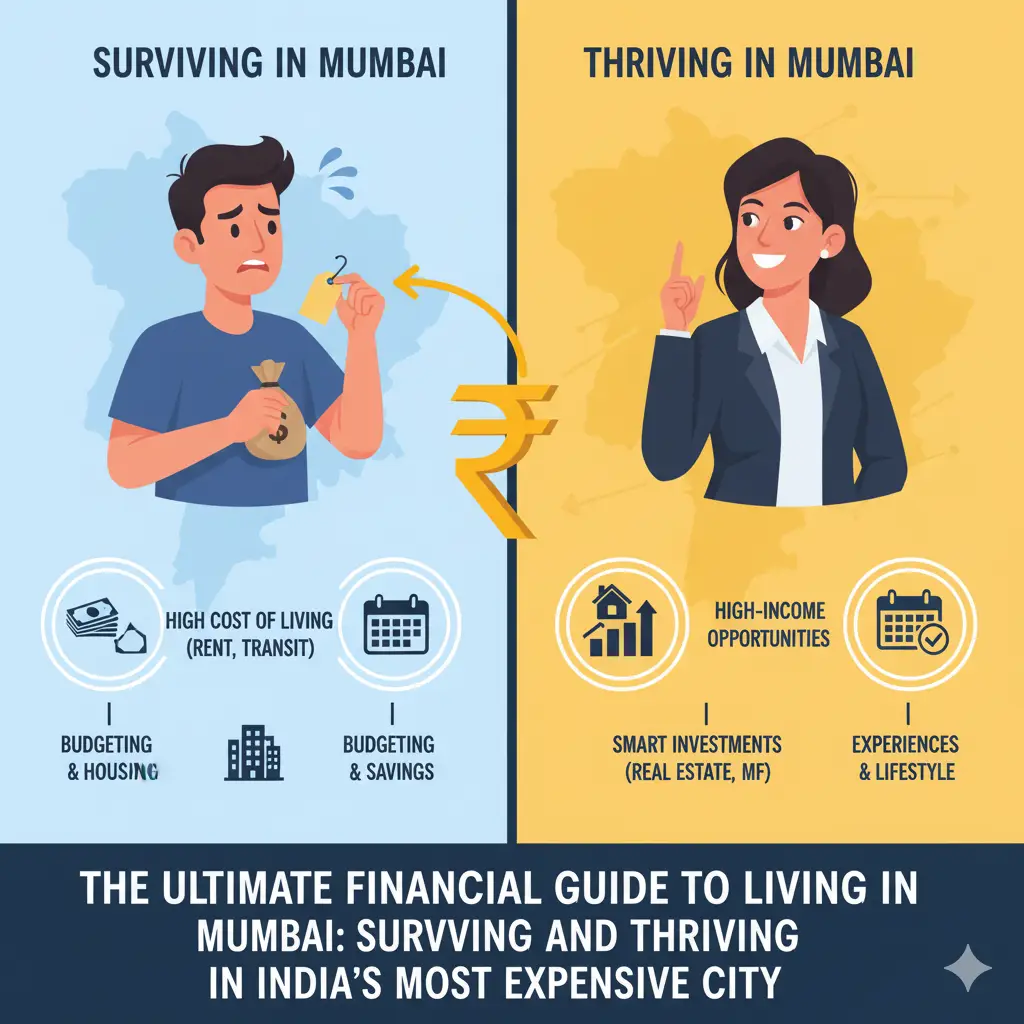
At 7:15 AM, the Borivali fast local is already packed. Rahul clutches the overhead handle, calculating in his head: ₹55,000 rent for a 1BHK in Kandivali, ₹165 monthly pass, ₹12,000 for groceries, ₹8,000 eating out because who has time to cook after the 90-minute commute each way. His ₹18 lakhs salary seemed impressive when he got the offer from HDFC Bank’s BKC office, but three months into Mumbai life, he’s wondering where all the money goes.
Meanwhile, Priya sits in an Uber stuck in traffic on the Western Express Highway, debating whether buying that ₹1.3 crore 2BHK in Thane makes sense. Her salary is ₹24 lakhs, her husband earns ₹28 lakhs at a consulting firm in Lower Parel. Together they’re paying ₹75,000 rent for a cramped 2BHK in Powai. The property broker promised them this Thane flat is a “steal” at ₹15,000 per square foot, but the EMI would be ₹95,000 for 25 years. Does it make sense?
This is Mumbai, where dreams come with a price tag that shocks most of India. Where a 500 sq ft flat costs more than a 2,000 sq ft house in tier-2 cities. Where “affordable housing” means ₹75 lakhs for a 1BHK in the suburbs. This guide will help you navigate Mumbai’s brutal financial reality with strategies that actually work.
Mumbai Financial Reality: The Brutal Truth
Property prices: ₹15,000-50,000 per sq ft (South Mumbai even higher). 2BHK rent: ₹35,000-1.5 lakhs. Local train pass: ₹165-295 monthly (lifeline, not luxury). Professional tax: ₹2,500 annually. Stamp duty: 5% for women, 6% for men. Average finance professional salary: ₹8-35 lakhs. To live comfortably as a single person: Need ₹12-15 lakhs CTC minimum. For a family: ₹30-40 lakhs combined. Mumbai doesn’t just test your bank balance, it tests your financial discipline daily.
Understanding Mumbai’s Salary Landscape Across Industries
Before we talk about expenses, let’s understand what people actually earn in Mumbai. The city attracts high salaries, but are they high enough to offset the crazy costs?
Banking and Finance: The Backbone of Mumbai
Mumbai is India’s financial capital for a reason. HDFC Bank, ICICI Bank, Axis Bank, Kotak Mahindra, Yes Bank all have their headquarters here. Investment banks like Goldman Sachs, JP Morgan, Morgan Stanley have significant presence. A fresher in retail banking starts at ₹4-6 lakhs. Three years in, you’re at ₹8-12 lakhs. A mid-level banker with 7-10 years makes ₹15-25 lakhs. Senior roles in investment banking or private wealth can command ₹40 lakhs to ₹1 crore+.
The advantage in finance is predictable increments and bonuses. A 15-20% annual increment is standard if you’re performing. Variable pay can add 20-30% to your CTC during good years. Use the Salary Take Home Pay Calculator to see what your banking CTC actually means in monthly income.
Consulting and Professional Services
McKinsey, BCG, Bain, Deloitte, EY, KPMG, PwC all have large Mumbai offices. Starting consultants make ₹12-18 lakhs. Three years in, you’re at ₹20-30 lakhs. Manager level is ₹35-50 lakhs. The work is brutal, the hours insane, but the compensation somewhat justifies Mumbai’s costs.
Media, Entertainment, and Advertising
Mumbai is the hub for Bollywood, TV production, advertising agencies, and media houses. However, this is where the salary-to-cost equation breaks badly. A copywriter at an ad agency starts at ₹3-5 lakhs. Five years in, you’re making ₹8-12 lakhs. Senior creative directors make ₹18-25 lakhs. Production houses pay even less. Many in this industry struggle financially despite the glamour, sharing flats with 3-4 roommates even at 30 because salaries simply don’t match Mumbai’s costs.
Tech and Startups
While Bengaluru dominates tech, Mumbai has significant presence from companies like Tata Consultancy Services, Tech Mahindra, and startups in fintech and e-commerce. Salaries are competitive: ₹6-12 lakhs for freshers, ₹15-25 lakhs mid-level, ₹30-50 lakhs for senior roles. However, for the same role, you’d earn similar or even better in Bengaluru while spending 30-40% less on living costs.
Manufacturing and Pharma
Companies like Reliance, Larsen & Toubro, Tata Motors, pharma companies have corporate offices in Mumbai. Salaries range from ₹6-15 lakhs for mid-level roles to ₹25-40 lakhs for senior management. The advantage here is stability and structured increments, making 20-25 year home loan commitments more feasible.
| Industry | Entry Level (0-2 years) | Mid-Level (5-8 years) | Senior (10+ years) | Can You Afford Mumbai? |
|---|---|---|---|---|
| Investment Banking | ₹8-15 lakhs | ₹20-35 lakhs | ₹50L-1Cr+ | Yes, comfortably from mid-level |
| Retail Banking | ₹4-7 lakhs | ₹10-18 lakhs | ₹22-40 lakhs | Tight initially, comfortable mid-level+ |
| Consulting | ₹12-18 lakhs | ₹25-40 lakhs | ₹50L-1Cr+ | Yes, well-suited for Mumbai costs |
| IT Services | ₹4-8 lakhs | ₹12-22 lakhs | ₹28-45 lakhs | Difficult initially, manageable mid-level |
| Media/Advertising | ₹3-6 lakhs | ₹8-15 lakhs | ₹18-30 lakhs | Very difficult, requires compromises |
| Pharma/Manufacturing | ₹5-9 lakhs | ₹12-20 lakhs | ₹25-50 lakhs | Moderate initially, good at senior level |
The Mumbai Cost of Living: Area-Wise Breakdown
Mumbai isn’t one city, it’s several cities merged by local trains and traffic jams. Where you live dramatically affects your monthly burn rate.
South Mumbai: The Original Mumbai
Areas like Colaba, Cuffe Parade, Worli, Lower Parel, Parel are where Mumbai’s old money and new wealth reside. Property prices here are ₹35,000-80,000 per sq ft in premium locations. A 2BHK of 800 sq ft costs ₹2.5-6 crores to buy. Rent ranges from ₹1.2-3 lakhs monthly for a decent 2BHK.
Unless you’re earning ₹75 lakhs+ or have family wealth, South Mumbai is aspirational, not practical. However, if you work in the financial district (BKC, Lower Parel, Nariman Point), the reduced commute time is worth considering even at high rents, especially if you value time over money.
Western Suburbs: The Sweet Spot
From Bandra to Borivali, the Western suburbs offer the best balance of lifestyle and affordability. Bandra and Khar are expensive (₹25,000-40,000 per sq ft, rent ₹60,000-1.5 lakhs for 2BHK) but offer excellent restaurants, cafes, and social life. Andheri and Malad are middle ground (₹18,000-28,000 per sq ft, rent ₹35,000-65,000). Goregaon to Borivali are more affordable (₹14,000-22,000 per sq ft, rent ₹28,000-50,000).
The Western line local train is relatively better maintained, and this corridor has the best mix of offices, entertainment, and residential areas. Most Mumbai professionals eventually settle somewhere on this belt.
Central and Harbor Suburbs: The Budget Options
Areas along the Central line (Dadar, Kurla, Ghatkopar, Vikhroli, Mulund) and Harbor line (Chembur, Mankhurd, Vashi, Nerul) offer lower costs. Property prices are ₹12,000-20,000 per sq ft, rent ₹25,000-45,000 for 2BHK. The trade-off is longer commute times if your office is in Western suburbs or South Mumbai, and comparatively less developed social infrastructure.
Navi Mumbai and Thane: The Escape Route
Navi Mumbai (Vashi, Nerul, Kharghar, Panvel) and Thane offer significantly better value. Property prices are ₹8,000-16,000 per sq ft, rent ₹18,000-40,000 for spacious 2-3BHKs. You get more space, better air quality, organized township planning, and lower costs.
The catch is the commute. If your office is in BKC or Lower Parel, you’re looking at 90-120 minutes each way. However, if you work in Navi Mumbai itself (TCS, Reliance offices in Ghansoli, Airoli) or have flexible work-from-home, these areas make perfect sense financially.
Real Cost Comparison: Same Family, Different Locations
Family Profile: Couple with one child, combined income ₹35 lakhs (₹2.2 lakhs monthly take-home).
Scenario 1 – Living in Andheri West: Rent ₹50,000, Groceries ₹15,000, Eating out ₹12,000, Child school ₹60,000/year (₹5,000/month), Local train passes ₹500 (both work in BKC, 45 min commute), Utilities ₹4,000, Entertainment ₹8,000, Maid/Cook ₹6,000. Total: ₹1,00,500 monthly. Savings potential: ₹1,19,500 (54%).
Scenario 2 – Living in Thane: Rent ₹32,000, Groceries ₹14,000, Eating out ₹8,000, School ₹40,000/year (₹3,333/month), Commute costs ₹6,000 (longer distance, some days cab due to timing), Utilities ₹3,500, Entertainment ₹5,000, Maid/Cook ₹4,500. Total: ₹76,333 monthly. Savings potential: ₹1,43,667 (65%).
Analysis: Living in Thane saves ₹24,167 monthly (₹2.9 lakhs annually) but costs 1-1.5 hours extra commute daily (30-40 hours monthly). If both work from home 3 days/week, Thane makes strong financial sense. If both must be in office 5 days, the quality of life cost isn’t worth the ₹24,000 monthly saving.
The Great Mumbai Debate: Rent vs Buy
This is the most emotionally charged financial decision in Mumbai. Let’s do the math without the emotions clouding judgment.
The Mathematics of Mumbai Real Estate
A 1,000 sq ft 2BHK in Kandivali costs approximately ₹1.6 crores at ₹16,000 per sq ft. With 20% down payment (₹32 lakhs), you take a loan of ₹1.28 crores at 8.5% for 25 years. Your EMI is ₹1,03,000 monthly. Add ₹5,000 for society maintenance, ₹1,500 for property tax, and ₹3,000 for repairs/corpus fund. Your total monthly outflow is ₹1,12,500.
The same flat rents for ₹35,000-40,000 monthly. That’s a difference of ₹72,000 monthly. If you invest this ₹72,000 difference in equity mutual funds averaging 12% returns over 25 years, you accumulate ₹8.2 crores. Meanwhile, your flat’s value might grow to ₹4-5 crores at 4-5% annual appreciation (Mumbai’s recent trend).
Financially, renting and investing makes mathematical sense. However, this analysis ignores rent escalation (5-10% annually), the psychological security of ownership, and the forced savings discipline that EMI provides. Use the Rent vs Buy Calculator for your specific situation.
When Buying Makes Sense in Mumbai
Buy only if: (1) You have 40-50% down payment saved without touching emergency funds or retirement corpus, (2) Your EMI doesn’t exceed 35% of combined household income, (3) You’re absolutely certain Mumbai is your forever home for next 15-20 years, (4) You’re over 35 and want the psychological security of ownership, (5) You can afford property near your workplace, eliminating brutal commutes.
If even one of these doesn’t apply, continue renting. Mumbai’s rent-to-price ratio is among the worst globally, strongly favoring renters financially.
⚠️ The Mumbai Property Trap: Many young professionals buy property in Navi Mumbai or Thane at 25-28 because “it’s affordable” (₹60-80 lakhs). Then they spend the next decade commuting 3 hours daily, unable to switch jobs that might need them closer to Western suburbs, and watching their quality of life deteriorate. The ₹40,000 saved monthly in rent isn’t worth 15 hours weekly lost to commute. Buy property where you can actually live comfortably based on your work location.
Make Data-Driven Mumbai Property Decisions
Should you rent or buy in Mumbai? Calculate the real financial impact with stamp duty, property tax, and loan costs.
Managing Daily Living Costs in Mumbai
Food: The Silent Budget Killer
A couple spending ₹10,000 monthly on groceries feels reasonable. But then there’s breakfast at the office cafeteria (₹150), lunch ordered in (₹250), evening chai and samosa (₹80), dinner from Swiggy because you reached home at 9:30 PM exhausted (₹500). That’s ₹980 daily, ₹29,400 monthly just on eating out for one person. For a couple, food expenses easily hit ₹50,000-60,000 monthly if you’re not careful.
Strategy: Cook bulk on weekends, carry lunch 3 days a week, limit eating out to 4-5 times monthly. Bring monthly food spend to ₹25,000-30,000 for a couple. The ₹25,000 saved goes directly to investments.
Transport: The Commute Cost
A first-class monthly pass for Western line costs ₹1,515, Central line ₹1,315. Second class is ₹165-295. If you’re traveling more than 40 km daily, local train is non-negotiable financially. The ₹8,000-12,000 you’d spend on Ola/Uber is simply unsustainable long-term.
However, if you’re a woman traveling late nights or early mornings, safety overrides cost. Budget ₹5,000-8,000 for cabs during those times. Many Mumbai professionals split costs: local train during peak hours, cab shared with colleagues for late nights.
The Hidden Costs Nobody Tells You About
Professional tax of ₹2,500 annually hits your February salary (₹300 deduction, vs ₹200 other months). Society deposits when renting (3-6 months rent as deposit means ₹1.5-3 lakhs blocked). The mandatory club membership in many housing societies (₹50,000-2 lakhs one-time). Parking charges in commercial areas (₹200-500 daily). The “convenience” of ordering everything online adds 30% to your budget without you noticing.
Investment Strategies for Mumbai Residents
High Income, High Burn: Breaking the Cycle
The typical Mumbai professional earns well but saves poorly. You get a ₹5 lakh increment, immediately upgrade from Goregaon to Andheri (₹15,000 more rent), start eating at Bandra restaurants instead of Malad ones (₹8,000 more monthly), take international vacation instead of Goa (₹1.5 lakhs vs ₹50,000). The increment is gone, savings unchanged.
The discipline needed: Lifestyle should improve with 30% of increments, 70% should go to investments and EMI prepayment. That ₹5 lakh increment means ₹1.5 lakhs to lifestyle improvement, ₹3.5 lakhs to wealth building annually.
The 50-30-20 Mumbai Modification
Traditional advice is 50% needs, 30% wants, 20% savings. In Mumbai, this becomes 60% needs (rent, food, transport, utilities, insurance), 20% savings (non-negotiable), 20% wants (dining, entertainment, travel, shopping). If you can push to 55% needs and 25% savings, even better.
On ₹1.5 lakhs monthly take-home: ₹90,000 needs (rent ₹45,000, food ₹20,000, transport ₹3,000, utilities ₹5,000, insurance ₹3,000, others ₹14,000), ₹30,000-37,500 savings, ₹22,500-30,000 wants.
Tax Optimization in Mumbai
With high incomes come high taxes. Someone earning ₹25 lakhs pays about ₹4 lakhs in income tax under old regime. But optimize through: Section 80C (₹1.5 lakhs via ELSS, PPF), Section 80CCD(1B) (₹50,000 via NPS), Section 80D (₹25,000 health insurance, ₹50,000 if parents above 60), HRA exemption (significant in Mumbai’s high-rent environment).
If paying ₹60,000 monthly rent, you can claim ₹3-5 lakhs as HRA exemption depending on your salary structure. This alone saves ₹90,000-1.5 lakhs in taxes. The HRA Calculator and tax planning guide help maximize these benefits.
Building Wealth Despite Mumbai Costs
A systematic SIP of ₹25,000 monthly in equity mutual funds, started at age 28 and continued till 58, builds approximately ₹2.8 crores (assuming 12% returns). Add PPF of ₹12,500 monthly building to ₹1.2 crores. Add NPS of ₹5,000 monthly reaching ₹60-70 lakhs. Total retirement corpus: ₹4.5-5 crores by age 58.
This requires saving ₹42,500 monthly. On a ₹25 lakh salary (₹1.5 lakhs take-home), this is 28% savings rate. It’s doable if you resist lifestyle inflation. The SIP Calculator shows your exact wealth trajectory.
Financial Planning by Age: The Mumbai Timeline
In Your 20s: Survive and Learn
Your first Mumbai job pays ₹6-10 lakhs. You’re probably sharing a flat in Andheri or Kandivali, paying ₹12,000-18,000 as your share. Focus on: Building ₹3-4 lakhs emergency fund, Starting SIP of ₹10,000 monthly (increase by ₹2,000 every year), Getting ₹50 lakh term insurance (costs just ₹8,000 annually), Avoiding debt (credit cards, personal loans), Learning to cook (saves ₹10,000 monthly).
Don’t worry about buying property. Don’t commit to big EMIs. Build liquid wealth first. Your 20s are for learning Mumbai, building your career, and establishing financial discipline.
In Your 30s: Build Wealth Aggressively
Now earning ₹15-30 lakhs, possibly married, thinking about property. Focus on: Increasing SIP to ₹25,000-40,000 monthly, Building ₹8-12 lakhs emergency fund (6-8 months expenses), Maxing out PPF/GPF contributions, Getting ₹1-2 crore term insurance, If buying property, ensure 40-50% down payment ready, Starting child education fund if planning family.
This is your wealth-building decade. Don’t let lifestyle inflation kill your savings. The SIP you start now will become your biggest asset by retirement.
In Your 40s: Optimize and Secure
Earning ₹30-50 lakhs, established in career, possibly kids in school. Focus on: Continuing SIPs (don’t stop despite EMIs), Child education corpus building aggressively, Considering property purchase if haven’t already (but only if all other financial goals are on track), Increasing health insurance (₹20-30 lakh family cover), Reviewing asset allocation (reduce equity to 50-60%, increase debt to 40-50%).
Your 40s are about balancing wealth building with wealth protection. Don’t take excessive risks, but don’t become overly conservative either.
Complete Financial Plan: Desai Family’s Mumbai Journey
Profile: Mr. Desai, 36, Investment Banking VP (₹42 lakhs), Mrs. Desai, 34, Marketing Manager (₹18 lakhs). Two children ages 8 and 5. Currently renting 3BHK in Andheri West (₹85,000 rent).
Combined Monthly Take-Home: ₹3.5 lakhs. Current Expenses: ₹2.3 lakhs (rent ₹85,000, kids education/activities ₹45,000, food ₹35,000, help ₹15,000, transport ₹18,000, utilities ₹12,000, entertainment/misc ₹40,000, insurance ₹15,000).
Current Assets: Mutual funds ₹35 lakhs, PPF ₹12 lakhs, EPF ₹28 lakhs, Emergency fund ₹15 lakhs. No property.
Goals: Buy property in 4 years, Children’s education (engineering), Retire by 55 with ₹5 crore corpus.
Strategy:
- Continue renting 2 more years, then buy ready-possession 3BHK in Borivali (₹2.2 crores) with ₹1 crore down payment
- Property down payment fund: ₹60,000 monthly in debt funds (currently ₹35 lakhs, will reach ₹1.05 crores in 4 years)
- Mr. Desai: ₹20,000 ELSS + ₹10,000 NPS + ₹30,000 equity SIP (₹60,000 monthly total)
- Mrs. Desai: ₹12,500 PPF + ₹5,000 NPS + ₹15,000 equity SIP (₹32,500 monthly total)
- Children’s education: ₹25,000 monthly each in child mutual fund plans (₹50,000 total)
- Emergency fund: Adequate at ₹15 lakhs (5 months expenses)
- Insurance: ₹2 crore term each (₹55,000 annual combined), Health ₹25 lakh family (₹45,000 annual)
Post-Property Purchase (Year 5): EMI ₹95,000 replaces ₹85,000 rent. Additional ₹10,000 outflow. Down payment fund redirected: ₹30,000 to EMI prepayment, ₹30,000 to additional investments.
Projection at Age 55: Owned property worth ₹4.5-5 crores (₹2.2Cr today growing at 4% for 19 years), Mutual funds ₹3.2 crores, PPF ₹85 lakhs, EPF/NPS ₹1.8 crores, Children’s education corpus ₹1.2 crores (used for their education). Total: ₹6+ crores at 55, exceeding goal despite Mumbai’s high costs.
Common Financial Mistakes Mumbai Residents Make
The biggest mistake is anchoring your lifestyle to gross salary, not take-home. Someone earning ₹30 lakhs thinks they’re rich, starts spending like it, then realizes their monthly take-home is ₹1.75 lakhs and ₹1.6 lakhs is committed to rent, EMIs, and expenses. There’s no buffer.
Another trap is buying property too early with inadequate down payment. Taking ₹1.2 crore loan for ₹1.4 crore flat (15% down payment), your EMI is ₹97,000 for 25 years. At age 28 earning ₹18 lakhs (₹1.1 lakhs take-home), this EMI is 88% of income. One job loss, and you’re devastated. Build liquidity first, buy later.
Many also underestimate Mumbai’s rental inflation. That ₹40,000 rent becomes ₹50,000 in three years, ₹65,000 in six years. Your salary might grow 10% annually, but if rent is 40% of income and growing 8% annually, the squeeze gets tighter. Build investment corpus that grows faster than your expense inflation.
Your Mumbai Financial Action Plan
First, calculate your real take-home using the salary calculator. Many people have no idea what actually hits their account monthly. This is your starting point.
Second, track every rupee for two months. Use apps or simple Google Sheets. The awareness of where money goes is the first step to controlling it. Most Mumbai residents are shocked to discover they spend ₹18,000 monthly on food delivery.
Third, automate your savings on salary credit date. ₹15,000 to ELSS, ₹10,000 to PPF, ₹5,000 to NPS, ₹15,000 to equity SIP, ₹5,000 to emergency fund. Automation removes the need for discipline. You spend what’s left, not save what’s left.
Fourth, resist the urge to buy property until you’ve built ₹40-50 lakhs in liquid investments (mutual funds, PPF, FD). This liquidity gives you negotiating power, handles emergencies, and ensures property EMI doesn’t strangle you financially.
Finally, accept that Mumbai extracts a premium for opportunities, not lifestyle. You’re here for career growth, networking, and financial advancement. Live below your means, save aggressively, and either make your Mumbai fortune and retire elsewhere, or stay and build wealth slowly but surely. There’s no third option in this city.
Mumbai Success Formula: Earn ₹20+ lakhs. Live in Western suburbs near workplace. Take local trains (swallow your pride, save ₹8,000 monthly). Cook 4-5 days weekly. Save 30% of take-home religiously. Don’t buy property till you’re 35+ with 40% down payment ready. Invest in equity for long term. Max out tax deductions. In 15 years, you’ll have ₹2-3 crores and can decide: stay in Mumbai and live well, or take your wealth and live like royalty elsewhere. The choice will be yours because you made the right financial moves.
Frequently Asked Questions
What salary is needed to live comfortably in Mumbai? +
For a single professional, minimum ₹80,000-1 lakh monthly take-home (₹12-15 lakhs CTC) is needed for comfortable living with savings. This covers ₹25,000-35,000 rent for 1BHK in suburbs, ₹15,000 food, ₹5,000 transport, ₹5,000 utilities, leaving ₹20,000-30,000 for savings. For a family of three, ₹2-2.5 lakhs combined take-home (₹30-40 lakhs total CTC) allows for decent 2-3BHK housing, children’s education, lifestyle, and meaningful wealth building. Below these numbers, Mumbai becomes a constant financial struggle.
Should I rent or buy property in Mumbai? +
With property prices at ₹15,000-50,000 per sq ft and rent-to-price ratio among worst globally, renting makes financial sense for most young professionals for at least 5-7 years. Buy only when: (1) You have 40-50% down payment saved without depleting emergency funds, (2) EMI doesn’t exceed 35% of household income, (3) You’re certain about staying in Mumbai for 15+ years, (4) You’re over 35 and want ownership security. Mathematically, renting and investing the rent-EMI difference often beats buying. Use the Rent vs Buy Calculator for your specific situation.
What is the stamp duty in Mumbai for property purchase? +
In Maharashtra (Mumbai), stamp duty is 5% for women buyers and 6% for men, plus 1% registration charges. For a ₹1 crore property, women save ₹1 lakh compared to men. For joint ownership, if woman is first/primary buyer, you get the 5% rate. This means always register property in wife’s name or with wife as primary owner to maximize savings. Use our Stamp Duty Calculator to calculate exact amounts for your property value.
Is it worth buying in Navi Mumbai or Thane to save costs? +
Only if you work in Navi Mumbai/Thane itself or have flexible work-from-home. Property prices are 40-50% lower (₹8,000-14,000 vs ₹18,000-35,000 per sq ft), but if your office is in BKC, Lower Parel, or Western suburbs, you’ll spend 3 hours daily commuting. The ₹30,000-40,000 saved monthly in EMI is lost to quality of life deterioration. However, if you work remotely 3+ days weekly or your office is in Navi Mumbai itself, it makes excellent financial sense. Location depends entirely on workplace, not just property prices.
How much should I save monthly on ₹20 lakh salary in Mumbai? +
On ₹20 lakhs CTC (approximately ₹1.2 lakhs monthly take-home after taxes), aim to save ₹35,000-40,000 monthly (30-35%). Suggested allocation: ₹12,500 ELSS + ₹12,500 PPF (tax saving), ₹5,000 NPS (additional 80CCD(1B)), ₹10,000-15,000 equity SIP for long-term wealth. This leaves ₹80,000-85,000 for expenses including rent ₹35,000-40,000, food ₹15,000, transport ₹3,000, giving you ₹25,000-30,000 buffer. If you can increase savings to 40% (₹48,000), even better – you’ll build ₹2+ crores over 15-20 years.
Which Mumbai suburb is best for young professionals? +
Western suburbs from Andheri to Borivali offer best balance. Andheri/Malad/Goregaon have excellent connectivity, restaurants, entertainment, and proximity to most corporate offices. Rent ranges ₹28,000-50,000 for 2BHK depending on exact location. If budget is tighter, Kandivali/Borivali offer ₹22,000-35,000 rent with good local train access. Avoid Bandra/Khar unless earning ₹30+ lakhs (rent ₹60,000-1.5 lakhs). Central suburbs like Ghatkopar/Mulund are cheaper but longer commute if office is in Western/South Mumbai. Choose based on your office location first, budget second.
How much does property tax cost in Mumbai? +
Mumbai property tax is calculated based on capital value of property. For residential self-occupied property, it’s approximately 0.15-0.25% of capital value annually. For a ₹1 crore flat, expect ₹15,000-25,000 annual property tax (₹1,250-2,100 monthly). Rental properties face higher rates. Additionally, you pay society maintenance (₹3-8 per sq ft monthly), sinking fund, and other charges. Total monthly outflow for a 1,000 sq ft owned flat: property tax ₹1,500, maintenance ₹5,000, repairs/corpus ₹2,000 = ₹8,500 monthly. Use Property Tax Calculator for exact estimates.
Should I take first-class or second-class local train pass? +
First-class monthly pass costs ₹1,515 (Western line), second-class ₹165-295. That’s ₹1,250-1,350 monthly difference (₹15,000 annually). First class offers: less crowded compartments, better chances of getting seat, relatively cleaner, more space. Second class is intense during peak hours but absolutely doable. Financial logic: If earning under ₹15 lakhs, stick to second class and save ₹15,000 annually. If earning ₹20+ lakhs and commuting 2+ hours daily, first class is worth it for quality of life. If traveling only 30-40 minutes, second class is fine even at higher income. Your time and sanity have value beyond pure economics.
Essential Tools for Mumbai Financial Planning
Disclaimer: This guide provides general financial planning information for Mumbai residents and should not be considered personalized financial advice. Property prices, rental rates, and cost of living figures mentioned vary dramatically across Mumbai’s micro-locations and change frequently. Salary benchmarks mentioned are indicative and vary significantly by company, role, experience, and economic conditions. Mumbai real estate carries market risks and prices can be volatile. Commute times mentioned are estimates and vary drastically with time of day, train schedules, and traffic conditions. Always verify current property rates, stamp duty rates, tax laws, and rental markets, conduct proper due diligence, and consult qualified financial advisors, chartered accountants, and legal professionals before making major financial decisions. Past property appreciation does not guarantee future returns. The rent vs buy analysis depends heavily on individual circumstances, property location, and market timing. CalcWise is not responsible for any financial decisions made based on this information.